MichaelTheMaven said:
Then we are going to have to respectfully disagree. If the precision your require is as outline, you cannot measure anything over 13.3 DR with a just a 13.3Ev strip. I would be happy to buy you an ND strip if you believe you can work it out.
Is the wedge 13.3 or 13.7 stops? You've stated both...just want to be sure I am on the same page as you...
If the wedge only has 13.3 stops, then yes, that is insufficient to measure the DR of the D750, even accounting for a potential loss in DR due to temperature.
MichaelTheMaven said:
I can see you are putting a lot of analysis into this and I really appreciate it. We agree on many points about the utilization of the wedge, but I actually think there are several ways to use it (not just one) and possibly even better tests that will come from it. Right now I am leaning towards putting a 4 stop ND filter infront of it, which technically then could get us a strip in the 17 Stop range.
Hmm, I'm confused. If you put a 4-stop ND in front of the wedge...that will darken all the swatches, no? All that does is shift the luminance output down, meaning your exposures would have to be even longer to properly saturate the exposure. But, that doesn't change the fact that each wedge is 1/3rd of a stop different. ND or no ND, the wedge represents the dynamic range it represents.
Unless you are talking about putting an ND filter in front of only part of the wedge...say steps 41 through 21 or something like that. Then, I agree...that would increase the dynamic range, at the cost of having a large sudden drop in exposure half way through the wedge. I guess that could work...
MichaelTheMaven said:
Additionally, what you are suggesting to overexpose the first step and only that first step on all cameras, as well as all channels is going to be just about impossible, and would make the test less quick and easy and more of a headache.
My mind still isn't reconciled that what I am doing is incorrect for comparison between two cameras shooting on the same settings, so we might disagree there too and that is ok.
I agree, it would make testing more tedious.
I do strongly assert, however, that doing so is the only way to generate a viable
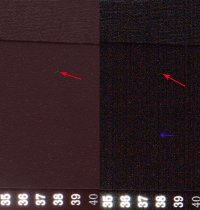
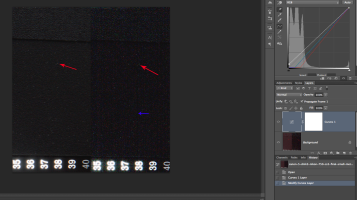
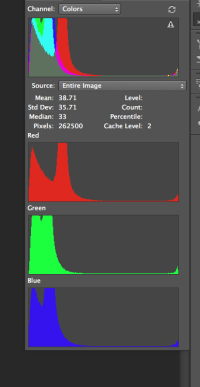
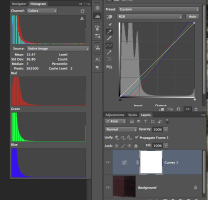
comparison. It's the only way to guarantee that all cameras expose optimally. As PixInsights statistics clearly demonstrate, the 5D III image is slightly underexposed relative to the D750 image. That is putting it at a disadvantage. I do not believe that increasing the exposure by a third of a stop (which is probably too much anyway to achieve parity with your existing D750 image) is really going to change things that much...instead of wedge 35 being the last useful wedge, wedge 36 would be the last useful wedge. Not a huge change, and in the grand scheme of things, even with your current images, pretty much all of the wedges in the range from 30-41 are riddled with color noise and banding, and are unlikely to be useful anyway without heavy NR, and after heavy NR, your going to suffer a significant loss in detail, so...how useful are they then? (And that, in a nutshell, is the cost of Canon's read noise.)
You could shortcut the process a bit. I think you underexposed by 2/3rds to 1 full stop. I would just redo the test, and increase the exposure by 2/3rds of a stop, then 1 stop, and see if either of those result in the correct output. I'm betting one of them does, so it shouldn't be all that tedious to get some better exposures on the wedges (i.e. you shouldn't have to painstakingly test each and every third stop difference to find the right one...I think the math can tell you exactly how to correct.)