Canon EF 16-35mm f/2.8L III Coming in June [CR3]

JohanCruyff said:
Have the mandatory "Canon is doomed" and "Canon is lagging behind" sentences been written? :)

A new product offering like this -- just a refresh, albeit to a critical professional lens -- will not shut those people up.

And it's always about sensors with those folks, anyway. A Sony A9 test rig was apparently spotted in New York yesterday, and it clearly had a '72 MP' badge on it (because Sony is classy like that). The 'sky is falling' crowd has plenty to crow about today. :P

- A
 
Upvote 0
privatebydesign said:
romanr74 said:
davidj said:
If it's going to be called the "Canon EF 16-35mm f/2.8L III" then it won't have IS, but I'd be happier if it was the "Canon EF 16-35mm f/2.8L IS" instead.

For those of us interested in IS, why would Canon make us choose between the f/4 IS and a way more expensive f/2.8 without?
Because othervise everybody will be complaining about size and weight...

Size and weight is a spurious argument, the difference between the 70-200 f2.8 and the 70-200 f2.8IS is 5oz, 1mm wide and 3mm long, and manufacturing processes and materials have improved immensely in that time.

Block diagram of a 70-200 f/2.8 below. There is endless space for the extra IS element between the standard groups. When you show me where this space is in the 24-70 and/or 16-35 we're in the discussion...
 

Attachments

  • Canon-EF-70-200-2_8L-USM.jpg
    Canon-EF-70-200-2_8L-USM.jpg
    46.7 KB · Views: 1,220
Upvote 0
GMCPhotographics said:
I best get saving....For me, the f2.8 aperture is more important than size or Image Stabilization. The current mkII has the best sunstars of any lens I know...I just hope Canon keep that the same...although I suspect they will follow the f4's route and put more blades in the aperture than necessary.

I'm pretty fond of the stopped down lighting/sunstars I see with my 16-35 f/4L IS -- sample attached. (In fairness, I think the odd number of blades and the resulting added points may have something to do with this. Like a kid, I just think it's more interesting to look at. #enthusiast)

But I've only rented a 16-35 f/2.8L II and haven't shot much landscape work with it. What makes its sunstars so special? It is a design consideration, or is it something to do with starting from an f/2.8 lens before you stop it down? (I'm admittedly ignorant on this.)

- A
 

Attachments

  • _Y8A1184Rc.jpg
    _Y8A1184Rc.jpg
    1.9 MB · Views: 288
Upvote 0
romanr74 said:
privatebydesign said:
romanr74 said:
davidj said:
If it's going to be called the "Canon EF 16-35mm f/2.8L III" then it won't have IS, but I'd be happier if it was the "Canon EF 16-35mm f/2.8L IS" instead.


For those of us interested in IS, why would Canon make us choose between the f/4 IS and a way more expensive f/2.8 without?
Because othervise everybody will be complaining about size and weight...

Size and weight is a spurious argument, the difference between the 70-200 f2.8 and the 70-200 f2.8IS is 5oz, 1mm wide and 3mm long, and manufacturing processes and materials have improved immensely in that time.

I doubt you can seriously take a 70-200 f/2.8 design IS vs. non-IS as a reference for a 24-70 design...
Agree to some extent, but if you understand what IS does, where it is in the optical path, and how small the movements it actually makes are then you'd realise there isn't a huge difference in the IS units. And don't forget, IS in lenses like the EF-s 18-55, the EF-s 10-18, and the true optical path and physical length benchmark the EF16-35 f4 IS. There is no reason why a 16-35 f2.8IS needs to be any longer than the f4 version, which few would argue is too long, wider yes, but no reason to be much wider in the lens barrel (not the front element) than the current 16-35 f2.8 MkII.

I believe the real reason Canon have not given the 'Blue Ribbon' f2.8 zooms IS is because of image quality and the core user base feedback about necessity, the big users, the news and sports outlets, don't feel the need for IS, so we don't get it in those lenses. Having said that, just take a look at the dire efforts Nikon made with their 24-70 f2.8 IS, the lens has become something of a joke among Nikon users!

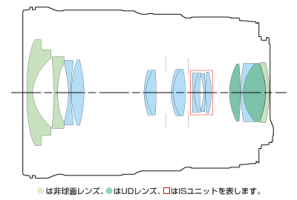
P.S. You ask for a block diagram to show you where the space is, here is the 16-35 f4 IS. Indeed if you compare the 16-35 f4IS and the 16-35 f2.8 MkII there is a lot of similarity.
 

Attachments

  • lens-construction.png
    lens-construction.png
    6.8 KB · Views: 1,151
  • Screen Shot 2016-05-12 at 11.46.28 AM.png
    Screen Shot 2016-05-12 at 11.46.28 AM.png
    141.1 KB · Views: 172
Upvote 0
romanr74 said:
Block diagram of a 70-200 f/2.8 below. There is endless space for the extra IS element between the standard groups. When you show me where this space is in the 24-70 and/or 16-35 we're in the discussion...

Length: I agree with you. The current 16-35 and 24-something designs are packed in really tightly.

Weight: Disagree. The IS hardware doesn't get heavier when you are handling less weight of glass, does it?

I absolutely think Canon could offer f/2.8 IS zooms. For whatever reason -- "Pros don't need IS in wider FLs", Neuro's argument that Canon wants us to buy both, etc. -- they aren't doing it.

- A
 
Upvote 0
quod said:
JohanCruyff said:
Have the mandatory "Canon is doomed" and "Canon is lagging behind" sentences been written? :)
Nope, nobody said that... Regarding the lack of IS, well, I have an A7RII which solves that problem.

That's it, you've solved it!

Canon Marketing Guy #1: "The market research says that there is an unmet need: standard zooms and ultra-wide f/2.8 zooms need image stabilization. I think we should put IS on those lenses."

Canon Marketing Guy #2: "Nah. They can slap those lenses on Sony rigs for IBIS. Job done. Nice work. High five."

Canon Marketing Guy #1: "Marketing is easy. Let's go count our money out loud like we're Scrooge McDuck."

[Both go out of their way to nutpunch / wedgie any hard-at-work engineers they pass by in the hallway as they walk out.]

- A
 
Upvote 0
ahsanford said:
romanr74 said:
Block diagram of a 70-200 f/2.8 below. There is endless space for the extra IS element between the standard groups. When you show me where this space is in the 24-70 and/or 16-35 we're in the discussion...

Length: I agree with you. The current 16-35 and 24-something designs are packed in really tightly.

Weight: Disagree. The IS hardware doesn't get heavier when you are handling less weight of glass, does it?

I absolutely think Canon could offer f/2.8 IS zooms. For whatever reason -- "Pros don't need IS in wider FLs", Neuro's argument that Canon wants us to buy both, etc. -- they aren't doing it.

- A

Beg u pardon... The IS hardware itself adds weight. The Nikkor IS 24-70 is 1070g vs. non IS 900g or plus 19% of weight.
 
Upvote 0
romanr74 said:
Beg u pardon... The IS hardware itself adds weight. The Nikkor IS 24-70 is 1070g vs. non IS 900g or plus 19% of weight.

People would give their left nut for an f/2.8 IS lens. A 20% weight premium is not a terrible price to pay for that. (Not everyone agrees on that, of course, so perhaps both a non-IS and IS version should be offered.)

Further, given that the update from the 24-70 f/2.8L I --> 24-70 f/2.8L II lost five ounces in the process, one would think a 16-35 f/2.8L IS could come in around the same weight as the 16-35 f/2.8L II is today.

I'm not saying that I personally want IS in this lens -- I'm just saying that this is entirely technically possible to deliver it. Canon is only reason why Canon is not offering this.

- A
 
Upvote 0
romanr74 said:
Beg u pardon... The IS hardware itself adds weight. The Nikkor IS 24-70 is 1070g vs. non IS 900g or plus 19% of weight.

That lens also went from 15 elements in 11 groups to 20 elements in 16 groups and 77mm filters to 82mm. I'm guessing that not all of that weight gain is because of IS.
 
Upvote 0
ahsanford said:
romanr74 said:
Block diagram of a 70-200 f/2.8 below. There is endless space for the extra IS element between the standard groups. When you show me where this space is in the 24-70 and/or 16-35 we're in the discussion...

Length: I agree with you. The current 16-35 and 24-something designs are packed in really tightly.

Weight: Disagree. The IS hardware doesn't get heavier when you are handling less weight of glass, does it?

I absolutely think Canon could offer f/2.8 IS zooms. For whatever reason -- "Pros don't need IS in wider FLs", Neuro's argument that Canon wants us to buy both, etc. -- they aren't doing it.

- A

Then look at the block diagrams I posted and tell me how they did it with the f4 that has a remarkably similar optical formulae as the 16-35 f2.8 MkII.
 
Upvote 0
davidj said:
romanr74 said:
Beg u pardon... The IS hardware itself adds weight. The Nikkor IS 24-70 is 1070g vs. non IS 900g or plus 19% of weight.

That lens also went from 15 elements in 11 groups to 20 elements in 16 groups and 77mm filters to 82mm. I'm guessing that not all of that weight gain is because of IS.

Was going to say the same, but the original point is still valid. IS hardware is not weightless, I get that. I just think the value proposition is a simple one:

Canon: "Hey dude, want a 16-35 f/2.8L IS for another [$$$ premium] and X% more weight over the 16-35 f/2.8L III?"

1/3 of market: "Yes, please. I occasionally shoot video or take handheld shots in low light."

2/3 of market: "Nah. No need / too heavy / too pricey."

- A
 
Upvote 0
ahsanford said:
quod said:
JohanCruyff said:
Have the mandatory "Canon is doomed" and "Canon is lagging behind" sentences been written? :)
Nope, nobody said that... Regarding the lack of IS, well, I have an A7RII which solves that problem.

That's it, you've solved it!

Canon Marketing Guy #1: "The market research says that there is an unmet need: standard zooms and ultra-wide f/2.8 zooms need image stabilization. I think we should put IS on those lenses."

Canon Marketing Guy #2: "Nah. They can slap those lenses on Sony rigs for IBIS. Job done. Nice work. High five."

Canon Marketing Guy #1: "Marketing is easy. Let's go count our money out loud like we're Scrooge McDuck."

[Both go out of their way to nutpunch / wedgie any hard-at-work engineers they pass by in the hallway as they walk out.]

- A
The IBIS feature is very effective with the 24-70/2.8 II. If the 16-35/2.8 III IQ is even remotely as good as the 24-70 on the A7RII, it will be an awesome combo.
 
Upvote 0
privatebydesign said:
romanr74 said:
davidj said:
If it's going to be called the "Canon EF 16-35mm f/2.8L III" then it won't have IS, but I'd be happier if it was the "Canon EF 16-35mm f/2.8L IS" instead.


For those of us interested in IS, why would Canon make us choose between the f/4 IS and a way more expensive f/2.8 without?
Because othervise everybody will be complaining about size and weight...

Size and weight is a spurious argument, the difference between the 70-200 f2.8 and the 70-200 f2.8IS is 5oz, 1mm wide and 3mm long, and manufacturing processes and materials have improved immensely in that time.

True, but canon have gone on record to say that it's easier to fit IS units on telephoto lenses than normal or wide lenses. They have also said that the wider the angle...the less effective they are. A 16mm should be hand hold-able at around 1/15th sec....a 500mm will need 1/500th for the same sharpness / reciprocal rule. IS units aren't as good as the shutter speed approaches the 1 second mark. So putting an IS unit on a wide is widely seen as academic....sorry I couldn't help the pun!
 
Upvote 0
ahsanford said:
davidj said:
romanr74 said:
Beg u pardon... The IS hardware itself adds weight. The Nikkor IS 24-70 is 1070g vs. non IS 900g or plus 19% of weight.

That lens also went from 15 elements in 11 groups to 20 elements in 16 groups and 77mm filters to 82mm. I'm guessing that not all of that weight gain is because of IS.

Was going to say the same, but the original point is still valid. IS hardware is not weightless, I get that. I just think the value proposition is a simple one:

Canon: "Hey dude, want a 16-35 f/2.8L IS for another [$$$ premium] and X% more weight over the 16-35 f/2.8L III?"

1/3 of market: "Yes, please. I occasionally shoot video or take handheld shots in low light."

2/3 of market: "Nah. No need / too heavy / too pricey."

- A

I wish I actually knew something about lens design so that I could have this conversation without making wild guesses based on existing lenses. To the best of my knowledge, IS weighs something, but it probably isn't much (maybe +10%?), and it costs something, but cheap lenses have it, so a higher price because it has IS is mostly Canon's profit.
 
Upvote 0
GMCPhotographics said:
privatebydesign said:
romanr74 said:
davidj said:
If it's going to be called the "Canon EF 16-35mm f/2.8L III" then it won't have IS, but I'd be happier if it was the "Canon EF 16-35mm f/2.8L IS" instead.


For those of us interested in IS, why would Canon make us choose between the f/4 IS and a way more expensive f/2.8 without?
Because othervise everybody will be complaining about size and weight...

Size and weight is a spurious argument, the difference between the 70-200 f2.8 and the 70-200 f2.8IS is 5oz, 1mm wide and 3mm long, and manufacturing processes and materials have improved immensely in that time.

True, but canon have gone on record to say that it's easier to fit IS units on telephoto lenses than normal or wide lenses. They have also said that the wider the angle...the less effective they are. A 16mm should be hand hold-able at around 1/15th sec....a 500mm will need 1/500th for the same sharpness / reciprocal rule. IS units aren't as good as the shutter speed approaches the 1 second mark. So putting an IS unit on a wide is widely seen as academic....sorry I couldn't help the pun!

That doesn't explain the 16-35 f4IS the EF-s 18-55 IS and the EF-s 10-18 IS.

Easier maybe, not possible, clearly not.
 
Upvote 0
Although I will get this lens if it is both sharp (like f/4 IS) and coma free (to combine landscapes with landscape astrophotography with one lens) I must admit that the stabilizer in f/4 L IS comes very handy when I use it inside museums (no flash photography).
 
Upvote 0