Canon EF 800mm f/5.6 DO IS in Development? [CR2]

Hesbehindyou said:
...the shorter length is also a big asset, especially if it makes the difference between carry on or hold...

I want to say that if they could make an 800mm lens 15" long, they would have a lot of people lining up for that lens.
But that's probably asking a lot. A lot a lot, the 400DO only cuts half an inch off vs. the 300f2.8, which is virtually the same comparison.
So maybe the 800DO would be 17" (currently 18").

The next big question in my mind is how small can they make a 600DO? Basically as far as I'm concerned anything longer than 500mm that fits into the same size category as the 500f4 is the next big lens to have...
Unless they start throwing around built in TC's too, make people choose between an ultralight 600DO and heavier 500+TC (or a 400f2.8+2XTC, now that would drive people up the wall).
 
Upvote 0
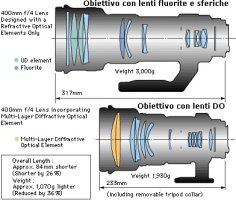
You can't really compare a longer fl lens with a shorter one +tc for length. They don't design lenses that way. If you look at this diagram of the 400do compared to a standard 400 then you see its a substantial length reduction. That same 26% reduction combined with series ii materials would make for a fantastic update to the 800.
 

Attachments

  • 400do2.jpg
    400do2.jpg
    70.7 KB · Views: 1,039
Upvote 0
Oh crap, now I'm imagining what a 600f5.6DO would look like.
The 400f5.6 is already 20% shorter than a regular 400f4, I wonder how much DO would compound with the smaller aperture?

Edit: Hmm, actually it might not be much different from the 300f2.8+2XTC, probably just a little lighter and a little shorter, so it's mostly still about returning top AF performance.
 
Upvote 0
RGF said:
Pixel said:
RGF said:
The great 100-400 II makes the 200-400 less desirable.
Speak for yourself on that. ;)

I did. You could say the 200-400 makes the 100-400 II less desirable.

Point is both are great lenses and there is a lot of overlap.

1Dx + 100-400 and 7D II + 200-400 makes a great combination.

1Dx + 100-400 and 1Dx + 600 DO (future lens) is another great combo and perhaps even better ?

+1 about the 100-400II and the 200-400

For my safari in September (Uganda, also rain forest) I'm still doubting between

1Dx + 100-400II or 1Dx + 300 2.8ii and if needed with 1.4x
the other camera is fixed (1Dx + 600 ii + 1.4x)

The 200-400 will stay at home at that moment
 
Upvote 0
Steve said:
I can't see any reason why anyone would shell out that kind of money when the 600mm with a 1.4 TC is just as good (if not better)with more flexibility and a bit more reach. Making the 800mm significantly more portable would give it a reason to exist.

If you live anywhere near South Wales I will be happy to demonstrate the existing Canon 800mm's "reason to exist". I use it FAR more than I ever used my 600.
Naturally you are welcome to use your own camera and it is quite practical to handhold for short (ish) periods. As to the 600 Mk2 + a 1.4, the pundits on the web tell me that it is as good or better than the 800. Well I don't know what testing they were using but I can assure you from personal experience that it is simply not! Without the extender the 600 Mk2 is a better (but shorter) lens, with the 1.4 Mk2 or 3 (various samples tried) it is very, very good but not as good as the bare 800.

Now if Canon could bring out an 800 DO at 3.5 Kilos or less then I will be in the queue! They can't make huge weight savings over the current model as it is already halfway to a Mk2 lens, but with DO optics it could get VERY interesting.
 
Upvote 0
C_Raven said:
As someone said, Sigma should offer lens designs in categories that others have not already done. What about supertelephoto lenses for APS-C cameras? Could they be cheaper relative to full-frame lenses?

I read somewhere that the size advantage of EF-S vs EF lenses diminishes with lengthening focal lengths, with 300mm being around the point at which sizes get equal. I'm just parroting info here - I'm sure someone will step in with actual knowledge on this.

Anyone?
 
Upvote 0
Hesbehindyou said:
C_Raven said:
As someone said, Sigma should offer lens designs in categories that others have not already done. What about supertelephoto lenses for APS-C cameras? Could they be cheaper relative to full-frame lenses?

I read somewhere that the size advantage of EF-S vs EF lenses diminishes with lengthening focal lengths, with 300mm being around the point at which sizes get equal. I'm just parroting info here - I'm sure someone will step in with actual knowledge on this.

Anyone?

If an EF-S lens and EF lens have the same numerical focal length (i.e., at infinity focus, both lenses project the same image, irrespective of the sensor size), then the only design issue that affects size is that the smaller mirror box for APS-C format cameras permits an EF-S lens to be designed with a shorter back focus distance. However, this only affects wide-angle lenses. Anything longer than around, say, 40 mm, would not have the back focus distance be a significant design constraint.

If, however, we consider the effect of a smaller sensor--that is to say, we compare EF-S lenses against EF lenses with an equivalent field of view as captured by their respective sensors, then there is a substantial difference at virtually all focal lengths, since in effect, an EF-S lens at 100 mm would be "focal-length equivalent" to an EF lens at 160 mm; and at 400 mm, equivalent to 640 mm. So if you care only about light-gathering ability and sensor field of view (and no other issues like noise or depth of field), then a 400/5.6 mounted to an APS-C DSLR would be comparable to a 640/5.6 on an "full-frame" DSLR.

But then factoring in noise and depth of field, the picture gets complicated again, and the size/weight advantage of EF-S is not so clear. The takeaway is that there is no hard and fast rule. There are tradeoffs and advantages, depending on how you look at it.
 
Upvote 0
I was curious is any one know who comes up with the new improved designs in optics in Canon.
Is it old guys who have been working on these lens for 40 years or is it new young designers with new ideas and up to date on new technology.
It must be getting to the point in technology that it would take ages to learn all the previous advances and current designs with such knowledge as how to improve upon it.
When I got my first PC in 1982 A Sinclair Spectrum you had a fair idea of what was inside one and how it worked.
The same with Camera's previously they were mechanical and you could see how it worked.
Nowadays 99.999% of young people have no idea what's in a laptop or ipad or iphone actually works or what's inside it. There must be so few people in the world who could improve on the current designs on camera lens.
 
Upvote 0
Hector1970 said:
I was curious is any one know who comes up with the new improved designs in optics in Canon.
Is it old guys who have been working on these lens for 40 years or is it new young designers with new ideas and up to date on new technology.
It must be getting to the point in technology that it would take ages to learn all the previous advances and current designs with such knowledge as how to improve upon it.
When I got my first PC in 1982 A Sinclair Spectrum you had a fair idea of what was inside one and how it worked.
The same with Camera's previously they were mechanical and you could see how it worked.
Nowadays 99.999% of young people have no idea what's in a laptop or ipad or iphone actually works or what's inside it. There must be so few people in the world who could improve on the current designs on camera lens.

Photographic optics design is certainly more sophisticated than it was decades ago, primarily as a result of massive advances in computing power that have facilitated the modeling and simulation of lenses.

However, the model is only as good as our understanding of the physics underlying the optical system. This then involves concepts from mathematics, physics, and materials science.

The issue is not about the age of people designing lenses; it is more about the amount of research into our understanding of optical physics and the long-term financial benefits. Computers are ubiquitous. Camera systems for large formats are not, and are unlikely to ever be so. And the consequence of this is that far more research and attention is being placed on things like sensor design and optical system design on small scales--that is to say, things that will fit in mobile phones. But even here, the emphasis is on consumer-level performance.

For "large" format lenses (and by "large" I mean anything that is not a point-and-shoot), a big challenge also lies in production: these designs are still primarily manufactured by hand. Certainly there is more automation than in the past, but for the most part, these are handcrafted, especially lenses with large-diameter elements such as those found in supertelephotos. Fluorite crystal, for example, is pretty much polished by hand, individually, by very experienced and discerning technicians. This is nothing like integrated circuit manufacturing, which is done almost entirely by robots, on wafers of silicon--if there is a defect, you might lose one chip out of a hundred; but lenses in comparison are huge. Tiny cameraphone lenses are easy to crank out with extremely small tolerances; DSLR lenses are several orders of magnitude larger, significantly more complex in design, and thus their manufacturing remains dependent on individual craftsmanship.
 
Upvote 0
johnf3f said:
Steve said:
I can't see any reason why anyone would shell out that kind of money when the 600mm with a 1.4 TC is just as good (if not better)with more flexibility and a bit more reach. Making the 800mm significantly more portable would give it a reason to exist.

If you live anywhere near South Wales I will be happy to demonstrate the existing Canon 800mm's "reason to exist". I use it FAR more than I ever used my 600.
Naturally you are welcome to use your own camera and it is quite practical to handhold for short (ish) periods. As to the 600 Mk2 + a 1.4, the pundits on the web tell me that it is as good or better than the 800. Well I don't know what testing they were using but I can assure you from personal experience that it is simply not! Without the extender the 600 Mk2 is a better (but shorter) lens, with the 1.4 Mk2 or 3 (various samples tried) it is very, very good but not as good as the bare 800.

Now if Canon could bring out an 800 DO at 3.5 Kilos or less then I will be in the queue! They can't make huge weight savings over the current model as it is already halfway to a Mk2 lens, but with DO optics it could get VERY interesting.

As another 800mmL owner and fan who used 600mm lenses for years and photographs a lot of small birds in the field, I'll also add that the 800+1.4x is noticeably better than a 600+2x. If you want a 600mm lens then buy one of those . If you buy one and find yourself using it mostly with a 1.4x and 2x, then you're better off with an 800. It's a lot more convenient taking a 1.4x on and off an 800 than having to switch between the two tc's on the 600 and fiddling around with a bunch of lens caps regardless of the optical qualities. By the time you add the weight of the tripod and head along with the camera, the weight difference between the 800 and new 600 is meaningless.
 
Upvote 0
Interested in your observations rbr.
Personally I haven't had much luck using extenders with my Canon 800mm. Don't get me wrong I am delighted with the lens it's just that I have been happier using it as a bare lens.
Looks like I need to do a little more testing to make sure that I am getting the full potential of this lens!
 
Upvote 0
johnf3f said:
Interested in your observations rbr.
Personally I haven't had much luck using extenders with my Canon 800mm. Don't get me wrong I am delighted with the lens it's just that I have been happier using it as a bare lens.
Looks like I need to do a little more testing to make sure that I am getting the full potential of this lens!

I wouldn't hesitate to use the 1.4x with the 800 assuming you have a camera that offers AF with an effective f8 lens. You may need to do a micro adjust for the focusing differently that with the bare lens. Also heat shimmer can be a bigger problem, so early mornings and late afternoons are best. The light is better then anyway. I've sold literally hundreds of bird photos taken with that combination. The 800 has the same 4 stop IS as all the series II big whites and you can routinely get sharp photos (on a good tripod, of course) down to 1/125 sec. at 1120mm with a still subject if you're careful. Most of the songbird photos I've taken in recent years have been with that combination :

http://roysephotos.com/
 
Upvote 0
rbr said:
johnf3f said:
Interested in your observations rbr.
Personally I haven't had much luck using extenders with my Canon 800mm. Don't get me wrong I am delighted with the lens it's just that I have been happier using it as a bare lens.
Looks like I need to do a little more testing to make sure that I am getting the full potential of this lens!

I wouldn't hesitate to use the 1.4x with the 800 assuming you have a camera that offers AF with an effective f8 lens. You may need to do a micro adjust for the focusing differently that with the bare lens. Also heat shimmer can be a bigger problem, so early mornings and late afternoons are best. The light is better then anyway. I've sold literally hundreds of bird photos taken with that combination. The 800 has the same 4 stop IS as all the series II big whites and you can routinely get sharp photos (on a good tripod, of course) down to 1/125 sec. at 1120mm with a still subject if you're careful. Most of the songbird photos I've taken in recent years have been with that combination :

http://roysephotos.com/

Thanks for your reply! My camera is the 1DX so AF should not be an issue. I have both the Canon 1.4 and 2 x Mk3 extenders that work very well in my 300 F2.8, so I will have to give them a go again and perhaps do a little focus adjustment. I haven't bothered much with the extenders as I rarely need them - but still handy to have in reserve.
I note your comments regarding the IS, however I have found that the third mode gives me the best and most consistent results. I tried this mode in the first days of 2014 and have used nothing else since. Since then I have switched all three of my IS lenses to this mode and am being rewarded with better images and a noticeably higher hit rate. Now you are probably thinking that I have lost my marbles as there are only 2 modes well there is another mode that works much better and that is OFF.
Thanks for your advice regarding the extenders, I will give them another go, and try disabling your IS for a while. My hit/keeper rate has improved noticeably.
 
Upvote 0
johnf3f said:
If you live anywhere near South Wales I will be happy to demonstrate the existing Canon 800mm's "reason to exist". I use it FAR more than I ever used my 600.
Naturally you are welcome to use your own camera and it is quite practical to handhold for short (ish) periods. As to the 600 Mk2 + a 1.4, the pundits on the web tell me that it is as good or better than the 800. Well I don't know what testing they were using but I can assure you from personal experience that it is simply not! Without the extender the 600 Mk2 is a better (but shorter) lens, with the 1.4 Mk2 or 3 (various samples tried) it is very, very good but not as good as the bare 800.

Now if Canon could bring out an 800 DO at 3.5 Kilos or less then I will be in the queue! They can't make huge weight savings over the current model as it is already halfway to a Mk2 lens, but with DO optics it could get VERY interesting.

Ha, thanks! If I was anywhere nearby I'd definitely take you up on that offer. I guess what I was trying to say was that if one had to pick one or the other, I imagine most would go for the 600mm f4 IS II. I know that I would, my friends that shoot birds/wildlife agree and Bryan over at TDP has said as much as well. I've seen many 600 f4 IS II's out in the wild but never the 800. It seems to me that most people are really only going to have the ability to purchase one or the other (if at all!) and the flexibility of the 600 makes more sense. I know that with my Sigma 300-800 I find myself zooming out to frame properly way more often than I thought I would when I bought it and I rarely find myself wishing for more reach (realistically, anyway - atmospheric haze and all that).
 
Upvote 0
May i ask you, why do you use the 1dx with 800 and 1.4x? a 7d (or better 7dii) would have more focal lenght and maybe better AF with the native 80 mm lens? only reason i can see is for more bokeh or faster Frame rate, but i would expext the Frame rate to be handicaped by the autofocus as f8?

For me (with other lenses) the row of focal lenght was 5d2+300 2.8, 50d+300 2.8, 50d+2xiii+300 2.8


rbr said:
johnf3f said:
Interested in your observations rbr.
Personally I haven't had much luck using extenders with my Canon 800mm. Don't get me wrong I am delighted with the lens it's just that I have been happier using it as a bare lens.
Looks like I need to do a little more testing to make sure that I am getting the full potential of this lens!

I wouldn't hesitate to use the 1.4x with the 800 assuming you have a camera that offers AF with an effective f8 lens. You may need to do a micro adjust for the focusing differently that with the bare lens. Also heat shimmer can be a bigger problem, so early mornings and late afternoons are best. The light is better then anyway. I've sold literally hundreds of bird photos taken with that combination. The 800 has the same 4 stop IS as all the series II big whites and you can routinely get sharp photos (on a good tripod, of course) down to 1/125 sec. at 1120mm with a still subject if you're careful. Most of the songbird photos I've taken in recent years have been with that combination :

http://roysephotos.com/
 
Upvote 0
To hendrik-sg

Firstly the 7D/7D2 will not give more focal length than a 1DX, it will merely give a narrower field of view through the viewfinder and reproduce a smaller part of the area that the lens covers. Additionally the image will need to be enlarged more for printing etc.
The advantage of cameras like the Canon 7D (APSC) series is that they have higher pixel density (or more pixels on target as some say). If, for example, we take the 1DX and 7D they have effectively the same number of pixels but the sensor of the 1DX is about 2.6 times the area so the "Pixel Density" is far lower. In theory this should mean less detail is resolved, in practice it sometimes does - but only by a small margin. The larger (less populated) sensor of the 1DX (and similar cameras) allows the use of far larger pixels which resolve proportionately more detail and have a far wider effective ISO range. The net result is that I may loose some reach compared to a 7D2 (not 7D Mk1) but I gain IQ and versatility.
Having used or owned a number of the Canon APSC cameras (though I have not tested the 7D2 very extensively) I much prefer their full frame cameras for wildlife work. Attaced is an example of a Bittern I photographed last year and a crop of the same image. Please note these are unaltered RAW files just converted to JPEG and scaled for the web - there is no processing/sharpening in PP. As a side note I am not absolutely certain that I would have got this image with another camera as the speed and responsiveness of the 1DX was barely enough - I don't even use IS anymore as it slows things down too much!
 

Attachments

  • Bittern04.JPG
    Bittern04.JPG
    379.9 KB · Views: 188
  • Bittern03.JPG
    Bittern03.JPG
    300.5 KB · Views: 229
Upvote 0