Canon EOS-1D X Manual Posted

Status
Not open for further replies.
sublime LightWorks said:
messus said:
sublime LightWorks said:
messus said:
Page.120.

The one thing that dissapoints me with the 1DX is the buffer size and the number of RAW frames possible to store during a high burst.
The 35 frames takes only 3seconds, 3 !!!!! to fill the buffer..

Anyway, there seem to be something strange going on, since shooting m-RAW mode actually decreases the number of possible burts
shots to 26, while shooting s-RAW mode increases the number to 39. I understand it takes some computing time to resize the RAW, but this will also happen while downsizine to s-RAW. Hence it is strange that the number of frames possible during m-RAW is "only" 26,
which is a ridicilously small number which you will reach within 1.5sec !! Why could not Canon install a 3 x bigger buffer when the rest
of the camera is built for speed?? (shutter/cpu). The D4 can shoot up to 3 times more frames than the 1DX.

I have tested the 1DX with the fastest memory card currently available on the planet (Lexar 128G 1000x Pro UDMA7 150/150MBps),
and the buffer was still full after 35frames continious shooting.

Too bad Canon!! :(

That seems to conflict with this report:

http://www.ronmartblog.com/2011/10/hands-on-canon-eos-1d-x-lots-of-photos.html

When I read about the 12fps performance of this camera I was excited – especially given the larger image size – but I was also worried as my 10fps performance of the 1D Mark III & IV has always been significantly limited by its puny buffer. In my early testing with what I was told was a slow CF card, I was able to get 52 full-size RAW frames in burst mode before the buffer started to stutter. That’s up from 30 in the 1D Mark IV, so that’s promising given the significantly larger file sizes. However, I would have really loved to have seen that number closer to 100 for RAW. RAM is pretty cheap, so I’m always frustrated there isn’t a way to add RAM or do something to overcome this limitation. With that gripe aside, the 52 RAW frames is going to be usable enough in most practical scenarios so this is a welcome relief. This also means that sRAW or JPEG only shooters will find themselves with an endless supply of buffer for sports shooting.

Indeed, and check Ole Salomonsen comments back then in that thread!!! (which he (Ron) called BS!! )

I re-read those comments to get a refresh on that, but dug further to some reliable sources. When you tested the 1Dx, where and when did you get to test it?

Here's what I'm finding odd on your comments:

1) the 1Dx manual states in RAW the burst is 35 images with a regular card and 38 with a UDMA 7 card. If the data xfer rate of 167MB/sec (max) for UMDA7 is supported, as stated in the specifications for the 1Dx, then I would expect that Ron's numbers of approx 50-55 RAW images to be about right. Your statements would have you believe that zero data made it out of the Lexar UDMA7 card, something not possible.

2) I know from experience with my 5D3, I can shoot approx 19-20 RAW images at 6 fps on a SanDisk Extreme Pro 32GB UDMA6 card before the buffer stutters. The 5D3 manual states it's RAW burst is 13 images, 18 when using UDMA7. I have not used a UDMA7 card in the 5D3 yet but would expect a little better performance than I have observed.

3) The D4 numbers you claim are highly questionable given reliable testing. For example, they totally conflict with Rob Galbraith's documented testing. That testing shows in a 30 second period the D4 using a Lexar 1000x 32GB UDMA7 was able to write 86 RAW+Jpeg images, with a max RAW data rate of 61.4MB/s. In the same testing with the same card on the 5D3, it could write 75 RAW+Jpeg images with a max RAW data rate of 80.2MB/s .

So, given documented testing by a known method and source of information that is also well know for his like of Nikon, the 5D3 is out performing the RAW xfer rate of the D4 by about 19MB/sec on the same card. I seriously doubt the 1Dx would be slower than the 5D3. In combined RAW+Jpeg, the D4 manages just 11 images more than the 5D3 in 30 seconds of shooting despite the 5D3's RAW+L-Jpeg rated burst capacity of 7 images.

This does not agree with your claims of the 1Dx or the D4's image rates and burst capacity. The D4 is barely outperforming RAW+Jpeg compared to the 5D3. So, can you tell us when you tested the 1Dx, where and when did you get to test it with the Lexar 1000x card?

Further, if anyone is wondering why M-RAWand S-RAW numbers seem odd, it because M-RAW is a 10M image which requires more processing (size reduction to a non-multiple of the RAW and processing to handle that). S-RAW you will note is exactly 1/4 of the original RAW (4.5M vs. 18M), so the math is far simpler, thus the greater burst ability.

D4 Performance:

http://robgalbraith.com/bins/camera_wb_multi_page.asp?cid=6007-12444

5D3 Performance:

http://robgalbraith.com/bins/camera_wb_multi_page.asp?cid=6007-12452&sort_col=raw&sort_dir=DESC

Additional hands on that do not agree with the D4 statements by the poster:

http://www.slashgear.com/nikon-d4-vs-canon-1d-x-burst-depth-continue-shutter-hands-on-videos-13209249/

http://www.imaging-resource.com/PRODS/nikon-d4/nikon-d4A6.HTM

http://reviews.cnet.com/digital-cameras/nikon-d4-body-only/4505-6501_7-35117818.html

People will get excited about a 12fps camera like I got excited when I got my 1D IV. But the only way my camera can do 10fps is in one-shot focusing. Put the camera in AI servo and there is no way the camera will focus quickly enough to maintain 10fps... Specially if the subject is running towards you... Even with 10 processors, the AF system needs time to accurately focus. You can tell the camera to shoot anyway, but who cares for an out of focus image anyway...
I hope the new AF system on the 1D X will be able to "keep up" with the camera's fps...
 
Upvote 0
[/quote]

People will get excited about a 12fps camera like I got excited when I got my 1D IV. But the only way my camera can do 10fps is in one-shot focusing. Put the camera in AI servo and there is no way the camera will focus quickly enough to maintain 10fps... Specially if the subject is running towards you... Even with 10 processors, the AF system needs time to accurately focus. You can tell the camera to shoot anyway, but who cares for an out of focus image anyway...
I hope the new AF system on the 1D X will be able to "keep up" with the camera's fps...
[/quote]

Your observation got me interested in what kind of qualifications Canon put on its "12 frames per second" rating (something that I am looking forward to), so I looked it up in their new online manual, and here is what they say (assuming you can decipher it):

From p. 111 of the manual, "The maximum continuous shooting speed of approx. 12 shots/sec. is attained under the following conditions*: At ISO 25600 or lower, 1/1000 sec. or faster shutter speed, and at the maximum aperture (varies dependin on the lens). The continuous shooting speed may be slower depending on the ISO speed, shutter speed, aperture, subject conditions, brightness, lens type, flash use, etc. *With the AF mode set to One-shot AF and the Image Stabilizer turned off when using the following lenses: EF 300mm f/4L IS USM, EF28-135mm f3.5-5.6 IS USM, EF 75-300mm f/2-5.6 IS USM, EF 100-400mm f/4.5-5.6L IS USM."

More disclaimers than the end of a used car dealership commercial! Can anyone say whether the asterisked text at the end is intended to mean that you only get 12 fps in one shot AF mode AND with those lenses, or whether instead they are saying that those lenses are a special case, and for them you have to use one-shot AF and turn off image stabilization?

Something got confusing in the translation. Or maybe it's intentionally confusing? :-\
 
Upvote 0
Jax, those lenses are extremely slow. They will most definitely shoot at a slower speed since the AF will take longer to lock on. And while I know my 1D MK IV never really gets 10 FPS unless I hit have the camera in one shot, I can use the AF stop button on my super-telephoto lenses to get the max burst speed. This works great for baseball if you want a shot of the ball leaving the bat. 12 FPS just means that I should get at least 10 in AI-Servo. I also noticed a frame rate increase when I updated my 70-200 f/2.8L IS to the newest version. The 70-200 f/2.8 IS II seems to give me an even faster frame rate than my 300 f/2.8 IS or 200 f/2.0 IS but maybe that is just me.

The buffer should hold around 50 RAW images, the 30 image buffer must have been an early model. Keep in mind we are still dealing with pre-production bodies. Lord knows what is inside those.

People are still comparing the 5D MK III to the 1DX, they are completely different monsters. In my testing I saw only a little more than 1 stop improvement in high ISO with the 5D3 over the 5D2. I've downloaded and played with several 1DX files and they look absolutely phenomenal. The 1DX probably has at least a 3-stop advantage over the 5D2.

This is a great year for Canon and I'm excited to finally get a camera body that combines my favorite features of the full frame bodies with the pro sports bodies. At one point I almost switched to Nikon but this is truly the year the be a Canon shooter. I'm already in love with the radio capabilities of the 600EX-RT.

I know I'm a noob to the forum but here are my credentials :)
http://markwebbphoto.com/
 
Upvote 0
Video file attached shows buffer of 1D X stop after 36 frames using the fastest memory card on the planet as of today. I had to downsize the video file to 480x270 mpeg2 and compress it heavily to be allowed to upload it here with the file size limit of 4096KB. The Lexar Pro UDMA7 card is mine, I am using it on my 5D3. I brought the card with me to a photography show here in Norway where they had the 1DX. I put my Lexar UDMA7 Pro card into the 1DX and my friend filmed while I kept the trigger until the buffer was full.

This means Ron here:
http://www.ronmartblog.com/2011/10/hands-on-canon-eos-1d-x-lots-of-photos.html

is probably wrong, since I tested the 1DX with a faster card than him, at a later date than him,
meaning the camera at least should have the same or newer firmware than at the time of him testing.
 

Attachments

Upvote 0
sublime LightWorks said:
messus said:
sublime LightWorks said:
messus said:
Page.120.

The one thing that dissapoints me with the 1DX is the buffer size and the number of RAW frames possible to store during a high burst.
The 35 frames takes only 3seconds, 3 !!!!! to fill the buffer..

Anyway, there seem to be something strange going on, since shooting m-RAW mode actually decreases the number of possible burts
shots to 26, while shooting s-RAW mode increases the number to 39. I understand it takes some computing time to resize the RAW, but this will also happen while downsizine to s-RAW. Hence it is strange that the number of frames possible during m-RAW is "only" 26,
which is a ridicilously small number which you will reach within 1.5sec !! Why could not Canon install a 3 x bigger buffer when the rest
of the camera is built for speed?? (shutter/cpu). The D4 can shoot up to 3 times more frames than the 1DX.

I have tested the 1DX with the fastest memory card currently available on the planet (Lexar 128G 1000x Pro UDMA7 150/150MBps),
and the buffer was still full after 35frames continious shooting.

Too bad Canon!! :(

That seems to conflict with this report:

http://www.ronmartblog.com/2011/10/hands-on-canon-eos-1d-x-lots-of-photos.html

When I read about the 12fps performance of this camera I was excited – especially given the larger image size – but I was also worried as my 10fps performance of the 1D Mark III & IV has always been significantly limited by its puny buffer. In my early testing with what I was told was a slow CF card, I was able to get 52 full-size RAW frames in burst mode before the buffer started to stutter. That’s up from 30 in the 1D Mark IV, so that’s promising given the significantly larger file sizes. However, I would have really loved to have seen that number closer to 100 for RAW. RAM is pretty cheap, so I’m always frustrated there isn’t a way to add RAM or do something to overcome this limitation. With that gripe aside, the 52 RAW frames is going to be usable enough in most practical scenarios so this is a welcome relief. This also means that sRAW or JPEG only shooters will find themselves with an endless supply of buffer for sports shooting.

Indeed, and check Ole Salomonsen comments back then in that thread!!! (which he (Ron) called BS!! )

I re-read those comments to get a refresh on that, but dug further to some reliable sources. When you tested the 1Dx, where and when did you get to test it?

Here's what I'm finding odd on your comments:

1) the 1Dx manual states in RAW the burst is 35 images with a regular card and 38 with a UDMA 7 card. If the data xfer rate of 167MB/sec (max) for UMDA7 is supported, as stated in the specifications for the 1Dx, then I would expect that Ron's numbers of approx 50-55 RAW images to be about right. Your statements would have you believe that zero data made it out of the Lexar UDMA7 card, something not possible.

2) I know from experience with my 5D3, I can shoot approx 19-20 RAW images at 6 fps on a SanDisk Extreme Pro 32GB UDMA6 card before the buffer stutters. The 5D3 manual states it's RAW burst is 13 images, 18 when using UDMA7. I have not used a UDMA7 card in the 5D3 yet but would expect a little better performance than I have observed.

3) The D4 numbers you claim are highly questionable given reliable testing. For example, they totally conflict with Rob Galbraith's documented testing. That testing shows in a 30 second period the D4 using a Lexar 1000x 32GB UDMA7 was able to write 86 RAW+Jpeg images, with a max RAW data rate of 61.4MB/s. In the same testing with the same card on the 5D3, it could write 75 RAW+Jpeg images with a max RAW data rate of 80.2MB/s .

So, given documented testing by a known method and source of information that is also well know for his like of Nikon, the 5D3 is out performing the RAW xfer rate of the D4 by about 19MB/sec on the same card. I seriously doubt the 1Dx would be slower than the 5D3. In combined RAW+Jpeg, the D4 manages just 11 images more than the 5D3 in 30 seconds of shooting despite the 5D3's RAW+L-Jpeg rated burst capacity of 7 images. And let's not forget the 5D3 is a 22Mpix image....the D4 is 16Mpix, about 30% smaller.

This does not agree with your claims of the 1Dx or the D4's image rates and burst capacity. The D4 is barely outperforming RAW+Jpeg compared to the 5D3. So, can you tell us when you tested the 1Dx, where and when did you get to test it with the Lexar 1000x card?

Further, if anyone is wondering why M-RAWand S-RAW numbers seem odd, it because M-RAW is a 10M image which requires more processing (size reduction to a non-multiple of the RAW and processing to handle that). S-RAW you will note is exactly 1/4 of the original RAW (4.5M vs. 18M), so the math is far simpler, thus the greater burst ability.

D4 Performance:

http://robgalbraith.com/bins/camera_wb_multi_page.asp?cid=6007-12444

5D3 Performance:

http://robgalbraith.com/bins/camera_wb_multi_page.asp?cid=6007-12452&sort_col=raw&sort_dir=DESC

Additional hands on that do not agree with the D4 statements by the poster:

http://www.slashgear.com/nikon-d4-vs-canon-1d-x-burst-depth-continue-shutter-hands-on-videos-13209249/

http://www.imaging-resource.com/PRODS/nikon-d4/nikon-d4A6.HTM

http://reviews.cnet.com/digital-cameras/nikon-d4-body-only/4505-6501_7-35117818.html

1) Ron's numbers are wrong, sadly, check my proof video I posted in this thread. I have used the fastest memory card available, Lexar 128GB CF UDMA7 Pro, which I use daily with my 5D3. The 5D3 Canon also claim to be able to fully utilize any UDMA7 card with up to 167MB/s, which I have found to be wrong.
The 5D3 is capable of almost 100MB/s, about the same as the D4. (tested with speeds which allowed for continous shooting without the buffer stopping)

2) I am capable of shooting 33-34 RAW images at 6fps on my 5D3 with the Lexar UDMA7 card before buffer stops.

3) Seem like I am not entirely correct on the D4, (although I have read several places it could go higher), this guy is achieving 6-7 seconds continous shooting until buffer is full (at 05:45), this should mean 60-70 RAW files:
XQD + Nikon D4 full speed test

I have also done extensive speed testing on my own with the 5D3, 5D2, the D4, D800 and D800E, all with the Lexar 128GB UDMA7 CF Pro 1000x, since I work a lot with stop motion video in the dark, and need the cameras to be able to shoot as fast as possible without the buffer stopping. The 5D3 has about the same write speed as the D4. IMO the D4 is actually slightly disappointing in its computing power, taking into account its fast shutter mechanics. Still its buffer seem to be larger than the 1DX, since RAW files of D4 is actually 33MB compared to 28 on the 1DX.

With the price tag, and the shutter speed and the computing power availbale on the 1DX, I have to say I it is disappointing Canon did not implement a bigger buffer, given also how cheap flash ram is these days, even if it might be enough for many people.

For my type of work, I am guessing the 1DX will still outperform the D4 (shooting as fast as possible without the buffer interfering), but thats not the only point. Even if my type of work is not what most people do, I also do regular work, such as wildlife and bird photography (BIF), and what If I am shooting an eagle diving down for a fish? This is a moment which could take much more than 3 seconds, sometimes 7-8seconds. But then the buffer on the 1DX is full.. :(

And if I have to turn down the shooting speed of the 1DX to not fill up the buffer, then what is the point of me spending 7000 dollars on the 1DX rather than just using my 5D3 ?
 
Upvote 0
MarkWebbPhoto said:
Jax, those lenses are extremely slow. They will most definitely shoot at a slower speed since the AF will take longer to lock on. And while I know my 1D MK IV never really gets 10 FPS unless I hit have the camera in one shot, I can use the AF stop button on my super-telephoto lenses to get the max burst speed. This works great for baseball if you want a shot of the ball leaving the bat. 12 FPS just means that I should get at least 10 in AI-Servo. I also noticed a frame rate increase when I updated my 70-200 f/2.8L IS to the newest version. The 70-200 f/2.8 IS II seems to give me an even faster frame rate than my 300 f/2.8 IS or 200 f/2.0 IS but maybe that is just me.

The buffer should hold around 50 RAW images, the 30 image buffer must have been an early model. Keep in mind we are still dealing with pre-production bodies. Lord knows what is inside those.

People are still comparing the 5D MK III to the 1DX, they are completely different monsters. In my testing I saw only a little more than 1 stop improvement in high ISO with the 5D3 over the 5D2. I've downloaded and played with several 1DX files and they look absolutely phenomenal. The 1DX probably has at least a 3-stop advantage over the 5D2.

This is a great year for Canon and I'm excited to finally get a camera body that combines my favorite features of the full frame bodies with the pro sports bodies. At one point I almost switched to Nikon but this is truly the year the be a Canon shooter. I'm already in love with the radio capabilities of the 600EX-RT.

I know I'm a noob to the forum but here are my credentials :)
http://markwebbphoto.com/

Mark, thanks for your feedback and input about the likely meaning of the quoted portion of the manual. I had noticed that the referenced lenses were considerably slower than what I'm usually using for sports (70-200 f/2.8L IS), but the way they placed the asterisk in the sentence made me wonder about the meaning.

I share your enthusiasm for the combination of new features and performance offered by the 1Dx.

Welcome to the forum!
 
Upvote 0
MarkWebbPhoto said:
Jax, those lenses are extremely slow. They will most definitely shoot at a slower speed since the AF will take longer to lock on. And while I know my 1D MK IV never really gets 10 FPS unless I hit have the camera in one shot, I can use the AF stop button on my super-telephoto lenses to get the max burst speed. This works great for baseball if you want a shot of the ball leaving the bat. 12 FPS just means that I should get at least 10 in AI-Servo. I also noticed a frame rate increase when I updated my 70-200 f/2.8L IS to the newest version. The 70-200 f/2.8 IS II seems to give me an even faster frame rate than my 300 f/2.8 IS or 200 f/2.0 IS but maybe that is just me.

The buffer should hold around 50 RAW images, the 30 image buffer must have been an early model. Keep in mind we are still dealing with pre-production bodies. Lord knows what is inside those.

People are still comparing the 5D MK III to the 1DX, they are completely different monsters. In my testing I saw only a little more than 1 stop improvement in high ISO with the 5D3 over the 5D2. I've downloaded and played with several 1DX files and they look absolutely phenomenal. The 1DX probably has at least a 3-stop advantage over the 5D2.

This is a great year for Canon and I'm excited to finally get a camera body that combines my favorite features of the full frame bodies with the pro sports bodies. At one point I almost switched to Nikon but this is truly the year the be a Canon shooter. I'm already in love with the radio capabilities of the 600EX-RT.

I know I'm a noob to the forum but here are my credentials :)
http://markwebbphoto.com/

I am sorry Mark, but your assumption of 50 RAW files until buffer stops on 1DX is wrong, read my post and watch my video. Buffer stops camera from shooting after 35-36 frames. I wish it was twice as big.

Also, I have tested the 1DX and compared it to my 5D3, 5D2, and the D4, D800,D800E.
No way if the 1DX has a two stop advantage on the 5D3 as you claim, the 1DX has maybe 1/2 stop
advantage on the 5D3. And even if this is good, and just as good as the D4, I was hoping for more from the 1DX. I have lots of RAWs from all cameras, even underexposed to try to lift shadows and check DR in post.

Some beautiful photos at your webpage, great work btw! :)
 
Upvote 0
Re: Canon EOS-1D X Manual Posted (D4 burst mode performance)

I'm getting 49 frames of RAW (lossless compression) with the D4 using the 95mb/sec Sandisk Extreme Pro 16GB CF card (95mb/sec).

http://www.ronmartblog.com/2012/06/review-nikon-d4-vs-nikon-d800-canon-5d.html

Ironically if I do RAW+JPEG I get the same result, so it seems that with CF its artifically capped at 49.

The drop off is brisk where there's zero lag for 49, then what feels like about a 1 second lag for each frame after that. I should have video it, but I just saw this thread and i sent the camera back this morning.

This could be a marketing ploy to make XQD look better because its uncharactaristic for cameras to go from full blast to single file sputtering. It's usually like full speed, then 80%, 50%, 30%, 20% then single file.

For my Canon cameras - even the 5D Mark III - the drop off is gradual and not as bad once it starts to lag.

Ron
 
Upvote 0
messus said:
1) Ron's numbers are wrong, sadly, check my proof video I posted in this thread. I have used the fastest memory card available, Lexar 128GB CF UDMA7 Pro, which I use daily with my 5D3. The 5D3 Canon also claim to be able to fully utilize any UDMA7 card with up to 167MB/s, which I have found to be wrong.
The 5D3 is capable of almost 100MB/s, about the same as the D4. (tested with speeds which allowed for continous shooting without the buffer stopping)

2) I am capable of shooting 33-34 RAW images at 6fps on my 5D3 with the Lexar UDMA7 card before buffer stops.

3) Seem like I am not entirely correct on the D4, (although I have read several places it could go higher), this guy is achieving 6-7 seconds continous shooting until buffer is full (at 05:45), this should mean 60-70 RAW files:
XQD + Nikon D4 full speed test

I have also done extensive speed testing on my own with the 5D3, 5D2, the D4, D800 and D800E, all with the Lexar 128GB UDMA7 CF Pro 1000x, since I work a lot with stop motion video in the dark, and need the cameras to be able to shoot as fast as possible without the buffer stopping. The 5D3 has about the same write speed as the D4. IMO the D4 is actually slightly disappointing in its computing power, taking into account its fast shutter mechanics. Still its buffer seem to be larger than the 1DX, since RAW files of D4 is actually 33MB compared to 28 on the 1DX.

With the price tag, and the shutter speed and the computing power availbale on the 1DX, I have to say I it is disappointing Canon did not implement a bigger buffer, given also how cheap flash ram is these days, even if it might be enough for many people.

For my type of work, I am guessing the 1DX will still outperform the D4 (shooting as fast as possible without the buffer interfering), but thats not the only point. Even if my type of work is not what most people do, I also do regular work, such as wildlife and bird photography (BIF), and what If I am shooting an eagle diving down for a fish? This is a moment which could take much more than 3 seconds, sometimes 7-8seconds. But then the buffer on the 1DX is full.. :(

And if I have to turn down the shooting speed of the 1DX to not fill up the buffer, then what is the point of me spending 7000 dollars on the 1DX rather than just using my 5D3 ?

See, now you're going to make me go and buy a Lexar 1000x to get that 33-34 RAW on my 5D3. 8)

I'm assuming the 1Dx you had was a pre-production unit, so perhaps it's still got a firmware update to go before it's at full speed. (Maybe).

It's also kind of weird that the D4 being 16Mpix has a larger RAW file than an 18Mpix 1Dx or a 22Mpix 5D3????

And I totally agree with you on the fact that RAM is cheap....it would be next to nothing to implement a RAW buffer of 60 to 96 RAW images for a 5-8 second burst buffer.
 
Upvote 0
sublime LightWorks said:
messus said:
1) Ron's numbers are wrong, sadly, check my proof video I posted in this thread. I have used the fastest memory card available, Lexar 128GB CF UDMA7 Pro, which I use daily with my 5D3. The 5D3 Canon also claim to be able to fully utilize any UDMA7 card with up to 167MB/s, which I have found to be wrong.
The 5D3 is capable of almost 100MB/s, about the same as the D4. (tested with speeds which allowed for continous shooting without the buffer stopping)

2) I am capable of shooting 33-34 RAW images at 6fps on my 5D3 with the Lexar UDMA7 card before buffer stops.

3) Seem like I am not entirely correct on the D4, (although I have read several places it could go higher), this guy is achieving 6-7 seconds continous shooting until buffer is full (at 05:45), this should mean 60-70 RAW files:
XQD + Nikon D4 full speed test

I have also done extensive speed testing on my own with the 5D3, 5D2, the D4, D800 and D800E, all with the Lexar 128GB UDMA7 CF Pro 1000x, since I work a lot with stop motion video in the dark, and need the cameras to be able to shoot as fast as possible without the buffer stopping. The 5D3 has about the same write speed as the D4. IMO the D4 is actually slightly disappointing in its computing power, taking into account its fast shutter mechanics. Still its buffer seem to be larger than the 1DX, since RAW files of D4 is actually 33MB compared to 28 on the 1DX.

With the price tag, and the shutter speed and the computing power availbale on the 1DX, I have to say I it is disappointing Canon did not implement a bigger buffer, given also how cheap flash ram is these days, even if it might be enough for many people.

For my type of work, I am guessing the 1DX will still outperform the D4 (shooting as fast as possible without the buffer interfering), but thats not the only point. Even if my type of work is not what most people do, I also do regular work, such as wildlife and bird photography (BIF), and what If I am shooting an eagle diving down for a fish? This is a moment which could take much more than 3 seconds, sometimes 7-8seconds. But then the buffer on the 1DX is full.. :(

And if I have to turn down the shooting speed of the 1DX to not fill up the buffer, then what is the point of me spending 7000 dollars on the 1DX rather than just using my 5D3 ?

See, now you're going to make me go and buy a Lexar 1000x to get that 33-34 RAW on my 5D3. 8)

I'm assuming the 1Dx you had was a pre-production unit, so perhaps it's still got a firmware update to go before it's at full speed. (Maybe).

It's also kind of weird that the D4 being 16Mpix has a larger RAW file than an 18Mpix 1Dx or a 22Mpix 5D3????

And I totally agree with you on the fact that RAM is cheap....it would be next to nothing to implement a RAW buffer of 60 to 96 RAW images for a 5-8 second burst buffer.

Hehe... Those Lexar cards are expensive, but IMO to fully utilize the 5D3 (and the 1DX) you probably need one.

I agree about the file sizes and megapixels on D4/1DX, strange. Let us hope this is not an indication of the 1DX getting crushed by the D4 in DR! Those pics I have done with the cameras does not indicate that, but we need to see more extensive tests done under controlled environment and lightning conditions.

And yes I really hope the model I was using was an early pre-production model, and that the final model is improved a lot. But to be honest I doubt it. But nothing would please me more than my doubts being proved wrong!! :)
 
Upvote 0
messus said:
MarkWebbPhoto said:
Jax, those lenses are extremely slow. They will most definitely shoot at a slower speed since the AF will take longer to lock on. And while I know my 1D MK IV never really gets 10 FPS unless I hit have the camera in one shot, I can use the AF stop button on my super-telephoto lenses to get the max burst speed. This works great for baseball if you want a shot of the ball leaving the bat. 12 FPS just means that I should get at least 10 in AI-Servo. I also noticed a frame rate increase when I updated my 70-200 f/2.8L IS to the newest version. The 70-200 f/2.8 IS II seems to give me an even faster frame rate than my 300 f/2.8 IS or 200 f/2.0 IS but maybe that is just me.

The buffer should hold around 50 RAW images, the 30 image buffer must have been an early model. Keep in mind we are still dealing with pre-production bodies. Lord knows what is inside those.

People are still comparing the 5D MK III to the 1DX, they are completely different monsters. In my testing I saw only a little more than 1 stop improvement in high ISO with the 5D3 over the 5D2. I've downloaded and played with several 1DX files and they look absolutely phenomenal. The 1DX probably has at least a 3-stop advantage over the 5D2.

This is a great year for Canon and I'm excited to finally get a camera body that combines my favorite features of the full frame bodies with the pro sports bodies. At one point I almost switched to Nikon but this is truly the year the be a Canon shooter. I'm already in love with the radio capabilities of the 600EX-RT.

I know I'm a noob to the forum but here are my credentials :)
http://markwebbphoto.com/

I am sorry Mark, but your assumption of 50 RAW files until buffer stops on 1DX is wrong, read my post and watch my video. Buffer stops camera from shooting after 35-36 frames. I wish it was twice as big.

Also, I have tested the 1DX and compared it to my 5D3, 5D2, and the D4, D800,D800E.
No way if the 1DX has a two stop advantage on the 5D3 as you claim, the 1DX has maybe 1/2 stop
advantage on the 5D3. And even if this is good, and just as good as the D4, I was hoping for more from the 1DX. I have lots of RAWs from all cameras, even underexposed to try to lift shadows and check DR in post.

Some beautiful photos at your webpage, great work btw! :)

Yeah maybe that is just wishful thinking on my part. Canon often understates their buffer capacities so I was hoping for a higher buffer rating with better cards but maybe since it is a pro body they assume you are using pro-grade memory cards. The-Digital-Picture.com lists it as 180 for JPEG and 38 for RAW and maybe after some firmware updates and some faster CF cards hit the market we may slowly be able to approach 45-50 RAW photos which is still quite wimpy. The JPEG buffer is definitely large enough for me and I never seem to have a problem with the buffer of the 1D MK IV when shooting in RAW or JPEG. If I do fill the buffer, I keep a second body handy! For me, its RAW for weddings and portraits; JPEG for photojournalism and sports.

1DX overview: http://the-digital-picture.com/Reviews/Canon-EOS-1D-X-Digital-SLR-Camera-Review.aspx
 
Upvote 0
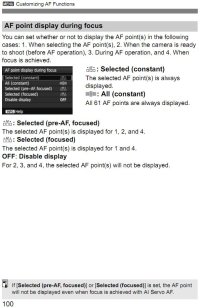
Check out page 100. This looks like it's identical to the 5D3, just described slightly differently in the manual. There is no mention of the hoped for red selected AF point remaining visible. Damn!
 

Attachments

  • 1DX page 100.jpg
    1DX page 100.jpg
    83.4 KB · Views: 926
Upvote 0
Zouk said:
pwp said:
It looks for sure like the red/black AF point issue has been completely addressed. Yay!
Now the firmware release for the 5D3 needs to ship and we'll all be up to date.

Maybe I'm just unobservant, but where in the manual does it say a change occurred?

Did you look through the 1DX AF Guide? I have had a couple of supervised test drives of pre-production 1DX, and I have a 5D3. What I'm seeing colorfully illustrated in the AF Guide is not what I saw on the test drives or what I use daily with the 5D3. The 5D3 & the 1DX presented as identical in the AF display points GUI.

Besides, Canon are not going to overtly say "this is a change" are they? They'll present the present time reality.

PW
 
Upvote 0
pwp said:
Zouk said:
pwp said:
It looks for sure like the red/black AF point issue has been completely addressed. Yay!
Now the firmware release for the 5D3 needs to ship and we'll all be up to date.

Maybe I'm just unobservant, but where in the manual does it say a change occurred?

Did you look through the 1DX AF Guide? I have had a couple of supervised test drives of pre-production 1DX, and I have a 5D3. What I'm seeing colorfully illustrated in the AF Guide is not what I saw on the test drives or what I use daily with the 5D3. The 5D3 & the 1DX presented as identical in the AF display points GUI.

Besides, Canon are not going to overtly say "this is a change" are they? They'll present the present time reality.

PW

PW, maybe you could help us out with a reference to the specific page in either the owner's manual or the AF guide that you think clears things up? I have read both the earlier AF guide and the new version you referred to, but it appears I missed where it says that they AF points will stay lit red while shooting. (I don't think the color illustrations were intended to convey that, but maybe I missed something).

That said, I did see in the owner's manual that there are settings to control when the AF points will light up that seem to include the ability to keep the AF points lit after achieving focus (see p. 100, "AF Point Display During Focus.") However, I have not worked with the 5D Mark III and am currently shooting a 40D, so I don't know if that section is "news" to people concered about the red focus point issue.
 
Upvote 0
pwp said:
Did you look through the 1DX AF Guide? I have had a couple of supervised test drives of pre-production 1DX, and I have a 5D3. What I'm seeing colorfully illustrated in the AF Guide is not what I saw on the test drives or what I use daily with the 5D3. The 5D3 & the 1DX presented as identical in the AF display points GUI.

Besides, Canon are not going to overtly say "this is a change" are they? They'll present the present time reality.

PW

I've got the original and the updated version here side-by-side. The illustrations of how the AF points are lit are exactly the same between the two, as far as I can tell.

Are you making inferences based on the selected AF points being in red on the AI Servo pages? Or is there an actual change in the verbage of the manual that indicates to you that the AF points are now lit differently?
 
Upvote 0
Anyone saw this?
I took it off the Canon USE update on the AF system.

With the EOS 5D Mark III, a less-complex 63-zone metering system is used, and this is not linked to the AF system for helping with Automatic AF point selection. Both cameras have a separate processor dedicated to AF calculation tasks, such as AI Servo AF focus-tracking, in addition to the DIGIC 4 processor used by the EOS-1D X.

I noticed it said BOTH cameras have a seperate processor dedicated to AF…Really? I know the 1DX has a Digic4..nit the 5D3 also has a dedicated processor for AF? I think not ya? Just 1 Digic5+for everything am i right?
 
Upvote 0
MarkWebbPhoto said:
People are still comparing the 5D MK III to the 1DX, they are completely different monsters. In my testing I saw only a little more than 1 stop improvement in high ISO with the 5D3 over the 5D2. I've downloaded and played with several 1DX files and they look absolutely phenomenal. The 1DX probably has at least a 3-stop advantage over the 5D2.

I agree that 1D X is completely different monster. But based on my testing of preproduction model of 1D X the difference between 1D X and 5D3 is only about 1/3 EV (together with noisy blotchy-colored shadows, unfortunately). And 5D3 is maybe 1/2 EV over 5D2 at high ISOs. So don't expect any miracles.

Btw, the speed was way faster than my 1D IV even in AI Servo, good job, Canon!
 
Upvote 0
Status
Not open for further replies.