Canon EOS 6D Mark II Talk [CR1]

Sabaki said:
So a different market but a pretty huge company by the name of Sega sat in a similar position a few years back...

...If anything, the above indicates that current market position needs to be looked at considering other factors...there is a strong argument that catering to the hardcore market whilst paying less attention to what the masses are looking for in a camera, may change the landscape quickly and dramatically for Canon.

I always love these strained analogies.

The camera market is either undergoing, or has already emerged, from the crash that so many people here like to predict.

The market crashed because all the major players (not just Canon) grossly misread the impact on internet connectivity and social media on the market. As a result, they saw the bulk of their customers and arguably some of their most valuable customers (young consumers who will someday have the resources to buy expensive equipment) leave them for the inferior technology of cell phones.

Finally, today, about six or seven years too late, they are just beginning to add internet connectivity to their products. Still, it is clunky and difficult to use and doesn't come remotely close to the convenience of a typical cell phone.

The question people should be asking is which companies have emerged from this meltdown with the least damage to their bottom line?

The other question is which companies seem well-positioned and willing to adapt to the new realities and finally give consumers cameras that are built for connectivity?

Canon obviously fares pretty well in the first question, but falls down in the second. Fortunately, for them, all their competitors have proven to be equally incompetent in this regard.

Someday soon, one of the players will emerge with a camera that allows consumers to easily and quickly go through their pictures, identify the ones they like, do a few quick in-camera edits and then post those pictures directly to the internet or upload them to a service like Dropbox.

If one of the other manufacturers does that before Canon, then I would say Canon has something to worry about. But, so long as the major differences between cameras are the feature sets that elicit so much angst among the dinosaurs on this forum (myself included), Canon has nothing to worry about and all the strained analogies won't change that.
 
Upvote 0
So data from CIPA, Canon and Nikon suggests the following for ILC (incl. MILC) volumes:

Canon an Nikon have grown at the same pace from 2006 to 2015 at an average growth rate of ca. 9.3%. Nikon growing slightly faster. The market (CIPA) at the same time grew 10.6% in average. Both Nikon and Canon have lost market share in volume.

2008 EOS 5D Mark II: Canon (+20%) outgrew Nikon (+9%) yet not Market (+30%)?

2012 EOS 5D Mark III: Canon (+13%) was outgrown big time by Nikon (+36%) and Market (+28%). Nikon accounted for something like 80% of the market growth.

2013: Canon shrank (-6%) slower than both Nikon and Market (-15%).

2014: Negative growth of -18% to -19% for all Canon, Nikon and Market

2015: Negative growth of -11% and -12% for Canon and Nikon respectively with Market shrinking -6%.
 
Upvote 0
romanr74 said:
So data from CIPA, Canon and Nikon suggests the following for ILC (incl. MILC) volumes:

Canon an Nikon have grown at the same pace from 2006 to 2015 at an average growth rate of ca. 9.3%. Nikon growing slightly faster. The market (CIPA) at the same time grew 10.6% in average. Both Nikon and Canon have lost market share in volume.

2008 EOS 5D Mark II: Canon (+20%) outgrew Nikon (+9%) yet not Market (+30%)?

2012 EOS 5D Mark III: Canon (+13%) was outgrown big time by Nikon (+36%) and Market (+28%). Nikon accounted for something like 80% of the market growth.

2013: Canon shrank (-6%) slower than both Nikon and Market (-15%).

2014: Negative growth of -18% to -19% for all Canon, Nikon and Market

2015: Negative growth of -11% and -12% for Canon and Nikon respectively with Market shrinking -6%.

Not saying there's anything wrong with your numbers, but just a warning if you're looking at Canon/Nikon annual reports and comparing them to CIPA data for any given year. CIPA data are for the calendar year, and Canon's fiscal year also matches the calendar year. But Nikon's fiscal year matches the Japanese government's fiscal year, which runs from April 1st to the folloiwing March 31st. Makes head-to-head comparisons a bit of a PITA.
 
Upvote 0
neuroanatomist said:
romanr74 said:
So data from CIPA, Canon and Nikon suggests the following for ILC (incl. MILC) volumes:

Canon an Nikon have grown at the same pace from 2006 to 2015 at an average growth rate of ca. 9.3%. Nikon growing slightly faster. The market (CIPA) at the same time grew 10.6% in average. Both Nikon and Canon have lost market share in volume.

2008 EOS 5D Mark II: Canon (+20%) outgrew Nikon (+9%) yet not Market (+30%)?

2012 EOS 5D Mark III: Canon (+13%) was outgrown big time by Nikon (+36%) and Market (+28%). Nikon accounted for something like 80% of the market growth.

2013: Canon shrank (-6%) slower than both Nikon and Market (-15%).

2014: Negative growth of -18% to -19% for all Canon, Nikon and Market

2015: Negative growth of -11% and -12% for Canon and Nikon respectively with Market shrinking -6%.

Not saying there's anything wrong with your numbers, but just a warning if you're looking at Canon/Nikon annual reports and comparing them to CIPA data for any given year. CIPA data are for the calendar year, and Canon's fiscal year also matches the calendar year. But Nikon's fiscal year matches the Japanese government's fiscal year, which runs from April 1st to the folloiwing March 31st. Makes head-to-head comparisons a bit of a PITA.

I know. The annual numbers might be impacted by that, the 10 years series not (materially).
 
Upvote 0
So if you account for the quarter shift in 2012 and 2013 you get the numbers in red

So data from CIPA, Canon and Nikon suggests the following for ILC (incl. MILC) volumes:

Canon an Nikon have grown at the same pace from 2006 to 2015 at an average growth rate of ca. 9.3%. Nikon growing slightly faster. The market (CIPA) at the same time grew 10.6% in average. Both Nikon and Canon have lost market share in volume.

2008 EOS 5D Mark II: Canon (+20%) outgrew Nikon (+9%) yet not Market (+30%)?

2012 EOS 5D Mark III: Canon (+13%) was outgrown big time by Nikon (+36%/+30%) and Market (+28%). Nikon accounted for something like 80%/67% of the market growth.

2013: Canon and Nikon shrank (-6%) slower than Market (-15%).

2014: Negative growth of -18% to -19% for all Canon, Nikon and Market

2015: Negative growth of -11% and -12% for Canon and Nikon respectively with Market shrinking -6%.
 
Upvote 0
romanr74 said:
So if you account for the quarter shift in 2012 and 2013 you get the numbers in red

So data from CIPA, Canon and Nikon suggests the following for ILC (incl. MILC) volumes:

Canon an Nikon have grown at the same pace from 2006 to 2015 at an average growth rate of ca. 9.3%. Nikon growing slightly faster. The market (CIPA) at the same time grew 10.6% in average. Both Nikon and Canon have lost market share in volume.

2008 EOS 5D Mark II: Canon (+20%) outgrew Nikon (+9%) yet not Market (+30%)?

2012 EOS 5D Mark III: Canon (+13%) was outgrown big time by Nikon (+36%/+30%) and Market (+28%). Nikon accounted for something like 80%/67% of the market growth.

2013: Canon and Nikon shrank (-6%) slower than Market (-15%).

2014: Negative growth of -18% to -19% for all Canon, Nikon and Market

2015: Negative growth of -11% and -12% for Canon and Nikon respectively with Market shrinking -6%.

But you are talking again about each companies growth compared to that company's previous year results. From smatterings of information across different years, it seems to me that Canon's growth may have been less but as it had a bigger share of the market to start off with which means it still outsells Nikon in absolute terms despite a 'smaller % increase'.

Who'd be a statistician, eh?
 
Upvote 0
Mikehit said:
romanr74 said:
So if you account for the quarter shift in 2012 and 2013 you get the numbers in red

So data from CIPA, Canon and Nikon suggests the following for ILC (incl. MILC) volumes:

Canon an Nikon have grown at the same pace from 2006 to 2015 at an average growth rate of ca. 9.3%. Nikon growing slightly faster. The market (CIPA) at the same time grew 10.6% in average. Both Nikon and Canon have lost market share in volume.

2008 EOS 5D Mark II: Canon (+20%) outgrew Nikon (+9%) yet not Market (+30%)?

2012 EOS 5D Mark III: Canon (+13%) was outgrown big time by Nikon (+36%/+30%) and Market (+28%). Nikon accounted for something like 80%/67% of the market growth.

2013: Canon and Nikon shrank (-6%) slower than Market (-15%).

2014: Negative growth of -18% to -19% for all Canon, Nikon and Market

2015: Negative growth of -11% and -12% for Canon and Nikon respectively with Market shrinking -6%.

But you are talking again about each companies growth compared to that company's previous year results. From smatterings of information across different years, it seems to me that Canon's growth may have been less but as it had a bigger share of the market to start off with which means it still outsells Nikon in absolute terms despite a 'smaller % increase'.

Who'd be a statistician, eh?

that doesn't make the growth comparison meaningless. if you give me quantyties from canon for the different camera types for any given year between 2006 and 2015 i'm happy to do the absolute comparison for you to add to the picture. eh!?
 
Upvote 0
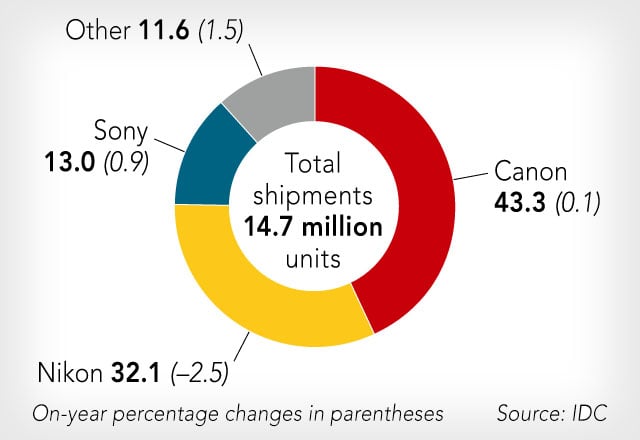
marketshare.jpg


IDC's data for 2014. The change from 2013 differs from romanr74's numbers. Another confound is lenses – IIRC, Canon rolls them in with cameras, Nikon breaks them out. Also, Canon just reports 'cameras' which includes dSLRs and compacts, then gives a value and a unit base for ILCs.
 
Upvote 0
This is a case of "figures don't fool, but fools do figure."

Mixing and matching numbers from different sources simply doesn't work. While it's entertaining for something as insignificant as this forum, no one should be under the illusion that the numbers will add any meaningful insight, especially since there is enough cherry-picking going on here to provide a year's supply of pie for everyone on the forum.
 
Upvote 0
unfocused said:
This is a case of "figures don't fool, but fools do figure."

Mixing and matching numbers from different sources simply doesn't work. While it's entertaining for something as insignificant as this forum, no one should be under the illusion that the numbers will add any meaningful insight, especially since there is enough cherry-picking going on here to provide a year's supply of pie for everyone on the forum.

please explain. it only doesn't work if you imply that the numbers of any of he sources are wrong. if you know they are please share your insight with us.
 
Upvote 0
So I re-summarize:

The post below shows data from CIPA, Canon and Nikon.

As neuroanatomist stated, Nikon has a fiscal year which is shifted by one quarter versus CIPA and Canon. This can impact yearly comparision while it will have a near-zero impact on the 10 year timespan. I adjusted the 2012 and 2013 data for this effect - see numbers in red.

As Mikehit stated, Canon might still outsell Nikon in absolute numbers due to base of growht to start off from. I didn't find absolute units numbers from Canon - if someone has them i'm happy to build them into my model. However, bigger growth number vs. market means market share gain and vice versa.

Unfocused states the whole excercise is futile but doesn't explain why...

romanr74 said:
So if you account for the quarter shift in 2012 and 2013 you get the numbers in red

So data from CIPA, Canon and Nikon suggests the following for ILC (incl. MILC) volumes:

Canon an Nikon have grown at the same pace from 2006 to 2015 at an average growth rate of ca. 9.3%. Nikon growing slightly faster. The market (CIPA) at the same time grew 10.6% in average. Both Nikon and Canon have lost market share in volume.

2008 EOS 5D Mark II: Canon (+20%) outgrew Nikon (+9%) yet not Market (+30%)?

2012 EOS 5D Mark III: Canon (+13%) was outgrown big time by Nikon (+36%/+30%) and Market (+28%). Nikon accounted for something like 80%/67% of the market growth.

2013: Canon and Nikon shrank (-6%) slower than Market (-15%).

2014: Negative growth of -18% to -19% for all Canon, Nikon and Market

2015: Negative growth of -11% and -12% for Canon and Nikon respectively with Market shrinking -6%.
 
Upvote 0
With such specs, I'll gladly add one to my 5DSr as back-up. The 6D's AF was really limited to my taste and a tad slow. For me, it just needs to come with the equivalent AF from the 80D (with a joystick, please Canon...) and a clean 6400 ISO. Not that I care much for DPAF but that's fine. Somehow, I just wonder whether DPAF actually does require an AA filter (just wondering why Canon is reticent to remove it on their new releases as compared to competition). Well, maybe I'm already spoiled by the look, feel and malleability of the 5DSr files...
 
Upvote 0
Moulyneau said:
With such specs, I'll gladly add one to my 5DSr as back-up. The 6D's AF was really limited to my taste and a tad slow. For me, it just needs to come with the equivalent AF from the 80D (with a joystick, please Canon...) and a clean 6400 ISO. Not that I care much for DPAF but that's fine. Somehow, I just wonder whether DPAF actually does require an AA filter (just wondering why Canon is reticent to remove it on their new releases as compared to competition). Well, maybe I'm already spoiled by the look, feel and malleability of the 5DSr files...

With such a lousy 11 point AF system and outer points that are meh at best you can kinda see why a joystick on the original 6D was largely unnecessary! :P

But yeah I agree if the 6DII has the 80D level of AF then a joystick would be very welcome indeed!
 
Upvote 0
romanr74 said:
Unfocused states the whole excercise is futile but doesn't explain why...

Why?

Anytime you mix data from different sources, you compromise the data. You have no way of knowing if the data was collected in a consistent manner (probably not, since you are using different sources). Data represents a snapshot in time, by your own admission, you have altered that. Since you are using different sources, you cannot be certain that each defines the data in identical ways.

One example: Do all your sources use shipments, or do some use sales? They are not the same. How does each define the terms. Does Nikon's definition of shipment or sale match Canon's? Do CIPA's definitions match up to Canon and Nikon?

You have added a causal relationship (release of specific high-end Canon cameras, 5D models) to the data that is not supported by anything in the data and is logically just wrong. Logically, the sales of any full frame camera constitutes too small of a percentage of overall sales for the effect you have assigned to it. You have no access to information that would make your assumed link between 5D sales and overall sales valid.

While assigning a causal relationship between the release of specific high-end models, you have completely ignored massive social and economic changes that have shaken the entire market, indeed the entire world economy, during the past 10 years.

You claim to be using 10-year data, but then you pull out data by year, which means your 10-year averaging no longer is relevant or valid.

You are using percentage of growth, as though that is the most relevant number possible, when it doesn't account for the overall market.

The 10-year period you've chosen constitutes something of an anomaly in the camera market. It begins during a growth period when digital was taking over the market, but ends in a period in which the larger digital camera market has collapsed due to cell phone competition. What was once an emerging market, as enthusiasts adopted digital technology, has now become a mature market where growth and the pace of change has slowed significantly.

But, your biggest mistake is in assuming that growth equates to success and trumps all other factors. That is a perspective that may not be shared by the industry. Few successful businesses pursue growth at the expense of all other factors. There is a cost associated with growth and companies recognize that the cost of capturing a slightly larger share of the market may not be worth the expense.

Use our own industry as an example. No photographer should pursue every possible client. The cost of servicing some clients may exceed their value, especially if serving them comes at the expense of other customers.

You have assumed that Canon (or Nikon) considers unlimited growth to be their primary objective. Their investors (who have a much bigger vote than you or I) are more likely to value return on investment over the relentless pursuit of small increases in market share.

In short, your data is unreliable and, even if it was reliable, it would not support your conclusions.
 
Upvote 0
unfocused said:
Anytime you mix data from different sources, you compromise the data. You have no way of knowing if the data was collected in a consistent manner (probably not, since you are using different sources). Data represents a snapshot in time, by your own admission, you have altered that. Since you are using different sources, you cannot be certain that each defines the data in identical ways.

You're correct on the sources. I have not "altered" the data, though, I have added quarters (for which data are available) differently to accomodate for calendar year view.

unfocused said:
You have added a causal relationship (release of specific high-end Canon cameras, 5D models) to the data that is not supported by anything in the data and is logically just wrong. Logically, the sales of any full frame camera constitutes too small of a percentage of overall sales for the effect you have assigned to it. You have no access to information that would make your assumed link between 5D sales and overall sales valid.

I did not do anything like that at all... Why are you saying that?

unfocused said:
While assigning a causal relationship between the release of specific high-end models, you have completely ignored massive social and economic changes that have shaken the entire market, indeed the entire world economy, during the past 10 years.

See above... I didn't assign any casual relationship at all...

unfocused said:
You claim to be using 10-year data, but then you pull out data by year, which means your 10-year averaging no longer is relevant or valid.

Not for the year-by-year statements but for the 10 year statement I make at the top...

unfocused said:
You are using percentage of growth, as though that is the most relevant number possible, when it doesn't account for the overall market.

I use percentage of growth because it is the only number which is consistently available i.e. has the highest reliability. I didn't make up numbers... I do not imply it is the single most imporant measure. You do that...

unfocused said:
The 10-year period you've chosen constitutes something of an anomaly in the camera market. It begins during a growth period when digital was taking over the market, but ends in a period in which the larger digital camera market has collapsed due to cell phone competition. What was once an emerging market, as enthusiasts adopted digital technology, has now become a mature market where growth and the pace of change has slowed significantly.

Which is true for the respective market, Canon and Nikon. No?

unfocused said:
But, your biggest mistake is in assuming that growth equates to success and trumps all other factors. That is a perspective that may not be shared by the industry. Few successful businesses pursue growth at the expense of all other factors. There is a cost associated with growth and companies recognize that the cost of capturing a slightly larger share of the market may not be worth the expense.

I make no such statement. You make that statement to yourself. I only describe the data I see...

unfocused said:
You have assumed that Canon (or Nikon) considers unlimited growth to be their primary objective. Their investors (who have a much bigger vote than you or I) are more likely to value return on investment over the relentless pursuit of small increases in market share.

I make no such statement. You make that statement to yourself. I only describe the data I see...

unfocused said:
In short, your data is unreliable and, even if it was reliable, it would not support your conclusions.

I make no conclusions. You make up conclusions yourself. I only describe the data I see...
 
Upvote 0
neuroanatomist said:
romanr74 said:
So data from CIPA, Canon and Nikon suggests the following for ILC (incl. MILC) volumes:

Canon an Nikon have grown at the same pace from 2006 to 2015 at an average growth rate of ca. 9.3%. Nikon growing slightly faster. The market (CIPA) at the same time grew 10.6% in average. Both Nikon and Canon have lost market share in volume.

2008 EOS 5D Mark II: Canon (+20%) outgrew Nikon (+9%) yet not Market (+30%)?

2012 EOS 5D Mark III: Canon (+13%) was outgrown big time by Nikon (+36%) and Market (+28%). Nikon accounted for something like 80% of the market growth.

2013: Canon shrank (-6%) slower than both Nikon and Market (-15%).

2014: Negative growth of -18% to -19% for all Canon, Nikon and Market

2015: Negative growth of -11% and -12% for Canon and Nikon respectively with Market shrinking -6%.

Not saying there's anything wrong with your numbers, but just a warning if you're looking at Canon/Nikon annual reports and comparing them to CIPA data for any given year. CIPA data are for the calendar year, and Canon's fiscal year also matches the calendar year. But Nikon's fiscal year matches the Japanese government's fiscal year, which runs from April 1st to the folloiwing March 31st. Makes head-to-head comparisons a bit of a PITA.

not only that, CIPA is shipped. Canon and Nikon report sold - you really can't correlate the two. especially market shrinkage like some are attempting.. that's ludicrous.

you can maybe assume relative numbers, however that is difficult.

this year we do have numbers from canon in the first half of the year they sold 2.52M ILC's.. Nikon 1.45 million (matching fiscal quarters)

Canon so far this year (2Q 2016) has maintained the same level of sold cameras from last year.
 
Upvote 0
rrcphoto said:
neuroanatomist said:
romanr74 said:
So data from CIPA, Canon and Nikon suggests the following for ILC (incl. MILC) volumes:

Canon an Nikon have grown at the same pace from 2006 to 2015 at an average growth rate of ca. 9.3%. Nikon growing slightly faster. The market (CIPA) at the same time grew 10.6% in average. Both Nikon and Canon have lost market share in volume.

2008 EOS 5D Mark II: Canon (+20%) outgrew Nikon (+9%) yet not Market (+30%)?

2012 EOS 5D Mark III: Canon (+13%) was outgrown big time by Nikon (+36%) and Market (+28%). Nikon accounted for something like 80% of the market growth.

2013: Canon shrank (-6%) slower than both Nikon and Market (-15%).

2014: Negative growth of -18% to -19% for all Canon, Nikon and Market

2015: Negative growth of -11% and -12% for Canon and Nikon respectively with Market shrinking -6%.

Not saying there's anything wrong with your numbers, but just a warning if you're looking at Canon/Nikon annual reports and comparing them to CIPA data for any given year. CIPA data are for the calendar year, and Canon's fiscal year also matches the calendar year. But Nikon's fiscal year matches the Japanese government's fiscal year, which runs from April 1st to the folloiwing March 31st. Makes head-to-head comparisons a bit of a PITA.

not only that, CIPA is shipped. Canon and Nikon report sold - you really can't correlate the two. especially market shrinkage like some are attempting.. that's ludicrous.

you can maybe assume relative numbers, however that is difficult.

this year we do have numbers from canon in the first half of the year they sold 2.52M ILC's.. Nikon 1.45 million (matching fiscal quarters)

Canon so far this year (2Q 2016) has maintained the same level of sold cameras from last year.


i don't claim the data to be perfect, i say in the opener that the data "suggests"...
however i do believe they are a very good indicator in particular the canon vs. nikon comparison.
if someone has better data then please share it.

can you share the source for the quantities?
 
Upvote 0