
Are you predicating a rumour if another rumour is fulfilled?If R10 mkII came out alongside R7 mkII, then R7 is basically dead and it's what inventory strategies looks like.
Upvote
0
Are you predicating a rumour if another rumour is fulfilled?If R10 mkII came out alongside R7 mkII, then R7 is basically dead and it's what inventory strategies looks like.

That's not necessarily how inflation affects launch prices. The 5DIII launched in 2012 at $3500, that's $4975 in 2026 dollars (and was $4870 in 2024 dollars when it launched). Inflation is not the only factor, what the market will bear, tariffs, etc., also factor in. I suspect that means an R7II will cost less $2500, even if Canon has to eliminate features to lower the cost of goods.
No doubt. But Canon doesn’t care what you, personally, would rather have. They care about what the market as a whole wants, and history shows they are pretty good at determining that.

Ha, good question and good catch, I edited that post several times as I was typing it, was referring to the year that the R5II launched but did not say that.What camera are you referencing when you say "in 2024 dollars when it launched"?
Of course not, but then...I don't care at all about the price or features of an R7II except as discussion points, since it's very unlikely that I will buy one, regardless of what Canon decides regarding those aspects of the camera.Neither does Canon care what you think they will do regarding price and features of the R7 Mark II.
R7 inventories are getting very low and, even getting big discounts.Are you predicating a rumour if another rumour is fulfilled?
It's not only the interest rate differential that is causing the weak yen. It's the bond situation in Japan, which is dire. I don't think US rates going down will have much impact on the USDJPY rate. Maybe it will move from 159 where it is now to 155 or something. Maybe even 150 is possible. But it's not going back to the 120-130 level.I am fairly confident, Canon will have a cheaper Japanese retail price than in the United States or Europe. Due to the weak yen, if they want any chance to succeed domestically in their backyard, they will need to set the retail at 300,000yen or below. Japanese will not pay more than that for an APS-C. It would likely be $2400-$2600USD. Everyone knows in May, the USA interest will fall quickly devalue the dollar after J.P. is out of his position. To get the camera at the best price convert your USD to YEN now, while the rate is in your favor. It will be camera industry biggest drop of the year.


I'm really looking forwards to this new camera. Spec wise it sounds like massive fix for all of the R7's deficiencies. It's far more like the camera we hoped for in the R7. great as the R7 was, It's AF was notoriously un-reliable in low light (pulsing issues too), it's slightly weird and unique ergonomics. Now it's got pre-capture, all the latest UI and ergonomic upgrades, a better battery and superior buffer and card media. I just hope Canon gives it a better EVF...I think the R7 shares the same unit as the R8. Yes the stacked sensor will be a huge benefit over the current R7 if that's ever been an issue for you.
For me, I've used the 1.6x crop sensor cameras as cameras where I have a built in teleconverter. If i need a teleconverter, then i might as well use a R7 instead.
Your milage, opinion and use case scenario might vary.
I really don't see it that way. The 7D was pretty good for 2009, and it came along just as I was wondering how to upgrade my 40D with something genuinely better that I could actually afford! Five years later I was well and truly ready for the Mark II, but not because of any real dissatisfaction with the 7D, just that five years of catching up was sorely needed by then.If the R7 Mark II turns out to be what many wished the R7 could have been, it will be a case of history repeating itself.
The 7D Mark II was what the 7D should have been, but the 7D had frustratingly inconsistent AF from one frame to the next, especially in AI Servo bursts but also with one shot single frame shooting. The 7D was also a lot noisier than the 7D Mark II at typical night field sports ISOs: 3200-6400.
I really don't see it that way. The 7D was pretty good for 2009, and it came along just as I was wondering how to upgrade my 40D with something genuinely better that I could actually afford! Five years later I was well and truly ready for the Mark II, but not because of any real dissatisfaction with the 7D, just that five years of catching up was sorely needed by then.
The R7, on the other hand, was a dreadful disappointment. A fairly decent R-series successor to the 90D, masquerading as a mirrorless 7D3 which of course it wasn't. The one consolation was the 90D-level price, but the fact remains that in this, the twelfth year since the 7D2 was launched, it still has no successor. The R7 Mark II needs to be head and shoulders above the R7, not just an update like the 7D to 7D2.
It looks like the original 7D with just some minor button rearrangements and the obvious GPS plate in front of the flash mount. The image quality, especially at higher ISO, is a bit better. I’m not an expert on it but shadow salvage seems better, too.
But when you started playing with the autofocus you’ll realize this isn’t your grandfather’s 7D. Some people claim to like the original 7D’s AF, but some people claim to like brussel sprouts. The 7DII had me doing ‘hey, y’all, look at this’ autofocus tricks in 2 minutes.
I loved my 7D!. Never had the 7DII. Moved to the 7D from a T2i, so perhaps that is why I was very happy. I stopped doing sports (thriathlon) and moved into new born / kids photographyThe 7D Mark Ii was far more than an update to the 7D. For those who used it to shoot night/indoors sports, flicker reduction was REVOLUTIONARY.
There was no comparison between the poor shot-to-shot consistency of the 7D's 19 point AF system and the much more consistent 65-pont AF system which also covered a larger percentage of the frame. Just read Roger Cicala's take on the 7D Mark II:
Compare that with his assessment of the original 7D, even when using single shot AF on a stationary subject using only the center AF point. It was the second most inconsistent camera he tested from the following list: 1Ds Mark III, 5D Mark II, 1D Mark IV, 1D X, 5D Mark III, 7D, 50D, 60D, T4i, T3i. Only the T3i was barely more inconsistent. The 1D X and 5D III had standard deviation of 15 line pairs per image height (lp/ih). The 7D had a standard deviation of 40 lp/ih, the T3i came in at 41. The 50D and 60D scored 34, and the T4i posted a 29.
My own experience when I transitioned from the 50D to the 7D was similar: The 50D missed focus less often and by lesser amounts than the 7D. When looking through the viewfinder and shooting with the 7D, it felt like a more capable camera. It certainly had a more configurable AF system in terms of settings options. But when looking at the results on even a 24" FHD monitor with the entire image on the screen, the results were undeniable.
 That is when I got the 5DIII. Man, that was a nice upgrade. I still regret selling the 5DIII when I moved on to the R5.
The biggest concern I have is: if the 20% increase in pixel density is true and a BSI sensor, I hope that the noise figure at higher ISOs (like 6400) will be much improved. If no improvement, then they should not have increased the pixel density in this proposed version of the R7 unless, they specifically wanted it to be targeted towards video users and not photographers. However, the R7-MII is supposedly designed as a wildlife camera - which generally needs to be able to handle and work in poor or low light situations, often requireing high ISOs. So I will be very disappointed if the noise figure is not improved. No improvement in noise figure and the R7 MII starts to become less desireable. For reasons I can't explain, no one seems to understand and discuss this.I have been writing a fair bit about the EOS R7 Mark II in recent weeks, and with good reason. It's good clickbait, and many people who may be interested haven't been following along yet.. That said, I am trying to be as truthful as I possibly can while stoking the rumors. A little hype […]
See full article...
If you want better noise performance, you need a bigger sensor. For those who understand the relevant concepts, there’s not much more to discuss. The 20% increase in pixel density will make zero difference. BSI will make zero difference.The biggest concern I have is: if the 20% increase in pixel density is true and a BSI sensor, I hope that the noise figure at higher ISOs (like 6400) will be much improved. … No improvement in noise figure and the R7 MII starts to become less desireable. For reasons I can't explain, no one seems to understand and discuss this.
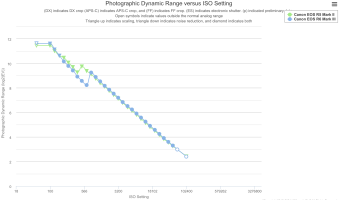
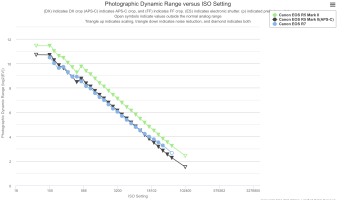
If you want better noise performance, you need a bigger sensor. For those who understand the relevant concepts, there’s not much more to discuss. The 20% increase in pixel density will make zero difference. BSI will make zero difference.
The R5II has a much higher pixel density than the R6III, the noise performance is the same.
View attachment 228690
A larger sensor has less image noise, because it gathers more total light. Crop down the R5II to APS-C size, you lose DR (because of increased image noise), and what you get is essentially the same as the R7.
View attachment 228689
No, we don't agree on that. For an individual pixel, smaller means more noise, sure. People who measurebate pixels love discussing that. People who take pictures care about image noise. Image noise is fundamentally independent of pixel size, but rather depends on total light gathered, which is determined by the area of the image sensor, not the number of pixels packed into that sensor. Divide a FF sensor into 45 million pixels or 24 million pixels, the total light gathered is the same.My point is that with higher pixel denity on the same size chip, the less light you can collect (we agree) and that worsens the noise figure.
At the pixel sizes relevant for APS-C and FF sensors, BSI makes effectively no difference in noise. BSI was developed to enable packing more pixels into smartphone-sized camera sensors while maintaining acceptable image quality. With pixel sizes <2 µm, the benefit of BSI is meaningful. In the 2-3 µm range, the effect is marginal at best, and >3 µm BSI is effectively a marketing slogan.With a BSI chip however (or even a stacked chip - if the rumours are true), that technology improves the ability to collect more light. However if the net overall performance gain between the increased pixel count and the BSI technology offsets in still no improvement in noise figure, then Canon missed an opportuniy to improve the camera overall. Had they kept the pixel density the same as the original 32MP sensor, then with the addition of the BSI technology, there would have been a much needed improvement in noise figure.
As stated, if you want to see meaningful noise improvement, get a camera with a larger sensor. Period. Full stop.I'm a photographer and I wanted to see a noise performance improvement and they may have missed the boat there.

Yes, evidently. The concepts you are fixated on are applicable to pixels, not to pictures. Image noise is inversely proportional to total light gathered. Total light gathered is dependent on the area of the sensor, and independent of pixel size.I definetly don't understand
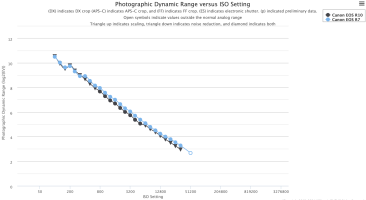
Yes. Each photosite collects less light. But there are more photosites, so for the sensor as a whole the same total amount of light is collected. Same image noise.I think we agree that for the same chip size, as you increase the number of pixels (or decrease the size of the individual collection sites), for each site as the density increases, the individual site collects less light. So, Canon in increasing pixel count, actually decreased the ability of each site to collect light and decreased the signal to noise (made the noise performance worse) of each site.
Each photosite would collect more light. But there would be fewer photosites, so for the sensor as a whole the same total amount of light is collected. Same image noise.If for example, Canon would conversely chose to go to 24MP, then each indiividual site would be larger and collect even more light than the smaller individual site on a 32MP chip;
At the level of the individual pixels. Not at the level of the whole sensor.and the signal to noise would increase (noise performance would improve at 24MP over 32MP).
I am not implying it, I am stating it explicitly. Going to a larger format is the way to get better noise performance.So it is incorrect to say that simply going to a larger format, is the only way to improve noise figure, if that is what you are implying.
No. The whole point is that the size of the pixel is irrelevant. Only the area of the sensor matters.I do also agree that as you increase the size of a photo site by going to a larger chip size or format you should also improve signal to noise but the discussion within a specific chip size and the fundamental underlying physics is the same. Increase site size, better noise performance, decrease cell size, worse noise performance. There are design choices that can be made to make the signal to noise better on an APC-S chip.
As already discussed, that is not true for the pixel sizes relevant here. But if you want to drink the marketing Koolaid, go right ahead.If the rumour is true and Canon has decided to go to newer sensor technology as in BSI, then that technology actually improves each sites ability to collect light. BSI technology moves the collection site higher and closer to the lens actually improving light collection and increasing (making better) the signal to noise
If Canon stays at the original 32MP density and improved the sensor technology by evolving to a BSI sensor, then the noise figure could have actually improved on the new R7 APC-S chip.


