Canon MP-E 65mm - Due an upgrade?

So I'm pretty nuts about macro photography and I've had my eye on the MP-E 65 for a while now and my finger is itching to pull the trigger.

I've been reading reviews and noted this lens is 16 years old! But the only negative I can see regarding this lens, aside from one's personal level of expertise, is softness at 1x on f/2.8

You guys feel this lens is due for an upgrade?
 
Unlikely. It's a niche lens that is nearly perfect for that niche. Almost never used wide open anyway. No AF, IS, etc., to be updated.

If you get one, plan on an MT-24EX to go with it. That one might get an update, similar to the MR-14EX (which really wasn't much of an update.
 
Upvote 0
If you mean upgrading your MR-14EX to the MkII, I don't see a point since the changes were really

For use with the MP-E 65mm, the MR-14EX actually projects light a little too far from the lens (behind the subject) and since it cannot be adjusted, it's suboptimal for the MP-E 65mm at higher magnifications (shorter working distances).
 
Upvote 0
What for?

MP-E65 is a manual lens - optically it's perfect, electronics is absent (and useless), so I don't see reason for any changes.

f/2,8 for macro - again, what for?
I like macro, too, but the widest open for me is f/5,6, and the most common - f/8, so f/2,8 in such a special lens for me is "just for fun" - I'll never use it.

Or you want to use this lens for portraits? O_o
 
Upvote 0
I also think it is unlikely. The lens is very good and unrivalled. Also, if this lens has its lowest IQ at 1:1 then this is not problematic, for I will chose ANY other macro lens when doing 1:1 images (for the reasons below). This lens is ment for magnifications much higher than 1:1, where there really is no alternative. Fun with this lens begins at 2:1, I would say.

Yet there is ample space for improvement. Not so much the IQ, it is really great, but the lack of possibility to focus the lens. This lens is un-focus-able. Focussing is done by varying the distance to the subject. So, to work with this lens you set the desired magnification on the lens first, then vary the distance to the subject (by means of a macro-rail). I find this to be inconvenient and rather slow. But it works.

So no, I don't think this lens will see an update, not in quite some time.

As to the MR14EX2, this really was a strange update. The 600EX-RT was already out, so this would have been the perfect opportunity to make an MR14EX-RT out of it, but: no, a mere EX2... No worth the upgrade, IMHO.
 
Upvote 0
Sabaki said:
So I'm pretty nuts about macro photography and I've had my eye on the MP-E 65 for a while now and my finger is itching to pull the trigger.

I've been reading reviews and noted this lens is 16 years old! But the only negative I can see regarding this lens, aside from one's personal level of expertise, is softness at 1x on f/2.8

You guys feel this lens is due for an upgrade?

DOF at 1:1 and f/2.8 is like half the diameter of an electron ;D so I wouldn't too much about that
 
Upvote 0
Sabaki said:
I've been reading reviews and noted this lens is 16 years old! But the only negative I can see regarding this lens, aside from one's personal level of expertise, is softness at 1x on f/2.8

f/2.8 in that lens in there only for viewing purposes I guess. No one in the right mind would shoot it wide open, especially at higher magnifications, unless you want micron-thin DoF :) It could have started at f/5.6, but image in the VF would be too dark (talking about non-live view age anyway). Also, lenses usually perform best when stopped 2-3 stops from maximum aperture. Which make this one ideal for usual aperture values.
 
Upvote 0
Khalai said:
Sabaki said:
I've been reading reviews and noted this lens is 16 years old! But the only negative I can see regarding this lens, aside from one's personal level of expertise, is softness at 1x on f/2.8

f/2.8 in that lens in there only for viewing purposes I guess. No one in the right mind would shoot it wide open, especially at higher magnifications, unless you want micron-thin DoF :) It could have started at f/5.6, but image in the VF would be too dark (talking about non-live view age anyway). Also, lenses usually perform best when stopped 2-3 stops from maximum aperture. Which make this one ideal for usual aperture values.

Most copies of this lens will be sharpest at about f/4, with f/5.6 only very slightly behind. However, copies do exist in which the lens is sharpest wide open. So, for maximum detail whilst focus stacking f/2.8 could be a rational aperture choice. I stack at f/4 most of the time.

You're right on the money about the VF thing though.
 
Upvote 0
Dear Friend Mr. Sabaki
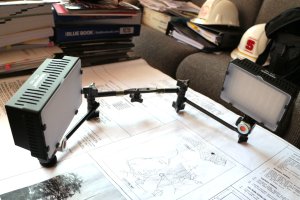
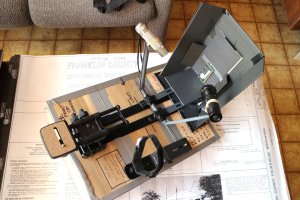
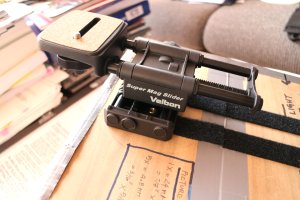
Yes, Macro Lenses are not quite Important Factor of Great Sharp Photos( Just in my IDEA, because I shoot most of MACRO photos in Manual Focus Mode , Plus I use High Number of F. Stop = more than 8.0 = to get the sharp detail photos) , But the Most important thing are Great Tripods, Great Adjustable Camera Movement Rail on Tripods, and The Most important light = Side lights that you can adjust the Angle of lights to get the shade and shadow of the subject , to create 3D. Look, And Plus you can Adjust the Quantity of difference Lights.
I shoot MACRO in past 20 years, and learn from my mistake.
Here is the Link that I just Up load with in 2 hours , and hope that will help you.

http://www.canonrumors.com/forum/index.php?topic=24556.msg482623#msg482623

Enjoy.
Surapon
 

Attachments

  • ME-5.jpg
    ME-5.jpg
    1.1 MB · Views: 237
  • ME-6.jpg
    ME-6.jpg
    922.3 KB · Views: 194
  • ME-4.jpg
    ME-4.jpg
    927 KB · Views: 172
  • MS003.JPG
    MS003.JPG
    40 KB · Views: 1,118
  • TS-15.jpg
    TS-15.jpg
    606.9 KB · Views: 197
Upvote 0
This is the second thread recently about an MP-E mark ii and I'm quite surprised to see them. However, I'm also quite surprised to learn that it was released in 1999. Nikon have had 15 years to come up with a competitor and they haven't bothered.

Realistically, most of the time the limitations of this lens will relate to physics, or user error, or the other equipment being used (or not used), rather than the optics. It'll be worth learning a bit about the behaviour of the lens at different apertures, and also thinking what other equipment you might need (e.g. rails, specialised lighting, focus stacking software, tripod/ballhead etc) to get the best out of it.

I've spent probably hundreds of hours using this lens as part of a research project, mostly in a focus stacking capacity but also single shots at narrower apertures for moving objects (tiny living animals). I'm quite happy with the sharpness. The convenience for framing is unmatched. But what really stuns me is the extremely low or absent CA with this lens. I see it with my other macro lenses, but not with this, which is quite amazing. There isn't much to ask for in a mark ii version. Probably more aperture blades would be one thing. The technical quality of the bokeh probably isn't top notch due to the 6 aperture blades, but in practise it doesn't bother me at all. I could think of a few other minor things.

The learning curve with this lens is quite steep and unfortunately I've never seen a really comprehensive review / guide for it on the net. There is a lot of excellent info out there, but it is scattered around all over the place.

Overall, I would say don't worry about a mk ii and get this lens if you're curious about it. It's wonderful and I've really enjoyed using it.
 
Upvote 0
Nikon had some good bellows and a few bellows lenses for the greater than 1:1 crowd. Yes, bellows are PITA in the field. There are not a lot of people who shoot extensively with this lens. Field insect photography seems to be one of the most popular uses.
 
Upvote 0
According to the manual, the depth of field at 5x f/2.8 is 0.048mm, or 48µm.
http://media.the-digital-picture.com/Owners-Manuals/Canon-MP-E-65mm-1-5x-Macro-Lens.pdf

A human hair is 100µm on average. Some cells in your body are around 10-100µm. A sheet of paper is about 100µm thick. You'll probably want to use the highest possible F stop. I used one of these lenses once, and it was difficult. The challenge is getting enough light. I had a couple halogen lights several hundred watts each, and it wasn't nearly enough for good results. A newer camera with better high ISO capability would help.

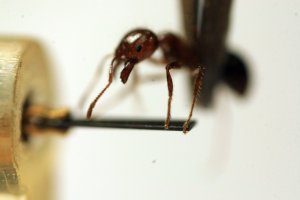
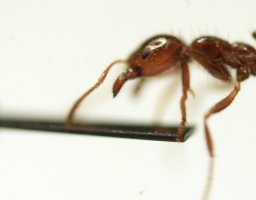
Here's one of the photos. We were doing an experiment to see how much force ants feet could grip with. They have sticky pads that let them walk on smooth vertical surfaces, and they have rough hairs that let them grip uneven surfaces. The gray bar is a very tiny force sensor. The ants are held by tweezers, which don't harm them. The experiment wasn't very successful, but at least the eyes are somewhat in focus!

This was probably 1-3x zoom, 1/90s f/3.5 ISO1600 65mm with a Canon 30D. There wasn't enough light or DOF to zoom in more, and it became too difficult to get anything in focus or in the frame. At 5x on an APS-C camera, an object approx. 5mm × 3.3mm fills the frame.
 

Attachments

  • IMG_2725.JPG
    IMG_2725.JPG
    757.6 KB · Views: 174
  • IMG_2749.jpg
    IMG_2749.jpg
    750 KB · Views: 176
Upvote 0