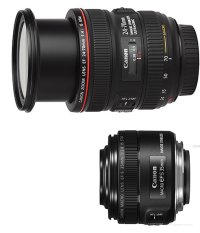
Canon Officially Announces the EF-S 35mm f/2.8 Macro IS STM

About fast ef-s lenses, the question is how to get fastness the cheapest way. What is cheaper, a 50mm 2.8 lens or a 30mm 1.8? maybe for 1 single lens, the 30mm lens would be chaper, but if you want a macro, a low light lens and a fast standard zoom it may be chaeper to buy a FF camera which gains more than 1stop by sensor size.

It makes no sense to buy a 24mm 1.4 lens for crop, better get a 35 2.0 IS and a FF body.

For the macro, i got for the price of this lens a 100mm USM macro and ring flash both used, which is probably the better macro setup if the FF camera is already there. only disadvantage is, it's not a walk around lens, it's specially for macro and usable for portraits maybe.
 
Upvote 0
Fuji has a 14mm f/2.8 APS-C. It costs $900.

Canon has a 10-18mm f/4.5-5.6 IS STM APS-C. It costs $280.

I think Canon's strategy is far better than Fuji.

The Canon lens is affordable, attracing a large following, and it has IS and silent STM AF, making it viable for video.

You can see Canon APS-C attracting far far more users than Fuji, Fuji is a blip on the radar, a rounding error, compared to Canon. People like versatility, IS, silent STM AF, zoom, etc. What canon offers in APS-C is not a cheaper version of full frame, they offer innovative and fun products that are made for 2017, while Fuji is stuck in the past without decent video features, without IS, and with old-school lenses. Yes, their lenses are fast, but they're also heavy, big, loud, expensive, and very one-dimensional, they're stuck in the past.

Each year ISO performance increases. The need for very fast wide angle lenses decreases each year, Canon is looking ahead, improving features that matter to the general public, IS, silent and fast AF, portability and affordability.
 
Upvote 0
hendrik-sg said:
About fast ef-s lenses, the question is how to get fastness the cheapest way. What is cheaper, a 50mm 2.8 lens or a 30mm 1.8? maybe for 1 single lens, the 30mm lens would be chaper, but if you want a macro, a low light lens and a fast standard zoom it may be chaeper to buy a FF camera which gains more than 1stop by sensor size.

It makes no sense to buy a 24mm 1.4 lens for crop, better get a 35 2.0 IS and a FF body.

For the macro, i got for the price of this lens a 100mm USM macro and ring flash both used, which is probably the better macro setup if the FF camera is already there. only disadvantage is, it's not a walk around lens, it's specially for macro and usable for portraits maybe.

A fast EF-S lens would cost far less than buying a FF body and 35 2.0 IS, not to mention replacing all of one's EF-S lenses.
 
Upvote 0
Nininini said:
AvTvM said:
The other aspect I am questioning about this lens is whether it really was the most urgent priority for Canon to offer 2 macro lenses in EF-S mount, but not a single prime faster than f/2.8

The point of EF-S and Canon's APS-C has always been affordability. Most people know this, Canon doesn't hide this, they mention it during interviews.

If you look at the EF-S lens line-up, all their lenses are affordable. Faster than f/2.8 would mean greatly increased costs.

Canon has one EF-S lens faster than f/2.8 afaik, the 50mm f/1.8, but a 50mm is also the cheapest design you can make in a lens, and the 50mm f/1.8 is still cheap.

If you are expecting canon to introduce 14mm f/2.0 EF-S, you are going to be waiting a long long time.


The APS-C audience is increasingly coming from people wanting to share video, youtube, etc. So you see Canon increasingly add video features.

-STM on all EFS lenses, to make video focusing silent
-IS on all EF-S zoom lenses
-hybrid IS to compensate for up and down movement
-built in video IS in the 77D

They are also adding usability menus on their newest cameras, to make them even easier to use.

Their focus is far less on the speed of the lens, but instead on the usability of the lens and ergonomics of the camera.

Imo, a good thing, the real money is coming from youtube vloggers and casual shooters, the market interested in professional landscape or wedding photography is incredibly small and isn't buying APS-C to begin with.

Fuji is coming out with very fast and expensive APS-C lenses and their marketshare is incredibly small compared to Canon's APS-C marketshare. I don't think Fuji is going in the right direction. ISO performance and IS keeps getting better, the need for very fast expensive lenses without IS is diminishing.

The 50mm f/1.8 is EF, not EF-S.

Canon still has no 50mm equivalent (31mm) fast EF-S prime. This new lens is close in focal length, but only f/2.8. Nothing for those of us who would like a fast normal lens for APS-C.
 
Upvote 0
What i really wanted is a cheap EF-S ultra-wide prime lens. It' doesn't need to be fast. It can be f4. Or f8! It can even be MF only. Do it Canon! . I'm pretty sure there are more people than myself shooting landscape than people shooting small bugs.
 
Upvote 0
Azathoth said:
What i really wanted is a cheap EF-S ultra-wide prime lens. It' doesn't need to be fast. It can be f4. Or f8! It can even be MF only. Do it Canon! . I'm pretty sure there are more people than myself shooting landscape than people shooting small bugs.

But are you also pretty sure there are more APS-C owners shooting landscapes than shooting (small bugs + food + flowers + anything else small)?

Also, how many APS-C owners shooting landscapes would choose a slow ultra-wide prime over a slow ultrawide zoom like the 10-18mm, which has IS and costs $280? I'm pretty sure that's not going to be many people besides you.

So APS-C dSLR owners who want ultrawide for landscapes have a great option in the 10-18mm, and it's evident that in general consumers prefer zooms over primes. But APS-C owners who want a wider perspective for macro, or just an inexpensive macro lens with IS, had no option...until now.
 
Upvote 0
neuroanatomist said:
Azathoth said:
What i really wanted is a cheap EF-S ultra-wide prime lens. It' doesn't need to be fast. It can be f4. Or f8! It can even be MF only. Do it Canon! . I'm pretty sure there are more people than myself shooting landscape than people shooting small bugs.

But are you also pretty sure there are more APS-C owners shooting landscapes than shooting (small bugs + food + flowers + anything else small)?

Also, how many APS-C owners shooting landscapes would choose a slow ultra-wide prime over a slow ultrawide zoom like the 10-18mm, which has IS and costs $280? I'm pretty sure that's not going to be many people besides you.

So APS-C dSLR owners who want ultrawide for landscapes have a great option in the 10-18mm, and it's evident that in general consumers prefer zooms over primes. But APS-C owners who want a wider perspective for macro, or just an inexpensive macro lens with IS, had no option...until now.

Agree with you, Neuro, but the general notion that Canon will only please the masses in crop and you need to go to EF to get specialized tools falls down pretty hard on the UWA end. Consider:

  • A birder can fully live out his/her days in bliss in crop with a nice long EF lens, say a 100-400L II or possibly a big white prime.
  • A portraiture person can do the same with a 50L or 85L on crop (rather than, say, an 85L or 135L on FF).
  • A crop product/food/flora/insect person is drowning in macro options, both in EF-S and EF.

...while the UWA crop person is (relatively) SOL to step up to great glass. Their only 10mm-ish option is to 'step up' to an 11-24L (or go third party). I suppose that could work, but I have yet to see an 11-24 on a crop rig IRL in my travels.

I'm not advocating L lenses for crop or anything so dramatic, but a higher end UWA EF-S lens would sell quite well, I think. I still think it should be a zoom (and a 'Mk II' replacement for the EF-S 10-22 USM), but I understand why people might like a 10mm prime as well. Such an offering could address the one glaring gap the EF line can't really solve for crop shooters.

- A
 
Upvote 0
ahsanford said:
neuroanatomist said:
Azathoth said:
What i really wanted is a cheap EF-S ultra-wide prime lens. It' doesn't need to be fast. It can be f4. Or f8! It can even be MF only. Do it Canon! . I'm pretty sure there are more people than myself shooting landscape than people shooting small bugs.

But are you also pretty sure there are more APS-C owners shooting landscapes than shooting (small bugs + food + flowers + anything else small)?

Also, how many APS-C owners shooting landscapes would choose a slow ultra-wide prime over a slow ultrawide zoom like the 10-18mm, which has IS and costs $280? I'm pretty sure that's not going to be many people besides you.

So APS-C dSLR owners who want ultrawide for landscapes have a great option in the 10-18mm, and it's evident that in general consumers prefer zooms over primes. But APS-C owners who want a wider perspective for macro, or just an inexpensive macro lens with IS, had no option...until now.

Agree with you, Neuro, but the general notion that Canon will only please the masses in crop and you need to go to EF to get specialized tools falls down pretty hard on the UWA end. Consider:

  • A birder can fully live out his/her days in bliss in crop with a nice long EF lens, say a 100-400L II or possibly a big white prime.
  • A portraiture person can do the same with a 50L or 85L on crop (rather than, say, an 85L or 135L on FF).
  • A crop product/food/flora/insect person is drowning in macro options, both in EF-S and EF.

...while the UWA crop person is (relatively) SOL to step up to great glass. Their only 10mm-ish option is to 'step up' to an 11-24L (or go third party). I suppose that could work, but I have yet to see an 11-24 on a crop rig IRL in my travels.

I'm not advocating L lenses for crop or anything so dramatic, but a higher end UWA EF-S lens would sell quite well, I think. I still think it should be a zoom (and a 'Mk II' replacement for the EF-S 10-22 USM), but I understand why people might like a 10mm prime as well. Such an offering could address the one glaring gap the EF line can't really solve for crop shooters.

- A

Generally speaking, I'm a pretty happy crop user. Since my photography only takes place in nice lighting (either non-moving objects in a studio or wildlife or flowers in sunny weather), the FF sensor benefits are a bit limited for me. I don't really enjoy photographing people, and my wife hates being photographed, so portraiture indoors or out is not an issue. However, when the right mix of price and features comes, I will buy a FF camera for landscapes -- probably the 6D2. It will also allow me to use a 50mm prime in some situations where APSC crops out part of the image (ie can't back up any further).

I am perfectly happy buying L lenses for my crop bodies, so long as it's something where the IQ is very important. I'm also perfectly happy buying consumer grade EFS lenses where it's less important -- especially, when the IQ of the EFS lens is good. For example, the 10-18, I think is a real gem. Good image quality, zoom, and IS; and this is a lens that I hardly use. *For me*, this lens makes the superwide prime unnecessary, because it's "good enough", even with f/4.5 at 10mm. But I can definitely see that there would be some people who would love a EFS prime near the bottom of that scale.
 
Upvote 0
The close focus is nice. was 30mm to be expected? Is it a typo? I note that both the 24 70 4L in macro mode and the efs 60 macro have 20cm close focus which is effectively 85% 1500% (?) anyways its A LOT farther away...
 
Upvote 0
Azathoth said:
What i really wanted is a cheap EF-S ultra-wide prime lens. It' doesn't need to be fast. It can be f4. Or f8! It can even be MF only. Do it Canon! . I'm pretty sure there are more people than myself shooting landscape than people shooting small bugs.

there is the Canon EF-S 10-22mm f/3.5-4.5 USM Lens - 599 new but can be had under $400 used.

so within $50 of the brand new ef-s 35mm macro.. what is the 10-22mm missing for you?
 
Upvote 0
TeT said:
The close focus is nice. was 30mm to be expected? Is it a typo? I note that both the 24 70 4L in macro mode and the efs 60 macro have 20cm close focus which is effectively 85% farther away...

...from the sensor. Both of those lenses are bigger. See below for how different the new one is to the 24-70 in fully extended (close to the 0.7x macro mode size). It's hard to get the scaling right as TDP's shot is not a true side view and the mount is capped, but it's close enough.

Also, a wider FL macro by its nature has to dramatically bring in the MFD just to pull off a 1:1 mag, doesn't it? I want to say the recent Venus Laowa 15mm macro has less than a 1 cm of working distance to the front element. :o

- A

P.S. Edit: don't mix up '30mm from the front element' and the MFD. MFD = to the sensor, whereas the working distance = MFD minus lens length (right? someone please correct me if that's off)
 

Attachments

  • To L or not to L (macro).jpg
    To L or not to L (macro).jpg
    87.8 KB · Views: 586
Upvote 0
The product description says the two lights are operated independently and both have bright and dim. But there's only one button. Does that really mean 7 presses to cycle from off back to off or is there another control that just hasn't shown in the pictures of the thing? Will new cameras have on-screen operation of the lights?
 
Upvote 0
Nininini said:
Fuji is coming out with very fast and expensive APS-C lenses and their marketshare is incredibly small compared to Canon's APS-C marketshare. I don't think Fuji is going in the right direction. ISO performance and IS keeps getting better, the need for very fast expensive lenses without IS is diminishing.
Actually Fuji has brought out a few f2.0 primes (older 18mm pancake, 35mm, 23mm, and lately 50mm) that are much cheaper than the f1.4 and f1.2 primes, but good performers even wide open and well built. (As an aside, he 90mm f2 is expensive - as can be expected for that f stop / focal range). All but the 18mm are weather resistant.
So there is a choice.
Where I live, Fuji has rebates twice a year, in the one last October the 18 and 35 had $100 rebates. Not that expensive if you build up your lens collection over time when items are on sale. One of the reasons I switched to Fuji for most of my mirrorless.
 
Upvote 0
The $64,000 question: might we ever see an illuminated macro lens like this for EF?

Why we might: If Canon ever put out a stripped down / budget $1000 FF rig, there might be a market for a slightly watered-down illuminated macro offering.

Why we might not: tons of reasons.

  • FF macro lenses have larger front elements that wouldn't suit this pancake front element / illuminated idea as well (would get pretty big diametrically, would't it?)
  • Canon wants to sell macro speedlites
  • Canon wants to sell 100Ls and surely a new 180L someday
  • The light is relatively unsophisticated/underpowered and would probably frustrate more serious macro folks
  • More 'serious' macro work is at longer FLs and larger working distances, which -- again -- wouldn't get much help from a tiny LED setup

So my money is on 'no' right now.

- A
 
Upvote 0
magarity said:
The product description says the two lights are operated independently and both have bright and dim. But there's only one button. Does that really mean 7 presses to cycle from off back to off or is there another control that just hasn't shown in the pictures of the thing? Will new cameras have on-screen operation of the lights?

I imagine it will work like it does on the EF-M version, i.e. a long press will toggle between both lights and single light.

So you can toggle between two cycles:
Off -> Bright (both) -> Dim (both) -> Off
and
Off -> Bright (left) -> Dim (left) -> Bright (right) -> Dim (right) -> Off
 
Upvote 0
SeppOz said:
(As an aside, he 90mm f2 is expensive - as can be expected for that f stop / focal range).

The EF 85 f/1.8 USM and EF 100mm f/2 USM lenses giggle at what you just said.

Fuji overcharges because it would appear the market for high end crop-dedicated primes is (shockingly) a lot smaller than this forum would have us believe. Volumes have got to be next to nothing for their 16mm f/1.4, 56mm f/1.2 APD, 90mm f/2 lenses, etc.

(That said, rabid enthusiasts with money in their pocket proudly own them and thank their lucky stars someone was willing to make them for a crop system.)

- A
 
Upvote 0
ahsanford said:
Agree with you, Neuro, but the general notion that Canon will only please the masses in crop and you need to go to EF to get specialized tools falls down pretty hard on the UWA end. Consider:

  • A birder can fully live out his/her days in bliss in crop with a nice long EF lens, say a 100-400L II or possibly a big white prime.
  • A portraiture person can do the same with a 50L or 85L on crop (rather than, say, an 85L or 135L on FF).
  • A crop product/food/flora/insect person is drowning in macro options, both in EF-S and EF.

...while the UWA crop person is (relatively) SOL to step up to great glass. Their only 10mm-ish option is to 'step up' to an 11-24L (or go third party). I suppose that could work, but I have yet to see an 11-24 on a crop rig IRL in my travels.

I'm not advocating L lenses for crop or anything so dramatic, but a higher end UWA EF-S lens would sell quite well, I think. I still think it should be a zoom (and a 'Mk II' replacement for the EF-S 10-22 USM), but I understand why people might like a 10mm prime as well. Such an offering could address the one glaring gap the EF line can't really solve for crop shooters.

- A

I don't really agree that it 'falls down hard'. Rather, consider that it's really only in the normal and wide ranges that there is significant optical/cost benefit derived from the APS-C format.

Canon makes 'standard quality' EF lenses and 'high quality' (= L-series) lenses in wide, normal and tele ranges. But in the film days, if you wanted an ultrawide zoom lens, you had to go L-series. So, crop users now have the benefit of being able to pay a lot less for a UWA zoom.

I'd actually argue that a UWA zoom is not a 'specialized' lens. For 'high quality' FF, you have two zoom trinities, fast and slow: 16-35+24-70+70-200 f/2.8 and 17-40+24-105+70-200 f/4. For APS-C users, there's only the slow/variable option: 10-18/22+18-55+55-250 f/4ish-5.6.

There's one other key point your argument leaves out, at least as far as UWA landscape shooting. Generally, speaking, what you're mostly paying for with 'high quality' lenses is performance at or near thair max aperture. If you compare the 10-18 vs. the 11-24L at f/8, they aren't all that different (and certainly not 10-fold price different), the main difference is the lower distortion with the 11-24L, and that's really driven by the sensor size relative to the larger image circle of the EF lens.
 
Upvote 0
AvTvM said:
"expensive enough" for a slow 35mm lens for APS-C image circle only ... most likely fully automated robo-assembly line ... quite some price premium for "Macro" ... over full frame EF 40/2.8 STM as well as EF-S 24/2.8.

I expect its made in Taiwan, where they have high production rate facilities. At the very least, the lenses are ground on fully automatic machinery, and, of course plastic parts are molded on automatic machinery as they have been for 30 years.

I wonder if they use Robots to deburr the molded plastic parts, their are lots of claims about doing it, but I retired before it was possible, so I don't know how well it actually works in practice for high rate production. Robotic assembly should not be a issue, but if labor is cheap and Robots expensive, there may still be lots of hand labor.

You can bet that production cost for the lens in >$100, the rest of the cost is related to recovery of design and tooling costs, shipping, storage costs, advertising, warranty service, including stocking spare parts upgrading software, and publishing service manuals. Then, there are both Canon's markup, taxes, and the Reseller markup.

Some figure on 8X the cost to produce to the Market price, but that drops as the item gets more expensive. For low production rate items, the markup is higher.
 
Upvote 0
neuroanatomist said:
There's one other key point your argument leaves out, at least as far as UWA landscape shooting. Generally, speaking, what you're mostly paying for with 'high quality' lenses is performance at or near thair max aperture. If you compare the 10-18 vs. the 11-24L at f/8, they aren't all that different (and certainly not 10-fold price different), the main difference is the lower distortion with the 11-24L, and that's really driven by the sensor size relative to the larger image circle of the EF lens.

All fair points -- appreciate the post.

The 10-18 is a gem -- please don't mistake my point. But it's not all about max aperture performance. That lens has a plastic mount, it's not sealed, it's not USM, it lacks a distance scale, it's not internally zooming despite a very modest 1.8x FL multiplier, etc.

In short, Canon gave UWA users a fine tool optically that has the feature-level charm of a base-level Honda Civic. If all you shoot is landscapes on crop, surely you wish for a little more here.

I still contend a rock-solid EF-S 10-22 f/3.5-4.5 USM II (or perhaps a beefier f/2.8-4 version) that is sealed, USM, has all the trappings of the 16-35 f/4L IS made for crop would sell well at a $699-799 price point.

- A
 
Upvote 0
Talys said:
Generally speaking, I'm a pretty happy crop user.

Same. There's things I would want, but nothing I need.

I would want a cheap small 100mm f/2.8 EF-S prime with IS for example. A short tele instead of carrying my 55-250mm IS STM everywhere. But I don't need it.

(yep yep, I know about the 100mm f/2.0, but it doesn't have IS, bit prone to flaring, and is still a bit expensive for me)

Just dreams really. Not like I need it.
 
Upvote 0