Canon RF 14mm F/1.4 – Is it the Astrophography Dream Lens for RF?

I'm relatively certain that if I don't get a dud I will love this lens. Here's hoping I get my copy in early March and can test it around New Moon. An MF lock switch would have been awesome, but I've learned to be very careful and also to monitor focus closely during acquisition of my subs. I've found that I don't need a mask to achieve critical focus, as long as I use high magnification on the screen. I'm normally not shooting quite wide open anyhow so I have a leeetle bit of wiggle room.
 
  • Like
Reactions: 1 user
Upvote 0
Hi!

1) The author is doing the classical mistake of saying that the aperture value is responsible for the light gathering which is wrong. It's the OPEN aperture and that's why a 24/1.4 is gathering 3x more light than a 14/1.4 lens with the same exposure time (and hence getting a much better s/n ratio). See the classical Clarkvision article for details. That's why a fast ultra-wide angle lens is a compromise (not-so-good light gathering, but also no panorama required) compared to a fast wide angle lens (good light gathering, but often requires stitching of several images). Some images like polar-lights are nearly only possible with ultra-wide angles due to the fast changing aurora.

2) The extreme vignette of 4 EV for the RF 14/1.4 is nowhere mentioned, but that is an important limitation of this lens for night photography. Add 1-2 EV under-exposure (e.g. to protect the bright parts of a strong aurora) and you will get noise issues in the corners when removing the vignette. That can be a problem for panorama images which are popular for night photography.

3) The so called 'coma' of this new lens seems to be acceptable at f/1.4 and I've seen a better coma example than the peta pixel images. The comment that the strong distortion-correction might rather increase the coma sounds logical.

4) The Samyang XP/ Rokinon SP 14/2.4 lens was mentioned once. It's a good 'astro' lens but needs a firmware upgrade for the newer Canon bodies to work (works fine without update on the old R and RP).

I appreciate the comments from the author about this new lens and I agree with most of his findings, but the importance of the open aperture (instead of the aperture) and the strong vignette should have been discussed in a proper review. It's definitely not the perfect 'astro-lens' (due to vignette, price and very strong distortion correction), but it's looking like a (well) suitable lens for night photography.
My opinion about this new 14/1.4 is also a little bit mixed and I will not buy it at the moment for night photography.
 
Last edited:
  • Like
Reactions: 1 user
Upvote 0
I... An MF lock switch would have been awesome, but I've learned to be very careful and also to monitor focus closely during acquisition of my subs. I've found that I don't need a mask to achieve critical focus, as long as I use high magnification on the screen. I'm normally not shooting quite wide open anyhow so I have a leeetle bit of wiggle room.

I use tape to fix the focus ring after focusing with the 10x live-view. That is mandatory when using a dew-heater. UWA lenses are usually not very sensitive to thermal adjustment, so I only focus once at the beginning. If you want to use a Bahtinov-mask for focus, you need a special one for UWA work with very close gaps. With a little bit of experience the live-view smethod should be good enough.
 
  • Like
Reactions: 1 user
Upvote 0
I use tape to fix the focus ring after focusing with the 10x live-view. That is mandatory when using a dew-heater. UWA lenses are usually not very sensitive to thermal adjustment, so I only focus once at the beginning. If you want to use a Bahtinov-mask for focus, you need a special one for UWA work with very close gaps. With a little bit of experience the live-view smethod should be good enough.
I've not used tape, I would worry that I would fat-finger it and move my focus, LOL. Usually, I have no issues with focus shifting. As you stated, the UWAs are pretty stable and don't change detectably during cool-down. I normally mount my camera and lens during polar alignment so they are cooling down for a good bit before I am setting up my imaging run.
 
  • Like
Reactions: 1 user
Upvote 0
Hi!

1) The author is doing the classical mistake of saying that the aperture value is responsible for the light gathering which is wrong. It's the OPEN aperture and that's why a 24/1.4 is gathering 3x more light than a 14/1.4 lens with the same exposure time (and hence getting a much better s/n ratio). See the classical Clarkvision article for details. That's why a fast ultra-wide angle lens is a compromise (not-so-good light gathering, but also no panorama required) compared to a fast wide angle lens (good light gathering, but often requires stitching of several images). Some images like polar-lights are nearly only possible with ultra-wide angles due to the fast changing aurora.

2) The extreme vignette of 4 EV for the RF 14/1.4 is nowhere mentioned, but that is an important limitation of this lens for night photography. Add 1-2 EV under-exposure (e.g. to protect the bright parts of a strong aurora) and you will get noise issues in the corners when removing the vignette. That can be a problem for panorama images which are popular for night photography.

3) The so called 'coma' of this new lens seems to be acceptable at f/1.4 and I've seen a better coma example than the peta pixel images. The comment that the strong distortion-correction might rather increase the coma sounds logical.

4) The Samyang XP/ Rokinon SP 14/2.4 lens was mentioned once. It's a good 'astro' lens but needs a firmware upgrade for the newer Canon bodies to work (works fine without update on the old R and RP).

I appreciate the comments from the author about this new lens and I agree with most of his findings, but the importance of the open aperture (instead of the aperture) and the strong vignette should have been discussed in a proper review. It's definitely not the perfect 'astro-lens' (due to vignette, price and very strong distortion correction), but it's looking like a (well) suitable lens for night photography.
My opinion about this new 14/1.4 is also a little bit mixed and I will not buy it at the moment for night photography.
I forgot about clarks work, thanks for the reminder.

however in this case, unless we want to assume different transmissions through various 14mm lenses - I didn't state anything about light collection difference between a 14mm f/1.4 and, for instance, a 24/1.8. which I agree would have been a collective hot mess trying to come up with that. For most of the people reading this, aperture values govern the collection of light for the same focal length - but yes, I do agree it's more nuanced. There's a reason why telescopes are sold primarily by the diameter of the aperture.

I left off stitching and also tracking because that's a never-ending rabbit hole.

Vignetting I don't usually mention that much in my conversations on lenses, because it's never just the lens with mirrorless cameras and lenses - it's a combination of the sensor generation level, and the lens itself that contributes to vignetting. Consider that light is falling on a sensor at a given angle of incidence in the corner of the sensor, and depending on the pixel and the microlens design, that may or may not collect less or more light as you move from the center. also depending on how the lens shifts elements around internally, even the focus distance can change the vignetting amounts - so it's, well, complicated, and there's never any one right answer for that.

Also, thanks for the heads up on the f/2.4 lenses.

 
  • Like
Reactions: 1 users
Upvote 0
I had thought PetaPixel was reasonably reputable. The wrong profile, and one for a relatively cheap, 2-stop slower non-L lens. He also applied additional manual distortion correction, which is linear and barrel only, while a proper profile corrects for the nonlinear nature of most distortion and any mustache components.
They really messed-up their review. It would have been a lot better using SOOC jpegs, since there's no support on DPP just yet, or uncorrected photographs, but using the profile for such a low end lens (don't get me wrong, I like my RF 16mm, but come on...) on such a high end optic is ridiculous.

I don't shoot astrophotography (never did), I don't even care for this lens, but it immediately looked like user error to me.

And then they blame it on the lens.

"Ultra-compromised", they say...


2) The extreme vignette of 4 EV for the RF 14/1.4 is nowhere mentioned, but that is an important limitation of this lens for night photography. Add 1-2 EV under-exposure (e.g. to protect the bright parts of a strong aurora) and you will get noise issues in the corners when removing the vignette. That can be a problem for panorama images which are popular for night photography.
While the RF 14mm VCM shows significant vignette at f/1.4, at f/2 it exhibits a little less than the EF 14mm f/2.8 II at f/2.8, so there's still an advantage with the new lens, as you're shooting one f-stop faster.
I use tape to fix the focus ring after focusing with the 10x live-view. That is mandatory when using a dew-heater. UWA lenses are usually not very sensitive to thermal adjustment, so I only focus once at the beginning. If you want to use a Bahtinov-mask for focus, you need a special one for UWA work with very close gaps. With a little bit of experience the live-view smethod should be good enough.
RF lenses have electronic focusing rings/focus by wire. However, you can completely disable manual focus while the switch is set to AF.
 
  • Like
Reactions: 2 users
Upvote 0
that's cute but what does it have to do with the RF mount? it was literally in the title and I'm not sure you actually read the article. Comparisons were not even a core part of this article.

sorry to be that guy, but no, you re a little wrong on - everything?

Let's see coma.
View attachment 228007

while, "okay" .. it's certainly not "nothing".

secondly on what planet is 1750 50% of 2600?

third:
View attachment 228008


I am looking for that miraculous 1EV better high ISO.

and finally.

60MP means if you are concerned about point sharpness (which you mentioned) your light gathering aka exposure time would be shorter. around 8 seconds versus 10 seconds for 5 trailing pixels.
Wow, I really must have hit a nerve here … trying to pick your arguments is a game as old as time….
Yes I’m looking at the same data …
The polish review site is the best for Sony Astro tests! There is no lens that has performed better in this very test in the range … put it in perspective to any lens below 20mm

Second, your point of picking only lenses on canon mount … sure.. the point is canon has disappointed anyone that wanted to do Astro wide angle… this is overpriced and worse by any stretch of the imagination … I bet not a single of the staunch defenders will buy this!

I’ve been waiting for this lens forever … then Half a year ago I moved on and bought the A7CR and the 14mm from Sony for this purpose … wide open it’s a dream. Watch Alyn Wallace videos on YouTube (RIP) compared to the sigma 14 1.4.

if you care about value for money … look in the mirror you’re arguing for this lens???

If you’re arguing for Astro performance … it’s 2.8 to get the results … I can meet you part of the way and say it’s 1.33 Stops … but that’s literally the difference between a 240 usd lens vs 2400 then.

… and the seconds light gathering stuff … that’s not how this works man! Have some decency of research: star tracker 15-30 sec subs, stacking. That’s how you make this work. Just that this lens will take 2.33 time (assume 1.33 stops to be generous) for the same results that a Sony delivers with the 14mm.

i dont care that you defined the competition for RF mount only @Canon Rumors … it has to be said that this is a disappointment of a lens - given how long this took and how many hundreds of juicy wide angle Astro lenses canon has teased and delivered 0 until this.
 
Last edited:
Upvote 0
Petapixel is reporting field curvature:
Getting accurate focus is tricky [with the RF 14 1.4] because the field curvature of the lens means that the center being in focus does not apply to the corners.
Is this true?

Field curvature can be an astro lens killer. Back in my APSC days I bought a Tokina 14-20 f/2 for astro. The lens was very sharp, even in the corners wide open, and coma and astigmatism was well corrected. But to get sharp corners I had to focus on objects in the corners. If I focused the center then the corners became a blurry mess... unless I stopped way down ... which defeated the whole point of the lens. So it sat on my shelf for a few years, and then I took it to Keh who gave me a few pennies for it.
 
  • Like
Reactions: 1 user
Upvote 0
Petapixel is reporting field curvature:
Is this true?
Petapixel is basing their conclusions on images with the RF 16/2.8 lens profile applied to them. If you want to trust their review, well...I've got some very nice pictures of the Brooklyn Bridge and some Kansas swampland that I can sell to you for a very good price.

Of course, the complete lack of any reliable testing of this not-yet-launched lens utterly fails to prevent some people from drawing detailed conclusions about its performance, like 'that guy' who claimed that, "The canon 14mm has to be stopped down to 2.8 to be even remotely where the Sony [14/1.8] is." I mean, personally I want to see the data before coming to a conclusion, but there are lots of 'that guy' out there that prefer to conclude first and not really look at data at all.
 
  • Like
Reactions: 1 users
Upvote 0
I forgot about clarks work, thanks for the reminder.

however in this case, unless we want to assume different transmissions through various 14mm lenses - I didn't state anything about light collection difference between a 14mm f/1.4 and, for instance, a 24/1.8. which I agree would have been a collective hot mess trying to come up with that. For most of the people reading this, aperture values govern the collection of light for the same focal length - but yes, I do agree it's more nuanced. There's a reason why telescopes are sold primarily by the diameter of the aperture.

I left off stitching and also tracking because that's a never-ending rabbit hole.

Vignetting I don't usually mention that much in my conversations on lenses, because it's never just the lens with mirrorless cameras and lenses - it's a combination of the sensor generation level, and the lens itself that contributes to vignetting. Consider that light is falling on a sensor at a given angle of incidence in the corner of the sensor, and depending on the pixel and the microlens design, that may or may not collect less or more light as you move from the center. also depending on how the lens shifts elements around internally, even the focus distance can change the vignetting amounts - so it's, well, complicated, and there's never any one right answer for that.

Also, thanks for the heads up on the f/2.4 lenses.
Hi,

In general I agree. :)

1) Yipp, we tend to use the f-stop as a simplification for the light gathering. My point is that even a perfect 14/1.4 lens is already a compromise for night photography (although a pretty fast one in this case).

2) Stitching and tracking are very powerful tool, but that are just techniques with pros and cons. I only used this as an example to show the potential problem for night photography with such a strong vignette.

3) Well, I can understand that the 'peripheral shading' is also depending on test setup, but a value of 4 EV is pretty high (I used the review from TDP as reference) and it is an important factor for night photography. I assume that the strong vignette is due to the size-limitations of the VCM lenses (and therefore it's also small and relatively light).
 
  • Like
Reactions: 1 user
Upvote 0
3) Well, I can understand that the 'peripheral shading' is also depending on test setup, but a value of 4 EV is pretty high (I used the review from TDP as reference) and it is an important factor for night photography. I assume that the strong vignette is due to the size-limitations of the VCM lenses (and therefore it's also small and relatively light).
It's pretty high, but also becoming the norm for such lenses. Interesting that the Sony 14/1.8 that 'that guy' loves so much he awards it a 2.5-stop advantage over Canon's lens still has over 3 stops of corner vignetting wide open. And the Canon lens has less vignetting with both lenses at f/2. Oh well, as I said...conclude first, check data later works for some people.
 
  • Like
Reactions: 2 users
Upvote 0
....
While the RF 14mm VCM shows significant vignette at f/1.4, at f/2 it exhibits a little less than the EF 14mm f/2.8 II at f/2.8, so there's still an advantage with the new lens, as you're shooting one f-stop faster.

RF lenses have electronic focusing rings/focus by wire. However, you can completely disable manual focus while the switch is set to AF.
Yipp, I was also thinking of stopping the RF 14/1.4 down to f/2.0 to get a vignette of 3EV which is OK for my panoramas of the aurora. But there is another lens with low coma and vignette at f/2.0 (Sigma Art EF 14/1.8) and the new Canon RF is expensive. The 'old' Canon EF 14/2.8 II was always a poor lens for astrophotography (horrible coma), so I'm not using that lens for comparison.
So my question was: Are the improvements of the RF 14/1.4 for night photography worth this price. My answer is 'no' at the moment.

Concerning the focusing: I use the RF 85/1.2 for astrophotography and this 'focus by wire' is a little bit tricky. I only use the manual focus for night photography and fix the focus ring afterwards with a tape (and don't switch off the electricity any more).
 
Upvote 0
I think you will need to be careful comparing stars at each of the corners when trying to get a feel if the lens is properly aligned. Given how wide this lens is, one corner is likely much closer to the north (or south) pole, where the star drift is much less than for stars much further away from the pole. If the shutter is fast enough, then it's true that the drift can be practically eliminated for all intents and purposes, but any formula that tries to have shutter speed account for star drift needs to factor in the distance from the pole.

My caveat - I do hobby level astrophotography, but I use dedicated astro cameras with telescopes in the 800-1400mm range on motorized mounts, so I'm not well versed with wide-field astrophotography.
 
Upvote 0
Petapixel is basing their conclusions on images with the RF 16/2.8 lens profile applied to them. If you want to trust their review, well...I've got some very nice pictures of the Brooklyn Bridge and some Kansas swampland that I can sell to you for a very good price.

Of course, the complete lack of any reliable testing of this not-yet-launched lens utterly fails to prevent some people from drawing detailed conclusions about its performance
I think Chris Niccolls and Jordan Drake did their testing with a production sample.
Their astro image at the Okotoks Big Rock clearly shows a blurred corner,
I'm not saying I fully trust their review - they spotted smoke and where there is smoke there may be fire.
Maybe their out-of-focus corner is due to decentering rather than field curvature? Either way it's cause for concern. I'm sure a more systematic review will come along that shed some light on this.
In any case, a 16/2.8 lens profile would result in hefty distortion and vignetting corrections but it would not affect focus.
 
Upvote 0
I'm not saying I fully trust their review - they spotted smoke and where there is smoke there may be fire.
When trust is damaged, rebuilding it is hard. If they believed that it was appropriate to use the RF 16/2.8 profile to correct the RF 14/1.4 RAW images and draw conclusions about lens performance based on those images, they're either trying to intentionally make the lens look bad or they're incompetent at testing lenses. Why the heck not just use DPP to convert the image? I get that DPP is kludgy, but with a new camera or lens it's often the only viable option. I downloaded a RAW image from the RF 14/1.4 from DPR's sample gallery and opened it in DPP:

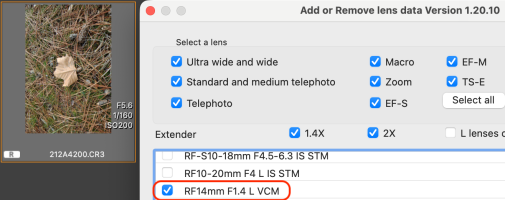
Screenshot 2026-02-17 at 6.53.07 PM.png

The 14/1.4 has a lens profile available. But PetaPixel used something else.

CameraLabs stated, "I also retested the lens focused in the corner and the result for this subject and distance looked no different from my first samples. So it’s looking like a nice flat field." Bryan/TDP is silent on the subject, but he reliably discusses field curvature for lenses that exhibit it.

You say they see smoke where there's smoke. I wonder if they'd smell smoke if their own pants were on fire.
 
  • Like
Reactions: 5 users
Upvote 0