Canon RF 14mm F/1.4 – Is it the Astrophography Dream Lens for RF?

I think Chris Niccolls and Jordan Drake did their testing with a production sample.
Their astro image at the Okotoks Big Rock clearly shows a blurred corner,
I'm not saying I fully trust their review - they spotted smoke and where there is smoke there may be fire.
Maybe their out-of-focus corner is due to decentering rather than field curvature? Either way it's cause for concern. I'm sure a more systematic review will come along that shed some light on this.
In any case, a 16/2.8 lens profile would result in hefty distortion and vignetting corrections but it would not affect focus.

I think there was something wrong with that lens, and then they doubled down with some dubious workflow decisions.
 
  • Like
Reactions: 2 users
Upvote 0
what do you use for tracking?
I use the Sky-Watcher Star Adventurer Pro 2i as my tracker. Heavy but has some advantages over others and not too expensive.
Dan does a good overview at https://capturetheatlas.com/best-star-trackers/

Benro is good for automation but their SW and updates has not been good. Dan sells a course specifically for the Benro based on his experience in the field and helping workshop participants with different systems. There is 3rd party SW now for it but it seems to be mostly for control at a distance.
 
Upvote 0
I've not used tape, I would worry that I would fat-finger it and move my focus, LOL. Usually, I have no issues with focus shifting. As you stated, the UWAs are pretty stable and don't change detectably during cool-down. I normally mount my camera and lens during polar alignment so they are cooling down for a good bit before I am setting up my imaging run.
Gaffer tape is my goto solution for my Samyang. Can't move the aperture ring or the focus ring with it in place. No MF/AF switch of course. Gaffer is also good for other stuff on site eg power banks to tripod legs etc. No residue as long as you take it off after use.
 
  • Like
Reactions: 1 user
Upvote 0
There is one aspect of f1.4 that you can't get elsewhere is that you can use a shorter exposure time irrespective of vignetting or coma or noise.

When it is really windy and can't get long tracked exposures without being affected by wind, being able to get a 10-20s exposure can only be done reasonably with a f1.4. It would make the difference between getting any shot and none.

I check for any trailing/bump/wind after every image. Taking 2 x 2 minute exposures with a 20mm means about half an hour for a single row full panorama. Re-shooting takes that much longer and you could have a time limit with the setting sky.

Trying to take a double arch is even more challenging with limited time to get each arch at the same height in the sky. Something I might try this year but there is one (2?) time in the year for each location to do it.

Nothing worse than getting home and having images you can't use.
 
Last edited:
  • Like
Reactions: 1 user
Upvote 0
Sorry to be that guy, but the Sony 14 1.8 gm is half the price,
False, and it's 2/3 stop slower.
Definitely slower but he is actually under-estimating at being half the price.

In Australia, the Sony at AUD1590 is less than half the Canon cost at AUD3700 (inc tax).

By comparison the RF14 is USD2350 at apples-to-apples comparison with USD2600 ex tax at B&H.... go tariffs! (and don't forget the 5yr warranty)

The Sony 20mm/1.8 is AUD1300 locally and hence ~40% cheaper than the RF20 at AUD2300 (USD1460 equivalent).

There is no doubt about initial pricing being high but the RF20 has not dropped in price since release locally.
 
Upvote 0
I use the Sky-Watcher Star Adventurer Pro 2i as my tracker. Heavy but has some advantages over others and not too expensive.
Dan does a good overview at https://capturetheatlas.com/best-star-trackers/

Benro is good for automation but their SW and updates has not been good. Dan sells a course specifically for the Benro based on his experience in the field and helping workshop participants with different systems. There is 3rd party SW now for it but it seems to be mostly for control at a distance.

sweet. i had the original model of that - I see it's really gotten more advanced since then.
 
Upvote 0
sweet. i had the original model of that - I see it's really gotten more advanced since then.
As a dual ball head is needed, I found that the SUNWAYFOTO DT-03R 2 way tilt was much easier to use as normal ball heads are restricted by the size of the "notch" and easier to level.
It is also a lower profile than normal ballheads as the combined ballhead/camera etc can be large. I don't need to use a counter weight.

A low profile index rotator can also make it easy to have defined overlap for stitching images, but using the rear screen with a 3x3 grid and match stars work as well.
 
Upvote 0
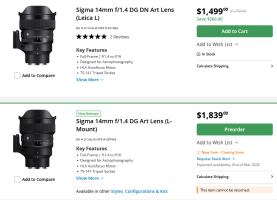
There was a Sigma 14mm f/1.4 DG for L-mount and Sony E mount, but that was also discontinued in 2025, and now you can still get it, but it’s a “special order”. Whatever that means. In other words, in the realm of lenses that you can purchase today, you can adapt or choose a lesser lens.

See full article...

The Sigma lens is still a current product for both E and L mounts, not discontinued. However as with most niche lenses they are produced in batches rather than a few at a time. If demand outstrips supply then it's possible for Sigma to run out and for people to have to wait until the next batch is produced.

Sigma also renamed all their lenses to drop the "DN" from the model name, so what was originally the "Sigma 14mm f/1.4 DG DN Art" is now the "Sigma 14mm f/1.4 DG Art". They did the same thing with their "DC" APS-C lenses, what used to be "DC DN" is now just "DC". The "DN" meant "digital native" and is redundant in a world of new mirrorless mounts where every Sigma lens is "digital native". The result is that there are sometimes apparent duplicate or orphaned listings on some websites, like this:

1771400686432.png
 
Upvote 0
The Sigma lens is still a current product for both E and L mounts, not discontinued. However as with most niche lenses they are produced in batches rather than a few at a time. If demand outstrips supply then it's possible for Sigma to run out and for people to have to wait until the next batch is produced.

Sigma also renamed all their lenses to drop the "DN" from the model name, so what was originally the "Sigma 14mm f/1.4 DG DN Art" is now the "Sigma 14mm f/1.4 DG Art". They did the same thing with their "DC" APS-C lenses, what used to be "DC DN" is now just "DC". The "DN" meant "digital native" and is redundant in a world of new mirrorless mounts where every Sigma lens is "digital native". The result is that there are sometimes apparent duplicate or orphaned listings on some websites, like this:

View attachment 228011

Ah I see. I haven't kept up because they weren't for the RF mount, thus dead to me. I was referring to Sigma's own website, which states the DG DN is discontinued. They re-released it as a DG Art, which I saw as a "special request item."

Sigma could have done that a lot better. Thanks for the clarification.
 
Upvote 0
When trust is damaged, rebuilding it is hard. If they believed that it was appropriate to use the RF 16/2.8 profile to correct the RF 14/1.4 RAW images and draw conclusions about lens performance based on those images, they're either trying to intentionally make the lens look bad or they're incompetent at testing lenses. Why the heck not just use DPP to convert the image? I get that DPP is kludgy, but with a new camera or lens it's often the only viable option. I downloaded a RAW image from the RF 14/1.4 from DPR's sample gallery and opened it in DPP:

View attachment 228010

The 14/1.4 has a lens profile available. But PetaPixel used something else.

CameraLabs stated, "I also retested the lens focused in the corner and the result for this subject and distance looked no different from my first samples. So it’s looking like a nice flat field." Bryan/TDP is silent on the subject, but he reliably discusses field curvature for lenses that exhibit it.

You say they see smoke where there's smoke. I wonder if they'd smell smoke if their own pants were on fire.
Speaking of profiles, DxO will support both the 14mm and the fisheye from April on.
 
  • Like
Reactions: 1 user
Upvote 0
what do you use for tracking?
I use several trackers, depending on the payload:
1) For the Canon RF 85/1.2 with a R8 or R6 II camera I use the Vixen Polarie U
2) For the lighter 'old' Canon EF 35/1.4 II (very good lens for astro-photography) I use the MSM/Nomad tracker
3) For heavier lenses (e.g. Sigma A 105/1.4 or the Apo-Telyt-R 280/4) I use the Fornax LT

With 240 days of rain per year I have to be a little bit flexible once we get a clear sky. :)
 
  • Wow
Reactions: 1 user
Upvote 0
Gaffer tape is my goto solution for my Samyang. Can't move the aperture ring or the focus ring with it in place. No MF/AF switch of course. Gaffer is also good for other stuff on site eg power banks to tripod legs etc. No residue as long as you take it off after use.
I also use BLACK Gaffer tape to dim the bright LED's from the Canon cameras and my other equipment (e.g. external batteries).
ANY focus ring is taped and I also have spare tape on my camera and on the tripods. You simply can't have enough of it! :)
 
  • Like
Reactions: 1 user
Upvote 0
.....
A low profile index rotator can also make it easy to have defined overlap for stitching images, but using the rear screen with a 3x3 grid and match stars work as well.
Thanks for the info with the Sunway head. I will look into it.
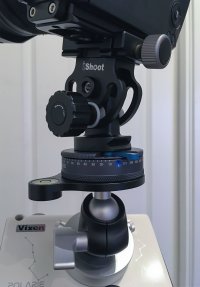
I build my own 'indexed' head for tracked panoramas. My goal was a robust, simple and light solution as I'm also trekking to my locations and I usually have to work with gloves in the cold.
 

Attachments

  • Polarie_pano_head.jpg
    Polarie_pano_head.jpg
    180.1 KB · Views: 9
  • Like
Reactions: 1 user
Upvote 0
And Canon steadfastly refusing to allow 3rd party glass on to RF is why Canon is dead to me. It's too bad because if 3rd party glass was allowed, there is a reasonably high probability I would own an R5 II.
Yipp, I don't like it too, but most people stick to their brand (and usually Canon knows best how the market works).
I have the impression that Sony is more popular for younger users, so that Canon might get problems in the future.
But I also see that the new(er) 3rd party lenses - from China - are relatively good for their low price, but they can only offer MF lenses for the RF mount or AF for the EF mount with adapter. If these 3rd party lenses would be available with AF for the RF mount, that would probably hurt Canons financial results a bit (and they still recover from the smartphone competition).
Well, the lack of lenses for the RF mount is a severe issue!
 
Upvote 0
Sorry to be that guy, but the Sony 14 1.8 gm is half the price, 2/3 the weight, smaller and famously has (almost) no aberrations wide open on a 60MP sensor… the canon 14mm has to be stopped down to 2.8 to be even remotely where the Sony is… and that’s before you consider the a7cr has 1 stop better noise performance (source:https://www.photonstophotos.net/Charts/RN_e.htm) - which gives it 2.33 stops advantage …

if you do wide angle Milky Way photography normally:
1. set the aperture to acceptable aberrations canon 14 1.4 @ 2.8, Sony 14 1.8 @ 1.8
2. Star tracker MSM nomad or something
3. 15-30 sec sub exposures
4. Stack the foreground and background etc
Then this lens needs somewhere between 2.33 to 3.33 the integration time for the same results!!

Buy this lens if you’re happy to spend EXTRA 13 sub exposures for EVERY 10 sub exposures you would take with the Sony setup.

the comparison is so ridiculous that CR has ignored it from the comparison

… avoid the ad hominem attacks guys. @Canon Rumors I’m disappointed you participate in pure tribalism

I'm glad you think high enough of me to be disappointed. ♥️
 
  • Haha
Reactions: 1 user
Upvote 0
I use several trackers, depending on the payload:
1) For the Canon RF 85/1.2 with a R8 or R6 II camera I use the Vixen Polarie U
2) For the lighter 'old' Canon EF 35/1.4 II (very good lens for astro-photography) I use the MSM/Nomad tracker
3) For heavier lenses (e.g. Sigma A 105/1.4 or the Apo-Telyt-R 280/4) I use the Fornax LT

With 240 days of rain per year I have to be a little bit flexible once we get a clear sky. :)

ick on the rain! where are you?

The Vixen is interesting! do you get enough precision with that? how long of exposures can you take?
 
Upvote 0