vscd said:
@jrista
Yepp, but one *large* advantage of a foveon is that you don't need a Zeiss Otus to get your 36MP Sensor served. "Normal" sharp lenses, even customer-ones, get 15MP Pixels without problems... so the whole, or at least most better L, Canon Lense Lineup would be able to outperform the D800E.
Of course the layers constrict the light... until someone invents something new and proves the old wrong.
It's not just the layers or well depth that constricts the light. If you look at the Foveon design (and, for that matter, Canon's own layered sensor patents), they have a LOT more activate and readout wiring per pixel. It's really complicated stuff, which further restricts the actual light-sensitive photodiode area.
The whole "eqivalent megapixels" deal that Sigma uses is also very misleading. Currently, today, megapixel counts are based on output image widthxheight. A 15mp Sigma Foveon is 15mp, in terms of actual megapixels stored in the output JPED image or a JPEG that you can create from RAW. It may have 45 million photodiodes, but that is not the same as megapixels, and I really wish Sigma would stop being so misleading.
I like the Foveon sensor design, it has SO much potential. It's just in the wrong hands with Sigma...they can't seem to develop it and bring it to bear on the market in a form that would make it a truly viable competitor with higher MP bayer type sensors. I think there are some innovations that have been developed for video sensor technology that could greatly increase the transparency of the silicon that surrounds the layered photodiodes and improve Q.E., reduce noise, improve dynamic range, etc. I've been hoping that Canon was working with some of those technologies on their own layered sensor design.
I would also dispute the whole "need for high resolution lenses" argument. Output resolution, in spatial terms, is the convolution of both sensor and lens resolution...AND, a most important point here, is LIMITED by the LEAST common denominator. The Sigma DP2, for example, is a 4.7 megapixel camera!!! Spatially, that is VERY low resolution. It is not a 15mp camera. It has richer, more complete color information per pixel, however from a luminance standpoint, it's luminance resolution is extremely low. It's pixel pitch is 7.85µm. Those are nice, big pixels, however because of the wiring requirements, the photodiode area is a lot smaller than 7.85µm (I don't know exactly off the top of my head...I would have to find the patents again...but I'd say that at least a third of the area is lost, so maybe around 6.3µm, which is about the same as the 5D III.)
The biggest benefit for the Foveon is the lack of an AA filter. You still experience moire, but because full color information is gathered at each pixel, you only have monochrome moire. Mono moire in most "natural" cases in photography is often not that bad. The lack of an AA filter makes it SHARPER, but it does not really increase the resolution of the sensor. This is very obvious from VCD's comment:
vscd said:
Have you seen the new DP2? They claim up to 39 MP...
I have and I'm waiting for the reviews, I think I may get one if the results are good. 39 MP are realistic... of course you just have to get rid of the context "pixels" just by x/y Resolution. The Details of a FoveOn (@lowISO) are
outstanding above a Nikon or even a Pentax 645D!
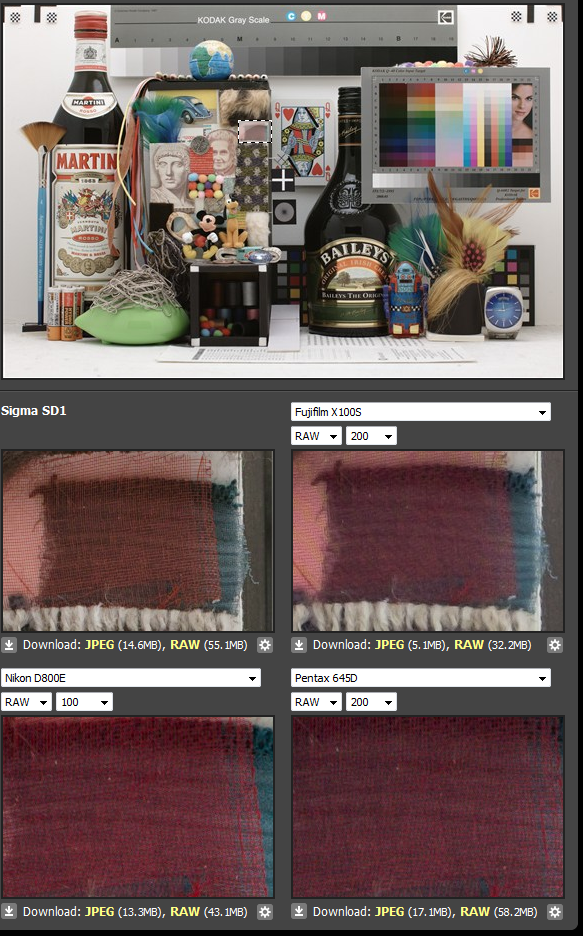
F.e. (picture from dpreview.com):
This was the
first sensor which really catched my attention after buying my 5D back then. Everything else is just "evolution" here and there, half a stop more Dynamic, more resolution, ISO25600. Hooray, you invented the holy grail. Nikon bla, Canon bla... everything no real leap. A 5D is still awesome and able to serve my needs. The sigma is again something worth time spending with.
I think VCD has radically misinterpreted this comparison. The Sigma SD1 does not have anything even remotely close to the same
resolution as the D800 or 645D. It isn't even a contest. The Sigma SD1
appears to be
sharper...but that is only in a non-normalized comparison like this, and sharpness alone does not translate into more resolution. If one were to downsample the D800 and 645D images to the same dimensions as the SD1 image, they would likely TROUNCE the SD1. They have significantly more information in total, and while they may seem slightly soft at the pixel level, on a normalized basis, all that extra information gets interpolated into fewer, but much more accurate, sharper, richer and less noisy pixels.
Furthermore, the D800 and 645D both have more information to start with. They are resolving details that are not even present in the SD1 image at all, despite it's sharpness. Even if those details aren't as crisp as the LESSER details of the SD1, it's still more detail. A light sharpening filter can deal with the softness in a few seconds, and then the SD1 is at a real disadvantage. You can sharpen the SD1 image in post to your heart's content...that will never create information that was never there to begin with, and since it's already sharp, your probably doing yourself a disservice by sharpening SD1 images.
So arguing that the DP2, which itself is still just a 4.7mp camera (or even the SD1, which is a much higher resolution Foveon), is potentially equivalent to a 39mp camera, is gravely missing the point of having a truly higher resolution sensor (in luminance terms...luminace is where detail comes from, color CAN be of much lower spatial resolution so long as your luminance information is high...as a matter of fact, this is actually a standard practice in astrophotography, to image at high resolution in luminance, then when you switch to RGB filters, you bin 2x2 or 3x3, which increases your sensitivity, and reduces your resolution by 4x or 9x...and your never the wiser when looking at the final blended result). It buys into the very misleading hype that Sigma spews, which I believe is ultimately, in the long term, going to damage their reputation and hurt Foveon (because as more people try to produce images with a 4.7mp or 15mp Foveon sensor that compare to even the regular old D800, let alone the D800E or the 645D, and realize they simply cannot...they are either going to ditch Foveon and go back to bayer type sensors, or they are going to begin badmouthing Foveon.)