Canon's Medium Format

Status
Not open for further replies.
Chuck Alaimo said:
I'll bite on this...

I think you make some very valid points.

Of course, only time will tell. But I have a hard time imagining that even with the presumed cost reductions in sensors (which folks more knowledgeable than I am have said are unlikely to be significant in the foreseeable future), that Medium Format will overcome the other limitations you reference, particularly because some of the limits result from the basic physics of the size.

I'm also not quite so anxious to presume the death of APS-C. I think it is always risky to bet against "good enough" in favor of "better." There are junkyards full of products that were better that lost out to good enough.

It's hard to look at the current quality of APS-C sensors, the relative sales and the 100-year plus march towards ever smaller and more efficient electronics and believe that the long-term trend will be towards larger, rather than smaller.

I think we may be better able to see the future of the crop format when the 7DII finally surfaces.

Looking at the medium format market today, it takes quite a leap of faith to think it will break out of the narrow niche that it lives in currently.

Still, I think your observations are valid and I certainly appreciate the way you have articulated them in a fair and unemotional manner.

Good job.
 
Upvote 0
unfocused said:
Chuck Alaimo said:
I'll bite on this...

I think you make some very valid points.

Of course, only time will tell. But I have a hard time imagining that even with the presumed cost reductions in sensors (which folks more knowledgeable than I am have said are unlikely to be significant in the foreseeable future), that Medium Format will overcome the other limitations you reference, particularly because some of the limits result from the basic physics of the size.

I'm also not quite so anxious to presume the death of APS-C. I think it is always risky to bet against "good enough" in favor of "better." There are junkyards full of products that were better that lost out to good enough.

It's hard to look at the current quality of APS-C sensors, the relative sales and the 100-year plus march towards ever smaller and more efficient electronics and believe that the long-term trend will be towards larger, rather than smaller.

I think we may be better able to see the future of the crop format when the 7DII finally surfaces.

Looking at the medium format market today, it takes quite a leap of faith to think it will break out of the narrow niche that it lives in currently.

Still, I think your observations are valid and I certainly appreciate the way you have articulated them in a fair and unemotional manner.

Good job.

Oddly enough, i think that the transition is more likely because of the very advancements you speak of. sensors smaller than APS-C are getting better and better, as are the optics in cell phone cameras. So APS-C is going to have to get a whole lot better, or, be phased out ---this is within a decade mind you. I'm not one of the physics masters here, but how much more can the APS-C be pushed?
 
Upvote 0
Chuck Alaimo said:
unfocused said:
Chuck Alaimo said:
I'll bite on this...

I think you make some very valid points.

Of course, only time will tell. But I have a hard time imagining that even with the presumed cost reductions in sensors (which folks more knowledgeable than I am have said are unlikely to be significant in the foreseeable future), that Medium Format will overcome the other limitations you reference, particularly because some of the limits result from the basic physics of the size.

I'm also not quite so anxious to presume the death of APS-C. I think it is always risky to bet against "good enough" in favor of "better." There are junkyards full of products that were better that lost out to good enough.

It's hard to look at the current quality of APS-C sensors, the relative sales and the 100-year plus march towards ever smaller and more efficient electronics and believe that the long-term trend will be towards larger, rather than smaller.

I think we may be better able to see the future of the crop format when the 7DII finally surfaces.

Looking at the medium format market today, it takes quite a leap of faith to think it will break out of the narrow niche that it lives in currently.

Still, I think your observations are valid and I certainly appreciate the way you have articulated them in a fair and unemotional manner.

Good job.

Oddly enough, i think that the transition is more likely because of the very advancements you speak of. sensors smaller than APS-C are getting better and better, as are the optics in cell phone cameras. So APS-C is going to have to get a whole lot better, or, be phased out ---this is within a decade mind you. I'm not one of the physics masters here, but how much more can the APS-C be pushed?

Does aps-c really need to get any better though? I would like to think that in 2008 with the introduction of the 40D, aps-c reached the level it needed to be at for the vast majority of customers . The addition of video and some better circuitry for higher max iso could have been done for that sensor and it would have been good enough even today, at least if you could convince people 10mpix is enough.

If we can get smaller and lighter FF cameras selling at the x0D price point with matching lenses I think more people will buy into FF. My old eos 300v for example is the same size as an x00D with the lens only being marginally bigger than the kit lens of a crop camera. Given that the electronics is getting getting smaller by the day it is about time someone built a camera like that.

MF however is less likely to catch on simply because of the portability issues, never mind the cost. There is no way to get around the fact that bigger chips have an exponentially lower yield in production and that the bigger the chip the fewer you can fit on a wafer which also drives up cost. The first problem you can get around if they can work out how to build the sensor from smaller subsensors without loss of image quality. This would also increase the number of assembled chips per wafer as smaller chips are easier to fill the round wafer with. There's still no good way to sort out the lens size though if you want a slr construction. The mirror box is also going to be bigger which means a deeper body and longer flange distances for the lenses which obviously brings problems of its own. 35mm format or better still aps-c is going to be difficult to beat for the sweet spot of portability vs IQ that most people buying a DSLR are looking for.

If someone builds a relatively compact MF rangefinder type camera with a good EVF and the sensor is assembled from smaller sections and it is sold for under $1000 it may get mass market appeal. For less than $3k the enthusiasts will flock. Less than $5k you'd probably attract some pros. I just don't think that the cost will drop enough for this to happen in the near future.
 
Upvote 0
The costs of larger sensors are unlikely to come down significantly. When 450mm wafers become common place, that might help, but overall, the problem with larger sensors isn't just how many you can fit on a wafer. With the increased area comes a similar exponential increase of devastating defects that render the entire sensor useless. With smaller sensors, you still lose the whole sensor, but you have so may more on the area of the wafer. With FF, one large defect still kills the whole sensor. With MF, same deal, only now your losing something closer to a fifth of the wafer, rather than a 20th or 30th.

Etching a larger sensor also requires more advanced fabrication technology that can handle larger templates and etch the whole area of that template. Remember, fabrication of CMOS circuitry still uses lenses. They may work in the extreme UV range, but it's still light, and that light is still being bent, so it's still succeptible to aberrations and diffraction effects.

As Don said earlier, it's a global problem. Making things larger doesn't just affect one thing, it affects everything, hence the exponentially higher cost of quality MFD systems.
 
Upvote 0
jrista said:
Making things larger doesn't just affect one thing, it affects everything, hence the exponentially higher cost of quality MFD systems.

I think the 'exponentially higher cost of quality MFD systems' is primarily an effect of something small, not something large - namely, market size. The MF market size is miniscule compared to the dSLR market. How minuscule? Exact figures aren't available for MF. But…in 2013, there were close to 14,000,000 dSLRs sold worldwide. Stephen Shulz, head of Leica's photo division, estimated that the annual worldwide market, all brands, is just 6,000 MF cameras. 14 million vs. 6 thousand.

Anyone want to argue that a difference in production cost is the reason for the >$5K higher cost of 1D C compared to the 1D X? An MF digital back probably doesn't cost all that much more than a 1-series body to produce, but if you're only going to sell ~1,000 units per year, you need a high price to realize a return on investment.
 
Upvote 0
neuroanatomist said:
jrista said:
Making things larger doesn't just affect one thing, it affects everything, hence the exponentially higher cost of quality MFD systems.

I think the 'exponentially higher cost of quality MFD systems' is primarily an effect of something small, not something large - namely, market size. The MF market size is miniscule compared to the dSLR market. How minuscule? Exact figures aren't available for MF. But…in 2013, there were close to 14,000,000 dSLRs sold worldwide. Stephen Shulz, head of Leica's photo division, estimated that the annual worldwide market, all brands, is just 6,000 MF cameras. 14 million vs. 6 thousand.

Anyone want to argue that a difference in production cost is the reason for the >$5K higher cost of 1D C compared to the 1D X? An MF digital back probably doesn't cost all that much more than a 1-series body to produce, but if you're only going to sell ~1,000 units per year, you need a high price to realize a return on investment.

But which is the cause, and which is the effect? Do they only sell 6000 units a year because of the high cost, or is the cost high because they only sell 6000 units a year? I don't think there is necessarily enough data to determine that either way. Kind of a chicken and egg problem. I think we could only tell based on the sales of a much "cheaper" entrant to the MFD market. Not saying Canon will be that entrant...Sony might be...but until it occurs, I don't think anyone can say, definitively, which is the cause and which is the effect here.

And there is no question that the cost of an MF sensor is (in it's own right) exponentially higher than a FF sensor, which is in turn quite a bit more expensive than an APS-C sensor, which in turn are more expensive than the small form factor sensors found in just about everything else these days. The radically lower yield isn't the only reason for the higher cost of MFD. It's part of the whole ball of wax, though. Larger sensors. Larger lenses. Bigger bodies. The interchangeable back option. Etc.

Now, most DSLRs cost on average around $1200 (maybe $800-$1500 for low end to lower midrange). A medium format camera that cost $15,000-$18,000 would still be exponentially more expensive. We still cannot say that the reason they cost $40,000 is because the market is small...the market could be small because they cost so much.
 
Upvote 0
Medium format sales were beginning to decline even before the advent of digital. I've had various companies involved in selling this gear over the years, I can't recall the exact figures just now, but the improvements in film emulsions eventually began to have an effect on larger format sales, and this was a time when medium format cost around twice that of a top end 35mm slr. Of course the advent of the digital FF knocked any amount of film development into a cocked hat and boosted the overall resolution of the 24x36 format enormously. Excluding drum scans I think my 20 odd mp FF is at least equal to my old film 6x7 system and retains the highly versatile nature of the 35mm system.

Some of the medium format companies were able to respond in digital; note how it's the high end ones who are offering something that is very expensive and exclusive. The Leica S2 is a good example of what it's all about. So regarding price, which is now rather than twice the cost of a high end DSLR, but ten times, the reason is both higher unit cost and greatly reduced unit sales. Then add to this exclusivity.

Non of this fits the bill for Canon, which is why in my opinion they would not be interested in producing a digital MF system. That's not to say larger sensor or format isn't better; at Building Panoramics our pictures are shot on an effective sensor size of either about 36x90 or 60x150 depending on the application, which is larger than most digital MF. Talk about having your cake and eat it.
 
Upvote 0
jrista said:
neuroanatomist said:
jrista said:
Making things larger doesn't just affect one thing, it affects everything, hence the exponentially higher cost of quality MFD systems.

I think the 'exponentially higher cost of quality MFD systems' is primarily an effect of something small, not something large - namely, market size. The MF market size is miniscule compared to the dSLR market. How minuscule? Exact figures aren't available for MF. But…in 2013, there were close to 14,000,000 dSLRs sold worldwide. Stephen Shulz, head of Leica's photo division, estimated that the annual worldwide market, all brands, is just 6,000 MF cameras. 14 million vs. 6 thousand.

Anyone want to argue that a difference in production cost is the reason for the >$5K higher cost of 1D C compared to the 1D X? An MF digital back probably doesn't cost all that much more than a 1-series body to produce, but if you're only going to sell ~1,000 units per year, you need a high price to realize a return on investment.

But which is the cause, and which is the effect? Do they only sell 6000 units a year because of the high cost, or is the cost high because they only sell 6000 units a year? I don't think there is necessarily enough data to determine that either way. Kind of a chicken and egg problem. I think we could only tell based on the sales of a much "cheaper" entrant to the MFD market. Not saying Canon will be that entrant...Sony might be...but until it occurs, I don't think anyone can say, definitively, which is the cause and which is the effect here.

And there is no question that the cost of an MF sensor is (in it's own right) exponentially higher than a FF sensor, which is in turn quite a bit more expensive than an APS-C sensor, which in turn are more expensive than the small form factor sensors found in just about everything else these days. The radically lower yield isn't the only reason for the higher cost of MFD. It's part of the whole ball of wax, though. Larger sensors. Larger lenses. Bigger bodies. The interchangeable back option. Etc.

Now, most DSLRs cost on average around $1200 (maybe $800-$1500 for low end to lower midrange). A medium format camera that cost $15,000-$18,000 would still be exponentially more expensive. We still cannot say that the reason they cost $40,000 is because the market is small...the market could be small because they cost so much.

As I stated, take the example of the 1D X vs. 1D C - either the heat sink that is basically the only hardware difference between the two adds thousands of dollars to the production cost, or other factors are determining that price difference.

At the 'widget' level and in B2B supply chain pricing, production costs are a major factor in determining price. At the consumer end, particularly for 'luxury' goods, market size trumps production costs, since prices must be set to drive ROI. A prime example from my industry is a drug for cystic fibrosis – the pills cost no more to produce than acetaminophen (Tylenol), but the price of the drug is nearly $300,000 per year because of the tiny market size (CF is a niche disease, and the drug works in only ~5% of CF patients).
 
Upvote 0
Chuck Alaimo said:
But ---- there is one other factor that adds or subtracts time from any of the above - the global economy needs to turn around. More costly systems can't fly when disposable income is low. Less on hand money for the average person means less purchases of things like...photography. People aren't buying all over the place so it's a ripple effect. If the economy turns around then I think we'll see another boom in tech offerings. Without that companies are bound to be more pragmatic.

Good points. If only the government would raise income taxes to 99% and hire more people to work directly for it, the entire economy would be completely fixed, wouldn't it? :P
 
Upvote 0
neuroanatomist said:
jrista said:
neuroanatomist said:
jrista said:
Making things larger doesn't just affect one thing, it affects everything, hence the exponentially higher cost of quality MFD systems.

I think the 'exponentially higher cost of quality MFD systems' is primarily an effect of something small, not something large - namely, market size. The MF market size is miniscule compared to the dSLR market. How minuscule? Exact figures aren't available for MF. But…in 2013, there were close to 14,000,000 dSLRs sold worldwide. Stephen Shulz, head of Leica's photo division, estimated that the annual worldwide market, all brands, is just 6,000 MF cameras. 14 million vs. 6 thousand.

Anyone want to argue that a difference in production cost is the reason for the >$5K higher cost of 1D C compared to the 1D X? An MF digital back probably doesn't cost all that much more than a 1-series body to produce, but if you're only going to sell ~1,000 units per year, you need a high price to realize a return on investment.

But which is the cause, and which is the effect? Do they only sell 6000 units a year because of the high cost, or is the cost high because they only sell 6000 units a year? I don't think there is necessarily enough data to determine that either way. Kind of a chicken and egg problem. I think we could only tell based on the sales of a much "cheaper" entrant to the MFD market. Not saying Canon will be that entrant...Sony might be...but until it occurs, I don't think anyone can say, definitively, which is the cause and which is the effect here.

And there is no question that the cost of an MF sensor is (in it's own right) exponentially higher than a FF sensor, which is in turn quite a bit more expensive than an APS-C sensor, which in turn are more expensive than the small form factor sensors found in just about everything else these days. The radically lower yield isn't the only reason for the higher cost of MFD. It's part of the whole ball of wax, though. Larger sensors. Larger lenses. Bigger bodies. The interchangeable back option. Etc.

Now, most DSLRs cost on average around $1200 (maybe $800-$1500 for low end to lower midrange). A medium format camera that cost $15,000-$18,000 would still be exponentially more expensive. We still cannot say that the reason they cost $40,000 is because the market is small...the market could be small because they cost so much.

As I stated, take the example of the 1D X vs. 1D C - either the heat sink that is basically the only hardware difference between the two adds thousands of dollars to the production cost, or other factors are determining that price difference.

At the 'widget' level and in B2B supply chain pricing, production costs are a major factor in determining price. At the consumer end, particularly for 'luxury' goods, market size trumps production costs, since prices must be set to drive ROI. A prime example from my industry is a drug for cystic fibrosis – the pills cost no more to produce than acetaminophen (Tylenol), but the price of the drug is nearly $300,000 per year because of the tiny market size (CF is a niche disease, and the drug works in only ~5% of CF patients).

It might also work somewhat similar as with perfume. I saw a documentary on television recently about the cost of expensive perfumes like Chanel no 5. The perfume contains less than 3 euros of ingredients and the bottle cost about 5 euros to produce, so you can get it in the shop for less than 10 euros. It sells for about 90 euros.
The argument they made was that if they lower the price, it would sell less, because it would be less exclusive.
With camera’s like the Lunar it’s very obvious a company like Hasselblad uses this strategy. With the MF models it’s less obvious, but it makes you think about profit margins on those too.
 
Upvote 0
Maybe the answer of canon will be the "Canon FoveOn". If they would bring a better and faster Fullframe foveon like the Merrill of Sigma, the Resolution of maybe 24 MPix would be comparable to maybe 60MP of a bayer-sensor. So, they would beat the Nikon D800 easily, with the full power of the EOS-lenseprogram. The patents for this are filed since a few months... I REALLY WOULD LOVE IT.

If I go out, making pictures with my Sigma Merrill DP3, and forget about all those disadvantages in speed, flexibility or Autofocus I would say the foveon is head and shoulders above anything else. A Nikon D800 is nothing against this small jewel. But I have to admit, mostly my Canon 5D is way more used ;)

A small example from a "poor" Compact Sigma DP3M, imagine this with FullFrame:
http://tf.weimarnetz.de/downloads/SDIM0175.jpg

Remember, no one said "Mediumformat" from Canon, just the quality and resolution of a medium Format ;)
 
Upvote 0
vscd said:
Maybe the answer of canon will be the "Canon FoveOn". If they would bring a better and faster Fullframe foveon like the Merrill of Sigma, the Resolution of maybe 24 MPix would be comparable to maybe 60MP of a bayer-sensor. So, they would beat the Nikon D800 easily, with the full power of the EOS-lenseprogram. The patents for this are filed since a few months... I REALLY WOULD LOVE IT.

If I go out, making pictures with my Sigma Merrill DP3, and forget about all those disadvantages in speed, flexibility or Autofocus I would say the foveon is head and shoulders above anything else. A Nikon D800 is nothing against this small jewel. But I have to admit, mostly my Canon 5D is way more used ;)

A small example from a "poor" Compact Sigma DP3M, imagine this with FullFrame:
http://tf.weimarnetz.de/downloads/SDIM0175.jpg

Remember, no one said "Mediumformat" from Canon, just the quality and resolution of a medium Format ;)

ISO100 on FoveOn is great, now show us something at ISO3200 and compare that to a 5D.
 
Upvote 0
ISO100 on FoveOn is great, now show us something at ISO3200 and compare that to a 5D.

Please read my text again ;) Of course you're right, but lacking ISO-Performance is even a problem of the very expensive (CCD-)Medium Format Sensor for >20k$. If you shoot in LowLight, the ISO-Performance is of course a problem of a Sensor where the Light has to dive into the specific Layers, but those are problems which I dare to get solved by canon. At least they could bring it to good ISO1600. The 5D has no real ISO3200, eighter, and I would not use it anyway.

Taking pictures with a FoveOn is really about shooting like a MediumFormat Cam. Use it in a studio (with a flash sync up to 1/2000 (!)) or with a tripod in LowLight.

Greetings.

PS By the way, if you want to shoot black/white then you *should really try* a DP3 with ISO3200. It's like real grain and looks damn good! Here 2 examples:

ISO1600:
http://tf.weimarnetz.de/downloads/SDIM0736.jpg

ISO6400:
http://tf.weimarnetz.de/downloads/SDIM0726.jpg
 
Upvote 0
One thing that has been missing from this discussion is: Why now?

Canon has been making 35mm format cameras since the 1930s. No doubt they have researched the medium format market hundreds of times over the past 80 years and have never decided to make the leap.

It would have made more sense for them to get into medium format probably sometime in the late 1970s - early1980s. The medium format market was much larger (at that time, almost all wedding and portrait photographers used medium format and Pentax actually did get into the market around that time); it would have been much simpler to produce a competitive medium format camera during the film era and the difference in quality was much greater then as well; the market conditions were similar to today (the SLR rage of the 60s and 70s was slowing down, as was the global economy).

Yet, Canon (or Nikon) has never felt compelled to go after the medium format market. Why would they pursue it today, when the required investment would be much greater and the likely return much smaller?
 
Upvote 0
vscd said:
Maybe the answer of canon will be the "Canon FoveOn". If they would bring a better and faster Fullframe foveon like the Merrill of Sigma, the Resolution of maybe 24 MPix would be comparable to maybe 60MP of a bayer-sensor. So, they would beat the Nikon D800 easily, with the full power of the EOS-lenseprogram. The patents for this are filed since a few months... I REALLY WOULD LOVE IT.

If I go out, making pictures with my Sigma Merrill DP3, and forget about all those disadvantages in speed, flexibility or Autofocus I would say the foveon is head and shoulders above anything else. A Nikon D800 is nothing against this small jewel. But I have to admit, mostly my Canon 5D is way more used ;)

A small example from a "poor" Compact Sigma DP3M, imagine this with FullFrame:
http://tf.weimarnetz.de/downloads/SDIM0175.jpg

Remember, no one said "Mediumformat" from Canon, just the quality and resolution of a medium Format ;)

It isn't really fair to say a 24mp Foveon is the same as a 60mp Bayer. The problem with that argument is that Bayer sensors have much higher luminance resolution than chrominance resolution. It might be that a 30mp-35mp Foveon is like a 55-60mp Bayer, it would really depend on the exact design specifics (of both sensors...many bayer sensors come without a low pass filter these days, or with very weak ones.)

Layered sensors have a harder time with high ISO as well, since all three colors are sensed at each pixel, the deeper layers get less light anyway. Throw in less light through the lens, and the problem with the green and red layers is exacerbated.
 
Upvote 0
@jrista

Yepp, but one *large* advantage of a foveon is that you don't need a Zeiss Otus to get your 36MP Sensor served. "Normal" sharp lenses, even customer-ones, get 15MP Pixels without problems... so the whole, or at least most better L, Canon Lense Lineup would be able to outperform the D800E.

Of course the layers constrict the light... until someone invents something new and proves the old wrong.
 
Upvote 0
vscd said:
@jrista

Yepp, but one *large* advantage of a foveon is that you don't need a Zeiss Otus to get your 36MP Sensor served. "Normal" sharp lenses, even customer-ones, get 15MP Pixels without problems... so the whole, or at least most better L, Canon Lense Lineup would be able to outperform the D800E.

Of course the layers constrict the light... until someone invents something new and proves the old wrong.

Have you seen the new DP2? They claim up to 39 MP...
 
Upvote 0
Have you seen the new DP2? They claim up to 39 MP...

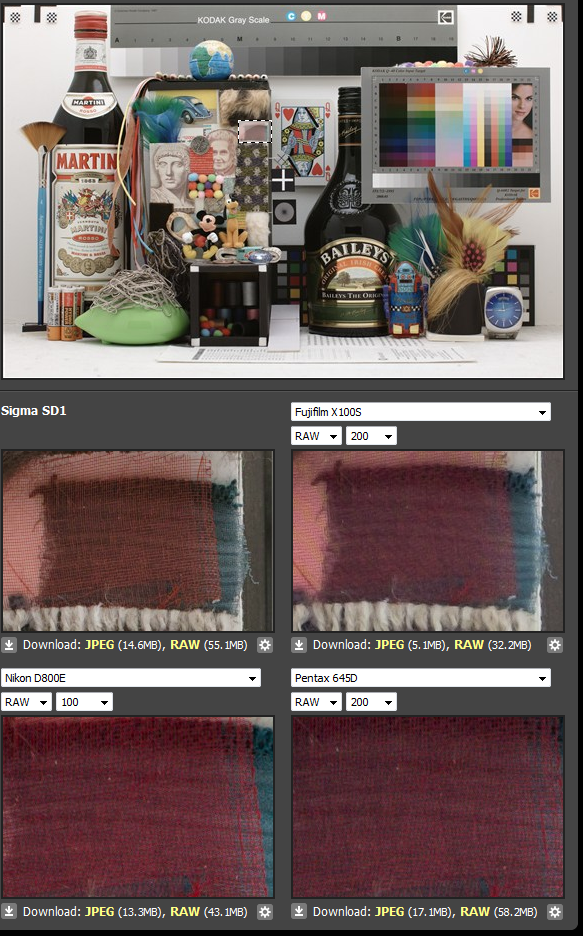
I have and I'm waiting for the reviews, I think I may get one if the results are good. 39 MP are realistic... of course you just have to get rid of the context "pixels" just by x/y Resolution. The Details of a FoveOn (@lowISO) are outstanding above a Nikon or even a Pentax 645D!

F.e. (picture from dpreview.com):
sigma.png


This was the first sensor which really catched my attention after buying my 5D back then. Everything else is just "evolution" here and there, half a stop more Dynamic, more resolution, ISO25600. Hooray, you invented the holy grail. Nikon bla, Canon bla... everything no real leap. A 5D is still awesome and able to serve my needs. The sigma is again something worth time spending with.
 
Upvote 0
vscd said:
Have you seen the new DP2? They claim up to 39 MP...

I have and I'm waiting for the reviews, I think I may get one if the results are good. 39 MP are realistic... of course you just have to get rid of the context "pixels" just by x/y Resolution. The Details of a FoveOn (@lowISO) are outstanding above a Nikon or even a Pentax 645D!

F.e. (picture from dpreview.com):


This was the first sensor which really catched my attention after buying my 5D back then. Everything else is just "evolution" here and there, half a stop more Dynamic, more resolution, ISO25600. Hooray, you invented the holy grail. Nikon bla, Canon bla... everything no real leap. A 5D is still awesome and able to serve my needs. The sigma is again something worth time spending with.

Their stated pixel dimensions don't make sense, unless the sensor is not a 3:2 aspect. I enjoyed the generation 1 Foveon a lot. Even though it was only 4.6 MP, it easily scaled to 25 MP, still looked sharp at that resolution on prints at 300 ppi. TDP and others reckoned the actual resolution was 14 MP, but I feel like it was a bit more (at least below ISO 200).

In the future I hope Sigma make a full frame DSLR with a foveon sensor, WITH A CANON EF MOUNT...rather than a Sigma mount. That way it could use all lenses, rather than only Sigma's. And if they make another crop sensor DSLR first, with the new DP series sensor, I hope it too comes with an EF mount. More people would buy Sigma's cameras if they at least offered having an EF mount as an option.
 
Upvote 0
vscd said:
@jrista

Yepp, but one *large* advantage of a foveon is that you don't need a Zeiss Otus to get your 36MP Sensor served. "Normal" sharp lenses, even customer-ones, get 15MP Pixels without problems... so the whole, or at least most better L, Canon Lense Lineup would be able to outperform the D800E.

Of course the layers constrict the light... until someone invents something new and proves the old wrong.

It's not just the layers or well depth that constricts the light. If you look at the Foveon design (and, for that matter, Canon's own layered sensor patents), they have a LOT more activate and readout wiring per pixel. It's really complicated stuff, which further restricts the actual light-sensitive photodiode area.

The whole "eqivalent megapixels" deal that Sigma uses is also very misleading. Currently, today, megapixel counts are based on output image widthxheight. A 15mp Sigma Foveon is 15mp, in terms of actual megapixels stored in the output JPED image or a JPEG that you can create from RAW. It may have 45 million photodiodes, but that is not the same as megapixels, and I really wish Sigma would stop being so misleading.

I like the Foveon sensor design, it has SO much potential. It's just in the wrong hands with Sigma...they can't seem to develop it and bring it to bear on the market in a form that would make it a truly viable competitor with higher MP bayer type sensors. I think there are some innovations that have been developed for video sensor technology that could greatly increase the transparency of the silicon that surrounds the layered photodiodes and improve Q.E., reduce noise, improve dynamic range, etc. I've been hoping that Canon was working with some of those technologies on their own layered sensor design.

I would also dispute the whole "need for high resolution lenses" argument. Output resolution, in spatial terms, is the convolution of both sensor and lens resolution...AND, a most important point here, is LIMITED by the LEAST common denominator. The Sigma DP2, for example, is a 4.7 megapixel camera!!! Spatially, that is VERY low resolution. It is not a 15mp camera. It has richer, more complete color information per pixel, however from a luminance standpoint, it's luminance resolution is extremely low. It's pixel pitch is 7.85µm. Those are nice, big pixels, however because of the wiring requirements, the photodiode area is a lot smaller than 7.85µm (I don't know exactly off the top of my head...I would have to find the patents again...but I'd say that at least a third of the area is lost, so maybe around 6.3µm, which is about the same as the 5D III.)

The biggest benefit for the Foveon is the lack of an AA filter. You still experience moire, but because full color information is gathered at each pixel, you only have monochrome moire. Mono moire in most "natural" cases in photography is often not that bad. The lack of an AA filter makes it SHARPER, but it does not really increase the resolution of the sensor. This is very obvious from VCD's comment:

vscd said:
Have you seen the new DP2? They claim up to 39 MP...

I have and I'm waiting for the reviews, I think I may get one if the results are good. 39 MP are realistic... of course you just have to get rid of the context "pixels" just by x/y Resolution. The Details of a FoveOn (@lowISO) are outstanding above a Nikon or even a Pentax 645D!

F.e. (picture from dpreview.com):
sigma.png


This was the first sensor which really catched my attention after buying my 5D back then. Everything else is just "evolution" here and there, half a stop more Dynamic, more resolution, ISO25600. Hooray, you invented the holy grail. Nikon bla, Canon bla... everything no real leap. A 5D is still awesome and able to serve my needs. The sigma is again something worth time spending with.

I think VCD has radically misinterpreted this comparison. The Sigma SD1 does not have anything even remotely close to the same resolution as the D800 or 645D. It isn't even a contest. The Sigma SD1 appears to be sharper...but that is only in a non-normalized comparison like this, and sharpness alone does not translate into more resolution. If one were to downsample the D800 and 645D images to the same dimensions as the SD1 image, they would likely TROUNCE the SD1. They have significantly more information in total, and while they may seem slightly soft at the pixel level, on a normalized basis, all that extra information gets interpolated into fewer, but much more accurate, sharper, richer and less noisy pixels.

Furthermore, the D800 and 645D both have more information to start with. They are resolving details that are not even present in the SD1 image at all, despite it's sharpness. Even if those details aren't as crisp as the LESSER details of the SD1, it's still more detail. A light sharpening filter can deal with the softness in a few seconds, and then the SD1 is at a real disadvantage. You can sharpen the SD1 image in post to your heart's content...that will never create information that was never there to begin with, and since it's already sharp, your probably doing yourself a disservice by sharpening SD1 images.

So arguing that the DP2, which itself is still just a 4.7mp camera (or even the SD1, which is a much higher resolution Foveon), is potentially equivalent to a 39mp camera, is gravely missing the point of having a truly higher resolution sensor (in luminance terms...luminace is where detail comes from, color CAN be of much lower spatial resolution so long as your luminance information is high...as a matter of fact, this is actually a standard practice in astrophotography, to image at high resolution in luminance, then when you switch to RGB filters, you bin 2x2 or 3x3, which increases your sensitivity, and reduces your resolution by 4x or 9x...and your never the wiser when looking at the final blended result). It buys into the very misleading hype that Sigma spews, which I believe is ultimately, in the long term, going to damage their reputation and hurt Foveon (because as more people try to produce images with a 4.7mp or 15mp Foveon sensor that compare to even the regular old D800, let alone the D800E or the 645D, and realize they simply cannot...they are either going to ditch Foveon and go back to bayer type sensors, or they are going to begin badmouthing Foveon.)

 
Upvote 0
Status
Not open for further replies.