Don Haines said:
jrista said:
Don Haines said:
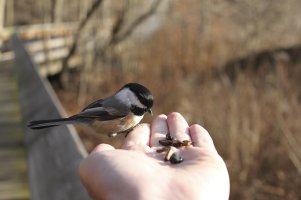
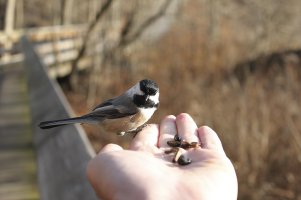
I have been trying (and failing) to get some decent pictures of chikadee's in flight. Do you have any idea how freaking fast those tiny wings flap..... and they don't fly level..... it's flap like crazy and climb, then tuck the wings in and go ballistic.... then flap.. then ballistic. It has to be the hardest thing I have ever tried photographicly.... taking pictures of the ISS was childs play in comparison.
Hah! Indeed! Getting a good shot if a perching chickadee is a chore...those little twits never stop moving, even for an instant. Even my best shots of chickadees have some blur somewhere on the bird (even in long sequences if 16 or more with my 7D). You need very high shutter speeds to capture them in flight, and a proper flight setup is pretty much essential.
I have been shooting with a 60D, shutter speed around a thousandth of a second, 400 f5.6 lens, burst mode (5.9 frames per second) or single shot, and have tried various autofocus modes. I have yet to get an in focus picture of one in flight.... no problems when they stop at the feeder, but none in flight. They really move fast, they don't fly level, and I have problems just tracking them with the camera, let alone get a decent picture. Any advice from those with more experience?
The trick, as with most small bird photography (and in many cases bird photography in general) is setup photography. The best photos of small songbirds in flight are usually done with a flight setup. In general, setup photography involves creating a contrived scenario wherein the bird pretty much must do what you want it to do, usually in order to get food.
Your basic setup photography will usually involve a seed tray with limited access, one or more perches set up for the birds to land on just before, just after, or in order to get to feed, a blind, and some patience. In my yard, I have a non-flight setup that I've been using for a while which has worked well. The general idea is bait the bird, set up perches at the right heights such that birds will land on it/them before heading for the seed, and be ready to take the shot when it occurs. The best way to do this is with a limited-access feeder tray. If you have an existing tray, you can simply cover it with a piece of cardboard with a small square hole cut into it, sized such that only one bird at a time can actually get at any seed. This will generally cause other birds to "queue up" on your perches.
I don't have any particularly great variety of bird photos as of yet, as I only started doing this a few months back just before winter started, and the variety of birds has been quite low so far (mostly just Juncos). My perches are also rather drab as they are all the variety of dead from last year's fall...dead branches, dead flora, dead tree stumps, etc. Here are some photos of my perching songbird setup (sorry for the picture quality...rather quick snaps on a very cold and frosty morning this morning!):


I have a number of cheap tripods set up to hold my perches. They are all set up around my feeder box...which is a home made box out of your basic 2x1" wood and some window screen tacked onto the bottom to serve as the tray. I built my box with a swivel lid, with a small-sized hole cut into it, to allow only one bird at a time access to seed. I have my blind, an Ameristep Chair Blind, set up within a few feet to get good frame-filling photos when they occur (which is actually a bit difficult with APS-C...king of the telephoto, but a little lackluster when you actually have the option of getting super close.) With the setup above, I was able to get shots like these with my lowly 7D and 100-400mm lens. I'd most certainly have preferred the 5D III with a 500mm or 600mm lens, as it would have produced sharper results, brighter exposures, with better boke...but alas, I have neither at the moment.
Bird in Flight photography for smaller birds is not really any different than perching setup photography. The same core technique applies: bait the bird, set the bird up such that its baser nature kicks in, and be prepared to get the shot when it occurs. The trick is to set up the perch and the feeder a number of feet off the ground, say 5-6 feet, with a space between. The space really depends on the type of bird, but for smaller birds a few feet will probably do. Set up your blind with the camera pointed at the gap, and just be ready to take the shot when a bird flys from perch to seed. This should work for most small birds, including chickadees...however they are one of the fastest birds. You'll need to make sure your shutter speed, and gear in general, are ready to capture that kind of motion that quickly (I'd say a 5D III with its 61pt AF system would be ideal, and the 1D X would be best.)
There are more specifics and nuances to this approach. I've had minimal time to work the technique myself, and as there is generally a lack of birds that fly a lot (juncos are ground feeders and they hop or trot around a lot, but fly very infrequently)...and thanks to my limited gear (7D with 100-400mm leaves me with an f/5.6 aperture, generally not quite enough to really get shots of chickadees). If you really want to get all the techniques, I highly recommend buying Alan Murphy's Guide to Songbird Setup Photography. You'll learn all the necessary techniques to get great bird in flight photos, even of small, fast birds like Chickadees.