Jack56 said:
Thought I made a decision. Went to the shop yesterday to buy the 16-35 f/4 and the 24-70 f/2.8.
The 16-35, yes. No doubts.
But, I was told in the shop, that one of the assistants tested the f/2.8 and the f/4, and that there was hardly any difference in IQ. He works in the fashion world for years.
So, I didn't buy the 24-70.
Macro option, I don't care. IQ, I do.
IS, a nice option.
But how about the IQ?
I know I will use a tripod a lot. I am not a type that walks the streets for making photos. I am more the calculating type.
What is wisdom?
IS or not?
Breaking down a question like this into something as simple as "little difference in IQ" is a ludicrously bad way to compare lenses.
The 24-70mm F/4.0 IS could not be more different from the 24-70mm f/2.8 II, and other normal zoom lenses.
Now I could definitely see a photographer taking both lenses shooting off a brick wall and not seeing much of a difference, and if your clients do not care that much about the details (most clients don't) then there isn't that much of a difference in practice.
But factually speaking there is a huge difference:
Let's compare the current 4 best options for normal zoom lenses:
Sigma/Canon 24-105mm, Canon 24-70mm F/4.0 IS, Canon 24-70mm F/2.8 II, Tamron 24-70mm f/2.8
For the record I own 3 of these 4 lenses because each is so very different and each has their own usage scenario.
Let's go down the list:
Canon 24-70mm f/4.0 IS L
- This is a very nice lens at the extremes, the 24mm and 70mm focal lengths deliver world class pro sharpness.
- The bokeh is also world class at all focal lengths.
- This lens is also the world's worst 50mm lens for any dslr. Literally. It is very hard to make a sharp normal zoom due to the extreme complication of the design, so Canon had little room to improve upon the 24-105mm f/4.0 IS L. Instead of improving upon it, they made it way better at 24mm, a bit better at 70mm and much worse in-between. Most zoom lens users use lenses towards the extreme so is good in theory, but overall the 24-70mm f/4.0 IS L scores lower in sharpness than the 24-105mm f/4.0 IS when you average all of the points on the frame and all of the zoom range that crosses over. The 24-70mm f/4.0 IS L lens is really genuinely terrible in the middle of the focal range, but excellent at everything else.
Example:
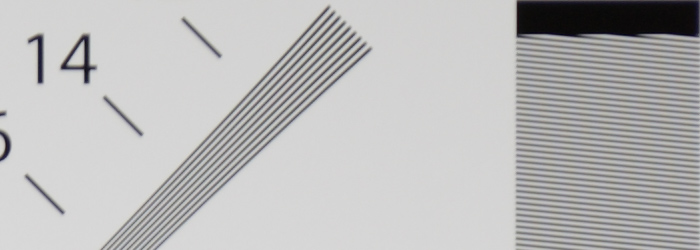
Test Chart @ 50mm f/4.0 - Canon 24-70mm f/4.0 IS L
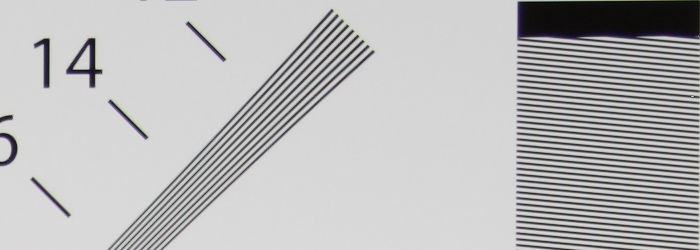
Test chart @ 50mm f/4.0 for Canon 28-300mm super zoom
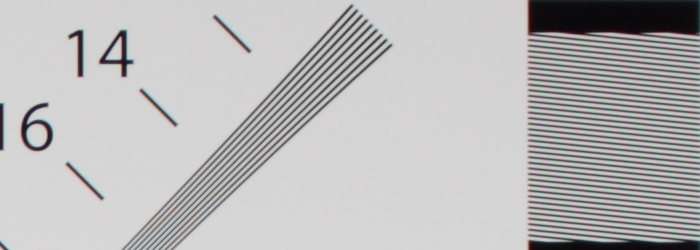
Here's a comparison with one of Canon's worst zoom lenses.
Test chart @ 50mm f/4.5 Canon 18-55mm kit lens:
Here's a comparison to Canon's cheapest zoom lens, the crop kit lens.
The 24-70mm f/4.0 IS is one of Canon's best lenses ever made at the widest and longest end of it's focal range, and you will indeed see little difference between it and the more expensive 24-70mm f/2.8 L II. However in-between it is literally one of the worst zoom lenses ever made. It is really genuinely terrible at around 50mm.
Canon 24-70mm f/2.8 IS II
- This lens is as sharp , at all focal ranges and at f/2.8. It is one of the sharpest lenses in the world at any setting.
- This lens also has an apochromatic design, also known as APO, APO is an incredible feature that results in no purple fringing. All normal zoom lenses suffer immensely from purple fringing and it ruins a lot of photos. APO is a feature that is generally found only in the best and most expensive lenses in the world, the big white super telephoto lenses have it, and so do some of the more special zeiss lenses. Purple fringing cannot be removed completely by any computer program automatically unlike regular color fringing, and if it is above anything but a very small level it will always be obvious in photos with extremes of contrast.
Purple fringing looks like this from any zoom lens other than the 24-70mm f/2.8 II L. Again you cannot get rid of it without painstaking hand color correction and editors of major publications and stock photo agencies typically do not allow photos with purple fringing in it to be published, so this is a very important pro feature.
Another comparison:
You can see how one lens renders text more purple in this comparison.
The 24-70mm f/2.8 II is an amazing lens MORE SO because of it's apochromatic nature than anything else that it does.
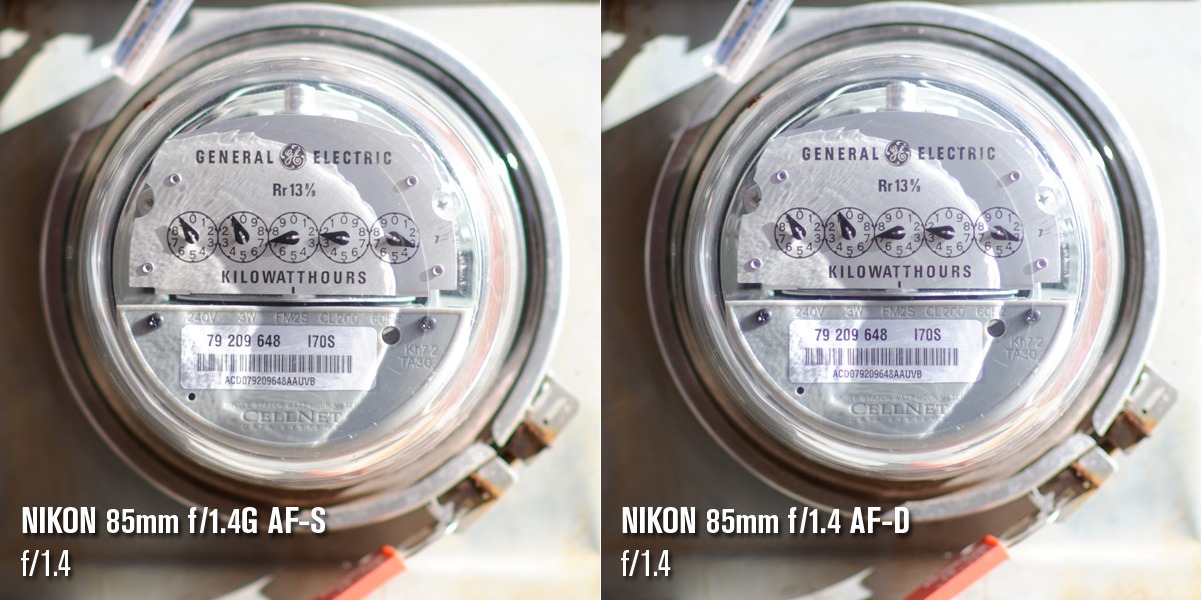
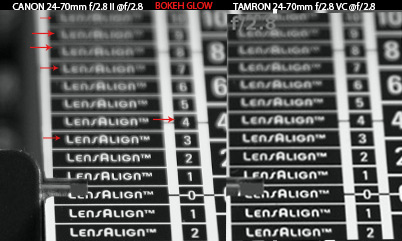
The major problem with the 24-70mm f/2.8 II is that it has very poor contrast in areas that are out of focus. This is because Canon had to do some weird tricks to make the lens do what they wanted.
As you can see on the left images taken with the 24-70mm f/2.8 II have a glow that reduces contrast in the out of focus areas. Everything has this halo. This is a characteristic that is not found in any similar lens.
The result of this bokeh haze is that images will have different levels of contrast and saturation in the out of focus and in focus areas. You cannot simply boost the contrast and saturation to fix this. Because then your in focus areas will become over saturated and/or have a crunchy contrast.
The net effect then is that images taken with the 24-70mm f/2.8 II in certain situations can have an extremely muddy and weird looking background that reduces the pop of the image. I have had this negatively impact several shoots and require time consuming hours to fix in photoshop.
Tamron 24-70mm f/2.8 II
This lens has sharpness that is near perfect, and provides nice bokeh. It lacks the apochromatic features of the Canon version, but lacks the hazy bokeh. However in some situations it has the exact opposite problem as the Canon with bokeh, it's sometimes way too harsh making things look busy too textured in certain situations. Not all situations, but it can ruin photos and is a problem.
Canon 24-105mm/Sigma 24-105mm
These lenses are basically of the same design and very similar performance. The Sigma is a little better in every image quality dimension, but only a little. I think it's worth it to get the Sigma personally.
The 24-105mm f/4.0 (Sigma or Canon) are a lenes that lacks any major flaws but also do not impress at any focal length. Never flawed but always mediocre in other words.
So as you can see each lens has it's problems, limitations benefits and differences. All of these lenses are terrible at something incredibly important or just mediocre and you have to pick which problem is going to affect you the least.
And that's excluding the aperture and IS discussion, which makes it even more complex.