Confused, 24-70 f/2.8 or f/4?

Nov 17, 2013
145
0
6,271
Thought I made a decision. Went to the shop yesterday to buy the 16-35 f/4 and the 24-70 f/2.8.
The 16-35, yes. No doubts.
But, I was told in the shop, that one of the assistants tested the f/2.8 and the f/4, and that there was hardly any difference in IQ. He works in the fashion world for years.
So, I didn't buy the 24-70.
Macro option, I don't care. IQ, I do.
IS, a nice option.
But how about the IQ?
I know I will use a tripod a lot. I am not a type that walks the streets for making photos. I am more the calculating type.
What is wisdom?
IS or not?
 
Well, the new 24-70 f/4 IS has excellent IQ.

The same question should be asked for the 24-70 that you should have asked yourself for the 16-35... Do I need f/2.8? This is much more helpful than reading reviews of lenses, for instance, as it will help you decide which lens will work best for what you shoot. Other people can't really decide this for you as only you know what you plan to shoot with the lens. If the type of shooting you do really needs f/2.8, your IQ will be seriously hurting if you try to accomplish the same task with a lens that only can do f/4.

If you don't need f/2.8, then get the cheaper f/4 lens.

If you are not sure if you need f/2.8, you should really research the topic and if it is needed for your style of shooting.

To make it simple, f/2.8 is most needed for low light/indoor situations when you are shooting moving objects i.e. people. So, f/2.8 aperture is indispensable at a wedding reception or other indoor party, for instance. In those situations you need to maintain a high shutter speed to in dim light avoid motion blur, and with an f/4 lens in doing so you often will get terrible IQ due to the high ISOs that are a result of f/4 letting in half the light of f/2.8. Tripod cannot help you with motion blur, tripod only helps camera shake.

But, if you are going to be shooting landscapes or daytime outdoors most of the time, there really is no pressing reason to get an f/2.8 lens, as you need a narrower aperture for landscape and you won't need the extra light f/2.8 gives you.

f/2.8 also gives you the ability to use a shallower depth of field than f/4, but if you are not into shallow depth of field photography then this is not an issue.

The common disadvantages of f/2.8 zoom lenses are increased flare, weight, size, and price due to the larger glass elements needed.

If there were absolutely no doubts getting the 16-35 f/4, why would you have doubts on a 24-70 f/4? Remember, while a tripod prevents camera shake, it does not prevent motion blur - and that is where f/2.8 can help you maintain high shutter speeds and low ISOs in dim light (on both the 16-35 and 24-70).
 
Upvote 0
I am a big fan of the new 24-70 f/4 IS.

I sold my 24-70 f/2.8 version I and picked up the 24-70 f/4 IS. The weight savings alone are huge. It makes a big difference in the handling on a 5D. Overall my IQ is much better - either due to the glass but mostly I think to the IS.

As for the f/2.8 V2 - This guy does a pretty compelling comparison between the f/2.8 vII and the f/4 IS.

http://www.ronmartblog.com/2013/02/review-canon-24-70mm-f4l-is-vs-24-70.html

My f/4 seems to have much better IQ than my f/2.8V1. The IS is a huge issue for me. I never use a tripod. So in the end, my pictures are significantly better than with the f/2.8 v1.

Also I take issue with the statement - "where f/2.8 can help you maintain high shutter speeds and low ISOs in dim light " With 4 stop IS you are 3 stops better than with the stop you give up with f/2.8. And if you shoot your VII at anything other than f/2.8 you will do much worse than the f/4 IS. The new 4 stop IS is really nice. I have the old 70-200 f/2.8 v1 and the IS performance on the new 24-70f/4 IS is much better. (BTW I also have the 70-300 f/4-5.6 IS L which has 4-stop IS and that is just an incredible lens.

Finally I have the 16-35 f/2.8 VII and have been debating on whether to keep it or go for the f/4IS version - that is how good my experience has been with the 24-70 f/4 IS.
 
Upvote 0
If you read Bryan Carnathan's review of the lenses, the 24-70 f/2.8L II does have better IQ. Whether it's that much better IQ for the price premium is another issue. I also agree that IS is useful in many cases. For me personally though, I went with the f/2.8 lens because it can literally replace the 24L, 35L, and 50L, all in one fell swoop if you don't need wider than f/2.8 apertures, not to mention the wider aperture for AF in sports.
 
Upvote 0
kurtj29 said:
Also I take issue with the statement - "where f/2.8 can help you maintain high shutter speeds and low ISOs in dim light " With 4 stop IS you are 3 stops better than with the stop you give up with f/2.8. And if you shoot your VII at anything other than f/2.8 you will do much worse than the f/4 IS. The new 4 stop IS is really nice. I have the old 70-200 f/2.8 v1 and the IS performance on the new 24-70f/4 IS is much better. (BTW I also have the 70-300 f/4-5.6 IS L which has 4-stop IS and that is just an incredible lens.

The 24-70 has a maximum focal length of 70. IS will therefore only start to really be useful at 1/60 shutter speed and slower which is not 'high shutter speeds'. All IS does is allow you to use a lens at a number of stops slower shutter speed than the reciprocal shutter speed of the focal length. What will happen is in order to get 1/100 or 1/125 shutter speed in dim light with an f/4 lens, you have to double the ISO (often into five digits) which will lead to increased noise and decreased resolution - because you will have half the light of an f/2.8 lens.

Many seem to not realize that camera shake and motion blur are two separate things. IS (and tripods) can only help camera shake, it can't help motion blur. Because of the short focal length of a 24-70 lens combined with the faster shutter speeds to freeze motion, image stabilization is multitudes less useful than f/2.8 when shooting in dim light. Sure, with IS you'll get a camera-shake free image, but to get enough light you will either have to crank up the ISOs or slow down the shutter which will result in motion blur. An f/4 lens will let in half the light of an f/2.8 lens. Therefore, when you attempt to do 1/100 with half the light, you have to double the ISO which can really destroy the image quality in poor light.

The 70-200 is a different story because the telephoto end of the lens far exceeds the reciprocal rule with 1/100 shutter, thus IS will be more useful in that lens when photographing moving subjects.

So, I do not see the issue with the statement.
 
Upvote 0
Jack56 said:
Thought I made a decision. Went to the shop yesterday to buy the 16-35 f/4 and the 24-70 f/2.8.
The 16-35, yes. No doubts.
But, I was told in the shop, that one of the assistants tested the f/2.8 and the f/4, and that there was hardly any difference in IQ. He works in the fashion world for years.
So, I didn't buy the 24-70.
Macro option, I don't care. IQ, I do.
IS, a nice option.
But how about the IQ?
I know I will use a tripod a lot. I am not a type that walks the streets for making photos. I am more the calculating type.
What is wisdom?
IS or not?

Breaking down a question like this into something as simple as "little difference in IQ" is a ludicrously bad way to compare lenses.

The 24-70mm F/4.0 IS could not be more different from the 24-70mm f/2.8 II, and other normal zoom lenses.

Now I could definitely see a photographer taking both lenses shooting off a brick wall and not seeing much of a difference, and if your clients do not care that much about the details (most clients don't) then there isn't that much of a difference in practice.

But factually speaking there is a huge difference:

Let's compare the current 4 best options for normal zoom lenses:

Sigma/Canon 24-105mm, Canon 24-70mm F/4.0 IS, Canon 24-70mm F/2.8 II, Tamron 24-70mm f/2.8

For the record I own 3 of these 4 lenses because each is so very different and each has their own usage scenario.


Let's go down the list:


Canon 24-70mm f/4.0 IS L

- This is a very nice lens at the extremes, the 24mm and 70mm focal lengths deliver world class pro sharpness.
- The bokeh is also world class at all focal lengths.
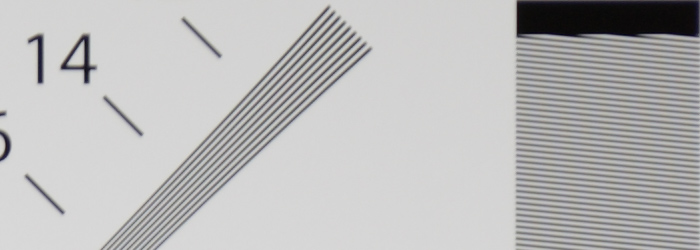
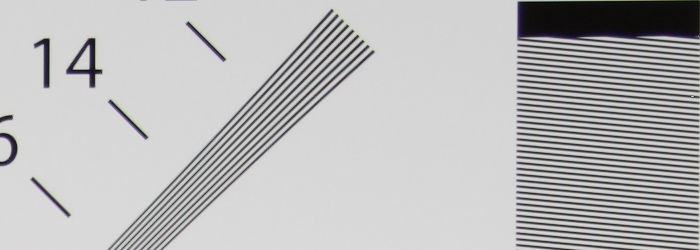
- This lens is also the world's worst 50mm lens for any dslr. Literally. It is very hard to make a sharp normal zoom due to the extreme complication of the design, so Canon had little room to improve upon the 24-105mm f/4.0 IS L. Instead of improving upon it, they made it way better at 24mm, a bit better at 70mm and much worse in-between. Most zoom lens users use lenses towards the extreme so is good in theory, but overall the 24-70mm f/4.0 IS L scores lower in sharpness than the 24-105mm f/4.0 IS when you average all of the points on the frame and all of the zoom range that crosses over. The 24-70mm f/4.0 IS L lens is really genuinely terrible in the middle of the focal range, but excellent at everything else.

Example:

Test Chart @ 50mm f/4.0 - Canon 24-70mm f/4.0 IS L

2013-01-11_09-49-52.jpg


Test chart @ 50mm f/4.0 for Canon 28-300mm super zoom

2009-05-14_09-25-03.jpg


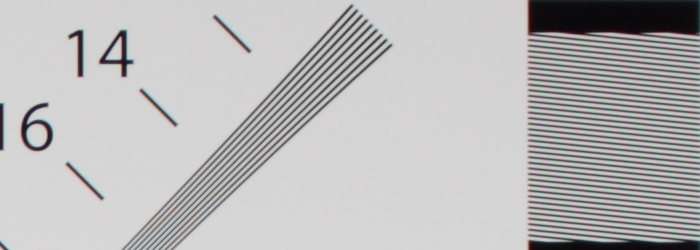
Here's a comparison with one of Canon's worst zoom lenses.

Test chart @ 50mm f/4.5 Canon 18-55mm kit lens:

2013-05-15_14-38-58.jpg


Here's a comparison to Canon's cheapest zoom lens, the crop kit lens.

The 24-70mm f/4.0 IS is one of Canon's best lenses ever made at the widest and longest end of it's focal range, and you will indeed see little difference between it and the more expensive 24-70mm f/2.8 L II. However in-between it is literally one of the worst zoom lenses ever made. It is really genuinely terrible at around 50mm.

Canon 24-70mm f/2.8 IS II

- This lens is as sharp , at all focal ranges and at f/2.8. It is one of the sharpest lenses in the world at any setting.
- This lens also has an apochromatic design, also known as APO, APO is an incredible feature that results in no purple fringing. All normal zoom lenses suffer immensely from purple fringing and it ruins a lot of photos. APO is a feature that is generally found only in the best and most expensive lenses in the world, the big white super telephoto lenses have it, and so do some of the more special zeiss lenses. Purple fringing cannot be removed completely by any computer program automatically unlike regular color fringing, and if it is above anything but a very small level it will always be obvious in photos with extremes of contrast.

118759d1329929803-how-do-you-fix-purple-fringing-31mm-limited-purple-fringe-example-imgp4613.jpg


Purple fringing looks like this from any zoom lens other than the 24-70mm f/2.8 II L. Again you cannot get rid of it without painstaking hand color correction and editors of major publications and stock photo agencies typically do not allow photos with purple fringing in it to be published, so this is a very important pro feature.

Another comparison:

85mm-purple-fringing-comparison.jpg


You can see how one lens renders text more purple in this comparison.

The 24-70mm f/2.8 II is an amazing lens MORE SO because of it's apochromatic nature than anything else that it does.

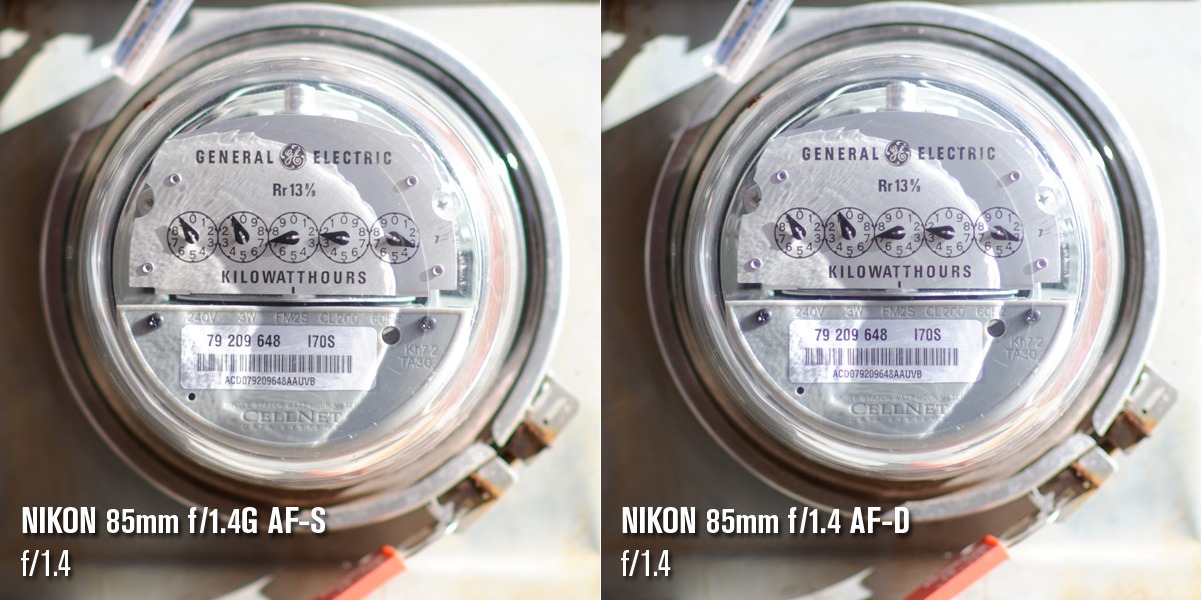
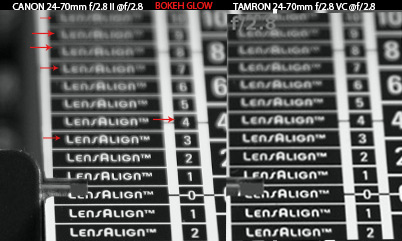
The major problem with the 24-70mm f/2.8 II is that it has very poor contrast in areas that are out of focus. This is because Canon had to do some weird tricks to make the lens do what they wanted.

2470iivstam.jpg


As you can see on the left images taken with the 24-70mm f/2.8 II have a glow that reduces contrast in the out of focus areas. Everything has this halo. This is a characteristic that is not found in any similar lens.

The result of this bokeh haze is that images will have different levels of contrast and saturation in the out of focus and in focus areas. You cannot simply boost the contrast and saturation to fix this. Because then your in focus areas will become over saturated and/or have a crunchy contrast.

The net effect then is that images taken with the 24-70mm f/2.8 II in certain situations can have an extremely muddy and weird looking background that reduces the pop of the image. I have had this negatively impact several shoots and require time consuming hours to fix in photoshop.


Tamron 24-70mm f/2.8 II

This lens has sharpness that is near perfect, and provides nice bokeh. It lacks the apochromatic features of the Canon version, but lacks the hazy bokeh. However in some situations it has the exact opposite problem as the Canon with bokeh, it's sometimes way too harsh making things look busy too textured in certain situations. Not all situations, but it can ruin photos and is a problem.

Canon 24-105mm/Sigma 24-105mm

These lenses are basically of the same design and very similar performance. The Sigma is a little better in every image quality dimension, but only a little. I think it's worth it to get the Sigma personally.

The 24-105mm f/4.0 (Sigma or Canon) are a lenes that lacks any major flaws but also do not impress at any focal length. Never flawed but always mediocre in other words.


So as you can see each lens has it's problems, limitations benefits and differences. All of these lenses are terrible at something incredibly important or just mediocre and you have to pick which problem is going to affect you the least.

And that's excluding the aperture and IS discussion, which makes it even more complex.

 
Upvote 0
Ruined said:
kurtj29 said:
Also I take issue with the statement - "where f/2.8 can help you maintain high shutter speeds and low ISOs in dim light " With 4 stop IS you are 3 stops better than with the stop you give up with f/2.8. And if you shoot your VII at anything other than f/2.8 you will do much worse than the f/4 IS. The new 4 stop IS is really nice. I have the old 70-200 f/2.8 v1 and the IS performance on the new 24-70f/4 IS is much better. (BTW I also have the 70-300 f/4-5.6 IS L which has 4-stop IS and that is just an incredible lens.

The 24-70 has a maximum focal length of 70. IS will therefore only start to really be useful at 1/60 shutter speed and slower which is not 'high shutter speeds'. All IS does is allow you to use a lens at a number of stops slower shutter speed than the reciprocal shutter speed of the focal length. What will happen is in order to get 1/100 or 1/125 shutter speed in dim light with an f/4 lens, you have to double the ISO (often into five digits) which will lead to increased noise and decreased resolution - because you will have half the light of an f/2.8 lens.

Many seem to not realize that camera shake and motion blur are two separate things. IS (and tripods) can only help camera shake, it can't help motion blur. Because of the short focal length of a 24-70 lens combined with the faster shutter speeds to freeze motion, image stabilization is multitudes less useful than f/2.8 when shooting in dim light. Sure, with IS you'll get a camera-shake free image, but to get enough light you will either have to crank up the ISOs or slow down the shutter which will result in motion blur. An f/4 lens will let in half the light of an f/2.8 lens. Therefore, when you attempt to do 1/100 with half the light, you have to double the ISO which can really destroy the image quality in poor light.

The 70-200 is a different story because the telephoto end of the lens far exceeds the reciprocal rule with 1/100 shutter, thus IS will be more useful in that lens when photographing moving subjects.

So, I do not see the issue with the statement.

Not everyone shoots things that move...
 
Upvote 0
neuroanatomist said:
Ruined said:
kurtj29 said:
Also I take issue with the statement - "where f/2.8 can help you maintain high shutter speeds and low ISOs in dim light " With 4 stop IS you are 3 stops better than with the stop you give up with f/2.8. And if you shoot your VII at anything other than f/2.8 you will do much worse than the f/4 IS. The new 4 stop IS is really nice. I have the old 70-200 f/2.8 v1 and the IS performance on the new 24-70f/4 IS is much better. (BTW I also have the 70-300 f/4-5.6 IS L which has 4-stop IS and that is just an incredible lens.

The 24-70 has a maximum focal length of 70. IS will therefore only start to really be useful at 1/60 shutter speed and slower which is not 'high shutter speeds'. All IS does is allow you to use a lens at a number of stops slower shutter speed than the reciprocal shutter speed of the focal length. What will happen is in order to get 1/100 or 1/125 shutter speed in dim light with an f/4 lens, you have to double the ISO (often into five digits) which will lead to increased noise and decreased resolution - because you will have half the light of an f/2.8 lens.

Many seem to not realize that camera shake and motion blur are two separate things. IS (and tripods) can only help camera shake, it can't help motion blur. Because of the short focal length of a 24-70 lens combined with the faster shutter speeds to freeze motion, image stabilization is multitudes less useful than f/2.8 when shooting in dim light. Sure, with IS you'll get a camera-shake free image, but to get enough light you will either have to crank up the ISOs or slow down the shutter which will result in motion blur. An f/4 lens will let in half the light of an f/2.8 lens. Therefore, when you attempt to do 1/100 with half the light, you have to double the ISO which can really destroy the image quality in poor light.

The 70-200 is a different story because the telephoto end of the lens far exceeds the reciprocal rule with 1/100 shutter, thus IS will be more useful in that lens when photographing moving subjects.

So, I do not see the issue with the statement.

Not everyone shoots things that move...

See post #2 in thread :)
 
Upvote 0
The solution is to rent (or borrow if you can) the 24-70/4L IS for a few days when you can put it to good use. That's a much cheaper option than buying the 'wrong' lens - I'm sure that both are awesome.

I was torn between the 70-200/4L IS and slightly slower 70-300L. Renting first made my decision easy.

Try the 24-70/4L IS both with and without IS switched on. If the slower shutter speeds allowed by the IS for static shots in poor light give you a benefit, then the lighter cheaper lens is probably better for you. IS is a bigger benefit than one one stop of of speed if the subject isn't fast moving.

If however you find yourself wanting to open the aperture wider to stop motion blur in poor light, or to achieve selective focus at the long end, then the extra weight and cost of the 2.8 could be worthwhile.

If in good light, or using a tripod stopped down then I would expect both to be excellent, so it comes down to the original question of IQ, to which I would add weight as others have mentioned.

But try before you buy, there are some vendors/renters who will refund the rental if you then buy. I would veer towards the lighter weight and IS, but you need to confirm whether your type of photography would benefit losing the IS for the 1 extra stop speed advantage of the 2.8.
 
Upvote 0
Jack56 said:
Thought I made a decision. Went to the shop yesterday to buy the 16-35 f/4 and the 24-70 f/2.8.
The 16-35, yes. No doubts.
But, I was told in the shop, that one of the assistants tested the f/2.8 and the f/4, and that there was hardly any difference in IQ. He works in the fashion world for years.
So, I didn't buy the 24-70.
Macro option, I don't care. IQ, I do.
IS, a nice option.
But how about the IQ?
I know I will use a tripod a lot. I am not a type that walks the streets for making photos. I am more the calculating type.
What is wisdom?
IS or not?

Both the 24-70 2/8 II and 24-70 f/4 IS are very good.

I think the 24-70 II has just a little more microcontrast bite for the most part and a bit sharper edges under f/8, especially at f/4-f/4.5 (but it sounds like you will use it for landscapes so probably shooting f/7.1-f/11 anyway), and just a touch better resistance to longitudinal CA/PF (both fight it off very well, the 24-70 II 2.8 probably the best I've seen for a wide/standard FF zoom).

The 24-70 f/4 IS seemed to give better far edge performance near 70mm on FF in real world usage though at any aperture, that seemed to be the one weak spot the 24-70 II (it is not bad there, just a bit weaker at the edges than the 24-70 f/4 IS or than the 70-300L for instance).

24-70 II is probably the single best UWA or standard FF zoom. 24-70 f/4 IS is probably the next best. The old 24-70 I is definitely worse and same goes for the 24-105 and even more for the 28-135 and so on. I'm not sure the 16-35 f/4 IS is quite in the 24-70 II class either and it might not even quite be in the 24-70 f/4 IS class either from my early looks.

My first 24-70 f/4 IS was a trace less sharp center frame and noticeably less sharp anywhere remotely near any border so there can be some real copy variation, definitely noticeable compared to my second copy (that said even the first one seemed to give a better 24mm than any 24-105 I have ever tried for landscape work). The focal plane seemed set to the same plane across copies, just the edges were not at all as crisp on the first one.

Every single 24-70 II I have tried has the focal plane slightly tilted differently, not quite perfect QC there, they still all come out better than the old lenses though, it is a bit annoying though sine one migh thave one side pushed back a bit more or one corner closer and the opposite set focus a trace deeper, etc. And f/2.8-f/3.5 performance center frame varied a bit, even the worst I've seen was very good, but the best were WHOA and you could tell the difference compared to the more regular copies. The top one appeared to hit max sharpness center frame already at f/3.2.
 
Upvote 0
Don't be confused. Just compare what you'll be getting -- top to bottom -- and make a decision based on your priorities:

24-70 F/2.8L II
  • It is believed to be the sharpest 24-70 out there by many reviewers. That may or may not be so depending on the apertures you shoot. I believe it to be the sharpest for general use, but if you are shooting landscapes at F/11, chances are you won't notice much of a difference between the F/2.8 and F/4 lenses.
  • This lens is weather sealed.
  • F/2.8 max aperture will give you faster shutters for sports, moving subjects, etc.
  • F/2.8 max aperture will give you the opportunity to shoot with smaller DOF, smoother background blur, etc. (if so inclined)
  • This lens takes 82mm filters, which you may not currently own. Consider that when you add up the total cost.
  • This lens is much more expensive than the F/4 IS lens.
  • I am totally speculating here, but the F/2.8L II is probably a better bet for resale value over the F/4L IS as it is the 'pro' staple lens for standard focal lengths -- this will be a go to for many photogs, and as such, there will always be some demand for it.

24-70 F/4L IS

  • This lens is quite sharp but generally not regarded as sharp as the F/2.8L II; however, some reviewers disagree slightly:
  • This lens has Image Stabilization, it's #1 advantage over the F/2.8L II. If you shoot handheld stills in low light without a flash or if you shoot video, this will be a large upside for you. If not, it may not be that valuable.
  • This lens is also weather sealed.
  • F/4 max aperture will force you to crank up the ISO to match the shutter speed of the F/2.8 lens for moving subjects, sports, etc.
  • F/4 max aperture can not deliver the same great subject isolation, bokeh, etc. as the F/2.8L II.
  • This lens takes 77mm filters. I'm going to go out on a limb and assume if you are dropping $3-4k on glass, you have the relatively standard 77mm filters in your possession already.
  • The F/4L IS lens is about 33% lighter than the F/2.8L II. That matters if you carry all day, but I'm sure most pros would prefer the IQ and carry that weight.
  • This lens is considerably cheaper than the F/2.8L II.
  • The F/4L IS lens is about an 1" shorter if memory serves. That's a really small advantage in comparison to the points made above, but that might matter to you.
  • It has the macro mode, which is fun to use but limited compared to proper 1:1 macro lenses with more useful working distances. This particular feature is more for those who choose this lens as a walkaround lens on their FF rigs and do not want to carry a 100mm macro or extension tubes with them. It's a nice feature but not a killer one.

So if IQ is everything to you / you need strong bokeh in a zoom / you shoot sports --> the F/2.8L II is the clear choice. I think most everyone on this forum would say that if money were no object, that's the standard zoom you get.

If, however, you'd like 90-95% as good a lens and one of the green advantages above is a big deal to you, the F/4L IS may be the right choice for you. Just spitballing here, the biggest reasons to choose the F/4L IS would be...
  • You shoot video as well as stills and want an all-in-one stills/video lens. IS is great for video.
  • If you often shoot handheld + low light + no flash on non-moving subjects. Street, vacation, walkabout shooters desperately need IS. It's admittedly not a routine need, but in those circumstances, F/2.8L II shooters would need to crank their ISO 2-3 stops up to net the same shot as the F/4L IS.
  • Weight does matter for you. If you hike, camp, etc. and have to lug everything around, less weight is beautiful.

- A
 
Upvote 0
e17paul said:
I was torn between the 70-200/4L IS and slightly slower 70-300L. Renting first made my decision easy.

Try the 24-70/4L IS both with and without IS switched on. If the slower shutter speeds allowed by the IS for static shots in poor light give you a benefit, then the lighter cheaper lens is probably better for you. IS is a bigger benefit than one one stop of of speed if the subject isn't fast moving.

+1. Renting and testing head to head is always a good idea if you are going to sink four figures into glass.

- A
 
Upvote 0
Thank you all very, very much. Very kind of you to share your thoughts. Great feeling when you come back from work and read all these replies.

Renting the two lenses is what I will do. I've send the shop a mail and hope to hear from them very soon.
I made photos with the 15-85mm lens and I was very pleased with the results. I can imagine that both 24-70 lenses will deliver at least that quality.
I will let you know when I made my decision.
 
Upvote 0