Deep Sky Astrophotography (Gear Discussion)

Re: Deep Sky Astrophotography

wearle said:
scyrene said:
Very impressive. I've been looking to get that lens myself for this purpose (among others). From your description, I'm guessing it's a pretty dark site?

Thanks!

It's a very dark site. I measured it last Summer, and it was approaching 22.0 visual magnitudes per square arc-second. The only problem is eastern Oregon. It's rarely clear in the Winter. The Summer is generally clear, but then your contending with smoke-filled skies from wildfires. :( When things do work out, I get about 6-8 opportunities a year during the New Moon window.

Wade

Have you ever thought of narrow band imaging? Especially with the 3nm filters we have these days, you can even image DURING the full moon, and still get high SNR results that produce beautiful grayscale results (H-a only) or mapped images (S-II, H-a & O-III). I live under moderately light polluted skies. I was originally thinking about using an LPR, but I think now that I'm going to go all in for 3nm narrow band filters (although they are rather expensive...about $500-$700 each) so I can do more imaging from my home.

Not much you can do about cloud cover, but since you can image during the entire lunar cycle, you get a lot more cuddle time with your scope. ;)
 
Upvote 0
Re: Deep Sky Astrophotography

jrista said:
Have you ever thought of narrow band imaging? Especially with the 3nm filters we have these days, you can even image DURING the full moon, and still get high SNR results that produce beautiful grayscale results (H-a only) or mapped images (S-II, H-a & O-III). I live under moderately light polluted skies. I was originally thinking about using an LPR, but I think now that I'm going to go all in for 3nm narrow band filters (although they are rather expensive...about $500-$700 each) so I can do more imaging from my home.

Not much you can do about cloud cover, but since you can image during the entire lunar cycle, you get a lot more cuddle time with your scope. ;)

I do image in H-alpha, but only with my CCD camera.

I have a 5nm H-alpha filter. Keep in mind, the 3nm H-alpha filter blocks out the N2 spectrum so your results will look a little different than most narrowband H-alpha filters which are wide enough to capture N2.

You still lose contrast when imaging during "moon-up" even with narrowband filters. The effect just isn't as pronounced. Because of this, I generally do not image while the Moon is up.

It takes me about 90 minutes driving time to get to my dark site so I'm probably too picky when it comes to transparency. I could probably double my trips if I wasn't so picky. :(

Wade
 
Upvote 0
Re: Deep Sky Astrophotography

To all,

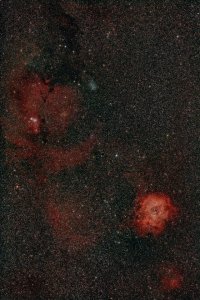
Here's a wide-field image of the Rosette and Cone Nebula region. This was taken with a modified Canon 5D2 and a Canon 200mm f/2.0L stopped down to f/4.0. It is an integration of 16 four-minute exposures. It was calibrated using six dark frames, twenty biases, and twenty flats. All calibration and processing was done in PixInsight.

Thanks for looking,

Wade
 

Attachments

  • rosette_and_cone_nebula_region_dslr_200mm.jpg
    rosette_and_cone_nebula_region_dslr_200mm.jpg
    422.1 KB · Views: 1,453
Upvote 0
Re: Deep Sky Astrophotography

To all,

This is not quite deep-sky, but might be "landscape". :)

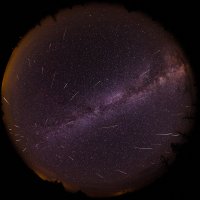
This is a composite image of the 2012 Perseid Meteor shower taken with a Canon 1DX and a rented Canon 8-15mm f/4.0L lens. The underlying background is a single image. I captured meteors throughout the night and picked the brightest ones to copy onto the background image. LightRoom and Photoshop CC were used to make the composite.

Thanks for looking,

Wade
 

Attachments

  • perseids_comp_8_15mm.jpg
    perseids_comp_8_15mm.jpg
    656 KB · Views: 1,430
Upvote 0
Re: Deep Sky Astrophotography

wearle said:
jrista said:
Have you ever thought of narrow band imaging? Especially with the 3nm filters we have these days, you can even image DURING the full moon, and still get high SNR results that produce beautiful grayscale results (H-a only) or mapped images (S-II, H-a & O-III). I live under moderately light polluted skies. I was originally thinking about using an LPR, but I think now that I'm going to go all in for 3nm narrow band filters (although they are rather expensive...about $500-$700 each) so I can do more imaging from my home.

Not much you can do about cloud cover, but since you can image during the entire lunar cycle, you get a lot more cuddle time with your scope. ;)

I do image in H-alpha, but only with my CCD camera.

I have a 5nm H-alpha filter. Keep in mind, the 3nm H-alpha filter blocks out the N2 spectrum so your results will look a little different than most narrowband H-alpha filters which are wide enough to capture N2.

You still lose contrast when imaging during "moon-up" even with narrowband filters. The effect just isn't as pronounced. Because of this, I generally do not image while the Moon is up.

It takes me about 90 minutes driving time to get to my dark site so I'm probably too picky when it comes to transparency. I could probably double my trips if I wasn't so picky. :(

Wade

Hmm, interesting about the N2 band. And 5nm filters are about $300 cheaper than 3nm filters are (~$600 vs. $900), so a decent savings in money.
 
Upvote 0
Re: Deep Sky Astrophotography

jrista said:
Hmm, interesting about the N2 band. And 5nm filters are about $300 cheaper than 3nm filters are (~$600 vs. $900), so a decent savings in money.

I would recommend getting the H-alpha in 5nm, S2 in 3nm, and O3 in 3nm. The only drawback to 3nm is if you have a fast system (i.e. f/3 or faster). They become less efficient and your almost better off getting all 5nm.

Wade
 
Upvote 0
Re: Deep Sky Astrophotography

wearle said:
jrista said:
Hmm, interesting about the N2 band. And 5nm filters are about $300 cheaper than 3nm filters are (~$600 vs. $900), so a decent savings in money.

I would recommend getting the H-alpha in 5nm, S2 in 3nm, and O3 in 3nm. The only drawback to 3nm is if you have a fast system (i.e. f/3 or faster). They become less efficient and your almost better off getting all 5nm.

Wade

Yeah, I read a bit about the f/3 issue on Astrodon's site. I am actually planning to use my 600mm f/4 lens as a fast APO refractor. Probably with an SBIG STF-8300m in the long run, with the filter ring accessory. Is f/4 fast enough to cause problems?
 
Upvote 0
Re: Deep Sky Astrophotography

wearle said:
To all,

This is not quite deep-sky, but might be "landscape". :)

This is a composite image of the 2012 Perseid Meteor shower taken with a Canon 1DX and a rented Canon 8-15mm f/4.0L lens. The underlying background is a single image. I captured meteors throughout the night and picked the brightest ones to copy onto the background image. LightRoom and Photoshop CC were used to make the composite.

Thanks for looking,

Wade

Without a doubt, that's the best meteor picture I've ever seen. Well done!
 
Upvote 0
Re: Deep Sky Astrophotography

jrista said:
Yeah, I read a bit about the f/3 issue on Astrodon's site. I am actually planning to use my 600mm f/4 lens as a fast APO refractor. Probably with an SBIG STF-8300m in the long run, with the filter ring accessory. Is f/4 fast enough to cause problems?

You should be okay. You might loose a little transmission efficiency, but probably not enough to notice.

Wade
 
Upvote 0
Re: Deep Sky Astrophotography

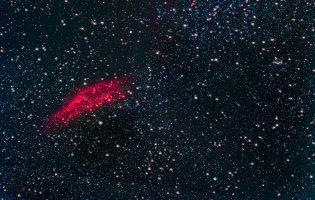
I hope it's not inappropriate, but my last astro effort (and my only one recently) was the following. California Nebula, suburban/semi-rural site, UHC filter. I've been repeatedly astounded how bright this is in ultra widefield (~14mm) shots, so I decided to go closer. But no flats, which seem to disagree with this lens (pity), and no darks cos I forgot. Still...
 

Attachments

  • california-1-1-1-1.jpg
    california-1-1-1-1.jpg
    2.5 MB · Views: 1,006
Upvote 0
Re: Deep Sky Astrophotography

wearle said:
To all,

Here's a wide-field image of the Rosette and Cone Nebula region. This was taken with a modified Canon 5D2 and a Canon 200mm f/2.0L stopped down to f/4.0. It is an integration of 16 four-minute exposures. It was calibrated using six dark frames, twenty biases, and twenty flats. All calibration and processing was done in PixInsight.

Thanks for looking,

Wade

Very nice Wade .
 
Upvote 0
Re: Deep Sky Astrophotography

scyrene said:
I hope it's not inappropriate, but my last astro effort (and my only one recently) was the following. California Nebula, suburban/semi-rural site, UHC filter. I've been repeatedly astounded how bright this is in ultra widefield (~14mm) shots, so I decided to go closer. But no flats, which seem to disagree with this lens (pity), and no darks cos I forgot. Still...

Nice shot. It looks a little overprocessed...saturation is a bit harsh, and the stars have that funky halo around them. I'd pull back on the processing a bit, reduce saturation...and that would actually probably help bring out more subtlety in nebula detail.

Out of curiosity, how long was the exposure?
 
Upvote 0
Re: Deep Sky Astrophotography

To all,

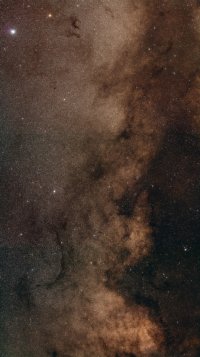
Here's a wide-field image of the dark nebula in Aquila. This is a three frame mosaic. It was taken with a modified Canon 5D2 and a Canon 200mm f/2.0L stopped down to f/4.0. Each frame is an integration of 10 four-minute exposures. Each frame was calibrated using six dark frames, twenty biases, and twenty flats. All calibration and processing was done in PixInsight.

I may try to add a few frames to the right side of the mosaic this year as it is just too dark. That's what happens when you grab a portion of the Great Rift. :)

Thanks for looking,

Wade
 

Attachments

  • aquila_dark_nebula_200mm_5d2_538x960.jpg
    aquila_dark_nebula_200mm_5d2_538x960.jpg
    285.9 KB · Views: 1,419
Upvote 0
Re: Deep Sky Astrophotography

jrista said:
scyrene said:
I hope it's not inappropriate, but my last astro effort (and my only one recently) was the following. California Nebula, suburban/semi-rural site, UHC filter. I've been repeatedly astounded how bright this is in ultra widefield (~14mm) shots, so I decided to go closer. But no flats, which seem to disagree with this lens (pity), and no darks cos I forgot. Still...

Nice shot. It looks a little overprocessed...saturation is a bit harsh, and the stars have that funky halo around them. I'd pull back on the processing a bit, reduce saturation...and that would actually probably help bring out more subtlety in nebula detail.

Out of curiosity, how long was the exposure?

Ah, the haloes are due to using a very wide aperture with the UHC filter, which they're not meant for. I get big red haloes round the medium-brightness stars, so I use 'remove colour fringing' in Lightroom, but that does leave these grey haloes, which isn't what I'd prefer, but it's a limitation of my setup at present. I'd like to stop down to reduce this, but I can't afford the light loss, as my tracking won't go beyond 1-2m mins per subframe. Also using this lens wide open creates all sorts of weird colour casts across the image, so it needs a bit more processing than the 100L Macro, for instance. The upshot is you get a lot more faint stars.

I rather like the saturation, though I can understand why some would tone it down. It's always a tough balance. This is 113x1min exposures at f/1.2 (50D @ ISO 1600)
 
Upvote 0
Re: Deep Sky Astrophotography

scyrene said:
jrista said:
scyrene said:
I hope it's not inappropriate, but my last astro effort (and my only one recently) was the following. California Nebula, suburban/semi-rural site, UHC filter. I've been repeatedly astounded how bright this is in ultra widefield (~14mm) shots, so I decided to go closer. But no flats, which seem to disagree with this lens (pity), and no darks cos I forgot. Still...

Nice shot. It looks a little overprocessed...saturation is a bit harsh, and the stars have that funky halo around them. I'd pull back on the processing a bit, reduce saturation...and that would actually probably help bring out more subtlety in nebula detail.

Out of curiosity, how long was the exposure?

Ah, the haloes are due to using a very wide aperture with the UHC filter, which they're not meant for. I get big red haloes round the medium-brightness stars, so I use 'remove colour fringing' in Lightroom, but that does leave these grey haloes, which isn't what I'd prefer, but it's a limitation of my setup at present. I'd like to stop down to reduce this, but I can't afford the light loss, as my tracking won't go beyond 1-2m mins per subframe. Also using this lens wide open creates all sorts of weird colour casts across the image, so it needs a bit more processing than the 100L Macro, for instance. The upshot is you get a lot more faint stars.

I rather like the saturation, though I can understand why some would tone it down. It's always a tough balance. This is 113x1min exposures at f/1.2 (50D @ ISO 1600)

You should look into getting Astronomy Tools. It's a set of PS actions that might help you with your halo problems. It's pretty cheap, around $20.
 
Upvote 0
Re: Deep Sky Astrophotography

So, I FINALLY got some clear sky for a period of several hours, and was finally able to create a nicer image of Horse Head and Flame Nebulas:


See at my blog

Integration of 1h 30m of subs. Not really enough to reduce noise to an acceptable level, I need about 5h total to really reduce noise. But I was able to stretch and enhance the nebula detail quite a bit!

Stack of 30x180s @ ISO 400. Canon 7D, EF 600mm f/4 L II as telescope. Calibrated with 30 flats and 100 bias.

See full size image at AstroBin:

 
Upvote 0
Re: Deep Sky Astrophotography

jrista said:
So, I FINALLY got some clear sky for a period of several hours, and was finally able to create a nicer image of Horse Head and Flame Nebulas:


See at my blog

Integration of 1h 30m of subs. Not really enough to reduce noise to an acceptable level, I need about 5h total to really reduce noise. But I was able to stretch and enhance the nebula detail quite a bit!

Stack of 30x180s @ ISO 400. Canon 7D, EF 600mm f/4 L II as telescope. Calibrated with 30 flats and 100 bias.

See full size image at AstroBin:


Nice work. So there's no tracking device, correct? This is the full size image? So it's a crop of the image?
 
Upvote 0