
You are using an out of date browser. It may not display this or other websites correctly.
You should upgrade or use an alternative browser.
You should upgrade or use an alternative browser.
Deep Sky Astrophotography
- Thread starter jrista
- Start date

jrista said:Looks like one of my images is going to be published in Sky & Telescope Magazine:
http://www.canonrumors.com/forum/index.php?topic=29527.0
Second time, although the first image, which should be in the May edition next month, was a collaboration between me and another astrophotographer. This time, it's 100% my work.
Congratulations, well deserved.
Upvote
0
Congratulations Jon.jrista said:Looks like one of my images is going to be published in Sky & Telescope Magazine:
http://www.canonrumors.com/forum/index.php?topic=29527.0
Second time, although the first image, which should be in the May edition next month, was a collaboration between me and another astrophotographer. This time, it's 100% my work.

Upvote
0
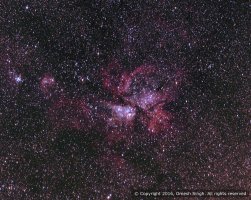
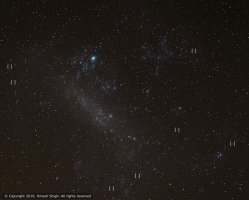
From last night's imaging session...
1 - Carina Nebula - ISO 3200, f/4, 161x3.2s (2x drizzle)
2 - Large Magellanic Cloud (incl. Tarantula Nebula) - ISO 3200, f/2.8, 102x6s
I highlighted some fuzzy objects in the background of the LMC image. Where can I find out what these are? Not sure if they are globular clusters orbiting our galaxy or background galaxies.
1 - Carina Nebula - ISO 3200, f/4, 161x3.2s (2x drizzle)
2 - Large Magellanic Cloud (incl. Tarantula Nebula) - ISO 3200, f/2.8, 102x6s
I highlighted some fuzzy objects in the background of the LMC image. Where can I find out what these are? Not sure if they are globular clusters orbiting our galaxy or background galaxies.
Attachments
Upvote
0
On some other post on some other forum someone was noticing that the "film guy" was taking perhaps a single role of 36 exp film during the day vs. the "electronic guy" was spraying and praying 1000s of exposures - that the discipline of film forced from a cost/frame would lead one to be a more thoughtful photographer.
In reading JRISTA work up to imaging the night sky - there seems to be plenty enough discipline and plenty of thought goes into the effort - perhaps only available because of electronic image processing. (this is in addition to getting the tracking gear lined up, etc)
Check me off as impressed about the discipline and thoughtfulness that goes into each finalized image the Astro folks produce.
Mike
In reading JRISTA work up to imaging the night sky - there seems to be plenty enough discipline and plenty of thought goes into the effort - perhaps only available because of electronic image processing. (this is in addition to getting the tracking gear lined up, etc)
Check me off as impressed about the discipline and thoughtfulness that goes into each finalized image the Astro folks produce.
Mike
Upvote
0
StudentOfLight said:From last night's imaging session...
1 - Carina Nebula - ISO 3200, f/4, 161x3.2s (2x drizzle)
2 - Large Magellanic Cloud (incl. Tarantula Nebula) - ISO 3200, f/2.8, 102x6s
I highlighted some fuzzy objects in the background of the LMC image. Where can I find out what these are? Not sure if they are globular clusters orbiting our galaxy or background galaxies.
Well done.. another step forward there.
I think you mentioned you had stellarium, that's not a bad place to start when trying to identify the fuzzies.
I hope you're saving your stacked images (pre-postprocessing) as you'll want to go back and reprocess them in due course and not having to restack is good, although ideally you should keep your raw files too as you can improve your stacking process as well.
Producing images like this is a spiral, you get basic images, then you get stacking, then maybe upgrade the mount to take longer images, then the lens/telescope, then the processing software, then the location you're imaging from then back to the mount as you realise you can take even longer images, then change to scope to get better reach then, narrowband filters, then... you get the picture.
One word of advice.. if you want to spendany cash, bankrupt yourself for the mount and make do with everything else. a point and shoot on a great mount will surpass any scope on a lousy mount. The two main parameters you should look for are load capacity and periodic error.
Right now I have a fullerscope MkIV.. ancient mount, but huge load capacity and I've got the tracking reasonably good.. however I want to upgrade to this: http://www.mesu-optics.nl/mesu200_en.html
in the meantime I'm still trying to find time to build my observatory.
Upvote
0

As I was going through my massive volumes (terrabytes) of old data, I fond some data from one of my original Pleiades images. Back when I first acquired this data, I gathered a couple nights worth in September 2014, and processed about 3h30m of data. Back then, I was still just a beginner, and my skill with processing images, which I was doing partly in PixInsight and partly in Photoshop, was far more primitive.
The original image was one of my best at the time:

The Pleiades - 3.5hr - Canon 5D III, 150s @ ISO 400 | PixInsight (linear) & Photoshop (non-linear)

When I first processed this, I was a bit surprised to find a bunch of dust details in the area of space around the Pleiades itself. I never expected to get enough signal to do anything with those details, and I set about trying to bring them out. The very high noise added by light pollution limited my options with only 3.5hr worth of data, however. So I set about gathering more data, and for the next three months, through November 26th 2014, I acquired a total of about 11 hours of data.
I tried to process the entire data set a couple of times, and each time I had issues with severe complex gradients that I was unable to overcome at the time with my existing processing (we had some wildly different weather phenomena throughout those three months.) It was also at the end of 2014, December 23rd, that I found and started using a dark site to do all my wide field imaging. The dark site produced vastly superior results in far less time (I was starting to average 9-10 hours per integration from my back yard, and often even that much still did not produce good results, especially when using an LP filter). Once I started going to the dark site, I basically forgot about all the data I had acquired for the Pleiades.
With it's recent rediscovery, including matching flat frames, I decided to reprocess with my more advanced PixInsight skills. I used SubframeSelector to cull out the worst of the subs, and I ended up with just over 9 hours of data in the new integration, produced entirely with PixInsight using better master bias and master dark frames, as well as some additional cosmetic correction to fix hot and cold pixels that the darks missed (my darks were similar in temp, but newer, and not all of the hot and cold pixels matched). I then processed the resulting integration entirely in PixInsight.

The Pleiades - 9Hr+ - Canon 5D III, 150s @ ISO 400 | PixInsight (linear & non-linear)

This data was actually one of the few that I acquired unfiltered from my back yard. All but a couple other images were acquired with the Astronomik CLS, which greatly enhanced emission nebula, but was not very good for broadband objects like Pleiades or Andromeda Galaxy. I was a bit surprised when the final integration revealed some of the faint reddish-brown dust that exists in the space behind the Pleiades...such a detail is usually reserved for dark sites. The overall detail is not as good as my current work, as my tracking back in those days was not as good as it is these days...however it turned out pretty good for what it is, and for how much data spanning such a broad range of time was stacked.
The original image was one of my best at the time:
The Pleiades - 3.5hr - Canon 5D III, 150s @ ISO 400 | PixInsight (linear) & Photoshop (non-linear)
When I first processed this, I was a bit surprised to find a bunch of dust details in the area of space around the Pleiades itself. I never expected to get enough signal to do anything with those details, and I set about trying to bring them out. The very high noise added by light pollution limited my options with only 3.5hr worth of data, however. So I set about gathering more data, and for the next three months, through November 26th 2014, I acquired a total of about 11 hours of data.
I tried to process the entire data set a couple of times, and each time I had issues with severe complex gradients that I was unable to overcome at the time with my existing processing (we had some wildly different weather phenomena throughout those three months.) It was also at the end of 2014, December 23rd, that I found and started using a dark site to do all my wide field imaging. The dark site produced vastly superior results in far less time (I was starting to average 9-10 hours per integration from my back yard, and often even that much still did not produce good results, especially when using an LP filter). Once I started going to the dark site, I basically forgot about all the data I had acquired for the Pleiades.
With it's recent rediscovery, including matching flat frames, I decided to reprocess with my more advanced PixInsight skills. I used SubframeSelector to cull out the worst of the subs, and I ended up with just over 9 hours of data in the new integration, produced entirely with PixInsight using better master bias and master dark frames, as well as some additional cosmetic correction to fix hot and cold pixels that the darks missed (my darks were similar in temp, but newer, and not all of the hot and cold pixels matched). I then processed the resulting integration entirely in PixInsight.
The Pleiades - 9Hr+ - Canon 5D III, 150s @ ISO 400 | PixInsight (linear & non-linear)
This data was actually one of the few that I acquired unfiltered from my back yard. All but a couple other images were acquired with the Astronomik CLS, which greatly enhanced emission nebula, but was not very good for broadband objects like Pleiades or Andromeda Galaxy. I was a bit surprised when the final integration revealed some of the faint reddish-brown dust that exists in the space behind the Pleiades...such a detail is usually reserved for dark sites. The overall detail is not as good as my current work, as my tracking back in those days was not as good as it is these days...however it turned out pretty good for what it is, and for how much data spanning such a broad range of time was stacked.
Upvote
0

Jon, seeing your pictures - no matter if they're from your "beginner" time or else - I sometimes wish I had even more passion for Astronomy and astro photography than I already have and do this myself.jrista said:... Back then, I was still just a beginner, and my skill ...
[snip]
... The overall detail is not as good as my current work, as my tracking back in those days was not as good as it is these days...however it turned out pretty good for what it is, and for how much data spanning such a broad range of time was stacked.
It is really great work that I see here and I thank you for sharing this with us.
I know that except from some nights of visual observations with my 6" I won't go further on this because of my two sons and me being "early birds" and a night without sleep causes to much sulky day afterwards.
So once again, you for sharing.
Upvote
0
Maximilian said:Jon, seeing your pictures - no matter if they're from your "beginner" time or else - I sometimes wish I had even more passion for Astronomy and astro photography than I already have and do this myself.jrista said:... Back then, I was still just a beginner, and my skill ...
[snip]
... The overall detail is not as good as my current work, as my tracking back in those days was not as good as it is these days...however it turned out pretty good for what it is, and for how much data spanning such a broad range of time was stacked.
It is really great work that I see here and I thank you for sharing this with us.
I know that except from some nights of visual observations with my 6" I won't go further on this because of my two sons and me being "early birds" and a night without sleep causes to much sulky day afterwards.
So once again, you for sharing.
Thank you, Max.
If you are interested in this stuff, and you have a 6" reflector, you might want to give planetary imaging a try. Lot less demanding, cheaper equipment, easier to get rolling. You need good seeing to get hte best results, but imaging Jupiter can be done in a couple of hours total, from setting up to processing the data, while DSO imaging can often take days to get through the whole process.
Upvote
0
Thank you for encouraging me.jrista said:Thank you, Max.
If you are interested in this stuff, and you have a 6" reflector, you might want to give planetary imaging a try. Lot less demanding, cheaper equipment, easier to get rolling. You need good seeing to get hte best results, but imaging Jupiter can be done in a couple of hours total, from setting up to processing the data, while DSO imaging can often take days to get through the whole process.
In my backyard there is a lot of light pollution from street lights and also some high trees.
The latter isn't that dramatic as you just have to concentrate away from the light polluted horizon.
But if you want to have really good seeing (5mag and better) in Germany you'll have to drive a few meters to find field or enclosure where it's dark enough.
But I was able to show my sons Jupiter lately from my backyard and I was positively surprised how well I could see the bands in the atmosphere and we were lucky that all four Galilean moons were in perfect position to be observed. So maybe seeing is better than I think

Upvote
0

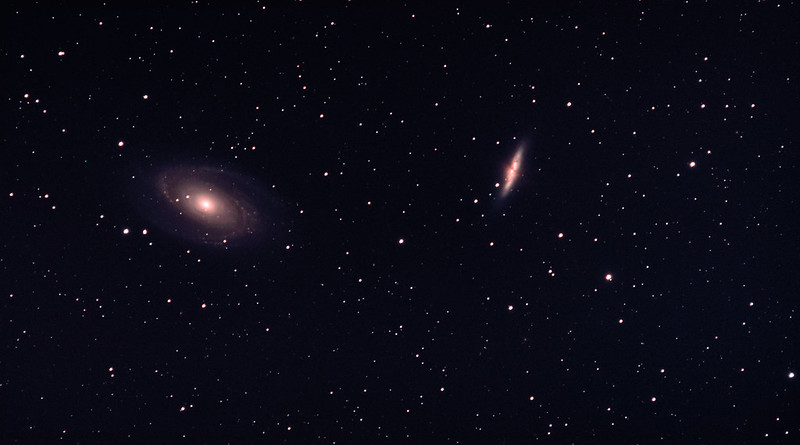

telemaq76 said:New picture of M81+M82
24* 5 minutes with canon 700d astrodon+500f4+tc 1.4III+neq6pro
+ dof
Iris and bit of photoshop
Thanks for sharing. Nicely done and a decently flat background, unusual to see another user of IRIS, I thought I was one of the last to still use it.
Upvote
0
Very nice work, Telemaq. Very nice indeed. I am pretty amazed you were able to bring out that detail with IRIS...not many IRIS users out there.
Upvote
0
thank you guys i appreciate. I enjoy m16, m17, m8 back soon 
i ve a question for people shooting with a dslr...do you shoot all your pictures with 1 seconde delay or do you wait a delay , 15 or 30 secondes between each pictures...to let the sensor cool down a bit? is it necessary to do that? i always shoot no stop with 1 sec delay but i wonder if it s better to wait between each shot
i ve a question for people shooting with a dslr...do you shoot all your pictures with 1 seconde delay or do you wait a delay , 15 or 30 secondes between each pictures...to let the sensor cool down a bit? is it necessary to do that? i always shoot no stop with 1 sec delay but i wonder if it s better to wait between each shot
Upvote
0
telemaq76 said:thank you guys i appreciate. I enjoy m16, m17, m8 back soon
i ve a question for people shooting with a dslr...do you shoot all your pictures with 1 seconde delay or do you wait a delay , 15 or 30 secondes between each pictures...to let the sensor cool down a bit? is it necessary to do that? i always shoot no stop with 1 sec delay but i wonder if it s better to wait between each shot
I would doubt it's going to make much difference, the ability for the sensor to cool down is unlikely to make much difference unless you're throwing away 50% or more of your imaging time, I never waited when I was using DSLR. I just accepted the dark current would change and compensate in calibration.
(OPT command)
Upvote
0
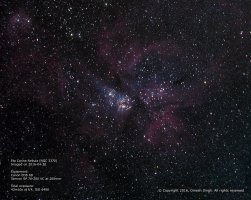
StudentOfLight said:My love affair with the Carina Nebula continues...
nice!.. faint nebulosity is really starting to show through.
are you still on ~2s exposures?
Edit: I think this is good enough to start thinking about how to scale the image without clipping stars, I've done this by just scaling the luminance and also by isolating the stars and the nebula into two images then processing them and joining them back together at the end. The final effect is to have lots of stars with somewhat accurate colours rather than having them all comming out white. Point is, there's more than just one way to do it, so I don't want to tell you this way or that way is what you need to do, just wanted to hi-light another step to make the image even better.
here's an example where no stars are clipped, it still needs a lot more data as the Galaxy is hidden behind dust in the milky way, but it will do to show how even the very brightest stars are not clipped:

Upvote
0
Thanks again for the feedback. I'll definitely implement the highlight retention processing going forward.
Side-note: On this occasion humidity was about 72% as well so not very good seeing conditions.
I'm still unfortunately without a tracking mount so there is still a tiny bit of trailing in my stars. So perhaps you guys can offer some advice. I think these are my requirements:
0) I'm looking to spend $800-1600 on a mount + drive system
1) I'm currently using the 6D, but will likely get an 80D (or 7D-III) in the future
2) I'm most interested in shooting objects with lenses in the 70-400mm focal length range
3) I value portability as I'd want to drive to a remote location and hike still further away from roads
4) I might get a telescope at a later stage so focal length could become a bit longer
5) I'd be happy with getting reasonably accurate tracking for 2-3 minute sub-exposures (Is that a realistic expectation given my price range?)
Ideally I'd want to walk into a brick-and-mortar shop, see the products first-hand, and speak in-person to an expert, but I don't think there are many shops like this anymore, not where I live at least.
Side-note: On this occasion humidity was about 72% as well so not very good seeing conditions.
I'm still unfortunately without a tracking mount so there is still a tiny bit of trailing in my stars. So perhaps you guys can offer some advice. I think these are my requirements:
0) I'm looking to spend $800-1600 on a mount + drive system
1) I'm currently using the 6D, but will likely get an 80D (or 7D-III) in the future
2) I'm most interested in shooting objects with lenses in the 70-400mm focal length range
3) I value portability as I'd want to drive to a remote location and hike still further away from roads
4) I might get a telescope at a later stage so focal length could become a bit longer
5) I'd be happy with getting reasonably accurate tracking for 2-3 minute sub-exposures (Is that a realistic expectation given my price range?)
Ideally I'd want to walk into a brick-and-mortar shop, see the products first-hand, and speak in-person to an expert, but I don't think there are many shops like this anymore, not where I live at least.
Upvote
0
Similar threads
- Replies
- 206
- Views
- 184K