Difference in image from APS-C to FF

bdunbar79 said:
I get that, I was more or less thinking in terms of absolute area of the lens diameter and not the focal length. Because in theory in Bizzaro World I could create a 16mm lens with a gigantic diameter or a super long and narrow 600mm lens. I didn't do the math on any of it so the 600 might very well always beat the 16mm...

...Ooo time for more Guiness Extra Stout...

Yea, it does get complicated. Here's a link to a guy who can explain it much better than me:

http://www.clarkvision.com/articles/exposure/

In a nutshell light density is not the same as total light in volume terms. Exposure is dictated by light density, not volume. A greater volume of light will lead to less noise.

When you magnify you lose light density. This is why the given aperture of a longer lens is larger in diameter than a shorter one, to give the same exposure. So when I said a longer focal length lens passes more light, in practice it does, unless you want a 600 mil lens that starts at f64.

This is why those who use long focal length lenses on their aps cameras are generally more content with the sensor size than those who use very short focal length lenses.

Of course this becomes more relevant in lower levels of light density - darker.

'Landscape' FF focal length lenses are still quite short, and so suffer from small diameter. This is why I find it amusing when I hear people referring to the likes of a D810 or A7r as the 'ultimate landscape camera'. It is also going to be the problem with cramming more pixels into a FF size sensor, and the reason why a lower mp count DMF sensor will run rings round a very high FF.
 
Upvote 0
neuroanatomist said:
Ps. After that, if you like dark beers try a Sam Smith's Imperial Stout. In the bottle, which has gold foil over the top, it looks a bit darker than a Guinness ES. But after you remove the foil, you see that unlike the brown Guinness bottle, the Sam Smith's is clear glass.

Cool. I love dark beers and it has always been a small hobby of mine to seek and find obscure ones. Thank you. My wife is about ready to kill me right now because I've been watching the New England game with my "6 pack." Sam Smith's Imperial Stout, I will have to try that. Where do you get the Foreign Stout?

Thanks.
 
Upvote 0
Sporgon said:
bdunbar79 said:
I get that, I was more or less thinking in terms of absolute area of the lens diameter and not the focal length. Because in theory in Bizzaro World I could create a 16mm lens with a gigantic diameter or a super long and narrow 600mm lens. I didn't do the math on any of it so the 600 might very well always beat the 16mm...

...Ooo time for more Guiness Extra Stout...

Yea, it does get complicated. Here's a link to a guy who can explain it much better than me:

http://www.clarkvision.com/articles/exposure/

In a nutshell light density is not the same as total light in volume terms. Exposure is dictated by light density, not volume. A greater volume of light will lead to less noise.

When you magnify you lose light density. This is why the given aperture of a longer lens is larger in diameter than a shorter one, to give the same exposure. So when I said a longer focal length lens passes more light, in practice it does, unless you want a 600 mil lens that starts at f64.

This is why those who use long focal length lenses on their aps cameras are generally more content with the sensor size than those who use very short focal length lenses.

Of course this becomes more relevant in lower levels of light density - darker.

'Landscape' FF focal length lenses are still quite short, and so suffer from small diameter. This is why I find it amusing when I hear people referring to the likes of a D810 or A7r as the 'ultimate landscape camera'. It is also going to be the problem with cramming more pixels into a FF size sensor, and the reason why a lower mp count DMF sensor will run rings round a very high FF.

Thanks to you and Neuro, I got it now. That's actually a really, really good point and one often overlooked.
 
Upvote 0
Sporgon said:
You're very observant, because what you have seen is the difference in the volume of light that a longer lens passes and the lower volume that a short focal length passes.

Sporgon said:
Yea, it does get complicated. Here's a link to a guy who can explain it much better than me:

http://www.clarkvision.com/articles/exposure/

In a nutshell light density is not the same as total light in volume terms. Exposure is dictated by light density, not volume. A greater volume of light will lead to less noise.

Consider his comparison – a 200mm f/4 lens vs. a 50mm f/2 lens, same shutter speed, same ISO, same subject. The image from the 200mm f/4 lens has less noise despite being two stops slower and pushed in post for matched brightness. You seem to be concluding that the greater 'volume of light' means less noise from the longer focal length.

But you must consider his setup, about which he states, "The images were made with the same camera, from the same distance, using two different lenses." He's showing the subjects at (essentially) identical size, which means the image from the 50/2 is a 4x crop compared to the 200/4 image. Of course the noise is worse with a 4x crop...the 'volume of light' is lower because a much smaller area of the sensor is being used with the shorter FL lens. It's like proving that at the same exposure, my 1D X has less noise than my PowerShot S100 (a 4.6x crop sensor). I don't think we should call Reuters to have that put on the wire services...

If he had moved forward with the 50mm lens so the framing was identical to the 200mm lens, the same area of the sensor would have been used in both shots, the 50/2 shot would have been less noisy than the 200/4 shot after the latter was pushed two stops to match brightness.

Your 'volume of light' concept (more light means less noise) is correct, but focal length is irrelevant. It's about the area of the sensor, which determines the total light gathered for a given exposure. I could compare 24mm on my 1D X with 24mm on my S100, same subject framed identically (thus from much further away with the S100), with the same exposure settings and the S100 would obviously have more noise because the area of the sensor is much smaller, and therefore gathers less total light.
 
Upvote 0
bdunbar79 said:
neuroanatomist said:
Ps. After that, if you like dark beers try a Sam Smith's Imperial Stout. In the bottle, which has gold foil over the top, it looks a bit darker than a Guinness ES. But after you remove the foil, you see that unlike the brown Guinness bottle, the Sam Smith's is clear glass.

Cool. I love dark beers and it has always been a small hobby of mine to seek and find obscure ones. Thank you. My wife is about ready to kill me right now because I've been watching the New England game with my "6 pack." Sam Smith's Imperial Stout, I will have to try that. Where do you get the Foreign Stout?

I first had the Foreign Extra Stout when I ordered "a Guinness" in the cafe/bar at the Hotel Muhabura in Ruhengeri, Rwanda. But about a year ago I ran across some 4-packs in the liquor store next to the Whole Foods in the town where I live, so obviously it can be ordered in the US. Maybe ask your local store?
 
Upvote 0
neuroanatomist said:
Sporgon said:
Yea, it does get complicated. Here's a link to a guy who can explain it much better than me:

http://www.clarkvision.com/articles/exposure/

In a nutshell light density is not the same as total light in volume terms. Exposure is dictated by light density, not volume. A greater volume of light will lead to less noise.

Consider his comparison – a 200mm f/4 lens vs. a 50mm f/2 lens, same shutter speed, same ISO, same subject. The image from the 200mm f/4 lens has less noise despite being two stops slower and pushed in post for matched brightness. You seem to be concluding that the greater 'volume of light' means less noise from the longer focal length.

But you must consider his setup, about which he states, "The images were made with the same camera, from the same distance, using two different lenses." He's showing the subjects at (essentially) identical size, which means the image from the 50/2 is a 4x crop compared to the 200/4 image. Of course the noise is worse with a 4x crop...the 'volume of light' is lower because a much smaller area of the sensor is being used with the shorter FL lens. It's like proving that at the same exposure, my 1D X has less noise than my PowerShot S100 (a 4.6x crop sensor). I don't think we should call Reuters to have that put on the wire services...

Darn you beat me to it.

Surely this 'observation' is just a function of magnification?

The first two images in the link illustrate this, the stars are dimmer because the same amount of light captured is being enlarged more, bearing in mind both images are crops, it is just that the 15mm image is cropped and enlarged more.
 
Upvote 0
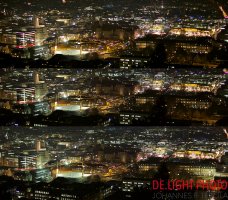
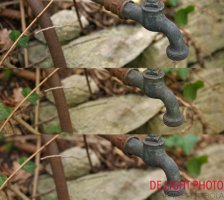
I believe this comparison is too weak: you should consider µ43 as well. I do have 2 photos from all 3 formats in comparison:

The top is the 5D3
The middle is 7D2
The lowest is the Panasonic GM1

I will extend that comparison in the future but I think you have to do extrem stuff to get the advantage of FF, but than there is no choice, f.i. @ HDR and extreme adaptions in post...
 

Attachments

  • 20141216 ISO1600 nächtliche Stadt.JPG
    20141216 ISO1600 nächtliche Stadt.JPG
    2.7 MB · Views: 230
  • Vergleich 5D3-7D2-GM1- Wasserhahn.JPG
    Vergleich 5D3-7D2-GM1- Wasserhahn.JPG
    1.8 MB · Views: 213
Upvote 0
JoFT said:
I believe this comparison is too weak: you should consider µ43 as well. I do have 2 photos from all 3 formats in comparison:

The top is the 5D3
The middle is 7D2
The lowest is the Panasonic GM1

I will extend that comparison in the future but I think you have to do extrem stuff to get the advantage of FF, but than there is no choice, f.i. @ HDR and extreme adaptions in post...

Without knowing the specific camera settings for each shot the comparisons are useless. But the DOF apparent in the bottom group would suggest you have the labels reversed with the ff crop on the bottom and the m4/3 on the top.
 
Upvote 0
privatebydesign said:
JoFT said:
I believe this comparison is too weak: you should consider µ43 as well. I do have 2 photos from all 3 formats in comparison:

The top is the 5D3
The middle is 7D2
The lowest is the Panasonic GM1

I will extend that comparison in the future but I think you have to do extrem stuff to get the advantage of FF, but than there is no choice, f.i. @ HDR and extreme adaptions in post...

Without knowing the specific camera settings for each shot the comparisons are useless. But the DOF apparent in the bottom group would suggest you have the labels reversed with the ff crop on the bottom and the m4/3 on the top.

That was exactly the idea: All images were shot at comparable settings getting rid of the influence of the crop factor for DOF:

5D3 with 1.4 50mm@ f2.8
7D2 with 2.0 35mm @ f 2.0
GM1 with 1.4 25mm @ f 1.4

ISO @ the night shot: 1600
ISO @ the water tap: ISO 200
 
Upvote 0
JoFT said:
privatebydesign said:
JoFT said:
I believe this comparison is too weak: you should consider µ43 as well. I do have 2 photos from all 3 formats in comparison:

The top is the 5D3
The middle is 7D2
The lowest is the Panasonic GM1

I will extend that comparison in the future but I think you have to do extrem stuff to get the advantage of FF, but than there is no choice, f.i. @ HDR and extreme adaptions in post...

Without knowing the specific camera settings for each shot the comparisons are useless. But the DOF apparent in the bottom group would suggest you have the labels reversed with the ff crop on the bottom and the m4/3 on the top.

That was exactly the idea: All images were shot at comparable settings getting rid of the influence of the crop factor for DOF:

5D3 with 1.4 50mm@ f2.8
7D2 with 2.0 35mm @ f 2.0
GM1 with 1.4 25mm @ f 1.4

ISO @ the night shot: 1600
ISO @ the water tap: ISO 200

If they were then they would be identical, I have done similar comparisons (http://www.canonrumors.com/forum/index.php?topic=15884.msg291300#msg291300). I would suggest here is a fault in your methodology because my results did not show that difference in dof.
 

Attachments

  • index.jpg
    index.jpg
    155.5 KB · Views: 1,321
Upvote 0
privatebydesign said:
JoFT said:
privatebydesign said:
JoFT said:
I believe this comparison is too weak: you should consider µ43 as well. I do have 2 photos from all 3 formats in comparison:

The top is the 5D3
The middle is 7D2
The lowest is the Panasonic GM1

I will extend that comparison in the future but I think you have to do extrem stuff to get the advantage of FF, but than there is no choice, f.i. @ HDR and extreme adaptions in post...

Without knowing the specific camera settings for each shot the comparisons are useless. But the DOF apparent in the bottom group would suggest you have the labels reversed with the ff crop on the bottom and the m4/3 on the top.

That was exactly the idea: All images were shot at comparable settings getting rid of the influence of the crop factor for DOF:

5D3 with 1.4 50mm@ f2.8
7D2 with 2.0 35mm @ f 2.0
GM1 with 1.4 25mm @ f 1.4

ISO @ the night shot: 1600
ISO @ the water tap: ISO 200

If they were then they would be identical, I have done similar comparisons (http://www.canonrumors.com/forum/index.php?topic=15884.msg291300#msg291300). I would suggest here is a fault in your methodology because my results did not show that difference in dof.

there is basically no difference in DOF, but I did not had the camera in a tripod. Therefore the focusing was not exactly at the same point of the water tap. It was some millimeters difference... and in the camera angle as well.

My main topic is to check wether i will see the difference in dynamic range, tonal range or color sensitivity etc...
 
Upvote 0
Honestly, you will be very happy with your 70D, until you get a 6D or a 5DIII. Then your 70D will begin to collect dust.

Put it this way, you don't know what you are missing, so you love your 70D. But if you had a 5DIII and someone took it away and gave you a 70D, you'd probably not like photography any more.

I exaggerate, a little, for impact.
 
Upvote 0
JoFT said:
there is basically no difference in DOF, but I did not had the camera in a tripod. Therefore the focusing was not exactly at the same point of the water tap. It was some millimeters difference... and in the camera angle as well.

My main topic is to check wether i will see the difference in dynamic range, tonal range or color sensitivity etc...

As I said, there is a problem in your methodology. You cannot make comparisons of minutiae if you have bigger flaws in the methodology. There are big differences in your point of focus and/or dof so your comparison is fatally flawed for comparing the smaller differences in other aspects.
 
Upvote 0
privatebydesign said:
JoFT said:
there is basically no difference in DOF, but I did not had the camera in a tripod. Therefore the focusing was not exactly at the same point of the water tap. It was some millimeters difference... and in the camera angle as well.

My main topic is to check wether i will see the difference in dynamic range, tonal range or color sensitivity etc...

As I said, there is a problem in your methodology. You cannot make comparisons of minutiae if you have bigger flaws in the methodology. There are big differences in your point of focus and/or dof so your comparison is fatally flawed for comparing the smaller differences in other aspects.

I agree; the method is flawed, all the pics should be at the same f-stop. Sure, the FF can create similar bokeh as the micro 4/3, but the POINT is that the opposite is not true. The Micro 4/3 can't achieve the same shallow DOF as the FF. Changing the f-stops to create the same looks is a pointless endeavor. If they were all shot at f/2.0 the shallow DOF capability of the FF would be illustrated.
 
Upvote 0
jepabst said:
I agree; the method is flawed, all the pics should be at the same f-stop.

I thought the whole idea is that the guy is trying to show equivalence between the format sizes - so the actual aperture opening has to be the same diameter - the f stop will be different on the different focal lengths to achieve this.
 
Upvote 0
Sporgon said:
jepabst said:
I agree; the method is flawed, all the pics should be at the same f-stop.

I thought the whole idea is that the guy is trying to show equivalence between the format sizes - so the actual aperture opening has to be the same diameter - the f stop will be different on the different focal lengths to achieve this.
Then I retract my ignorant statement. I should have read closer. My apologies. I guess I didn't see the point of that.
 
Upvote 0
jepabst said:
Sporgon said:
jepabst said:
I agree; the method is flawed, all the pics should be at the same f-stop.

I thought the whole idea is that the guy is trying to show equivalence between the format sizes - so the actual aperture opening has to be the same diameter - the f stop will be different on the different focal lengths to achieve this.

Thank you...
But it is not the equivalence I want to see... I want to see the differences -if possible- at "same" optical conditions - perspective and DOF...

Bu I see that I have to improve the technical setup..
Then I retract my ignorant statement. I should have read closer. My apologies. I guess I didn't see the point of that.
 
Upvote 0
TeT said:
300mm 1/125 5.6 400 from 6D & SL1

Thanks for this very good example! I shows perfectly that when shooting a subject with the exactly same parameters and distance, the APS-C photo is really a crop of the FF photo: Same DOF, same perspective, same everything... just a crop!
 
Upvote 0
neuroanatomist said:
bdunbar79 said:
neuroanatomist said:
Ps. After that, if you like dark beers try a Sam Smith's Imperial Stout. In the bottle, which has gold foil over the top, it looks a bit darker than a Guinness ES. But after you remove the foil, you see that unlike the brown Guinness bottle, the Sam Smith's is clear glass.

Cool. I love dark beers and it has always been a small hobby of mine to seek and find obscure ones. Thank you. My wife is about ready to kill me right now because I've been watching the New England game with my "6 pack." Sam Smith's Imperial Stout, I will have to try that. Where do you get the Foreign Stout?

I first had the Foreign Extra Stout when I ordered "a Guinness" in the cafe/bar at the Hotel Muhabura in Ruhengeri, Rwanda. But about a year ago I ran across some 4-packs in the liquor store next to the Whole Foods in the town where I live, so obviously it can be ordered in the US. Maybe ask your local store?

Watch that Foreign Extra Stout it makes your eyes go funny!
Note there are a number of versions, I prefer the one brewed in St James' Dublin. It is also made in:
"FES is produced at Diageo owned breweries in Nigeria, Kenya, Ghana, Cameroon, Ethiopia, Tanzania, Uganda, Seychelles, Malaysia and Jamaica.[23] In addition, it is produced under licence in 39 other countries.[23][24] Diageo has brewing arrangements with the Castel Group to license brew and distribute Guinness in the Democratic Republic of Congo, Gambia, Gabon, Ivory Coast, Togo, Benin, Burkina Faso, Chad, Mali and Guinea" according to Wikipedia.
 
Upvote 0