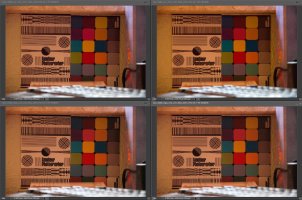
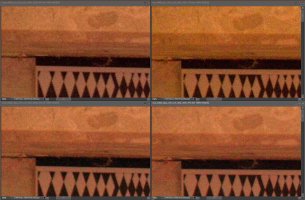
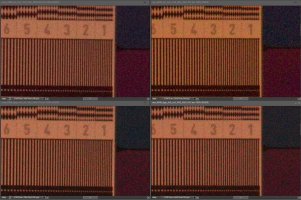
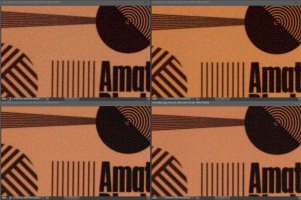
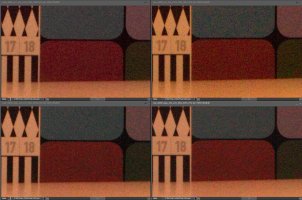
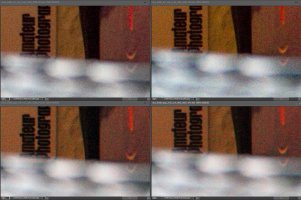
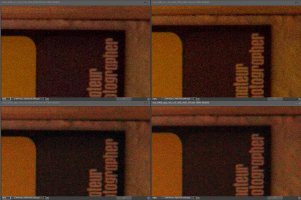
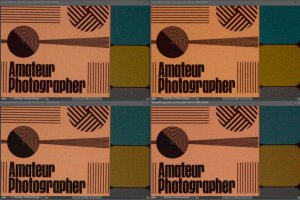
tl;dr version: I'm really interested in low noise during low-light/high-ISO shots, and am wondering if shooting in smaller RAW formats could help in that effort.
I'm betting it doesn't work, but what does shooting in smaller RAW sizes (e.g. M-RAW, S-RAW) actually do in terms of mapping sensor sites to the final image, and can it combine sensor site outputs to increase apparent light sensitivity without boosting ISO? And if not, why not?
Example: take a 20 megapixel sensor, intelligently combine the readings of each block of 2x2 red, green, and blue neighboring sensor sites, and spit out a 5 megapixel image. If that's done closer to the sensor, before the interpolation of subsensor sites into RGB pixels, might it result in a better (e.g. lower noise) result? The idea would be to discard the outputs of aberrant sensor sites before they could muddy the interpolation algorithm and "dirty" more final pixels. I wonder if that would be better than taking a full resolution image, applying noise reduction post-processing tools, and spitting out a 5 megapixel image at the end of the workflow.
Any thoughts? Anyone actually know how sensor sites are mapped onto S-RAW and M-RAW image pixels? Thanks!
I'm betting it doesn't work, but what does shooting in smaller RAW sizes (e.g. M-RAW, S-RAW) actually do in terms of mapping sensor sites to the final image, and can it combine sensor site outputs to increase apparent light sensitivity without boosting ISO? And if not, why not?
Example: take a 20 megapixel sensor, intelligently combine the readings of each block of 2x2 red, green, and blue neighboring sensor sites, and spit out a 5 megapixel image. If that's done closer to the sensor, before the interpolation of subsensor sites into RGB pixels, might it result in a better (e.g. lower noise) result? The idea would be to discard the outputs of aberrant sensor sites before they could muddy the interpolation algorithm and "dirty" more final pixels. I wonder if that would be better than taking a full resolution image, applying noise reduction post-processing tools, and spitting out a 5 megapixel image at the end of the workflow.
Any thoughts? Anyone actually know how sensor sites are mapped onto S-RAW and M-RAW image pixels? Thanks!