DXO: Canon EOS 6D Mark II Sensor Review: Great Color and ISO Performance

SecureGSM said:
https://www.e-infin.com/uk/item/3071/canon_eos_5d_mark_iv_dslr_camera_(body_only)

As you wish, GBP £2,149.00, all taxes inclusive, free delivery, 14 days Money Back Guarantee, 12 Month Warranty .How is that for Christmas in September? :)

tomscott said:
...Grey market the 5DMKIV is still £2459. Still dont think the 5DMKIV is worth £1000 more grey market.

When it gets to £2-2250 will probably pull the trigger. Would say it will be in that range by Christmas.

Damn there's some real good prices on that site, never even heard of it before, thanks for the link!
How's your experience with them?

Has anyone bought regularly from them?
 
Upvote 0
No worries, Sir! . Experience wise: so far so good. I paid through PayPal in order to protect transaction and received camera just 5 days later. Once received, I jumped on Canon Australia website and registered the product.


zim said:
Damn there's some real good prices on that site, never even heard of it before, thanks for the link!
How's your experience with them?

Has anyone bought regularly from them?
 
Upvote 0
AA said:
DR is a BIG DEAL. It is a big deal because our eyes can see 20 stops of DR!!!

No.
https://en.wikipedia.org/wiki/Human_eye
The retina has a static contrast ratio of around 100:1 (about 6.5 f-stops).

I have another source that says 10 stops, but photo enthusiasts have the tendancy to vaslty exaggerate their own capabilities simply as a form of post purchase rationalization.

When I look at test images across multiple sensors I still like the low ISO images from the 5D2 more than almost anything else, that may very well be the case because it has less DR. "Black" shadows, deep and rich without unnecessary confusion.
This idea of putting detail in every pixel of every photo didn't even exist when I joined this forum less than 6 years ago, it's simply a reaction to the different capabilities being brought about in the brand wars.

Of course having more DR isn't stricly "bad", making an evening exposure look like daylight is great fun, but hardly necessary.
 
Upvote 0
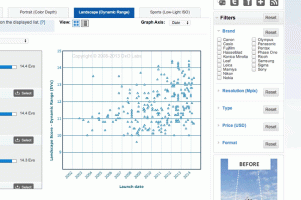
Some of the responses to news of this data coming out has been entertaining.

This animated GIF is worth a gander. Subtle.

- A
 

Attachments

  • d5771c805fa2c5f91efaf36e9c107ae50e148826b8070ca34a08400d7183818e.gif
    d5771c805fa2c5f91efaf36e9c107ae50e148826b8070ca34a08400d7183818e.gif
    122.1 KB · Views: 557
Upvote 0
ahsanford said:
Hflm said:
ahsanford said:
Some of the responses to news of this data coming out has been entertaining.

This animated GIF is worth a gander. Subtle.

- A
Where is the 5div (13.6) and 1dxii?

See the timescale in that plot. This is the pre- on-chip ADC era for Canon.

- A

It obviously goes to show that all the negativity directed at canon over DR did not go unnoticed and so bias/no bias, Canon has responded and that's a positive outcome that even the trolls contributed to. The squeaky wheel got greased.

Jack
 
Upvote 0
9VIII said:
AA said:
DR is a BIG DEAL. It is a big deal because our eyes can see 20 stops of DR!!!

No.
https://en.wikipedia.org/wiki/Human_eye
The retina has a static contrast ratio of around 100:1 (about 6.5 f-stops).

Static contrast ratio. When you view a scene, your eyes move around, with extreme rapidity. In essence, your eye and brain are great at HDR imaging, which means the static contrast ratio is relatively unimportant.
 
Upvote 0
ahsanford said:
Hflm said:
ahsanford said:
Some of the responses to news of this data coming out has been entertaining.

This animated GIF is worth a gander. Subtle.

- A
Where is the 5div (13.6) and 1dxii?

See the timescale in that plot. This is the pre- on-chip ADC era for Canon.

- A
I wasn't sure, as the image showed date selected, only.
 
Upvote 0
neuroanatomist said:
9VIII said:
AA said:
DR is a BIG DEAL. It is a big deal because our eyes can see 20 stops of DR!!!

No.
https://en.wikipedia.org/wiki/Human_eye
The retina has a static contrast ratio of around 100:1 (about 6.5 f-stops).

Static contrast ratio. When you view a scene, your eyes move around, with extreme rapidity. In essence, your eye and brain are great at HDR imaging, which means the static contrast ratio is relatively unimportant.

So, what is the DR capability of Hooty? How can we possibly function, we're so handicapped. ;)

Jack
 
Upvote 0
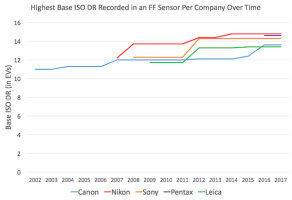
But, in fairness, I will actually offer the same DXO data with a tiny, tiny change: the vertical axis actually going to zero instead of zooming in on the range of values. All values from DXO, this plot is representative of the 'company record' DR each company has delivered in FF as a function of time.

Yep, Canon's just getting murdered with base ISO DR. :P

I appreciate that in 2017 Canon inexplicably didn't deliver 1DX2/5D4/80D-level DR in the 6D2. That's why some Canon faithful folks are seething about the 6D2: the 80D got the good stuff and their chosen horse didn't. I get it.

But you should ask yourself if the absolute delta between companies (at base ISO only!) is so vast as to walk away from the EF portfolio, Canon's ergonomics / handling / interface / quality / reliability, etc. If you are even remotely considering a yes to that, I must tip my cap and acknowledge that you are not me and wish you good luck on your path to photographic happiness.

Meanwhile, five years running, my 5D3 has let me down exactly zero times and I have built up a nice little cabinet of EF glass that I will own for a very long time. Somehow, I endure.

- A
 

Attachments

  • DR over time.png
    DR over time.png
    71.5 KB · Views: 634
Upvote 0
privatebydesign said:
AA said:
DR is a BIG DEAL. It is a big deal because our eyes can see 20 stops of DR!!! A state-of-the-art DR of 14-15 (by Sony) still blows! Every stop counts. 12 stops is simply not good enough in 2017.

No they can't, not in static pupil situations.

Best estimates put static pupil human dynamic range in the 10-14 stop range, if a scene has more DR within it the eye changes aperture so fast we can't tell, but we can't see both the light and dark areas at the same time. We can view scenes with well over 20 stops of DR in them, but only by adjusting exposure for one area at a time.

It always amazes me how close the average static pupil range is to actual camera range, hmmm, wonder why? ::)

Glad you pointed that out so I didn't have to. In other words, the DR of every camera brand at base ISO is within the actual DR range of the human eye. There are so many folks who want more and more DR and seem to have no idea what that means in terms of the actual IQ of their photos. They see review sites measure that metric and see that it continues to go up over the years so more must always be better. Yes, there are some instances where more DR capture from the camera is better, but in most scenarios in my experience, I am adding contrast in PP and reducing DR. I can already tell the difference in how much more often I need to do that with my new M5 compared to my older cameras that had less DR. So, yes, if you want flatter photos with less contrast, by all means keep pushing camera makers to keep adding more DR.
 
Upvote 0
@dak723 That's kind of how I see it. Increasingly we see photos that are simply unrealistic and the eye, at least mine, says this doesn't look real. The more extreme HDR photos I see I simply don't like. What I do like on wildlife is to bring up shadows at times to show feather detail etc. but it does contribute to a less contrasty photo.

Jack
 
Upvote 0
Jack Douglas said:
@dak723 That's kind of how I see it. Increasingly we see photos that are simply unrealistic and the eye, at least mine, says this doesn't look real. The more extreme HDR photos I see I simply don't like. What I do like on wildlife is to bring up shadows at times to show feather detail etc. but it does contribute to a less contrasty photo.

Jack

Hi Jack, when lifting shadows, especially with Canon RAW files, it is absolutely essential to pair that with a black slider movement, moving your black point will enable good shadow lifts yet retain 'natural' contrast.
 
Upvote 0
AlanF said:
Talys said:
I think that the main reason that most people want more DR is so that they can take a picture that looks like a shadowy block with the sun behind the subject, and then, CSI-style, make actual colors magically appear. Look! Something from nothing!

The problem is, the end result is still a crappy picture that isn't properly illuminated. So actually, it's still nothing :o

A common example from your hobby of bird photography is when you take a photo of a bird in flight illuminated from the sun above; the top is often perfectly illuminated and the underneath in shadow. It can be nice to lighten the shadows below, which you can do without spoiling the correctly illuminated parts using PS. Your eyes can see the details underneath when your camera can't in one take. The same reasoning applies to other scenes.

Well, that's actually a perfect example that makes my point.

The type of bird in flight that you're likely to get illuminated by the sun above and blacked out below is waterfowl, or another bird low-flying over water. Unless you're at an unusual elevation, it will otherwise be difficult to catch a bird at that sort of angle. For example, hawks and falcon will just too often be too high up for you to catch them from above. You'll rarely get the shot you describe with a songbird.

In this kind of shot, yes you can improve the photo by lifting the shadows. But it will never be an amazing shot, because the water reflections won't be pretty, and no matter how you raise those shadows, the sun will be at the wrong angle to reflect nicely off the bird's eye and lifting shadows will always result in losing the definition in the plumage (being able to see the feathers) that you'd get if you if the bird were shot earlier or later in the day. Sure, you can fix the water to a degree with a polarizer, but it still won't be as nice as in the right light, and there goes your shutter speed or ISO; what kind of trade is that?

So you get to turn some poor shots into mediocre keepers in post... but if you came at a different time of day, you'd start with much better shots, even before they're touched. Why waste your time with the crappy shots? Just look at where the sun is first, and if it's not where you need it to be, come back another time. I'll be the first one to admit that when I bought my first DSLRs and it didn't cost anything to take pictures (unlike film), I ran out there and took bad shots that I knew wouldn't work out all the time. When I buy a new body or new lens, I do the same thing, because I'm very eager. But it never turns into great photographs.

I think a much better argument would be sports, where your time, lighting, and positioning are much more constrained. But, first, the 6DMkII is not marketed as a sports photography camera, and even if it were so used, I think it has plenty of DR to handle most real-life sports situations.

 
Upvote 0
Looking at the comparisons between 6DMkII and 5DMkIV, and considering that they are grey marketed at about $1,800 / $2,900 or MSRP'd at $2,000 / $3,300, and then looking at the major elements:

- Resolution
- Drive speed
- AF System
- Low ISO DR
- High ISO DR
- High ISO Noise
- Shutter Speed
- 4k Video
- Dual Cards

Which would you be willing to sacrifice to save a third of the price? If you're only allowed to keep a couple of them at near-parity, which would they be?

I think that for the target market of the 6DII, Canon picked the right items to be great at -- High ISO, resolution, and shutter speed are close; shutter speed is something most people can live with. Low ISO performance isn't as good, nor is AF, and absent are 4k and dual cards.

I mean, that seems like a reasonable compromise for the price difference to me. Plus, you get some nice extras like Bluetooth and ***, and it's a smaller body that's easier for people who aren't used to FF bodies to handle.
 
Upvote 0
privatebydesign said:
Jack Douglas said:
@dak723 That's kind of how I see it. Increasingly we see photos that are simply unrealistic and the eye, at least mine, says this doesn't look real. The more extreme HDR photos I see I simply don't like. What I do like on wildlife is to bring up shadows at times to show feather detail etc. but it does contribute to a less contrasty photo.

Jack

Hi Jack, when lifting shadows, especially with Canon RAW files, it is absolutely essential to pair that with a black slider movement, moving your black point will enable good shadow lifts yet retain 'natural' contrast.

Thanks Scott, but I haven't yet graduated from DPP. If the highlights are not blown everywhere, right now I'll push the contrast up one, which may be similar. I've also dabbled with the curves a bit but that's not well understood so not particularly helpful at the moment. I did buy ON1 RAW but all I've had time for is viewing how to videos they've put out.

Summer work projects really got in my way again - not even a holiday this year ... and our garden is ... how can I complain it's self inflicted!

Jack
 
Upvote 0
Talys, you didn't even mention the flip screen which is not a small item for many.

"So you get to turn some poor shots into mediocre keepers in post... "

You sound like a purist. In the real world we find ourselves at various places, possibly once in a lifetime and we need to be good at exactly what you describe. Avoiding taking a once in a lifetime shot because lighting is less than perfect simply doesn't cut it for me. Many of the worlds most noteworthy photos are far from technically perfect. I say, fire away, regardless.

Jack
 
Upvote 0
Jack Douglas said:
privatebydesign said:
Jack Douglas said:
@dak723 That's kind of how I see it. Increasingly we see photos that are simply unrealistic and the eye, at least mine, says this doesn't look real. The more extreme HDR photos I see I simply don't like. What I do like on wildlife is to bring up shadows at times to show feather detail etc. but it does contribute to a less contrasty photo.

Jack

Hi Jack, when lifting shadows, especially with Canon RAW files, it is absolutely essential to pair that with a black slider movement, moving your black point will enable good shadow lifts yet retain 'natural' contrast.

Thanks Scott, but I haven't yet graduated from DPP. If the highlights are not blown everywhere, right now I'll push the contrast up one, which may be similar. I've also dabbled with the curves a bit but that's not well understood so not particularly helpful at the moment. I did buy ON1 RAW but all I've had time for is viewing how to videos they've put out.

Summer work projects really got in my way again - not even a holiday this year ... and our garden is ... how can I complain it's self inflicted!

Jack

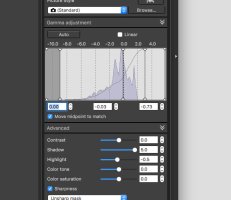
In DPP it is the left hand gamma adjustment.

This example isn't ideal but its the one I had to hand.

Second of the four is out of camera with camera profile applied.
Third of four is 100% shadow slider adjustment.
Fourth of four is the black slider compensation for the shadow slider adjustment.
 

Attachments

  • 4.jpg
    4.jpg
    60.8 KB · Views: 479
  • 1.jpg
    1.jpg
    69.5 KB · Views: 507
  • 2.jpg
    2.jpg
    82 KB · Views: 512
  • 3.jpg
    3.jpg
    83.2 KB · Views: 506
Upvote 0