EF 500 OR EF 600?

My choice was the 500 (Mark II) and for me at least it has proved to be the right one. Several friends have 600s and they need special bags and put a disproportionate amount of effort into carrying them around. It's possible to hand-hold the 600 II (I've tried a friend's) but not very enjoyable and not for a whole session. I wouldn't want the extra weight for just 20% more magnification. In some situations, if I don't need/want to carry a bag at all, I can carry the 500 quite happily on a shoulder strap - again the 600 is just too big for that, in my view (though I do know one person who does it).

In cases of extreme need I use the 500 with a 2x III and on a really solid tripod (Gitzo Series 4) the image quality is pretty good. As others have commented in this thread, the limiting factor at those lengths is often the 'seeing' which hasn't often been good enough in this British so-called summer.

But I shoot with a 7D2 and an 80D and maybe that's where at least part of the difference lies - I get the extra reach from the smaller pixels.
 
Upvote 0
DaveWales said:
CanonFanBoy said:
DaveWales said:
If I were you I would consider trading the 1DX for a 1DX 2 as then you can get better AF performance when using your 2x TC and have the extra reach created by more pixels to play with amongst other benefits.

:o Or he could save a few thousand $$$ and just get a 5D Mark III for even more extra reach than the 1DX Mark II :o :o :o

You know... because there are so many extra pixels. :)

Presume you are picking up on a bit of grammar. As an owner of the 5D3,1DX2, and until yesterday a 1DX, oh as well as a 500mmMk2 and a 600mmMk2 perhaps my opinion is worth a bit more than a useless comment by a smart arse.

Actually, I am happy for you to educate me as to how more megapixels = more reach. That's with or without an extender.

I don't think it does.

What gear you own doesn't make you the smart boy in class, or right, either. It just means you have some $$$, doesn't it? It also doesn't make your opinion worth anything at all over the next man's opinion.

Opinion doesn't mean jack. Opinion being better simply because you own nice gear doesn't make it smell any better either. Heck, I own nice gear too, and as anyone here can tell you, it only made me more stupidererly. There are many stupiderer guys with even better gear than you.

There are many people on these forums who claim their crop sensor cameras give more "reach" than a full frame camera because of a narrower field of view and more megapixels on the subject.

Now you are saying that two full frame cameras with the same lens mounted and the same sensor sizes (Not pixel sizes.) have different reach capability. The 5D Mark III has more megapixels than the 1Dx and the 1Dx Mark II so it (5D mark III) has more reach to play with for cropping right? Right? I think that is what you said. Is that what you said?

I disagree.

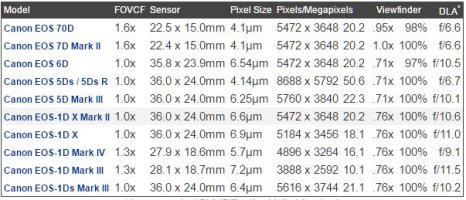
I'm attaching a chart from "The digital picture" that compares oodles of cameras. BTW, just how many more cropping pixels does the 1DX Mark II offer over the 1DX? And what is the impact on photo quality?

*Disclaimer: I may be completely wrong and unhinged. My friend here called me a smart arse. I take that as a complement as I am widely known as a dumb ass. I'd shake the man's hand and buy him a beer if I could. In the event that I am wrong, and I probably am, I hope to have added to the entertainment value of the forum. It's just that I've never heard the "factoid" that one FF camera with 20 mp has more reach than a FF camera with 18 mp. While I salivate for a 1Dx Mark II, I've learned here that my 5D Mark III has more reach than both the 1DX and 1DX Mark II and that I better upgrade my education and buy a 500mm and 600mm lens combo Magna Cum Laude. Imagine that, I've had the more reachy camera all this time.* :) Never should have sold my 70D. Dang it!
 

Attachments

  • sensor.JPG
    sensor.JPG
    62.2 KB · Views: 672
Upvote 0
CanonFanBoy said:
Actually, I am happy for you to educate me as to how more megapixels = more reach. That's with or without an extender.
the conventional wisdom is that with finer sampling you get more pixels on the target, but those pixels are of lower quality.....

Also, smaller pixels require a higher shutter speed to combat shake..... and that means loosing flexibility with your aperture settings...

To my experience, the end result is that with great lighting conditions you can get a bit more reach with more megapixels, but it is not a huge difference. With poor lighting, more pixels makes things worse.

This is probably why the 1DX2, designed to get the shot in harsh conditions, is not a high megapixel camera :)
 
Upvote 0
Don Haines said:
CanonFanBoy said:
Actually, I am happy for you to educate me as to how more megapixels = more reach. That's with or without an extender.
the conventional wisdom is that with finer sampling you get more pixels on the target, but those pixels are of lower quality.....

Also, smaller pixels require a higher shutter speed to combat shake..... and that means loosing flexibility with your aperture settings...

To my experience, the end result is that with great lighting conditions you can get a bit more reach with more megapixels, but it is not a huge difference. With poor lighting, more pixels makes things worse.

This is probably why the 1DX2, designed to get the shot in harsh conditions, is not a high megapixel camera :)

Completely agree.

But Don, and this is very tongue in cheek, does my 5D III have more reach, with the same lenses and settings, than the 1DX Mark II because of all the extra megapixels? ;)
 
Upvote 0
CanonFanBoy said:
Don Haines said:
CanonFanBoy said:
Actually, I am happy for you to educate me as to how more megapixels = more reach. That's with or without an extender.
the conventional wisdom is that with finer sampling you get more pixels on the target, but those pixels are of lower quality.....

Also, smaller pixels require a higher shutter speed to combat shake..... and that means loosing flexibility with your aperture settings...

To my experience, the end result is that with great lighting conditions you can get a bit more reach with more megapixels, but it is not a huge difference. With poor lighting, more pixels makes things worse.

This is probably why the 1DX2, designed to get the shot in harsh conditions, is not a high megapixel camera :)

Completely agree.

But Don, and this is very tongue in cheek, does my 5D III have more reach, with the same lenses and settings, than the 1DX Mark II because of all the extra megapixels? ;)
I think the difference would be so minimal that people could argue over it for years :)
 
Upvote 0
Don Haines said:
CanonFanBoy said:
Don Haines said:
CanonFanBoy said:
Actually, I am happy for you to educate me as to how more megapixels = more reach. That's with or without an extender.
the conventional wisdom is that with finer sampling you get more pixels on the target, but those pixels are of lower quality.....

Also, smaller pixels require a higher shutter speed to combat shake..... and that means loosing flexibility with your aperture settings...

To my experience, the end result is that with great lighting conditions you can get a bit more reach with more megapixels, but it is not a huge difference. With poor lighting, more pixels makes things worse.

This is probably why the 1DX2, designed to get the shot in harsh conditions, is not a high megapixel camera :)

Completely agree.

But Don, and this is very tongue in cheek, does my 5D III have more reach, with the same lenses and settings, than the 1DX Mark II because of all the extra megapixels? ;)
I think the difference would be so minimal that people could argue over it for years :)
:)And they do. :)
 
Upvote 0
I don't wish to continue a negative conversation. I was only pointing out that there are lots of advantages to keeping the 500mm and, instead of spending the extra on a 600mm, he might be better upgrading his 1DX to a 1DX2. Pixels are one small reason, but I have found to be a good reason. The 1DX2 has other benefits such as the ability to use all 61 AF points when using a 2.0X TC on an 500mmf4 lens, a silent shutter which is actually quite silent compared to the 1DX and can also be used at a fairly fast frame rate too.
The cost of upgrading the camera body might be cheaper than upgrading the lens although long term the lens will hold value longer ( just to avoid someone jumping in on that point!)

I like others can only share what we have found to be an advantage or disadvantage. It doesn't necessarily follow that it will be every one's choice.

Trying to find fault in other peoples postings might be entertainment for some, it seems a few hang around this forum purely to do that. The OP asked for advice on if he should change lenses. I shared my findings trying to keep on topic.
 
Upvote 0
I may be wrong, but I always thought that the "reach" advantage of a "crop" camera was because it basically crops the FF image circle (and then makes the final image the same size as the FF). I also read that with the 5DSR 50 MP FF camera, you can crop the file image a lot, say down to the MP file size of 20 MP, and thus do the same thing as a crop camera does, because of all the extra (but smaller) pixels on target. This kind of effectively gives you more reach...doesn't it? Or I am wrong. Where is Neuro or the other experts in this forum to set us all straight ;D
 
Upvote 0
Don Haines said:
CanonFanBoy said:
Actually, I am happy for you to educate me as to how more megapixels = more reach. That's with or without an extender.
the conventional wisdom is that with finer sampling you get more pixels on the target, but those pixels are of lower quality.....
It's much more than conventional wisdom. When you are focal length limited - i.e. you don't have the option of getting closer or using a longer lens - then more pixels will always have the potential to give you more detail. It will never, ever be worse.
Also, smaller pixels require a higher shutter speed to combat shake..... and that means loosing flexibility with your aperture settings...
But so does a longer lens, so there's no disadvantage compared with the alternative.
To my experience, the end result is that with great lighting conditions you can get a bit more reach with more megapixels, but it is not a huge difference. With poor lighting, more pixels makes things worse.
Well, that is quite simply not true. More pixels is never worse.
This is probably why the 1DX2, designed to get the shot in harsh conditions, is not a high megapixel camera :)
It's a trade off, in particular against speed.

If you are in a situation where you can take full advantage of a larger sensor - you can get closer to the subject, and/or you can use a longer lens, and you can maintain your aperture, then it will always produce a higher quality image. But so often in the real world (my world anyway) you can't do that.

I once stood alongside a friend shooting an owl in a tree. We were using the same lens but he had his 5D3 and I had my 7D2. We couldn't get closer because we would have lost the shooting angle and probably spooked the bird. My shots were *much* better than his. If, on the other hand, he could have switched to a 1.6x bigger lens (with a small adjustment for 22 MP vs 20 MP), he would have obtained the better images. (He has since bought a 7D2.)
 
Upvote 0
Steve Balcombe said:
Don Haines said:
CanonFanBoy said:
Actually, I am happy for you to educate me as to how more megapixels = more reach. That's with or without an extender.
the conventional wisdom is that with finer sampling you get more pixels on the target, but those pixels are of lower quality.....
It's much more than conventional wisdom. When you are focal length limited - i.e. you don't have the option of getting closer or using a longer lens - then more pixels will always have the potential to give you more detail. It will never, ever be worse.
Also, smaller pixels require a higher shutter speed to combat shake..... and that means loosing flexibility with your aperture settings...
But so does a longer lens, so there's no disadvantage compared with the alternative.
To my experience, the end result is that with great lighting conditions you can get a bit more reach with more megapixels, but it is not a huge difference. With poor lighting, more pixels makes things worse.
Well, that is quite simply not true. More pixels is never worse.
This is probably why the 1DX2, designed to get the shot in harsh conditions, is not a high megapixel camera :)
It's a trade off, in particular against speed.

If you are in a situation where you can take full advantage of a larger sensor - you can get closer to the subject, and/or you can use a longer lens, and you can maintain your aperture, then it will always produce a higher quality image. But so often in the real world (my world anyway) you can't do that.

I once stood alongside a friend shooting an owl in a tree. We were using the same lens but he had his 5D3 and I had my 7D2. We couldn't get closer because we would have lost the shooting angle and probably spooked the bird. My shots were *much* better than his. If, on the other hand, he could have switched to a 1.6x bigger lens (with a small adjustment for 22 MP vs 20 MP), he would have obtained the better images. (He has since bought a 7D2.)

Your theory doesn't align with empirical observation.

In good light with good technique the smaller pixels are capable of resolving detail without that detail being buried in noise, ergo the crop camera image 'wins'.

However your claim that smaller pixels are never worse is just not true. Up the iso and the the smaller pixels fall apart much sooner than the larger pixels, to the extent that even if you normalise the output the averaged smaller pixels do not out perform the larger pixels in resolution/detail because they are so noisy.

The "crop camera advantage" is largely a myth, in good light with good technique you can sometimes realise the difference, in many more situations the difference is buried in so much noise the larger pixels cropped will give you a 'better' result.
 
Upvote 0
DaveWales said:
I don't wish to continue a negative conversation. I was only pointing out that there are lots of advantages to keeping the 500mm and, instead of spending the extra on a 600mm, he might be better upgrading his 1DX to a 1DX2. Pixels are one small reason, but I have found to be a good reason. The 1DX2 has other benefits such as the ability to use all 61 AF points when using a 2.0X TC on an 500mmf4 lens, a silent shutter which is actually quite silent compared to the 1DX and can also be used at a fairly fast frame rate too.
The cost of upgrading the camera body might be cheaper than upgrading the lens although long term the lens will hold value longer ( just to avoid someone jumping in on that point!)

I like others can only share what we have found to be an advantage or disadvantage. It doesn't necessarily follow that it will be every one's choice.

Trying to find fault in other peoples postings might be entertainment for some, it seems a few hang around this forum purely to do that. The OP asked for advice on if he should change lenses. I shared my findings trying to keep on topic.

Actually, David, my original post has a well placed smiley and yes, a few wild eyed looks too. You took it far too seriously and started with the "smart arse" remark.

You then rattled off your list of gear and implied the list made your opinion more valid than it otherwise would be. ::)

If you can show that a 2 megapixel difference between the 1DX and the 1DX Mark II should be one of the deciding factors as to whether to have the 500mm or 600mm [because of extra "reach"( croppable megapixels?)] then I am happy to see evidence that there is any real world evidence at all.

Otherwise, I am still :o :o :o and :) Because that is what your "reach" claim lightheartedly deserves.

You are right in your reasoning for keeping the 500mm except, I think, for the "reach" part.

People on this forum challenge the claims (many times unprovable, emotional and completely unsubstantiated claims) of others all the time.

Why did I bring up the more "reach" argument for the 5D mark III? I used your logic. I have more megapixels on target with a 500mm lens than your 1DX Mark II. However, I am of the belief (I can't prove it and this is just a poor man's opinion) that the quality of photos taken with the 1DX Mark II are much better than those of the 5D Mark III with a 500mm lens (even though the 5D Mark III has more "reach" or "croppable pixels").

If you find having you claims/opinions challenged to be "finding fault" or get offended by ::) then maybe you should toughen your skin up a little. Opinions can be right or wrong. Facts stand on their own and have nothing to do with opinion or what is in a man's kit.

By the way, thanks again for the compliment. :) Most of a rumors website IS entertainment.
 
Upvote 0
600mm with a 18Mp FF camera gives more resolution than a 500mm lens with a 20Mp FF camera.

Allow me to elaborate.

The difference in magnification of a subject across its diameter (assume the subject is circular for simplicity, say the moon) is 600/500 = 1.2

But Since the total size of a circle is PI*(R^2) (which means doubling the diameter - or radius - quadruples the size) we have to increase the 1.2 in the power of 2 (1.2^2 = 1.2*1.2 = 1.44). Which means a 44% increase in size due to a 600mm lens relative to a 500mm.

This is bigger than the 20M pixel advantage over 18mm = 11%. even when comparing 22Mp to 18Mp = 22% increase.

Having said all that I have opted for 500mm f/4L IS II vs the 600mm version due to size and (mainly) weight reasons...
 
Upvote 0
privatebydesign said:
Your theory doesn't align with empirical observation.

In good light with good technique the smaller pixels are capable of resolving detail without that detail being buried in noise, ergo the crop camera image 'wins'.

However your claim that smaller pixels are never worse is just not true. Up the iso and the the smaller pixels fall apart much sooner than the larger pixels, to the extent that even if you normalise the output the averaged smaller pixels do not out perform the larger pixels in resolution/detail because they are so noisy.

The "crop camera advantage" is largely a myth, in good light with good technique you can sometimes realise the difference, in many more situations the difference is buried in so much noise the larger pixels cropped will give you a 'better' result.

Just to respond to the "with good technique" qualifier first - getting optimal results always requires good technique. Using a longer lens requires good technique too.

But the main point is resolution. Please remember I was talking about a very specific situation, i.e. when focal length limited. So all other things are identical and we are cropping to at most the crop sensor area and potentially smaller. So it ceases to be crop camera vs full frame camera and becomes high resolution vs low resolution. Within the practical range (I didn't say that but surely it is always implied), having fewer pixels will always record less data.

To put it another way, I'm not claiming a "crop sensor advantage", I'm claiming a high resolution advantage.

When you are in a position to take advantage of the additional light-collecting power of full frame it will always 'win', I am not questioning that for a moment. But in these long lens situations you do have to use a bigger lens, otherwise it doesn't work.
 
Upvote 0
Steve Balcombe said:
privatebydesign said:
Your theory doesn't align with empirical observation.

In good light with good technique the smaller pixels are capable of resolving detail without that detail being buried in noise, ergo the crop camera image 'wins'.

However your claim that smaller pixels are never worse is just not true. Up the iso and the the smaller pixels fall apart much sooner than the larger pixels, to the extent that even if you normalise the output the averaged smaller pixels do not out perform the larger pixels in resolution/detail because they are so noisy.

The "crop camera advantage" is largely a myth, in good light with good technique you can sometimes realise the difference, in many more situations the difference is buried in so much noise the larger pixels cropped will give you a 'better' result.

Just to respond to the "with good technique" qualifier first - getting optimal results always requires good technique. Using a longer lens requires good technique too.

But the main point is resolution. Please remember I was talking about a very specific situation, i.e. when focal length limited. So all other things are identical and we are cropping to at most the crop sensor area and potentially smaller. So it ceases to be crop camera vs full frame camera and becomes high resolution vs low resolution. Within the practical range (I didn't say that but surely it is always implied), having fewer pixels will always record less data.

To put it another way, I'm not claiming a "crop sensor advantage", I'm claiming a high resolution advantage.

When you are in a position to take advantage of the additional light-collecting power of full frame it will always 'win', I am not questioning that for a moment. But in these long lens situations you do have to use a bigger lens, otherwise it doesn't work.

Yes and what am saying is in the conditions where the smaller pixels can actually resolve, good light and contrast, high shutter speed, low iso, good lenses, great technique etc then yes, the pixel density of the smaller pixels wil show an advantage in outright IQ.

On that we agree, however where we differ is you are saying even when you don't have those shooting conditions the "smaller pixels will never be worse". That is simply not true.

http://www.the-digital-picture.com/Reviews/Camera-Noise.aspx?Camera=963&Test=0&ISO=1600&CameraComp=1041&TestComp=0&ISOComp=1600

Now that example isn't normalised, but even if you do normalise it the smaller pixels are still worse at resolution and noise control. Of course normalisation can take many forms but in this instance, emulating focal length limitations, the best way is to up res the bigger pixels to the same number as the smaller pixels. And that, iso, is only one of the many variables that can impact IQ.

The statement "smaller pixels will never be worse" is not true, even when limiting the discussion to focal length limited situations.

The statement "having fewer pixels will always record less data" is technically true, but only if you consider noise data. If we are talking about useful quality truthful data, your statement is again, false.

Bigger pixels give higher quality data, at some point comparatively low in the iso scale the ability of the small pixels to collect quality data is overwhelmed by their ability to collect noise and they are at an IQ disadvantage to bigger pixels even when normalised.
 
Upvote 0
privatebydesign said:
http://www.the-digital-picture.com/Reviews/Camera-Noise.aspx?Camera=963&Test=0&ISO=1600&CameraComp=1041&TestComp=0&ISOComp=1600

Now that example isn't normalised, but even if you do normalise it the smaller pixels are still worse at resolution and noise control.

That's not a realistic comparison. First as you say it's not normalised, and since that is the very nub of the discussion you can't just cast it aside as an exercise for the reader. Secondly, the 1D X II sensor is considerably more advanced than the 7D2's - I thought it would be unnecessary to state that for a practical test the sensor technology must be reasonably close. And sure enough, if you use the 5D3 instead:

http://www.the-digital-picture.com/Reviews/Camera-Noise.aspx?Camera=963&Test=0&ISO=1600&CameraComp=792&TestComp=0&ISOComp=1600

Now the difference is considerably less. That's when not focal length limited of course, so the smaller-pixel sensor is not yet showing its potential advantage.

Look at it this way. If you take one square cm of the 5D3 sensor as an arbitrary standard, and compare it with one square cm of one with larger and therefore fewer pixels, the latter will obviously resolve less data. There's no subtlety here, it's simple and obvious and there are no gotchas. Less data collected.

But you also want to have it that one with more, smaller pixels will also resolve less data - which means the *arbitrarily chosen* 1cm2 of 5D3 sensor is better than any other, merely because we chose it first.
 
Upvote 0
All things being equal, resolution depends on the linear dimensions of a pixel when it is not diffraction limited. The length of a side of a square pixel = square root(sensor area/number of mpx), where area is in square mm and length is in microns. Accordingly, for sensors of the same size, their relative resolving powers vary as the square root of the ratio of number of pixels. Going from the 18.1 mpx 1DX to the 20.2 mpx 1DX2 increases resolving power by sqrt(20.2/18.1), that is by only 1.056x. A 50.6 mpx 5DS R has sqrt(50.6/20.2) more resolution than a 1DX 2, that is 1.58x.

Of course, if the light is bad, the lens is soft and you shake etc, then you won't reach 1.58x.

The resolving power of a lens, all things being equal of course, depends on its focal length, not the square. A 600mm lens gives 1.2x the resolving power of a 500, not 1.2x1.2 times.
 
Upvote 0
Steve Balcombe said:
privatebydesign said:
http://www.the-digital-picture.com/Reviews/Camera-Noise.aspx?Camera=963&Test=0&ISO=1600&CameraComp=1041&TestComp=0&ISOComp=1600

Now that example isn't normalised, but even if you do normalise it the smaller pixels are still worse at resolution and noise control.

That's not a realistic comparison. First as you say it's not normalised, and since that is the very nub of the discussion you can't just cast it aside as an exercise for the reader. Secondly, the 1D X II sensor is considerably more advanced than the 7D2's - I thought it would be unnecessary to state that for a practical test the sensor technology must be reasonably close. And sure enough, if you use the 5D3 instead:

http://www.the-digital-picture.com/Reviews/Camera-Noise.aspx?Camera=963&Test=0&ISO=1600&CameraComp=792&TestComp=0&ISOComp=1600

Now the difference is considerably less. That's when not focal length limited of course, so the smaller-pixel sensor is not yet showing its potential advantage.

Look at it this way. If you take one square cm of the 5D3 sensor as an arbitrary standard, and compare it with one square cm of one with larger and therefore fewer pixels, the latter will obviously resolve less data. There's no subtlety here, it's simple and obvious and there are no gotchas. Less data collected.

But you also want to have it that one with more, smaller pixels will also resolve less data - which means the *arbitrarily chosen* 1cm2 of 5D3 sensor is better than any other, merely because we chose it first.

You clearly haven't owned same generation crop and ff cameras and compared actual images.

I have, Neuro has, Alan F has, Eldar and many others here have. Without exception they tell a very similar story, as soon as the iso goes up any theoretical small pixel advantage disappears and is replaced by noise, making the crop camera (small pixels) worse than a cropped ff camera (big pixels), or, smaller pixels can be worse than bigger pixels and having fewer pixels records better data. Your two comments "smaller pixels will never be worse" and "having fewer pixels will always record less data" are not true.

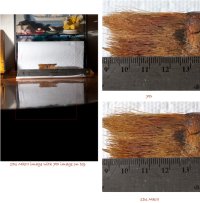
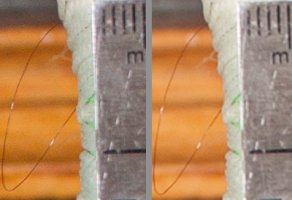
So here are same generation small pixel and bigger pixel crops normalised set up to maximise the small pixel advantage at 200 iso.

Second image is a greater than 100% crop, over 200% for the bigger pixels, I just don't see that small pixel advantage to any meaningful degree.
 

Attachments

  • index-1.jpg
    index-1.jpg
    161 KB · Views: 710
  • index-2.jpg
    index-2.jpg
    38.3 KB · Views: 682
Upvote 0
AlanF said:
All things being equal, resolution depends on the linear dimensions of a pixel when it is not diffraction limited. The length of a side of a square pixel = square root(sensor area/number of mpx), where area is in square mm and length is in microns. Accordingly, for sensors of the same size, their relative resolving powers vary as the square root of the ratio of number of pixels. Going from the 18.1 mpx 1DX to the 20.2 mpx 1DX2 increases resolving power by sqrt(20.2/18.1), that is by only 1.056x. A 50.6 mpx 5DS R has sqrt(50.6/20.2) more resolution than a 1DX 2, that is 1.58x.

Of course, if the light is bad, the lens is soft and you shake etc, then you won't reach 1.58x.

The resolving power of a lens, all things being equal of course, depends on its focal length, not the square. A 600mm lens gives 1.2x the resolving power of a 500, not 1.2x1.2 times.
Resolving power yes, but not size. But lets revert to resolving power. In that case the bigger lens gives 1.2 resolving power relative to the square root of (20/18) = 1.056 of the camera pixel increase. Still this is in favor of the lens...
 
Upvote 0
My personal experience with crop and FF cameras bears out PBD's talking points - at higher ISOs, although the 7D2 image appeared larger, the 5D3 image is sharper and even had an edge in detail in many cases. In addition, 5D3 images seem to be able to withstand more cropping than 7D images, cutting into the "reach advantage" of the 7D...

The only exception to this was some shots of birds I took out in the sun - now this is base ISO, comparing shots I took with both cameras, I'm hard-pressed to tell which camera took which shot. If reach-limited, the 7D2 clearly has an advantage in this situation...however, move into the shade (or wait until the sun begins to set) and as the ISO (correspondingly) goes up, that advantage vanishes. I was never happy with the 7D's detail capture ability above 800, but the 5D3 maintains respectable results all the way up to 3200...
 
Upvote 0