
Effective focal length of some telephotos

Pi said:
AlanF said:
A perfect lens does not have infinite resolution - read about Abbe's law - http://en.wikipedia.org/wiki/Diffraction-limited_system. The wave nature of light dictates that resolution is limited by the size of the Airey disk - see http://en.wikipedia.org/wiki/Airy_disk. Infinite resolution would require that the f number is 0 - ie the lens has an infinite diameter.

I never said that a perfect lens exists. A perfect lens is an abstraction.

You wrote: "A perfect lens has infinite resolution, and half of it it is still infinity.", which contains an arbitrary component in the definition of a perfect lens that is irrelevant and an impossibility, ie infinite resolution. You couldn't even approach to make such a lens because it would have to be of infinite size to have infinite resolution A perfect lens is simply one that has no detectable optical flaws. You could make an f/2.8 or f/4 lens etc that has undetectable flaws within the limits of measurement, and that lens would not be an abstraction.
 
Upvote 0
AlanF said:
You wrote: "A perfect lens has infinite resolution, and half of it it is still infinity.", which contains an arbitrary component in the definition of a perfect lens that is irrelevant and an impossibility, ie infinite resolution. You couldn't even approach to make such a lens because it would have to be of infinite size to have infinite resolution.

Yeah, perfect things are impossible, how surprising is that to you? On the other hand, given your definition of perfect below, it just needs to be large enough, right?

A perfect lens is simply one that has no detectable optical flaws. You could make an f/2.8 or f/4 lens etc that has undetectable flaws within the limits of measurement, and that lens would not be an abstraction.

This is a new arbitrary definition, and if you just did that, I would not have said anything more. But you claim that a lens with undetectable flaws within the limits of measurement is a possibility, which is a very bold and most likely wrong claim. There is no lens under the sun yet for which you cannot measure drop in resolution away from the center. The theory of this is not simple at all but my educated guess is that there is a limit that you cannot break with what we call a lens, and that limit is measurable. Not to mention that you did not explain how we would know that there are no flaws without seeing an image from ... you know ... a perfect lens as a comparison.
 
Upvote 0
Pi said:
AlanF said:
A perfect lens does not have infinite resolution - read about Abbe's law - http://en.wikipedia.org/wiki/Diffraction-limited_system. The wave nature of light dictates that resolution is limited by the size of the Airey disk - see http://en.wikipedia.org/wiki/Airy_disk. Infinite resolution would require that the f number is 0 - ie the lens has an infinite diameter.

I never said that a perfect lens exists. A perfect lens is an abstraction.

Oh, I just love abstract photography! ;)
 
Upvote 0
Pi said:
AlanF said:
You wrote: "A perfect lens has infinite resolution, and half of it it is still infinity.", which contains an arbitrary component in the definition of a perfect lens that is irrelevant and an impossibility, ie infinite resolution. You couldn't even approach to make such a lens because it would have to be of infinite size to have infinite resolution.

Yeah, perfect things are impossible, how surprising is that to you? On the other hand, given your definition of perfect below, it just needs to be large enough, right?

A perfect lens is simply one that has no detectable optical flaws. You could make an f/2.8 or f/4 lens etc that has undetectable flaws within the limits of measurement, and that lens would not be an abstraction.

This is a new arbitrary definition, and if you just did that, I would not have said anything more. But you claim that a lens with undetectable flaws within the limits of measurement is a possibility, which is a very bold and most likely wrong claim. There is no lens under the sun yet for which you cannot measure drop in resolution away from the center. The theory of this is not simple at all but my educated guess is that there is a limit that you cannot break with what we call a lens, and that limit is measurable. Not to mention that you did not explain how we would know that there are no flaws without seeing an image from ... you know ... a perfect lens as a comparison.

Google perfect definition and this is what comes up:
https://www.google.co.uk/search?q=perfect+definition&ie=utf-8&oe=utf-8&rls=org.mozilla:en-US:official&client=firefox-a&channel=np&source=hp&gws_rd=cr&ei=aDSDUtL8DYrOhAewqIHgBg
"per·fect
adjective
adjective: perfect
ˈpərfikt/

1.
having all the required or desirable elements, qualities, or characteristics; as good as it is possible to be.
"she strove to be the perfect wife"."

That is the generally used definition of perfect, not the abstractness that you are attempting to hide behind.

I suggest you go into the nearest bar, sidle up to the meanest, toughest looking guy and tell him that you are a philosopher manque and that his wife is not perfect. Or, tell him that his teeth aren't perfect. Or his nose isn't perfect.
this

It wasn't a new arbitrary definition by me in answer to your point. Your post was yet another example of someone coming in and making comments without having read the earlier postings. Look at my comment in the 4th posting on the first page where I had already defined what I meant by "perfect":

AlanF said:
We all know that there is no such thing as a "perfect" lens. But, lenses like the 300mm f/2.8 II come pretty close to it. Indeed, at f/4 lenstip measured its resolution to be 97.8% of the maximum (which fits in with Canon's MTF charts). All such calculations require some degree of approximation, and saying 97.8% is close enough to 100% for the calculations is good enough for me. If you want 100.000000%, then read no further.
 
Upvote 0
AlanF said:
We all know that there is no such thing as a "perfect" lens. But, lenses like the 300mm f/2.8 II come pretty close to it. Indeed, at f/4 lenstip measured its resolution to be 97.8% of the maximum (which fits in with Canon's MTF charts). All such calculations require some degree of approximation, and saying 97.8% is close enough to 100% for the calculations is good enough for me. If you want 100.000000%, then read no further.

I will ignore the childish part of your post and concentrate on that. Do you understand that what lenstip measured was the combined resolution of a lens+body? That you have no way of knowing how this lens will perform on a higher mp body (even though methods for extrapolating that exist but you are not familiar with them)? And that it was whatever percentage of the best lens tested so far (on that body) which is no indication of what is practically or theoretically possible with newer lenses? And that this is just MTF-50 which is just one measure of resolution? This makes your definition of "perfect" very questionable.

You took a comment which was intended to be more of a joke too seriously, and ignored the essential part of my posts, which was: (1) all tests test lens+body, (2) "removing the body" from the measurements is in principle possible, to some extent, but we do not have the data for it, (3) resolution is not measured with one number and the answer would highly depend on the MTF value you choose; and (4) without a clear answer to all this, the question asked by the OP does not make much sense.
 
Upvote 0
I'm only going to say this once. If you don't understand the meaning of what I'm saying, then consider that the appropriate course of action might not be "oh, you must be wrong," but instead, "how can I better understand this concept?"

The problem with this statistic is that it is dependent on the pixel density of the sensor. A good lens can easily resolve spatial frequencies beyond the Nyquist limit of the sensor. This information is, for effective purposes, not available and therefore, the calculated ratio will change as a function of the sensor behind it. This makes the notion of "effective focal length" an inadequate measure of the resolving power of a lens.
 
Upvote 0
chromophore said:
I'm only going to say this once. If you don't understand the meaning of what I'm saying, then consider that the appropriate course of action might not be "oh, you must be wrong," but instead, "how can I better understand this concept?"

The problem with this statistic is that it is dependent on the pixel density of the sensor. A good lens can easily resolve spatial frequencies beyond the Nyquist limit of the sensor. This information is, for effective purposes, not available and therefore, the calculated ratio will change as a function of the sensor behind it. This makes the notion of "effective focal length" an inadequate measure of the resolving power of a lens.

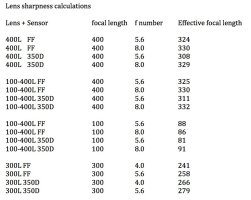
I do understand what you are saying. But, all I am trying to do is to obtain an approximate measure, a rough measure, of how the MTF affects the resolving power of the lens in terms of its telephoto length. I do know that there are theoretical problems, and I am not formulating a precise analytical theory. DxO is doing the same approximation thing with their P-Mpix scale, and they are not exactly fools. Anyway, here are effective focal lengths calculated from the MTFs provided by Photozone for a FF sensor of 3850 LW/PH and an APS-C of 2150 LW/PH (350D) max resolutions. Even though there is a change in sensor, the calculated effective focal lengths are similar.
 

Attachments

  • Lens sharpness calculations350D_5D.jpg
    Lens sharpness calculations350D_5D.jpg
    110.3 KB · Views: 302
Upvote 0
Here is some theoretical justification of why I think the approximation may work. The resolution of the entire lens-sensor-camera system, (R system), is given by the empirical equation that is usually cited in textbooks:

1 / (R system)² = 1 / (R lens)² + 1 / (R sensor)² + 1 / (R low bypass filter)² + ...

where R lens is the resolution of the lens etc. Under conditions where the weak link in the chain is the resolution of the lens, then the equation approximates to:

1 / (R system)² = 1 / (R lens)², as all the other terms are relatively small.

That is: (R system) ~ (R lens)

The question is how do we measure (R lens)? Some people use MTF 05, others may use higher values. However, if we are comparing two lenses, lens1 and lens2, then the ratio of MTFs at other values, eg MTF 50, MTF 20 etc may be used as an approximation. So, even though we know that the resolution of the whole system, (R system), depends on the camera etc, as chromophore and others correctly say, under conditions where the resolution of the lens is the dominant factor:

(R system)lens1/(R system)lens2 ~ (MTF 50)lens1/(MTF 50)lens2

As seen from the data I calculated in the previous post, the calculations on MTFs obtained from a 5D FF and a 350D crop from Photozone.de were similar, and I have also found the ratios of MTFs measured by lenstip using a 20D or 1DSIII gave similar results to those from photozone. So, experiment shows it is not entirely stupid to make the assumptions.

As I keep emphasizing, I am not trying to provide a serious analytical theory. All I want to know is what is roughly the relative performance of different telephoto lenses. I know that my 100-400mm L is not nearly as good as my 300mm f/2.8 with a 1.4xTC. But, I also know that if I move closer to the subject with the 100-400mm, I can get an image that is as good as the 300+TC at a further distance. My equation gives me an idea of what that is worth in practice in terms of distance. It also tells you that you that the Sigma 150-500mm at 500mm is about the same as using the good old 300mm f/4L for photographing a distant bird, which I think is useful information, if correct.
 
Upvote 0
AlanF said:
Here is some theoretical justification of why I think the approximation may work. The resolution of the entire lens-sensor-camera system, (R system), is given by the empirical equation that is usually cited in textbooks:

1 / (R system)² = 1 / (R lens)² + 1 / (R sensor)² + 1 / (R low bypass filter)² + ...

where R lens is the resolution of the lens etc.

This is the model that I mentioned a few posts above, you can see the link in my profile for more.

Under conditions where the weak link in the chain is the resolution of the lens, then the equation approximates to:

1 / (R system)² = 1 / (R lens)², as all the other terms are relatively small.

That is: (R system) ~ (R lens)

Oh, no. This could be true for very, very soft lenses, like the 75-300 at certain FL, etc. but very far from the truth for decent lenses. There are two ways to get an idea about the effect of the sensor: (1) compare resolution on sensors with several pixel densities (assuming AA filters of related strength) or (2) compare the measured resolution with the theoretical diffraction limited one. I would not do (2), but for (1) we used to have useful data from DXO. You could see that with most lenses, 7D>50D>30D in a very measurable way, which is an indication that there is more to gain with even higher res. sensors. As I said above, I did some rough calculations, and concluded that the AA filter plus the sensor contributes to at least 1/2 of the softening, in fact a bit more. Tests done on the Pentax Q confirm that.

And again, that depends hugely on the MTF. At MTF-00, you will always get 100%. At MTF-100, you get 0% regardless of everything.
 
Upvote 0
Thank you for your comments. Those are just what I want - a proper discussion so I can clarify in my own mind what is going on and get more useful information.

You are correct that the reduction of the complex equation to just the lens component term applies to soft lenses. What I am really interested in is comparing a soft lens with a really good lens. Let me go away and do some more algebra to get a better formulation.
 
Upvote 0
OK, I can't come up with anything more quantitative, which I don't think anyone can. I think we can agree on the following points. For high class telephoto lenses like the series II big whites, the resolution is pretty close to being limited by the sensor, filters etc. For that reason, the measured MTFs on cameras with different sensors are close to to 1 (as I wrote previously, 0.978 is good enough for me).

When you get MTFs that become significantly less than 1, the lens itself is the weak link in the whole resolution system and its MTF largely determines the overall measured MTF. For a lens like the Sigma 150-500, which has a measured MTF of 0.52 at f/6.3 and 500mm, the resolution of the system is pretty close to that of the lens itself.

So, I would say to a first, very rough, approximation, you would have to get twice as close to the subject to make it 2x wider and 2x higher in order to get an image to reveal as much detail as a very good 250mm lens at the same distance. So, I would equate that to the Sigma having an effective focal length of ~250mm for telephoto purposes.

The 400mm f/5.6 L lens is described by many of its devotees as being very sharp. It is not tack sharp, but if you get closer to the subject than you would have to get close with a tack sharp lens, like the 400mm f/2.8, you will get an apparently very sharp image because the image has a larger size and covers more of the sensor. I estimate in practice that it performs as about as well as a 330mm tack sharp lens. But, of course, there are other factors that come in as well.

I'll leave it at this point and thank everyone who joined in the discussion.
 
Upvote 0
You still need to define what xx% means. What is the 100% base? You'd better stick with a fixed sensor (and a fixed MTF value). You can take the base to be the Nyquist frequency. Depending on the way resolution is measured, some lenses can surpass Nyquist but so what. Then you will get 110% or so. Another way is to use a reference lens as a base. In all cases, the numbers you get can be compared to each other (you can say Lens A is 20% sharper than lens B, or has, say, 30% more reach) but their values would be just relative, like using meters vs. feet, etc.

The question you raised is very practical, indeed. A sharper (and faster) shorter lens can easily beat an older an longer one but you would still get what you pay for, I guess. Oh, here is an idea: add another column: mm per $. :)
 
Upvote 0
Pi said:
The question you raised is very practical, indeed. A sharper (and faster) shorter lens can easily beat an older an longer one but you would still get what you pay for, I guess. Oh, here is an idea: add another column: mm per $. :)

I think the proper comparison would be the additional cost of additional Effective Focal Length per MM.

For instance in the OP the 300mm F/4 at F/4 is listed at 254, the 300mm f/2.8 II at F/4 is listed as 293.

The difference is 39mm. Since 254 can be delivered for about $1400 and the cost of the 300mm f/2.8 is about $6700 the additional cost for 39mm would be $135.90 per mm.
 
Upvote 0
takesome1 said:
The difference is 39mm. Since 254 can be delivered for about $1400 and the cost of the 300mm f/2.8 is about $6700 the additional cost for 39mm would be $135.90 per mm.

You should move the decimal point, to get something like less than $20 per mm for the $6k lens, etc.

Which makes my 15 fisheye a really luxury item and low value: $40 per mm!
 
Upvote 0