f4 needed for birds if only shooting in full sun?

nc0b said:
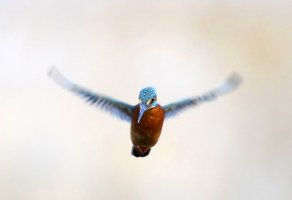
On a walk in the country with a 6D & 100-400mm II, there wasn't much to shoot except a meadowlark on a barbed wire fence. The perched bird isn't tack sharp, but when it took off, I was stunned that the wings were a complete blur at 1/800th shutter speed. (f/8, ISO 200 & zoom at 400mm) When shooting raptors in flight with a 400mm f/5.6, I try to keep my shutter speed at 1/1600 or above, but it appears for smaller birds, reducing wing blur requires a much faster shutter speed than I would have expected. I no longer live in the mountains with humming birds around, but if I get a chance to shoot them, will a strobe be needed if a shot with sharp wings is desired?
I don't have much experience with birds, but do you really need to have zero wing blur?

I shoot dragonflies and if you want really sharp wings with the faster species you need 1/4000s shutter speed or so, if they are doing strange acrobatics probably even faster. With my 450D camera even 1/2000 is hardly an option in good light (I need f/5.6 or so for decent DOF). But shots at 1/400-1/800s look great if I am able to 'track' the subject well enough and make sure that at least the head/body is sharp.

It looks to me like focus is off in both of your pictures (especially the second one) but difficult to judge at this small size. Using a 6D for a fast moving subject doesn't seem a good idea to me (on my 450D which is probably even slightly worse for AF speed I always use MF for this type of subject).

P.S. regarding subject of thread: one thing I didn't see mentioned after a quick read is that size/weight of the lens can be a problem, this could work against very bright long tele lenses when you are dealing with BIF instead of stationary birds. Obviously it depends on the subject, most large birds move relatively slower (in angular velocity, relative to the camera) and more predictable than the small ones. For my dragonfly photography - a bit similar to BIF for very small birds - even with a 4/300mm lens it is tough to quickly point the camera to the subject and track it, with 2x higher weight fast movement becomes 4x more difficult (because of the required acceleration). So despite all the goodies of the large and bright lens (which I don't doubt, and even though the bright aperture improves AF speed) at some point it becomes impossible to get the shot.
 
Upvote 0
nc0b said:
I no longer live in the mountains with humming birds around, but if I get a chance to shoot them, will a strobe be needed if a shot with sharp wings is desired?

Not a strobe, but rather strobes. If you want to freeze hummingbird wings, you need exposures in the 1/15000 - 1/30000 second range, much faster than your max shutter speed. A Speedlite varies flash power by duration not intensity, thus a max power flash exposure is actually a 'slow' 1/800 - 1/1000 s flash duration. Therefore, you need to use a flash on low power (1/128 or 1/64 power) to get a short enough exposure, and since you need to eliminate ambient you must also be stopped down quite a bit. That means you'll need to gang 4-6 Speedlites on low power to get sufficient light.
 
Upvote 0
Mikehit said:
Focusing is done with the aperture wide open so with f4 you have more light for the AF system to work with. However you may well find that the DOF is thin enough to have to stop down anyway unless the subject is stationary, and this bring you to the adage that most lenses are best stopped down one from maximum. Plus you have an optoin for AF with a tc attached

So no, the f4 will not be wasted.

I have recently bought the 100-400 MkII and it is a superb lens and while I do not have the joy of owning the 500mm f4, I have read quite a few experienced birders saying they have hardly used their 500mm f4 since buying it (though I believe they were comparing to the MkI 500mm).
Pverall, I think you have probably got probably the best 2 alternatives in the Canon and Sigma zooms so stop worrying, shoot loads and you have the jealousy-inducing option of selecting the best tool for the job.

If you are looking for ways to spend spare money, when the 500mm mkii came out, one respected wildlife photographer (may have been Andy Rouse but can't be sure) did an article asking what benefits there are to matching the latest generation of lens and camera. At the time he had a couple of models of 1D and said that yes, there is a benefit greater than the sum of their apparent parts.
So you could always go for the 1DxMkii.

Or go on 2 or 3 fantastic wildlife tours to use the lens to maximum benefit...

And if all those options are exhausted then send a few grand my way and you can bask in the warm glow that upi are helping someone else is reaching the pleasurable heights you are. :P

You are quite magnanimous.
 
Upvote 0
applecider said:
Do you really mean full noon day sun or are you also thinking of full sunset sun?

Because if the latter then F 4 itself may indeed be needed or at least desired to get an extra half hour of shooting at decent shutter speed when birds are more active interesting and more warmly evenly lit.

As neuro has already said I also usually find my F to be larger than minimum to get enough depth of field, but still nice to be able to shoot earlier and later.

Don't ever shoot at noon. I mean in the early morning/late afternoon/evening hours (depending on the time of year) when there are no clouds in the sky. So the king of light when the sun is low in the sky, birds have nice light on them with no harsh shadows and nothing causing me to have to raise the ISO much about 640. Shutter speeds at that time with this lens at f4 are in the 1/6400 range. Hope that helps.
 
Upvote 0
Hi nhz. Yes the meadowlark in flight isn't in good focus. Once it took off it takes me at least 50 - 100 ms to react and push the shutter. Thus the bird has moved away from the wire on which it was perched. DOF totally insufficient to handle any horizontal movement. There is also what appears to me some motion blur. The reason for the post was my surprise how much wing movement occurred within 1/800 second.

No I don't think it is necessary to have no wing blur, particularly wing tips. I usually shoot BIF of raptors, or perched small birds since I have not had success with small BIF. I am not sure why the perched meadowlark is not quite sharp. I have only had the 100-400mm II lens for a short time, and while I have seen very sharp shots at 100 to 200 feet, some shots of our neighbor's horses at 10 - 20 feet seem soft.

I will have a 5DS R within a week or two, it will be interesting to see how well I can make it perform vs. the 6D. For BIF the 6D vastly put performs my 60D. Overall I am very happy with the 6D and 400m f/5.6.
 
Upvote 0
and here comes the math.....

Let's use the example of a chickadee. Let's say that we are able to perfectly track the bird in flight and that from top of wingbeat to bottom of wingbeat takes up a little under half of the frame, say about 2000 pixels..

The chickadee flaps it's wings at 27 times per second. That's up and down, 27 times per second... the wing covers 2000 pixels up and 2000 pixels down 27 times per second..... that's 4000 pixels 27 times per second. Of course it is moving faster at the middle than at the ends, but let's use the average speed. 4000 pixels 27 times per second means 108,000 pixels per second.... shoot at a thousandth of a second and you will get 108 pixels of blur for every significant detail.... so we crank up our shutter speed to as fast as we can go and shoot at 1/8000 of a second and end up with 14 pixels of blur..... it sucks, but that's as fast as we can go!

Now let's say it is really bright out.... our exposure meter reads 15EV. If we want to shoot that speed with an F4 lens, we end up at ISO400. At that speed we still have very good image quality, but the wings are blurred a bit. Remember that this is with perfect conditions... earlier or later in the day we drop to 13EV and our ISO jumps to 1600 to keep that shutter speed.... and image quality begins to fall off.

Go slower than F4 and your ISO goes up..... some clouds blow in and your ISO goes up....

Shooting birds, particularly tiny ones, and you need the fastest lenses you can get. If you are shooting through a long lens, you need to shoot faster speeds to avoid blurring, so once again, you need fast lenses....
 
Upvote 0
Isaac Grant said:
This may seem like an odd question, but I recently purchased a 500f4 ii to be used for bird photography. I love the lens. Image quality is fantastic. Auto focus is fast and it is built like a tank. But it is expensive, heavy, big and not so easy to lug around (obvious for such a big lens but just wanted to get it out there).

The real issue is, do I really need an f4 lens if shooting under full sun conditions? Most times would not really be taking advantage of the f4. Is there another option that gives the same image quality that I am not considering? I also own the 100-400 ii and a 1.4x, plus the Sigma 150-600C as well. Plan on using the 1.4x with the 500 as well.

Really looking for advice from people that currently own this lens or others like it.

It really depends on the photo and how close you are to your subject:

19926430979_f611138479_o.jpg

5DIII, 400mm f2.8 LIS and a 1.4x TC, shot wide open.
 
Upvote 0
Mt Spokane Photography said:
Isaac Grant said:
This may seem like an odd question, but I recently purchased a 500f4 ii to be used for bird photography. I love the lens. Image quality is fantastic. Auto focus is fast and it is built like a tank. But it is expensive, heavy, big and not so easy to lug around (obvious for such a big lens but just wanted to get it out there).

The real issue is, do I really need an f4 lens if shooting under full sun conditions? Most times would not really be taking advantage of the f4. Is there another option that gives the same image quality that I am not considering? I also own the 100-400 ii and a 1.4x, plus the Sigma 150-600C as well. Plan on using the 1.4x with the 500 as well.
Funny I held one of them today. Guy had one on a tripod and an induro head. Weighed half a ton. I don't envy you. By comparison the 500mm is childs play.
Really looking for advice from people that currently own this lens or others like it.

Out in the country where I live, I bought a big monster 600mm f/4 non IS. It was not long enough, and I even tried two TC's (1.4 +2X) on it. F/4 had become f/11 by then, and at noon on a winter day, I could not get as fast a shutter speed as needed. The 500mm MK II is a little toy compared to that old 600.
 
Upvote 0
Isaac Grant said:
This may seem like an odd question, but I recently purchased a 500f4 ii to be used for bird photography. I love the lens. Image quality is fantastic. Auto focus is fast and it is built like a tank. But it is expensive, heavy, big and not so easy to lug around (obvious for such a big lens but just wanted to get it out there).

The real issue is, do I really need an f4 lens if shooting under full sun conditions? Most times would not really be taking advantage of the f4. Is there another option that gives the same image quality that I am not considering? I also own the 100-400 ii and a 1.4x, plus the Sigma 150-600C as well. Plan on using the 1.4x with the 500 as well.

Really looking for advice from people that currently own this lens or others like it.

It is more about IQ than F/4. If you can get IQ to equal the 500mm II out of any the lenses you listed I wouldn't take mine to the field at all.

There are other lenses that get close, but those combinations would be just as heavy.

Really it comes down to what you think is acceptable IQ. But since you are talking birds, I want my pictures extremely sharp and I want to make out the fine detail of feathers and eye. For that I take every advantage I can get whether it is the best IQ lens or best camera for the job. I wouldn't find the results from the two lenses you listed acceptable, especially with an extender.

But I would have hoped you knew this before you dropped a but load of money on the 500mm. Maybe you thought if you paid the extra you would get the best 500mm made by Canon. If that is the case you thought right.
 
Upvote 0
NancyP said:
nc0b, I like to see some blurring of the wings in some photos, as long as the head is sharp.

The only time I caught a kingfisher hovering, in the days before I used RAW.
 

Attachments

  • Kingfisher.jpg
    Kingfisher.jpg
    268.9 KB · Views: 178
Upvote 0
takesome1 said:
Isaac Grant said:
This may seem like an odd question, but I recently purchased a 500f4 ii to be used for bird photography. I love the lens. Image quality is fantastic. Auto focus is fast and it is built like a tank. But it is expensive, heavy, big and not so easy to lug around (obvious for such a big lens but just wanted to get it out there).

The real issue is, do I really need an f4 lens if shooting under full sun conditions? Most times would not really be taking advantage of the f4. Is there another option that gives the same image quality that I am not considering? I also own the 100-400 ii and a 1.4x, plus the Sigma 150-600C as well. Plan on using the 1.4x with the 500 as well.

Really looking for advice from people that currently own this lens or others like it.

It is more about IQ than F/4. If you can get IQ to equal the 500mm II out of any the lenses you listed I wouldn't take mine to the field at all.

There are other lenses that get close, but those combinations would be just as heavy.

Really it comes down to what you think is acceptable IQ. But since you are talking birds, I want my pictures extremely sharp and I want to make out the fine detail of feathers and eye. For that I take every advantage I can get whether it is the best IQ lens or best camera for the job. I wouldn't find the results from the two lenses you listed acceptable, especially with an extender.

But I would have hoped you knew this before you dropped a but load of money on the 500mm. Maybe you thought if you paid the extra you would get the best 500mm made by Canon. If that is the case you thought right.

If you would not find the results from a 100-400mm II to be acceptable for bird photography, then either most of the rest of us must have unacceptably low standards or you do not know how to take bird photographs.
 
Upvote 0
takesome1 said:
Isaac Grant said:
This may seem like an odd question, but I recently purchased a 500f4 ii to be used for bird photography. I love the lens. Image quality is fantastic. Auto focus is fast and it is built like a tank. But it is expensive, heavy, big and not so easy to lug around (obvious for such a big lens but just wanted to get it out there).

The real issue is, do I really need an f4 lens if shooting under full sun conditions? Most times would not really be taking advantage of the f4. Is there another option that gives the same image quality that I am not considering? I also own the 100-400 ii and a 1.4x, plus the Sigma 150-600C as well. Plan on using the 1.4x with the 500 as well.

Really looking for advice from people that currently own this lens or others like it.

It is more about IQ than F/4. If you can get IQ to equal the 500mm II out of any the lenses you listed I wouldn't take mine to the field at all.

There are other lenses that get close, but those combinations would be just as heavy.

Really it comes down to what you think is acceptable IQ. But since you are talking birds, I want my pictures extremely sharp and I want to make out the fine detail of feathers and eye. For that I take every advantage I can get whether it is the best IQ lens or best camera for the job. I wouldn't find the results from the two lenses you listed acceptable, especially with an extender.

But I would have hoped you knew this before you dropped a but load of money on the 500mm. Maybe you thought if you paid the extra you would get the best 500mm made by Canon. If that is the case you thought right.
Yes I did know this. I guess that really is the ultimate point. No other lens gives the same image quality. F4 is there if you need it on this one but if not it is still the image quality king (along with a few others like the 300 2.8 and 600 f4). I also got lucky and got this for a little less than but load. Canon refubished and on sale at that. Still not cheap at all.
 
Upvote 0
AlanF said:
takesome1 said:
Isaac Grant said:
This may seem like an odd question, but I recently purchased a 500f4 ii to be used for bird photography. I love the lens. Image quality is fantastic. Auto focus is fast and it is built like a tank. But it is expensive, heavy, big and not so easy to lug around (obvious for such a big lens but just wanted to get it out there).

The real issue is, do I really need an f4 lens if shooting under full sun conditions? Most times would not really be taking advantage of the f4. Is there another option that gives the same image quality that I am not considering? I also own the 100-400 ii and a 1.4x, plus the Sigma 150-600C as well. Plan on using the 1.4x with the 500 as well.

Really looking for advice from people that currently own this lens or others like it.

It is more about IQ than F/4. If you can get IQ to equal the 500mm II out of any the lenses you listed I wouldn't take mine to the field at all.

There are other lenses that get close, but those combinations would be just as heavy.

Really it comes down to what you think is acceptable IQ. But since you are talking birds, I want my pictures extremely sharp and I want to make out the fine detail of feathers and eye. For that I take every advantage I can get whether it is the best IQ lens or best camera for the job. I wouldn't find the results from the two lenses you listed acceptable, especially with an extender.

But I would have hoped you knew this before you dropped a but load of money on the 500mm. Maybe you thought if you paid the extra you would get the best 500mm made by Canon. If that is the case you thought right.

If you would not find the results from a 100-400mm II to be acceptable for bird photography, then either most of the rest of us must have unacceptably low standards or you do not know how to take bird photographs.
While I do not fully agree with his statement, that does not make him wrong. Fact is that I now have both lenses. The 100-400 ii is really nice. Pictures taken with it are quite sharp with beautiful colors and contrst. If you take the same picture with the 500 and compare them side by side it is clear which is the sharper lens. So if that is the main objective there is no real argument. I got the 100-400 ii to use in times that I can not use the 500 ii. To me it is an acceptable alternative, but I am fully aware that it is not as sharp as the 500. It is the lens I will take on long hikes, to be used generally while birding, and for capturing fast flying birds as well.
 
Upvote 0
Isaac Grant said:
AlanF said:
takesome1 said:
Isaac Grant said:
This may seem like an odd question, but I recently purchased a 500f4 ii to be used for bird photography. I love the lens. Image quality is fantastic. Auto focus is fast and it is built like a tank. But it is expensive, heavy, big and not so easy to lug around (obvious for such a big lens but just wanted to get it out there).

The real issue is, do I really need an f4 lens if shooting under full sun conditions? Most times would not really be taking advantage of the f4. Is there another option that gives the same image quality that I am not considering? I also own the 100-400 ii and a 1.4x, plus the Sigma 150-600C as well. Plan on using the 1.4x with the 500 as well.

Really looking for advice from people that currently own this lens or others like it.

It is more about IQ than F/4. If you can get IQ to equal the 500mm II out of any the lenses you listed I wouldn't take mine to the field at all.

There are other lenses that get close, but those combinations would be just as heavy.

Really it comes down to what you think is acceptable IQ. But since you are talking birds, I want my pictures extremely sharp and I want to make out the fine detail of feathers and eye. For that I take every advantage I can get whether it is the best IQ lens or best camera for the job. I wouldn't find the results from the two lenses you listed acceptable, especially with an extender.

But I would have hoped you knew this before you dropped a but load of money on the 500mm. Maybe you thought if you paid the extra you would get the best 500mm made by Canon. If that is the case you thought right.

If you would not find the results from a 100-400mm II to be acceptable for bird photography, then either most of the rest of us must have unacceptably low standards or you do not know how to take bird photographs.
While I do not fully agree with his statement, that does not make him wrong. Fact is that I now have both lenses. The 100-400 ii is really nice. Pictures taken with it are quite sharp with beautiful colors and contrst. If you take the same picture with the 500 and compare them side by side it is clear which is the sharper lens. So if that is the main objective there is no real argument. I got the 100-400 ii to use in times that I can not use the 500 ii. To me it is an acceptable alternative, but I am fully aware that it is not as sharp as the 500. It is the lens I will take on long hikes, to be used generally while birding, and for capturing fast flying birds as well.
The point at issue is the statement that the 100-400mm II does not give images that are acceptably sharp. No one is disputing that a 500 prime is sharper, it is the cavalier writing off of images taken with the 100-400mm II and similar lenses that grates. I wonder if the author has even tried such lenses - there are no postings from him in the Bird Portrait thread.
 
Upvote 0
Most of my BIF shots taken over several years were from the low cost EF 400mm f/5.6 (no extender). Most of my bird portraits or relatively static shots were taken with an older EF 500mm f/4.5. I'm pleased with both and have printed and framed a bunch of them. Sold a few also. Use what works for you in the situation; if pleased, then keep on shooting.
 
Upvote 0
AlanF said:
The point at issue is the statement that the 100-400mm II does not give images that are acceptably sharp. No one is disputing that a 500 prime is sharper, it is the cavalier writing off of images taken with the 100-400mm II and similar lenses that grates. I wonder if the author has even tried such lenses - there are no postings from him in the Bird Portrait thread.

Also, things seem to imply that you can't go take bird pictures without the newest and fastest lens.... For the vast bulk of photographers, the big whites are never going to be an affordable option and even the 100-400 is more $s than most people will spend.... yet they still go out and take great pictures because they have worked on their field craft to the point where they can get close enough to get away with "cheaper and slower" lenses like the 70-200F4.... and yes, sometimes you can get close enough to the bird to not need that 600F4 and 2X teleconverter...
 

Attachments

  • D16A2855.jpg
    D16A2855.jpg
    963 KB · Views: 159
Upvote 0
Don Haines said:
AlanF said:
The point at issue is the statement that the 100-400mm II does not give images that are acceptably sharp. No one is disputing that a 500 prime is sharper, it is the cavalier writing off of images taken with the 100-400mm II and similar lenses that grates. I wonder if the author has even tried such lenses - there are no postings from him in the Bird Portrait thread.

Also, things seem to imply that you can't go take bird pictures without the newest and fastest lens.... For the vast bulk of photographers, the big whites are never going to be an affordable option and even the 100-400 is more $s than most people will spend.... yet they still go out and take great pictures because they have worked on their field craft to the point where they can get close enough to get away with "cheaper and slower" lenses like the 70-200F4.... and yes, sometimes you can get close enough to the bird to not need that 600F4 and 2X teleconverter...
Don, we are all entitled to think different things and that is fine. Reality is that if budget and weight were no object, just looking at the pics, that the 500 is a sharper lens. We all know that using the sharper lens does not make you a better photographer. We also all know that you can take beautiful pics with "cheaper" gear. But those pics would be sharper when using the best. Not really debatable. This assumes identical lighting, ability, etc.

Either way, this bickering really does nothing to answer my question which is using an f4 lens in cloudless skies with early morning and evening light.
 
Upvote 0
I agree with most of the points here. F4 is not always about light but about IQ. An f4 stopped down to f5.6 may have better IQ than an F5.6 wide open. Depends on the lenses you are comparing. Generally speaking any measure of aperture can help with lens faults.

Sometimes however you need the f4 and in some case F2.8 particlarly if you find yourself shooting really early, really late, or shooting during rain and snow storms.
 
Upvote 0
East Wind Photography said:
I agree with most of the points here. F4 is not always about light but about IQ. An f4 stopped down to f5.6 may have better IQ than an F5.6 wide open. Depends on the lenses you are comparing. Generally speaking any measure of aperture can help with lens faults.

Sometimes however you need the f4 and in some case F2.8 particlarly if you find yourself shooting really early, really late, or shooting during rain and snow storms.

I think if I am being honest I was just scared to keep this lens. Tried to justify returning it by saying that I do not need the f4 if shooting in "ideal" lighting conditions. But the reality is that the image quality is what made me keep it. Just amazing and worth every penny if you are looking for the best. While I may rarely use f4, I will always use and appreciate the image quality this lens affords.
 
Upvote 0