Full Frame Vs Crop Sensor

I would have to disagree and my opinion is that the 70D sensor and capability is vastly superior to 5 year old APS-C technology in the 7D and 6 years in the 500D. I switched from a 7D to a 70D because I do get much better high ISO performance. IMO, my 6400 performance with the 70D exceeds 3200 on the 7D and the AF is much faster. Anything above 3200 on the 7D was, in my opinion, unusable. When working at low ISO, the older sensors hold their own. All due respect to Neuro but when was the last time you shot anything less than an up-to-date 1D series? For better low light performance without a new body, go with large aperture prime lenses?
 
Upvote 0
tiger82 said:
I would have to disagree and my opinion is that the 70D sensor and capability is vastly superior to 5 year old APS-C technology in the 7D and 6 years in the 500D. I switched from a 7D to a 70D because I do get much better high ISO performance. IMO, my 6400 performance with the 70D exceeds 3200 on the 7D and the AF is much faster. Anything above 3200 on the 7D was, in my opinion, unusable. When working at low ISO, the older sensors hold their own. All due respect to Neuro but when was the last time you shot anything less than an up-to-date 1D series? For better low light performance without a new body, go with large aperture prime lenses?

Neuro is talking of 5D (FF) against 70D. That very old FF sensor will still produce better IQ at the same ISO setting with the current 70D. Of course, if you pit a 70D against a 7D then it will be between 2 sensors with the same size. Then the more current sensor will win most of the time (but not all the time, see 550D vs 600D).
 
Upvote 0
tiger82 said:
I would have to disagree and my opinion is that the 70D sensor and capability is vastly superior to 5 year old APS-C technology in the 7D and 6 years in the 500D. I switched from a 7D to a 70D because I do get much better high ISO performance. IMO, my 6400 performance with the 70D exceeds 3200 on the 7D and the AF is much faster. Anything above 3200 on the 7D was, in my opinion, unusable. When working at low ISO, the older sensors hold their own. All due respect to Neuro but when was the last time you shot anything less than an up-to-date 1D series? For better low light performance without a new body, go with large aperture prime lenses?


I am unsure what you are disagreeing with. As Neuro mentioned, the 70D is better than 7D/500D, which is what you said as well. There you are comparing apples against apples, which is all very true.
However, that has nothing to do with an FF sensor, which in this case is an orange. The sensor receives more than twice the amount of light, which is a physical fact and has nothing to do with sensor technology. The pixels are larger, so you will get higher light sensitivity. So the 5D being better than 70D doesn't contradict the 70D being better than 7D. In fact, my 7D was worse than my 50D in terms of high-ISO noise.
With the current pricing of 6D and even used 5DIIs, I wouldn't recommend an APS-C to anyone who is primarily looking for IQ.
 
Upvote 0
verysimplejason said:
tiger82 said:
I would have to disagree and my opinion is that the 70D sensor and capability is vastly superior to 5 year old APS-C technology in the 7D and 6 years in the 500D. I switched from a 7D to a 70D because I do get much better high ISO performance. IMO, my 6400 performance with the 70D exceeds 3200 on the 7D and the AF is much faster. Anything above 3200 on the 7D was, in my opinion, unusable. When working at low ISO, the older sensors hold their own. All due respect to Neuro but when was the last time you shot anything less than an up-to-date 1D series? For better low light performance without a new body, go with large aperture prime lenses?

Neuro is talking of 5D (FF) against 70D. That very old FF sensor will still produce better IQ at the same ISO setting with the current 70D. Of course, if you pit a 70D against a 7D then it will be between 2 sensors with the same size. Then the more current sensor will win most of the time (but not all the time, see 550D vs 600D).

Exactly. Size matters, and this statement:

tiger82 said:
The ISO capability has no connection to full frame or APS-C, it's a function of sensor age.

...is completely wrong. Ignoring advances in sensor technology, a FF sensor has a 1.3-stop noise advantage over APS-C based on the larger area gathering more total light. When you factor in sensor technology advancement, sensor size still trumps it, as shown by the fact that despite 8 years of advances, the old 5D still delivers better high ISO performance than the new 70D.

Note that if you're shooting JPG, the you're adding advances in Digic to advances in the sensor. However, shooting RAW and applying proper NR in post yields better results than in-camera JPG, so only RAW performance matters when comparing noise.
 
Upvote 0
First of all, I did say low ISO performance is comparable. The OP was looking for better high ISO performance. Ass for size matters, you are talking about TOTAL light on an equivalent age sensor. The current generation sensor sensitivity is similar per square unit of area so if you compare a similar area on the FF sensor that is equivalent to an APS-C sensor, it would be very similar in performance. When you account for TOTAL area, obviously the larger sensor captures more. It's like saying 2 solar panels are better than 1 but the single panel could be equivalent to each of the two solar panels. Now the lenses' focal plane for both sensors is identical so the same image on the area of the APS-C sensor on the FF is identical is it not? Therefore, that area would be fairly similar in image content and IQ for same generation sensors. In fact the pixel density on the APS-C may even help it along. 20.2MP in APS-C vs 22.1 in a FF. 10% more pixels in 60% more area for the FF.

Regardless, I'd prefer an 80MP medium format camera but even that won't suit what many of us shoot.
 
Upvote 0
tiger82 said:
First of all, I did say low ISO performance is comparable. The OP was looking for better high ISO performance. Ass for size matters, you are talking about TOTAL light on an equivalent age sensor. The current generation sensor sensitivity is similar per square unit of area so if you compare a similar area on the FF sensor that is equivalent to an APS-C sensor, it would be very similar in performance.

Sorry, but you really don't seem to understand how this works... :(

Total light IS what determines image noise. Light per unit area determines exposure - for the same scene at ISO 800 with an f/2 lens wide open, I get the same shutter speed on my 1D X, EOS M (meaning yes, I've used a recent Canon APS-C camera), and PowerShot S100. But the image noise of the EOS M at ISO 800 is similar to the 1D X at ISO ISO 2500, and the image noise of the PowerShot S100 at ISO 800 is similar to ISO 16000 on my 1D X.

You're right about similar areas, though - if I crop the 1D X to 38% of its area (= APS-C in EOS M) or to 5% of its area (= 1/1.7" in S100), the noise would be similar. But if you routinely need to crop away 60% or 95% of your image, you need a longer lens...

tiger82 said:
It's like saying 2 solar panels are better than 1 but the single panel could be equivalent to each of the two solar panels.

Exactly. As a homeowner with solar panels on my roof, the output per panel is an academic curiosity - what I care about is the amount of electricity I get when the sun hits my roof...thus, two solar panels are better than one. Similarly, as a photographer the noise per unit area is of little practical relevance, what matters is the noise in my pictures, so FF is better than APS-C in terms of image noise, at both low ISO and high ISO.
 
Upvote 0
neuroanatomist said:
Similarly, as a photographer the noise per unit area is of little practical relevance, what matters is the noise in my pictures, so FF is better than APS-C in terms of image noise, at both low ISO and high ISO.

Now this is something I cannot understand. I have before me, several 16x24 prints, all taken at ISO 400. Some with a 7D and some with a 5DIII. As for the shots themselves, the 5DIII shots are full frame, while the 7Ds are slightly cropped, which would place the 7D at a disadvantage. All were printed by MPix.

Yet, at any normal viewing distance, I cannot see any difference in noise. If I press my nose almost upon the image, I might see a small amount of added noise in some of the shadow areas of the 7D prints, but I really have to hunt for it and it has zero impact on the overall quality of the photo.

I know that people who have spent thousands on a full frame camera want to see a difference. But at ISO 400 or below, if you are seeing additional noise in a photograph taken with an APS-C sensor, it is likely to be either (a) confirmation bias or (b) your processing skills.
 
Upvote 0
unfocused said:
I know that people who have spent thousands on a full frame camera want to see a difference. But at ISO 400 or below, if you are seeing additional noise in a photograph taken with an APS-C sensor, it is likely to be either (a) confirmation bias or (b) your processing skills.

Sure. ISO 400 on APS-C is like ISO 1250 on FF...and with proper processing that looks perfectly clean. However, about 25% of my shots are at ISO 3200 or higher, and that includes the majority of my bird/wildlife shots (need fast shutter speed in lower light levels).

In bright light, moderately large prints are possible even from sensors smaller than APS-C. The reason some of us spend thousands on a full frame camera is that we know some of our most impactful shots are taken in less than ideal light, and we're willing to pay a premium so those shots look as good as possible.

Sometimes people who haven't or can't spend thousands on a full frame camera want to rationalize away the benefits. ;)
 
Upvote 0
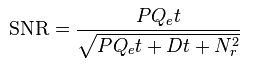
"The overall signal to noise ratio of a sensor (SNR), observed at the scale of a single pixel, is dependent on P, the incident photon flux (photons per second in the area of a pixel), Qe, the quantum efficiency, t, the exposure time, D, the pixel dark current in electrons per second and N, the pixel read noise in electrons."

I don't see signal-to-noise ratio as a function of total area here although I would concede a larger sensor area make for a better photo in terms of composition and framing. The exposure time would be a function of lens aperture so a larger aperture will improve SNR as well as pixel efficiency. Newer, and presumably better, sensors would be better than older sensors at high ISO regardless of sensor size when you are talking about APS-C and larger.
 

Attachments

  • Capture.JPG
    Capture.JPG
    11.1 KB · Views: 504
Upvote 0
tiger82 said:
"The overall signal to noise ratio of a sensor (SNR), observed at the scale of a single pixel, is dependent on P, the incident photon flux (photons per second in the area of a pixel), Qe, the quantum efficiency, t, the exposure time, D, the pixel dark current in electrons per second and N, the pixel read noise in electrons."

I don't see signal-to-noise ratio as a function of total area here although I would concede a larger sensor area make for a better photo in terms of composition and framing. The exposure time would be a function of lens aperture so a larger aperture will improve SNR as well as pixel efficiency. Newer, and presumably better, sensors would be better than older sensors at high ISO regardless of sensor size when you are talking about APS-C and larger.

You're fixated on pixel level noise, but we don't look at pixels, we look at pictures. What matters is the noise at the image level, not at the pixel level. Perceived image sharpness works in a similar manner - smaller pixels deliver higher spatial resolution, but images from FF sensors appear sharper (due to the additional enlargement needed from the smaller sensor for a fixed output size). As a side note, you're wrong about the pixel level noise being the same, too. The term 'P' you mention - photon flux - is higher with larger pixels, and pixels of FF sensors are generally larger. Basically, signal scales with pixel area (the square of pixel pitch), while noise scales with pixel pitch – therefore, larger pixels have higher S/N. I consider that an aside because in practice, the effect of sensor size trumps the effect of pixel size.

As Emil Martinec states, "The clear rule of thumb that emerges from such an exercise (not surprisingly) is that larger size sensor formats are less noisy than smaller size sensor formats. ... Bigger sensors have higher S/N ratios, because bigger sensors collect more photons."

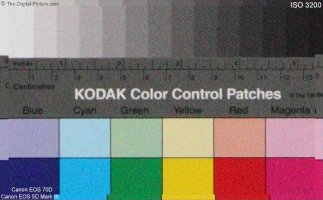
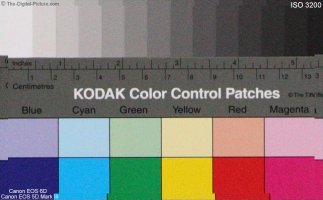
Perhaps a visual example will help, below are some of the noise test images from TDP's review of the 70D, showing ISO 3200 images from the 70D and 6D, both 20 MP and of a similar generation. According to your viewpoint, they should have similar noise. Looking at the images below, is the image noise the same? Absolutely not - the FF sensor delivers a much cleaner image (and slightly sharper, too). You can apply NR to the APS-C image and reduce the noise to a simlar level as the FF image, but if you do, you'll eliminate a fair amount of detail in the APS-C image…and end up with an image that is significantly softer, instead of just slightly less sharp.
 

Attachments

  • 70D-3200.jpg
    70D-3200.jpg
    49.4 KB · Views: 1,009
  • 6D-3200.jpg
    6D-3200.jpg
    85.9 KB · Views: 994
Upvote 0
Sabaki said:
Hi everybody :)

So as I move into my 3rd year of photography, I find my 500D isn't able to help my take my photography to the next level and its beginning to feel like my L series lenses are begging to shoot on a full frame body.

I've never had the chance to shoot full frame so most of what I know is pure theory derived from reading reviews etc online.

With South Africa's economy in a bit of trouble, I can get a hardly used 5D mkii for a reasonable price so I'm considering taking that.

Just what can I expect in terms of image quality and noise performance? Is the IQ of a full frame substantially better than a crops? Will I be able to take relatively noise free images at say ISO 3200?

The reviews seem to indicate that the native system for L series glass is full frame. Does this mean that I will experience a dramatic improvement in IQ?

The more I read, it seems that crop bodies have a singular advantage over full frame and that is the increase in focal length.

Can you guys chip in and throw some opinions and facts my way please?

Thanks in advance everybody.

the op was asking about what we think he should do with his setup. i think he should get a 6d. you have a 24-70ii and 100 macro plus the 50 f/1.8 those lenses shine on the ff body, that's what they are made for. you have the 10-22 and the long lenses for your 500d so if you are okay with a 2 camera setup then get a 6d. you were asking about iso 3200? thats what the 6d does, it is the best there is at high iso.
 
Upvote 0
Sella174 said:
Sabaki said:
What I am lacking is the ability to create compelling photography but that is a process independent of technology.

I can go on and on and on about how I learned photography with just a 55mm f/1.8 and a 135mm f/3.5 prime lens. I can go on and on and on about how the 55mm taught me to work within the limitations of the focal length, i.e. DoF and FoV. I can go on and on and on about how the 55mm taught me about angles and moments. I can go on and on and on ... but I won't. (Chorus: "Too late!")

I always challenge people, who want to really learn photography, to pick one prime lens and shoot straight to JPEG for three months. Everything, one prime lens in JPEG. Do it!

I so totally disagree.
 
Upvote 0
neuroanatomist said:
tiger82 said:
The ISO capability has no connection to full frame or APS-C, it's a function of sensor age. The 70D would have given you as big a bump in ISO capability at nearly half the price and allow you to continue using your APS-C lenses. I could compare a 5D classic with a 7D and conclude that APs-C is superior in many ways.

Sorry, no. The maximum ISO setting available tracks with sensor age (loosely), but having a setting available doesn't mean it produces usable images. 'High ISO capability' depends on sensor size. The 7D is a better camera than the 5D in many ways...but at the same ISO setting, the 5D has less image noise despite being a much older sensor.

The 70D offers less than 1/2 stop improvement over the 500D, and the 5D is about 1/2-stop better than the 70D. A current FF (6D, 5DIII) is over a stop better than the 70D.

Basic fact!
 
Upvote 0
sanj said:
Sella174 said:
Sabaki said:
What I am lacking is the ability to create compelling photography but that is a process independent of technology.

I can go on and on and on about how I learned photography with just a 55mm f/1.8 and a 135mm f/3.5 prime lens. I can go on and on and on about how the 55mm taught me to work within the limitations of the focal length, i.e. DoF and FoV. I can go on and on and on about how the 55mm taught me about angles and moments. I can go on and on and on ... but I won't. (Chorus: "Too late!")

I always challenge people, who want to really learn photography, to pick one prime lens and shoot straight to JPEG for three months. Everything, one prime lens in JPEG. Do it!

I so totally disagree.

I'm not sure about the whole jpeg issue... I shot in jpg for the first 3 or 4 years with an SLR because I didn't like the file size of raw and I didn't have a program that would read a raw file. But in retrospect... I really like shooting in raw because of the added data and I feel as though I can bring out more of the shot than what a normal jpeg would be able to offer. Sure over saturation is a risk or over contrasting...
 
Upvote 0
sanj said:
Sella174 said:
Sabaki said:
What I am lacking is the ability to create compelling photography but that is a process independent of technology.

I can go on and on and on about how I learned photography with just a 55mm f/1.8 and a 135mm f/3.5 prime lens. I can go on and on and on about how the 55mm taught me to work within the limitations of the focal length, i.e. DoF and FoV. I can go on and on and on about how the 55mm taught me about angles and moments. I can go on and on and on ... but I won't. (Chorus: "Too late!")

I always challenge people, who want to really learn photography, to pick one prime lens and shoot straight to JPEG for three months. Everything, one prime lens in JPEG. Do it!

I so totally disagree.

I think he said that so that you are limited to just you and the camera. Zero Post-processing. If you can take amazing pictures, then that makes you a photographer. Post-processing makes you an editor, and although thats what it takes to be photographer nowadays i.e. be both photographer & editor... It wasn't like that back in the day. And you have to agree... Seldomly, do we all take good pictures anymore, we all take half-assed pictures then throw it in lightroom to correct it, then crop it so they frame it better and lastly do a bunch of touch ups to make it clean and/or artsy.
 
Upvote 0
mkabi said:
sanj said:
Sella174 said:
Sabaki said:
What I am lacking is the ability to create compelling photography but that is a process independent of technology.

I can go on and on and on about how I learned photography with just a 55mm f/1.8 and a 135mm f/3.5 prime lens. I can go on and on and on about how the 55mm taught me to work within the limitations of the focal length, i.e. DoF and FoV. I can go on and on and on about how the 55mm taught me about angles and moments. I can go on and on and on ... but I won't. (Chorus: "Too late!")

I always challenge people, who want to really learn photography, to pick one prime lens and shoot straight to JPEG for three months. Everything, one prime lens in JPEG. Do it!

I so totally disagree.

I think he said that so that you are limited to just you and the camera. Zero Post-processing. If you can take amazing pictures, then that makes you a photographer. Post-processing makes you an editor, and although thats what it takes to be photographer nowadays i.e. be both photographer & editor... It wasn't like that back in the day. And you have to agree... Seldomly, do we all take good pictures anymore, they take half-assed pictures then throw it in lightroom to correct it, then crop it so they frame it better and lastly do a bunch of touch ups to make it clean and/or artsy.

No man. No no no.
Photography to me, in todays world means:
Knowing limits of the sensor/files and also how to enhance that. Without knowledge of proper benefits of RAW, the photographer will not be able handle exposures etc in low/extreme light situations.
Being very well versed with lenses and knowing which will work best for the story telling is a must.

And how about people who want to shoot wildlife? They MUST have proper telephoto... Landscape guys would need a proper wide... Ya?

Of course composition, lighting, and learning to see are fundamentals. Which I believe was the point being made but to disregard lenses and post is a very simplistic and limited approach.
 
Upvote 0
mkabi said:
sanj said:
Sella174 said:
Sabaki said:
What I am lacking is the ability to create compelling photography but that is a process independent of technology.

I can go on and on and on about how I learned photography with just a 55mm f/1.8 and a 135mm f/3.5 prime lens. I can go on and on and on about how the 55mm taught me to work within the limitations of the focal length, i.e. DoF and FoV. I can go on and on and on about how the 55mm taught me about angles and moments. I can go on and on and on ... but I won't. (Chorus: "Too late!")

I always challenge people, who want to really learn photography, to pick one prime lens and shoot straight to JPEG for three months. Everything, one prime lens in JPEG. Do it!

I so totally disagree.

I think he said that so that you are limited to just you and the camera. Zero Post-processing. If you can take amazing pictures, then that makes you a photographer. Post-processing makes you an editor, and although thats what it takes to be photographer nowadays i.e. be both photographer & editor... It wasn't like that back in the day. And you have to agree... Seldomly, do we all take good pictures anymore, we all take half-assed pictures then throw it in lightroom to correct it, then crop it so they frame it better and lastly do a bunch of touch ups to make it clean and/or artsy.

Does not apply to me for sure...
 
Upvote 0
mkabi said:
sanj said:
Sella174 said:
Sabaki said:
What I am lacking is the ability to create compelling photography but that is a process independent of technology.

I can go on and on and on about how I learned photography with just a 55mm f/1.8 and a 135mm f/3.5 prime lens. I can go on and on and on about how the 55mm taught me to work within the limitations of the focal length, i.e. DoF and FoV. I can go on and on and on about how the 55mm taught me about angles and moments. I can go on and on and on ... but I won't. (Chorus: "Too late!")

I always challenge people, who want to really learn photography, to pick one prime lens and shoot straight to JPEG for three months. Everything, one prime lens in JPEG. Do it!

I so totally disagree.

I think he said that so that you are limited to just you and the camera. Zero Post-processing. If you can take amazing pictures, then that makes you a photographer. Post-processing makes you an editor, and although thats what it takes to be photographer nowadays i.e. be both photographer & editor... It wasn't like that back in the day. And you have to agree... Seldomly, do we all take good pictures anymore, we all take half-assed pictures then throw it in lightroom to correct it, then crop it so they frame it better and lastly do a bunch of touch ups to make it clean and/or artsy.

then why bother using auto focus. Isn't that cheating? How dare you allow the camera to follow your subject. You should either find the plane at which you want to take the photo and wait for your subject to get there or try and track your quickly moving subject while turning the focus ring and then track him the old fashioned way all while getting in the proper position, finding the right angle, exposing correctly, and applying the rule of thirds.

Good lord. This reminds me of the conversation about everyone should learn with film. Film film film.

Gear isn't everything... but to refuse to use the new technology to make ones job easier is just silly.
 
Upvote 0
jdramirez said:
mkabi said:
sanj said:
Sella174 said:
Sabaki said:
What I am lacking is the ability to create compelling photography but that is a process independent of technology.
...I always challenge people, who want to really learn photography, to pick one prime lens and shoot straight to JPEG for three months. Everything, one prime lens in JPEG. Do it!

I so totally disagree.

I think he said that so that you are limited to just you and the camera. Zero Post-processing. If you can take amazing pictures, then that makes you a photographer. Post-processing makes you an editor... It wasn't like that back in the day...

...Good lord. This reminds me of the conversation about everyone should learn with film. Film film film.

Gear isn't everything... but to refuse to use the new technology to make ones job easier is just silly.

I'm with JD and Sanj. Some of the comments make as much sense as saying that you have to use a pencil and paper to write a great novel. Actually...it sounds more like you have to use a pencil and paper and do no editing or proofreading to write a great novel. That's just silly.

Photographers have always used the tools available to them to manipulate images after the shot was taken. Some more than others.

If you have talent and vision, it's not going to be lessened by using the tools available to you.
 
Upvote 0
neuroanatomist said:
unfocused said:
I know that people who have spent thousands on a full frame camera want to see a difference. But at ISO 400 or below, if you are seeing additional noise in a photograph taken with an APS-C sensor, it is likely to be either (a) confirmation bias or (b) your processing skills.

Sure. ISO 400 on APS-C is like ISO 1250 on FF...and with proper processing that looks perfectly clean.

Except that's not what you said in the earlier post (see below):

neuroanatomist said:
...FF is better than APS-C in terms of image noise, at both low ISO and high ISO.


And, frankly, ISO 400 on APS-C looks pretty much the same as ISO 400 on Full Frame.

neuroanatomist said:
The reason some of us spend thousands on a full frame camera is that we know some of our most impactful shots are taken in less than ideal light, and we're willing to pay a premium so those shots look as good as possible.

I never took issue with the argument that full frame provides better noise control at higher ISOs, I simply pointed out that at normal ISOs the differences are marginal at best.

neuroanatomist said:
Sometimes people who haven't or can't spend thousands on a full frame camera want to rationalize away the benefits. ;)

I own both a 5DIII and a 7D, so it's not a question of having to rationalize anything. Perhaps I just have a healthier perspective about the limitations of equipment.
 
Upvote 0