
You are using an out of date browser. It may not display this or other websites correctly.
You should upgrade or use an alternative browser.
You should upgrade or use an alternative browser.
Grainy images from my 5D MK IV?
- Thread starter Morlin
- Start date

StudentOfLight said:OP still MIA after opening the thread :
Reminds me of an ex who thought putting more pressure on a guy led to improved performance...
Upvote
0
OP hasn't posted a single example of what HE MEANT after he opened the thread and you guys are already well on your way to page 4 :YuengLinger said:StudentOfLight said:OP still MIA after opening the thread :
Reminds me of an ex who thought putting more pressure on a guy led to improved performance...
Upvote
0
Thank you all for some useful answers.
I have been away from the site since my last post and could not have guessed the number off answers.
Actually I have been away shooting with the camera and I really enjoy it. Though I still feel as some also have pointed that when underexposed the images can be a bit noisy. The sad part is that one of the reason (absolutely not the biggest) was the improved dynamic range. I thought it would be nice that for some occasions underexpose and then pull the shadows as many photographers do nowadays. But when having a bit off noise even before pulling shadows I might not use that technique that often.
I also think as many answered that it´s because of viewing the picture even "closer" because of the higher mp I can see more noise.
This is a Dropbox link where you can download an example off what I have been up to for a while in the woods. Shot with the 5D mk IV, 600mm is usm ii and a 1,4 teleconverter series iii. When properly exposed I can´t complain over the noise level but as mentioned when underexposed I still think that I could have been happier.
https://www.dropbox.com/s/v9e2u9ggpodaxqq/ST3A1209%20kopia.CR2?dl=0
Thank you all.
I have been away from the site since my last post and could not have guessed the number off answers.
Actually I have been away shooting with the camera and I really enjoy it. Though I still feel as some also have pointed that when underexposed the images can be a bit noisy. The sad part is that one of the reason (absolutely not the biggest) was the improved dynamic range. I thought it would be nice that for some occasions underexpose and then pull the shadows as many photographers do nowadays. But when having a bit off noise even before pulling shadows I might not use that technique that often.
I also think as many answered that it´s because of viewing the picture even "closer" because of the higher mp I can see more noise.
This is a Dropbox link where you can download an example off what I have been up to for a while in the woods. Shot with the 5D mk IV, 600mm is usm ii and a 1,4 teleconverter series iii. When properly exposed I can´t complain over the noise level but as mentioned when underexposed I still think that I could have been happier.
https://www.dropbox.com/s/v9e2u9ggpodaxqq/ST3A1209%20kopia.CR2?dl=0
Thank you all.
Upvote
0
Thanks for providing a sample. I'm sure you'll get some very good advice/feedback/assitance soon.Morlin said:Thank you all for some useful answers.
I have been away from the site since my last post and could not have guessed the number off answers.
Actually I have been away shooting with the camera and I really enjoy it. Though I still feel as some also have pointed that when underexposed the images can be a bit noisy. The sad part is that one of the reason (absolutely not the biggest) was the improved dynamic range. I thought it would be nice that for some occasions underexpose and then pull the shadows as many photographers do nowadays. But when having a bit off noise even before pulling shadows I might not use that technique that often.
I also think as many answered that it´s because of viewing the picture even "closer" because of the higher mp I can see more noise.
This is a Dropbox link where you can download an example off what I have been up to for a while in the woods. Shot with the 5D mk IV, 600mm is usm ii and a 1,4 teleconverter series iii. When properly exposed I can´t complain over the noise level but as mentioned when underexposed I still think that I could have been happier.
https://www.dropbox.com/s/v9e2u9ggpodaxqq/ST3A1209%20kopia.CR2?dl=0
Thank you all.
Upvote
0

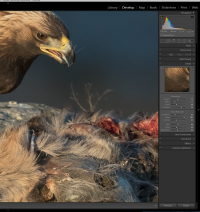
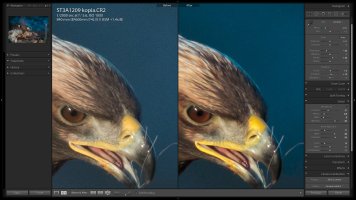
privatebydesign said:This 100% view is what we now consider noisy?
Sorry if I was unclear about that image. That was not an example of noise. Instead it was an example of that I actually been using the camera and not only spent time pixel peeping =) Also I thought that it could be nice for someone not owning the camera to have another raw file to play with.
When correct exposed the noise level is pretty good I think but I will look for an example where I think that there is too much grain. Not sure if I have a good example for now but as soon as I have I will post it.
Thank you all again for your answers. There is a lot of knowledge in this forum.
Upvote
0

Thanks for the download Morlin,
As someone who doesn't own the camera (yet) it is indeed nice to have another raw file to play with.
Given the title of the topic though I'd be even more interested in a 'grainy' example, underexposed or not.
I may have missed it but what raw converter are you using?
I really do believe in horses for courses and that images react better to some converters over others depending on subject matter. I don't think total reliance on ACR for example is particularly objective or healthy in defining the traits of a particular sensor.
But what do I know, I don't even like the notion of downscaling to compare, as I like doing large prints I think that disadvantages the higher Mpix sensor. I'd rather upscale the smaller file for a like for like comparison for my needs!
As someone who doesn't own the camera (yet) it is indeed nice to have another raw file to play with.
Given the title of the topic though I'd be even more interested in a 'grainy' example, underexposed or not.
I may have missed it but what raw converter are you using?
I really do believe in horses for courses and that images react better to some converters over others depending on subject matter. I don't think total reliance on ACR for example is particularly objective or healthy in defining the traits of a particular sensor.
But what do I know, I don't even like the notion of downscaling to compare, as I like doing large prints I think that disadvantages the higher Mpix sensor. I'd rather upscale the smaller file for a like for like comparison for my needs!
Upvote
0

Hi Morlin.
I'm glad you have clarified this, I was looking at it (in PhotoRaw lite) on my iPad and thinking what a bloody good shot it appeared to be, there is no f in noise! ;D
Looking forwards to a 'noisy' shot please.
Cheers, Graham.
I'm glad you have clarified this, I was looking at it (in PhotoRaw lite) on my iPad and thinking what a bloody good shot it appeared to be, there is no f in noise! ;D
Looking forwards to a 'noisy' shot please.
Cheers, Graham.
Morlin said:privatebydesign said:This 100% view is what we now consider noisy?
Sorry if I was unclear about that image. That was not an example of noise. Instead it was an example of that I actually been using the camera and not only spent time pixel peeping =) Also I thought that it could be nice for someone not owning the camera to have another raw file to play with.
When correct exposed the noise level is pretty good I think but I will look for an example where I think that there is too much grain. Not sure if I have a good example for now but as soon as I have I will post it.
Thank you all again for your answers. There is a lot of knowledge in this forum.
Upvote
0
Morlin said:Sorry if I was unclear about that image. That was not an example of noise. Instead it was an example of that I actually been using the camera and not only spent time pixel peeping =) Also I thought that it could be nice for someone not owning the camera to have another raw file to play with.
When correct exposed the noise level is pretty good I think but I will look for an example where I think that there is too much grain. Not sure if I have a good example for now but as soon as I have I will post it.
Thank you all again for your answers. There is a lot of knowledge in this forum.
Underexposing will always decrease the S/N ratio, and will lead to more noisy images. IMHO a larger dynamic range means better and smoother details in shadows for properly exposed images, and more room to manage them in postprocessing, not a way to allow for systematic "large" underexposure, although it could help to savage some underexposed images - especially when most data are not really in the lowest levels (and having more levels helps to avoid it).
Upvote
0

LDS said:Morlin said:Sorry if I was unclear about that image. That was not an example of noise. Instead it was an example of that I actually been using the camera and not only spent time pixel peeping =) Also I thought that it could be nice for someone not owning the camera to have another raw file to play with.
When correct exposed the noise level is pretty good I think but I will look for an example where I think that there is too much grain. Not sure if I have a good example for now but as soon as I have I will post it.
Thank you all again for your answers. There is a lot of knowledge in this forum.
Underexposing will always decrease the S/N ratio, and will lead to more noisy images. IMHO a larger dynamic range means better and smoother details in shadows for properly exposed images, and more room to manage them in postprocessing, not a way to allow for systematic "large" underexposure, although it could help to savage some underexposed images - especially when most data are not really in the lowest levels (and having more levels helps to avoid it).
That's what I was thinking. "Exposing to the right" should be always the way to shoot if you want the best IQ. The increse in DR is good in some ocasions when you have a situation with some contrast, but even in really high contrast situation you should use other techniques (bracketing, filters) to get the best IQ in the final image.
Upvote
0
sebasan said:That's what I was thinking. "Exposing to the right" should be always the way to shoot if you want the best IQ. The increse in DR is good in some ocasions when you have a situation with some contrast, but even in really high contrast situation you should use other techniques (bracketing, filters) to get the best IQ in the final image.
ETTR works best when the image is well within the DR of the sensor, and you have enough space left to shift exposure to the right without clipping the highlights - it could help minimizing noise in the shadows. In high contrast situation, that could be very difficult, because there's no really room to shift exposure. ETTR too needs to be used carefully when it makes sense, it's not a generic way to shoot, IMHO.
That's why IMHO graduated filters may still be useful (especially if you're not a photoshop master, and/or merging different shots is not possible)
Upvote
0
Similar threads
- Replies
- 1
- Views
- 533

D
- Replies
- 32
- Views
- 5K

- Replies
- 8
- Views
- 1K