High ISO comparo: 5DIII vs. D800

Status
Not open for further replies.
jrista said:
LetTheRightLensIn said:
I just want to clear up one too though, most us did dig into for no particular reason but only after we ran into the issues in the real world more than a few times. It depends what you want to shoot, etc. I don't mean to say it will matter for everyone at all, for some it virtually never may, but it's garbage OTOH to just turn the whole thing into a big joke and laugh it and so beyond downplay it as you are and you can get a bit snide and insulting about it all.

I'm sorry that I disagree, but I do. I'm also sorry that I've found the growing level of...angst...in the Canon community (at least those that hang out on DPR, here, and a couple other places) to be particularly humorous. I spend a lot of time viewing other photographers work. Online, at galleries, in books. Most of it is beautiful, artful, creative, and beautifully composed. Its only at final glance that I MAY notice grain or noise...or a funky artifact tucked away in a corner somewhere, or a tiny bit of banding in some deep shadow. Those things just don't matter...the beauty, art, and creative composure are what matter...what catch my eye...what draw me in.

Comparing the capabilities of the technology that took most of those photographs to what we have today...the difference on a technological level is stunning! I'm frequently awed when I see a photograph that looks like it was taken with $60,000 worth of gear, only to find it out was something like a 350D with the cheap 18-55mm kit lens! The fact that you can get the worlds best AF system, second highest ISO capability, and one of the best viewfinders I've ever seen (not to mention the host of other improvements the 5D III has) for $3500...as compared to the $7k, $8k, or even $40-60k you might have had to spend 4 years ago for similar and even LESS CAPABLE gear...amazes me. It absolutely floors me though that so many photographers are hung up on the bottom few bits of DR and a megapixel count as the focal point upon which their world hynges.

What really boggles my mind, though, is that all that angst appears to actually be making photographers worry that they chose the wrong brand (as evidenced by @tonyp's question in this very forum.) So yes, I downplay the angst, and I intend to keep downplaying it because it really doesn't matter. People have been making awesome photographs with far lesser technology than either the 5D III or D800. People will continue making awesome photographs with far lesser technology. In five years, people will be making awesome photographs with the 5D III and D800 when they pale in comparison to the next greatest gear to hit the markets, even if that gear supports 16-bit ADC and a full four stops better DR.


It's not the gear that makes the photograph...and I just can't help but laugh when so many people are nearly up in arms over issues that are...relatively speaking...so small, and largely irrelevant in the face of talent and skill. I don't mean to be snide, I apologize if it comes off that way (I tend to argue passionately regardless of what I'm arguing), and I'll try to avoid that in the future. But my mind is truly blown...so much ruckus for such little things. ;)

Yeah, I wonder if Nikon had less of it, if you'd be going on about how no true artist could ever use a Nikon or some such equally ridiculous nonsense from the other side of things.

And before you toss more snide insults realize that not everyone is the same and what is a minor thing some may not be for others .

I said 1000 times sure you can make awesome photos, fantastic ones even with say the 10D, but that doesn't mean that you have as much freedom to make certain types that some might want to make and it isn't fair to put that all down to pathetic tech head talk.
 
Upvote 0
jrista said:
Second, we obviously don't disagree (and, btw, I was not claiming you actually don't use your gear or your software correctly.) The point I've been trying to make, which I believe you have made for me better than I could myself...is low-level differences that require poking around a raw file with open-source editors so you can see special masked off data that is only supposed to be used by code...just doesn't matter.

I never thought we were in disagreement. We just had different ways of illustrating our points. It's nice to have a civil discussion on a topic that's become so incendiary these days. As soon as the 5DIII and D800 hit the streets, hopefully people will be too busy shooting to split hairs about such trivial issues :)
 
Upvote 0
Here's why I'm having a hard time accepting LetTheRightLensIn's (and other DPR guys') method for determining the DR from the black & white exposures:

Thought experiment:

You could have some arbitrary algorithm in the processing pipeline that says 'hey, if you're <2060 (say that's the average maximum pixel signal Canon ever saw in a number of completely black exposures on the 5D III), I'm gonna make you 0'... and then suddenly your black exposure would be ~0 with very little standard deviation... like the Nikon D7000 file... and then suddenly your DR from this method of calculation goes up like 2 or 3 stops.

So what if Nikon did that with the D7000?

Some operation like this would not, however, affect the more rigorous way to measure DR based on actually measuring the luminosity of scene elements recorded (the range of which should exceed DR capable by camera).

Apologies in advance if you think I should take this conversation elsewhere.
 
Upvote 0
V8Beast said:
sarangiman said:
Apologies in advance if you think I should take this conversation elsewhere.

I find the tech talk somewhat interesting, but admit that I don't fully understand it. Maybe I'm too dumb or too lazy to learn. I prefer the old school method of looking at a image, and judging the quality of the technology behind it accordingly.

Of course, doing so introduces the human factor.

Both methods (objective and subjective) have their flaws.

Personally, I'm far more interested in the images I am able to produce with a camera than any of its paper stats or what staff photogs are publishing. Hoping my pre-order was early enough that I'll have a "3" in hand late next week. We'll see.
 
Upvote 0
V8Beast said:
jrista said:
Second, we obviously don't disagree (and, btw, I was not claiming you actually don't use your gear or your software correctly.) The point I've been trying to make, which I believe you have made for me better than I could myself...is low-level differences that require poking around a raw file with open-source editors so you can see special masked off data that is only supposed to be used by code...just doesn't matter.

I never thought we were in disagreement. We just had different ways of illustrating our points. It's nice to have a civil discussion on a topic that's become so incendiary these days. As soon as the 5DIII and D800 hit the streets, hopefully people will be too busy shooting to split hairs about such trivial issues :)

I hope! I'm actually interested to see what people do with really high native ISO settings...the shots of Earth from the ISS with the D3X were stunning. I can only imagine what might be possible now...
 
Upvote 0
jrista said:
I hope! I'm actually interested to see what people do with really high native ISO settings...the shots of Earth from the ISS with the D3X were stunning. I can only imagine what might be possible now...

Me too. I just hope it's a real-world application of high-ISO usage. Shooting at ISO 25,600 in the middle of a sunny day on a tripod at f/22 with a pitch black ND filter is bogus. OK, that's an exaggeration, but you get the idea. IMHO, high ISO test shots that are taken in dark environments where high ISO would normally be used are valid, but shooting at high ISO in bright light just for testing purposes is questionable at best.
 
Upvote 0
V8Beast said:
jrista said:
I hope! I'm actually interested to see what people do with really high native ISO settings...the shots of Earth from the ISS with the D3X were stunning. I can only imagine what might be possible now...

Me too. I just hope it's a real-world application of high-ISO usage. Shooting at ISO 25,600 in the middle of a sunny day on a tripod at f/22 with a pitch black ND filter is bogus. OK, that's an exaggeration, but you get the idea. IMHO, high ISO test shots that are taken in dark environments where high ISO would normally be used are valid, but shooting at high ISO in bright light just for testing purposes is questionable at best.

Aye, certainly. I read something somewhere...I think a comment to one of Ctein's articles on TOP, that if they had enough ISO, they would take photos of fireflies at night that would "mimic the way they saw them with their own eyes." I think the needed ISO was in the range of ISO 1,000,000...but if you add three native stops to what we have now, H1 would get you 819,200 and H2 would get you 1,638,400 ISO. We might get there in less than a decade (which when you think about it, is actually kind of impressive.) ;) Others have mentioned that they would take better wide-field night sky/milky way shots without wasting money on an expensive german equatorial tracking mount. Granted, ISO 25600, or in the case of the 1D X, 51200, is probably not quite high enough for those kinds of things...but we just took two big steps closer.
 
Upvote 0
V8 Beast - since you already shoot and merge multiple exposures i am interested to hear how you think that the theoretical greater DR of the D800 is going to impact your workflow (I like how you provide specific examples illustrating your arguments)

I can see where the additional MP might benefit you and more likely to a greater extent the Nikkor 14-24 will give you some serious benfits that well outweigh the D800 benefits (I assume you are going for the E version)

I can see where there will be some marginal real world difference in a single exposure with pushed shdows but in this scenario its really subjective and up to the tolerance to noise of the individual. however as soon as you are merging multiple exposures then the theoretical DR of a single exposure goes out the window as rather than struggling pushing shadows you just take the cleaner data from the relevent exposure

I will reference this tutorial again as a way to blend exposures (I am not sure of your method)
http://goodlight.us/writing/paintinghdr/paintinghdr-1.html
 
Upvote 0
sarangiman said:
I have to admit I have half an academic interest in this & half a real interest in this DR debate because I also have found myself in situations where I've wanted to raise the shadows more in a landscape (where I did already control DR using Singh-Ray grad NDs) but couldn't, b/c of banding or FPN.

Therefore, I'm with LTRLI's sentiment of 'it's unfair to bash those concerned with these (esoteric?) subjects'.

+2

I like the high ISO abilities of my 5D2 and 7D, they've allowed me to shoot in situations I'd have struggled with in the past.
But I sure wish they could provide me with the clean low-ISO shadows my old 40D still does so effortlessly. (& so did a number of cheap Rebels I had as backups)
I'm sure the 5D3 will further improve the hi-ISO end of things and perhaps there is less FPN/banding at low ISO. fingers crossed!
I still need improvements in base ISO far more than I need 12,800 or higher.

Good lighting technique has always been the "real world HDR" effect but big landscapes and many other situations don't afford such luxury of lighting control or even ETTR. Often these situations also benefit from major tone-curve and shadow lift in PP. When the result looks like a corduroy overlay, clients aren't impressed; I certainly wasn't.

You cannot imagine the streak of expletives I expelled upon discovering my 5D2 exhibited some banding even at normally exposed low-ISO midtones! It sat it a drawer for most of a year until upgrades and improvements in NR software made it possible to process raw files with less obvious banding. It suffered a fair bit of depreciation while not earning its keep. I'd sure not enjoy another such purchase.

Despite the many kilo-bux invested in Canon gear, I'm likely to pick up a cheap D5100 and some used glass, just to sample a little cheap weed from the other side of the fence. I've never really liked how Nikons "handled" but I think it won't hurt to explore a little if I can justify the cost.


BTW, does the IRIS software you're mentioning allow individual RGB levels of any given pixel to be read?
I'd sure like to be able to cross calibrate some light metering to the color headroom of some of my cameras.

TIA.
 
Upvote 0
wickidwombat said:
V8 Beast - since you already shoot and merge multiple exposures i am interested to hear how you think that the theoretical greater DR of the D800 is going to impact your workflow (I like how you provide specific examples illustrating your arguments)

I can see where the additional MP might benefit you and more likely to a greater extent the Nikkor 14-24 will give you some serious benfits that well outweigh the D800 benefits (I assume you are going for the E version)

I can see where there will be some marginal real world difference in a single exposure with pushed shdows but in this scenario its really subjective and up to the tolerance to noise of the individual. however as soon as you are merging multiple exposures then the theoretical DR of a single exposure goes out the window as rather than struggling pushing shadows you just take the cleaner data from the relevent exposure

I will reference this tutorial again as a way to blend exposures (I am not sure of your method)
http://goodlight.us/writing/paintinghdr/paintinghdr-1.html

Great point. For images that are captured on a tripod, or with the camera rigged to the car, there isn't much benefit of 1-2 extra stops of DR when you're merging multiple exposures. In shots that are hand-held, or that capture real action opposed to staged action, merging exposures isn't in option.

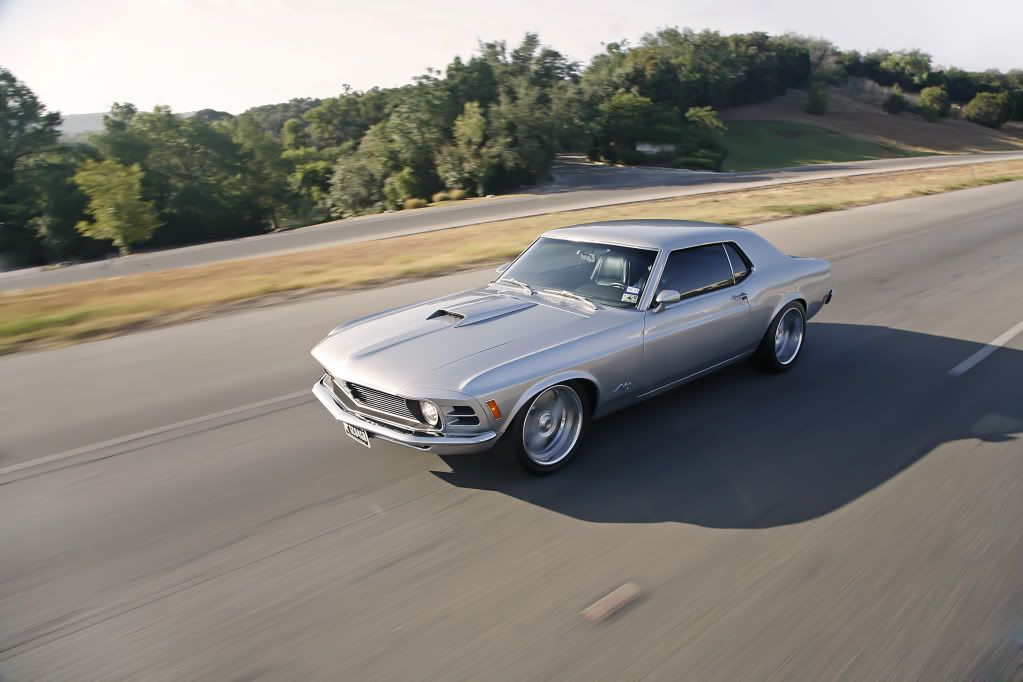
Here, I'm sticking my head out the top of an SUV. Even if I tried to keep the camera in the same spot and the composition identical from frame to frame in an effort to create a composite of multiple images, it's just not possible. The camera, the lead car, and the chase car move too much.
_MG_4304.jpg


So, there's no other option but to make do with what you got, and try to expose the image in a way that will assist in maximizing DR in post production. As you can see, there's a tremendous difference in contrast between the highlights on the grille, and the shadow side of the car. You could always shoot the car front-lit, but that makes the subject flat and two-dimensional, which I hate. Although this approach with the Mustang is far more challenging, I find it far more rewarding.

The same goes for this shot, but the situation is slightly different.
05d.jpg


Backlighting cars is tough, because they're not exactly translucent, but I love the results when it works. With the sun beating straight into the lens, there was very little detail left in the background, shadows, and midtones. This is another shot where multiple exposures can't be merged effectively, since I'm hand-holding the camera while hanging out the side of my minivan. Again, you have to make do with what you've got, and try to extend the DR as much as possible in a single exposure.

That said, I'm honestly not that concerned with the DR in the 5DIII. It's 22 mp are more than enough for the editorial work that I do, but there are instances for product or PR photography where extra resolution would come in handy. Extra pixels also give art directors to turn vertical shots in to horizontals, and horizontals into verticals.
 
Upvote 0
sarangiman said:
People keep touting the notion that ISO performance is increased, but DR at low ISO is not. I'm trying to understand how this is possible... is the following valid:

[list type=decimal]
[*]Increased QE due to better microlenses = increased SNR across the board. Coupled w/ lower gain, this decreases per pixel noise (shot noise is decreased). You'd think this'd also increase DR even at low ISO by decreasing noise at the lower end...
[*]No improvement in read noise means less usable data on the lower end
[/list]

So, ISO performance is increased b/c for any equivalent ISO setting on the, say, 5DII, the 5DIII is actually receiving more photons... which translates to higher SNR.

BUT, DR is only slightly improved at low ISO b/c absolute SNR increase for dark pixels is small compared to absolute SNR increase for brighter pixels (e.g. say read noise on 5DII & 5DIII is 5e-; QE is 0.5 on 5DIII vs. 0.25 on 5DII | then: for a signal of 20e- SNR of 5DIII vs 5DII would be 2 vs. 1, but for a signal of 2000e- SNR of 5DIII vs 5DII would be 200 vs. 100)?

Meaning DR is largely determined by full-well capacity, bit-depth of ADC, & read noise? Neither of which, it'd seem, have changed much for the 5DIII compared to 5DII?

(This of course leaves out practical usability of low-end due to banding, which is another issue in an of itself... less FPN = more forgiving raising of shadows since we're so sensitive to patterns).

Just trying to understand these arguments being thrown around... thanks!

One interesting thing is that I just noticed that some have said that the horizontal banding on the 20D had been more random and the vertical block kind more fixed and if that holds for the 5D3 maybe the vertical can be removed if software were to allow you to feed it a bunch of dark frames and since the 5D3 already seems to have cured the horizontal type, maybe banding could be really cut down. I wonder, if so, if ACR will allow for feeding of dark frame avgs for each person's particular camera? Maybe the banding can be very greatly removed with an advanced RAW converter? Maybe if ACR refuses to put it in a program can be written to pre-process the RAW and then feed that altered RAW to ACR....

it still won't fix the poor read noise but at least most the ugly stuff can be rid and maybe you can 1/2 stop more usable??? (wild guess, not sure exactly how much) and of course it has to be that the vertical sort left on the5D2 is the sort that stays even frame to frame for the most part, not yet certain


anyway

noise = sqrt(read noise^2 + # photons / gain)

if read noise^2 is a much bigger term then photos/gain photon shot noise doesn't matter and for dynamic range we want to test noise at that very floor where photons = zero and all you have left is the noise=read noise

(a little above that floor, noise = read noise + photons/(2*read noise*gain) + more terms as photos/gain gets bigger but bigger than R and when it gets to lighter tones noise = sqrt(photos/gain))

Anyway, I'm tried of all of this. It is what it is. Some will care legitimately and some will care just a tiny bit legitimately and some won't care at all legitimately. At this point it is what is. And you look at DxO, try things out, etc. or not as needed/desired. It's just one of many aspects.
 
Upvote 0
One interesting thing is that I just noticed that some have said that the horizontal banding on the 20D had been more random and the vertical block kind more fixed and if that holds for the 5D3 maybe the vertical can be removed if software were to allow you to feed it a bunch of dark frames and since the 5D3 already seems to have cured the horizontal type, maybe banding could be really cut down.

I've thought of this too. There is definitely some banding that remains constant in the 5D2, & I've averaged multiple dark frames to see this. Still trying to work out an algorithm to get rid of the pattern noise & see if it helps. Yeah maybe we'll be lucky & the banding will be fixed (not actually 'fixed', haha) and we'll be able to get rid of it (I'm pretty sure people have already worked out a software algorithm to do this).

LTRLI, dunno if you had a chance to read my other posts, but, in general I think your method for calculating the DR from the black/white files *could* be valid (certainly seems so, as they match up with DXO results, assuming DXO is doing DR tests properly by actually metering scene, or input, illumination)... but could also be entirely invalidated if some strange non-linear function were applied to the data before being written to the RAW file (such as my example of assigning any pixel value <2060 to 0... which'd effectively decrease your measured standard deviation in your black file... and maybe that black file would end up looking like the D7000 file I mentioned, which has an average pixel value of 0.43, a stdev of 0.7, and a max value of 8 ).

Anyway, I should be first in line for a 5D3 so I'll measure myself using the not-so-accurate method of shooting a gray card at many different exposures to estimate the DR.
 
Upvote 0
Astrogarden said:
V8Beast said:
There aren't many direct ISO comparisons (ie 1600 vs. 1600) in these samples, but my own worthless opinion is that the 5DIII at 25,600 looks almost as good as the D800 at 6400, and the 5DIII looks substantially better at 6400 than the D800 at 6400. So, my unscientific conclusion is that the 5DIII tops the D800 by 1.5 to 2 stops.

Discuss :)

All other things being equal any 36 mp camera will have poorer light sensitivity than any 22 mp camera. Fewer pixels, same size sensor, equals bigger pixels and a bigger pixel collects more photons in the same time period. Plain and very simple physics. Take it from an astronomical imager with 20 years experience - this matters.

All things being equal. In that case, and really only in that case...yes. Its not that simple though.

The simple fact of the matter is things are not completely equal, even from generation to generation of each sensor. The 36mp Nikon sensor DOES have some distinct advantages over the 5D III, I don't think anyone (including myself) have disputed that. I think at a per-pixel IQ level, the D800's 36.3mp will only be marginally worse than the 5D III's 22.3mp sensor. In a real-world context, I think the only real performance differences that are actually going to mean anything significant on the IQ front are the larger image size of the D800, and the higher ISO capability of the 5D III. Noise will proabably be very comparable between the two. The 5D III will probably have a slight edge on highlight headroom. The D800 will have a solid lead in terms of shadow recoverability.
 
Upvote 0
sarangiman said:
Man, V8Beast, I absolutely love your photos. The sense of motion and the lighting are spectacular.

Thanks :) I'm just trying to keep up with those that are better than me.

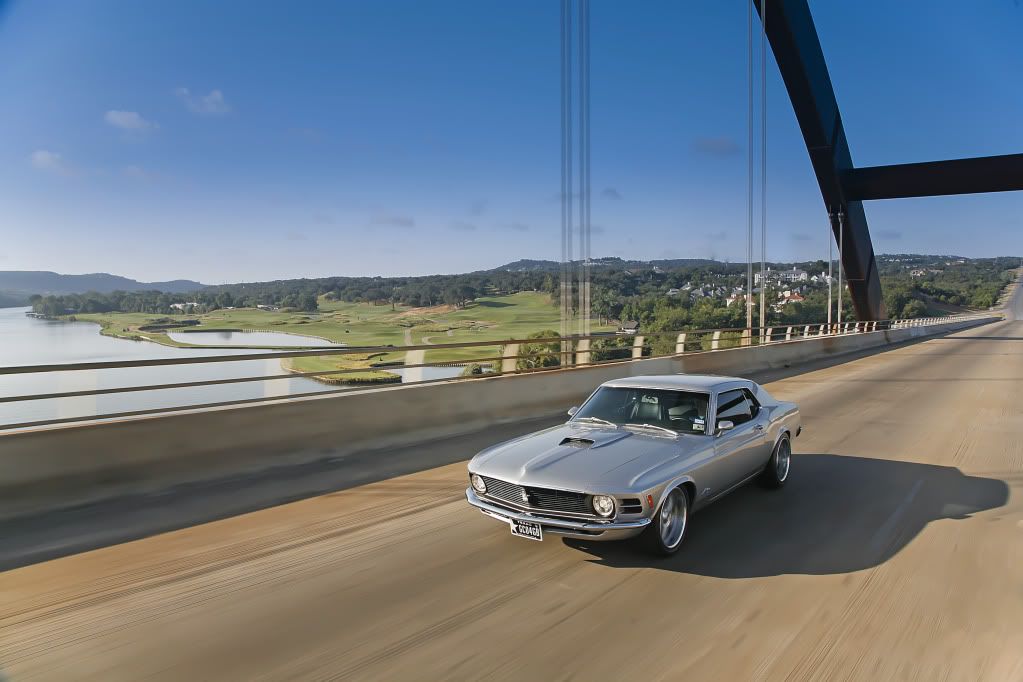
On a different topic, one factor I neglected to mention about the image with the Mustang is that for car-to-car shots, the 5DIII's advantage in FPS over the D800 is huge. If you're a high-end commercial photographer that has the means to get a permit to shut down a public road, then you can get as many cracks at a shot like this as you want, as long as the light doesn't get too harsh. For editorial hacks like me, unfortunately that's not an option.

For one, this shot was taken on a public road while trying to circumvent traffic. Secondly, I'm sticking my head out of the moon roof of an SUV, which is quite hairy. If a cop sees you doing something like this, he's going to tell you to go home ASAP. Thirdly, the surface was very bumpy, making it very difficult to get the desired motion blur with a low shutter speed while maintaining acceptable images sharpness. These are all factors work against you, and lower your "hit rate." The ability to fire off as many frames in a given amount of time is always helpful in these situations.

I tried to capture a shot at a very specific point on a bridge, but it didn't quite work out, and this is the best I could get. Oh well, maybe next time.

_MG_4322.jpg
 
Upvote 0
LetTheRightLensIn said:
sarangiman said:
People keep touting the notion that ISO performance is increased, but DR at low ISO is not. I'm trying to understand how this is possible... is the following valid:

.. wonder, if so, if ACR will allow for feeding of dark frame avgs for each person's particular camera? Maybe the banding can be very greatly removed with an advanced RAW converter? Maybe if ACR refuses to put it in a program can be written to pre-process the RAW and then feed that altered RAW to ACR....

it still won't fix the poor read noise but at least most the ugly stuff can be rid and maybe you can 1/2 stop more usable??? (wild guess, not sure exactly how much) and of course it has to be that the vertical sort left on the5D2 is the sort that stays even frame to frame for the most part, not yet certain..


I think fixed pattern banding should be removable to some degree with an averaging of dark frame noise using same shooting parameters from the same body. This could be done in ACR or an aftermarket plugin and is something I've already suggested to the group at Topaz.
It should also be possible to do this in Photoshop extended version by averaging some dark frames and then using that to subtract from the affected shadow area.
Doing it this way's gonna need some masking and levels tweaking to make the math work out but visually it otta be doable, just a lot of extra work better left to a specific plugin or raw converter front end.

Adobe, DxO, Canon?... you guys reading this? Get on it! ;)
 
Upvote 0
Status
Not open for further replies.