ISO 50

Status
Not open for further replies.
neuroanatomist said:
But the key point is that ISO 50 offers no benefit, and can in some cases result in a detriment - therefore, I see no reason to use it.

I, too, have no use for ISO 50 nor HTP. But I would find it useful if I were shooting JPEGs with no intention of post-processing, or if I were planning on doing ETTR or ETTL (respective) exposure and wanted a closer preview image on the back of the camera -- say, if a clueless client were looking over my shoulder.

Cheers,

b&
 
Upvote 0
Regardless of camera brand I often recommend using 'HTP' or whatever acronym a particular brand has chosen to signify a more gentle contrast curve towards the clipped highlights when shooting outdoors in sunny weather. -But for jpg shooters only!.

Often there's something more involved in the altered process too, like a different color profile, local contrast enhancements and/or other 'optimizations' and so on. And I do dislike the often overly contrasty rendition that most in-camera jpg engines use. Using HTP in stead of just lowering the 'contrast' setting does in that case often have several benefits.
 
Upvote 0
TheSuede said:
Regardless of camera brand I often recommend using 'HTP' or whatever acronym a particular brand has chosen to signify a more gentle contrast curve towards the clipped highlights when shooting outdoors in sunny weather.

When I got my 60d I was shooting htp all the time in sunny weather, but stopped doing so because it increases the sensor's main weakness: high noise levels after raising shadows.

I admit clipped highlights are the worst thing that can happen, but it's closely followed by shadow noise - so today I only enable htp for jpeg and when I know the scene has a tendency to clip hightlights and I won't have to raise shadows in post a lot.
 
Upvote 0
Marsu42 said:
TheSuede said:
Regardless of camera brand I often recommend using 'HTP' or whatever acronym a particular brand has chosen to signify a more gentle contrast curve towards the clipped highlights when shooting outdoors in sunny weather.

When I got my 60d I was shooting htp all the time in sunny weather, but stopped doing so because it increases the sensor's main weakness: high noise levels after raising shadows.

I admit clipped highlights are the worst thing that can happen, but it's closely followed by shadow noise - so today I only enable htp for jpeg and when I know the scene has a tendency to clip hightlights and I won't have to raise shadows in post a lot.

Me same
 
Upvote 0
TheSuede said:
Regardless of camera brand I often recommend using 'HTP' or whatever acronym a particular brand has chosen to signify a more gentle contrast curve towards the clipped highlights when shooting outdoors in sunny weather. -But for jpg shooters only!.

There's some slightly better and simpler advice you could offer JPEG shooters: do whatever you have to to make the image on the back of the camera look the way you want it to. Those on-camera knobs are the only ones you have to fiddle, so fiddle with them until you're happy with the result.

And HTP is an excellent in-camera implementation of "ETTL" (expose-to-the-left) post-processing, and perfect for situations where you care about highlights and won't see noise in shadows. Similarly, ISO 50 does a great job of doing exactly what ETTR does, when it's shadow noise you're worried about and don't care if the highlights blow. If you're shooting JPEG, you should know what each does and when to use either -- as well as when not to use them.

But, if you're shooting raw (and, generally, you should be if your post processing is much more than picking keepers), you should also understand what HTP and ISO 50 are doing, and why you're better off doing what they do yourself. Maybe it's an especially contrasty scene, and a single stop of ETTL isn't enough to keep those highlights you're so interested in, so you'll want to underexpose not by one stop but by two stops, for example.

Cheers,

b&
 
Upvote 0
TrumpetPower! said:
Maybe it's an especially contrasty scene, and a single stop of ETTL isn't enough to keep those highlights you're so interested in, so you'll want to underexpose not by one stop but by two stops, for example.

I eagerly await Mikael's comment that in such a situation, one should instead use a D800 where the motive can be to underexpose by four stops and allow bringing up of shadows without motive of banding and noise. I understand the technique works very well for sunrises, sunsets, cluttered sheds, and barbecues with QPcards on them.

EDIT: too late, Mikael beat me to the punch. ???
 
Upvote 0
neuroanatomist said:
LOL. Earlier, it was suggested that it means 'Half The Photons' - that seems to be Mikael's definition, anyway.

'Half The Photons' is correct IF you concede that enabling HTP raised the effective ISO amplification +1EV from whatever ISO you were at before activating HTP.
so the resultant metering of course causes a -1 EV exposure - and HALF THE PHOTONS! :)

Did you not understand what Michael meant vs what he may have typed or did you just feel the urge to have a battle from the same side of the argument?

Honestly, Neuro, we appreciate your extensive technical knowledge but some of us old guys are occasionally reminded of a a couple brothers scrapping over a toy by such an extensive display of (where do I get that cool little animation for) beating your head on a brick wall.

I hope you keep up your high rate of helpful and clear advice but temper it with a bit more restraint and human understanding in such cases. I think you might have driven Michael to drinking after this thread. ;)
 
Upvote 0
Aglet said:
neuroanatomist said:
LOL. Earlier, it was suggested that it means 'Half The Photons' - that seems to be Mikael's definition, anyway.

'Half The Photons' is correct IF you concede that enabling HTP raised the effective ISO amplification +1EV from whatever ISO you were at before activating HTP.
so the resultant metering of course causes a -1 EV exposure - and HALF THE PHOTONS! :)

Did you not understand what Michael meant vs what he may have typed or did you just feel the urge to have a battle from the same side of the argument?

Honestly, Neuro, we appreciate your extensive technical knowledge but some of us old guys are occasionally reminded of a a couple brothers scrapping over a toy by such an extensive display of (where do I get that cool little animation for) beating your head on a brick wall.

I hope you keep up your high rate of helpful and clear advice but temper it with a bit more restraint and human understanding in such cases. I think you might have driven Michael to drinking after this thread. ;)

Why would any of us concede to your explanation when that is not what HTP does. HTP does not change the aperture or shutter speed and therefore does not change the number of photons that are incident on the sensor.

We all understand what Mikael meant because he was very clear about it. He was also very clear about his condescending remarks such as "look at the attached link, can't you boys read" when in fact the attached article exactly refuted his statements.
 
Upvote 0
Aglet said:
neuroanatomist said:
LOL. Earlier, it was suggested that it means 'Half The Photons' - that seems to be Mikael's definition, anyway.

'Half The Photons' is correct IF you concede that enabling HTP raised the effective ISO amplification +1EV from whatever ISO you were at before activating HTP.
so the resultant metering of course causes a -1 EV exposure - and HALF THE PHOTONS! :)

Sorry, but you seem to be falling into the same trap and suffering from the same misconceptions as Mikael.

It's only half the photons if the aperture is set a stop narrower or the shutter speed is set a stop faster. Are you suggesting that enabling HTP directly affects aperture or shutter speed?

In fact, enabling HTP does nothing to the resultant metering - the camera meters for the ISO you select, it doesn't indicate that it's actually exposing at a 1-stop lower ISO, but it is (and that's why ISO 100 is unavailable with HTP enabled). Try it - set ISO 200 or higher (but not a H expansion, since those are unavailable with HTP), meter a scene, then toggle HTP and see if the metering changes - does it? Even in P Mode with Auto ISO where the camera is selecting all the parameters, enabling HTP does not change the aperture, shutter speed, or ISO selected.

HTP doesn't raise the ISO, unless you have it set lower than ISO 200 before enabling HTP (and if you're at an H expansion ISO, enabling HTP lowers it). I concede that in the specific case of the camera being set to ISO 100 before enabling HTP, the metered exposure will change by one stop, and IF you are in an auto exposure mode or you manually adjust exposure to compensate by one stop, then the number of photons will be halved. Also 'halved' applies only if ISO 100 was set - if it was set to 50, 125, or 160, the change will be more or less than one stop (but not 'halved'). But that's a byproduct of how HTP works, applicable in a limited range of circumstances. To conclude that reducing the photons by half is the mechanism by which HTP works is like concluding that a stopped analog clock is keeping correct time because you just happened to look at it at whatever time at which it was stuck.

As for misunderstanding Mikael, as I indicated earlier and Meh just wrote, that's clearly not the case. He specifically stated, at least five times in at least four different posts, that HTP halves the number of photons and/or the amount of light hitting the sensor, and used that phrasing in describing the mechanism of HTP. That manifestly demonstrates that his understanding of how HTP really works is seriously flawed, and if you are supporting that explanation, you are also failing to understand how HTP works.
 
Upvote 0
ilkersen said:
Long thread, but clear and informative. Thanks guys!

Take home message: No need to use ISO50, ever ;)

Almost.

For JPEG shooters, ISO 50 is the best way to do ETTR, for situations where you need the cleanest possible shadows and don't care about blown highlights. It's also useful for JPEG shooters who wished they had a one-stop neutral density filter but don't -- and, again, who can tolerate the loss of the last top of highlights.

Granted, the set of situations where either applies is so close as to be practically nonexistent...but there's at least the theoretical possibility it might apply somewhere sometime.

Cheers,

b&
 
Upvote 0
sanj said:
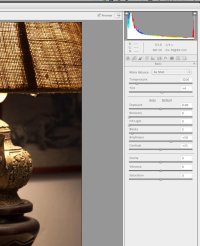
My test.
1. It is unscientific, do not pounce on me. Am learning!
2. Stats: 1dx. 24-70 II. Manual focus, exposure, WB (tungston). f5.6 1/4 and 1/8.

Its all for us to see, but to my eyes:
1. The tint at ISO 50 is truer. (This is next to my desk and I can make a visual comparison)
2. The blown whites between the statue and lamp is blown more on 50 ISO.
3. 50 ISO shows marginal noise and sharpness improvement. (This could of course be just my eyes playing games.) Or is there a shake? I did use a sturdy tripod.

Do you think I should make another test? If yes, how should I improve? :)

Thank you.

Sanjay

Thanks for the test sanj.

Personally, the blown highlights on the flower pattern and above the statue are more distracting to me than any marginal gain in sharpness from using ISO 50 offsets. If you are in a situation where no data exists near the saturation point, then you have lots of latitude to boost contrast anyway, and at that point it looks to me like the only difference between straight ETTR and ISO 50 is whether you apply the tone curve yourself or let the camera do it for you.
 
Upvote 0
Mikael Risedal said:
well you can put the d800, d600 at -6 stops then you are even safer regarding blowing highlights in all photographic situations, nothing you can do with your cameras-or?

Sure. We've covered the fact that the D800's sensor has better DR than any current Canon sensor, ad infinitum. Nothing new here.

Still no admission that you are wrong with your repeated statements about HTP working by reducing the amount of light falling on the sensor, 'eh? Not even after accusing me and others of an inability to admit being wrong, 'eh? I can't say I'm surprised. I can't even say I'm disappointed, because I expected no better...
 
Upvote 0
neuroanatomist said:
Aglet said:
neuroanatomist said:
LOL. Earlier, it was suggested that it means 'Half The Photons' - that seems to be Mikael's definition, anyway.

'Half The Photons' is correct IF you concede that enabling HTP raised the effective ISO amplification +1EV from whatever ISO you were at before activating HTP.
so the resultant metering of course causes a -1 EV exposure - and HALF THE PHOTONS! :)

Sorry, but you seem to be falling into the same trap and suffering from the same misconceptions as Mikael.

It's only half the photons if the aperture is set a stop narrower or the shutter speed is set a stop faster. Are you suggesting that enabling HTP directly affects aperture or shutter speed?

In fact, enabling HTP does nothing to the resultant metering - the camera meters for the ISO you select, it doesn't indicate that it's actually exposing at a 1-stop lower ISO, but it is (and that's why ISO 100 is unavailable with HTP enabled). Try it - set ISO 200 or higher (but not a H expansion, since those are unavailable with HTP), meter a scene, then toggle HTP and see if the metering changes - does it? Even in P Mode with Auto ISO where the camera is selecting all the parameters, enabling HTP does not change the aperture, shutter speed, or ISO selected.

HTP doesn't raise the ISO, unless you have it set lower than ISO 200 before enabling HTP (and if you're at an H expansion ISO, enabling HTP lowers it). I concede that in the specific case of the camera being set to ISO 100 before enabling HTP, the metered exposure will change by one stop, and IF you are in an auto exposure mode or you manually adjust exposure to compensate by one stop, then the number of photons will be halved. Also 'halved' applies only if ISO 100 was set - if it was set to 50, 125, or 160, the change will be more or less than one stop (but not 'halved'). But that's a byproduct of how HTP works, applicable in a limited range of circumstances. To conclude that reducing the photons by half is the mechanism by which HTP works is like concluding that a stopped analog clock is keeping correct time because you just happened to look at it at whatever time at which it was stuck.

As for misunderstanding Mikael, as I indicated earlier and Meh just wrote, that's clearly not the case. He specifically stated, at least five times in at least four different posts, that HTP halves the number of photons and/or the amount of light hitting the sensor, and used that phrasing in describing the mechanism of HTP. That manifestly demonstrates that his understanding of how HTP really works is seriously flawed, and if you are supporting that explanation, you are also failing to understand how HTP works.

Actually, I think all we experienced types know how HTP works as many have amply explained it.
I think this very long argument is in the semantics of describing the comparison of HTP to non-HTP is where I see the confusion.

Now I'm trying to explain what I think Michael was trying to explain regarding HTP and losing half the photons and how this argument got started.
Like Suede, I read enough of this thread to see that all of you experienced tech guys DO understand HTP but I think your methods of explaining it are being misunderstood by some. This is quite possibly a result of different linguistic syntax, typos, or lack of clear explanation by someone who should have been getting more sleep. ;D

Michael, correct me if I am wrong.
I think Michael WAS basing his explanation on the base of 100 ISO, and that enabling HTP now means you no longer have it available so your HTP base ISO is now 200 ISO and, therefore, you'll be using half the photons to create the same tone you would have if you were still using 100 ISO.
I know you all understand this and you as well conceded this in this specific case in your 2nd last paragraph, above.
This is the foundation of how HTP works. Agreed, yes?
Because, regardless of this argument, we all know that one full step up in ISO means we'll now be using half the photons to create a given tone or shade.

I think this got out of context when thinking about the higher ISO settings, with and w-o HTP

E.G. If we take a normal 800 ISO setting and require 100 photons per pixel to generate some shade.
at 1600 ISO we should only require 50 photons to generate the same shade or 200 photons at 400 ISO.

we're still good to this point too, yes?

now we turn on HTP and set to ISO 800
The metering is the same as for the normal ISO 800, hence the exposure is the same and we still use 100 photons to create the same shade.

But behind the scenes, inside the camera, the ISO (sensor gain) is actually ISO 400, and the subsequent processing of this raw file is tweaked so that those 100 photons create the same shade as they did with non-HTP 800 ISO.
The HTP advantage is that since the shot was really done, internal to the camera, at a 400 ISO sensitivity there's 1EV more headroom in the highlights available and the processing allows for a more gradual transfer curve near the top EV levels to prevent or reduce the likelihood of clipping bright shades of gray-white.
The HTP disadvantage is that this comes at the expense of signal to noise ratio which is most evident in shadow areas where fixed read noise becomes a considerable amount relative to the small signal of darker tones/shades.

we're still good ?.. I know what I'm talking about?.. :)

I think Michael merely views an HTP ISO 800 as ISO 400, 1600HTP as 800, etc.
I think his viewpoint is from INSIDE the sensor, and this does not surprise me considering how attentive he is to sensor metrics.
If you view things in this way then you ARE using half the photons compared to using the normal ISO and exposing appropriately.
If you view things in this way then you ARE changing the metering and therefore the exposure and the number of photons/electrons by -1 stop.
When using HTP you ARE getting more shadow noise for a given shade because it's only using half the photons to create compared to using the one step lower non-HTP ISO.

I think perhaps Michael did not succeed in making his point of view clearly to those of us who look at this from a different viewpoint is all.
If I had to explain this in another language i don't think i'd do a very good job of it myself.

I hope I presented a clear explanation of what I think is Michael's viewpoint.

Did I help clear anything up for anybody?

 
Upvote 0
I know there are a multitude of factors affecting the process in shooting in the 5D Mark III's expanded ISO 50;SNR, DR, electronics, physics, optics, post work in software, brand model specifications and hype, third party testing...on and on.
Many of those topics can be throughly argued far beyond my understanding of technical issues at hand, but actually prove nothing but a great debate topic amongst experts.

I think the real test of whether shooting @ ISO 50 with the 5D MKIII is usable or not is to actually go out and to test it yourself, not endlessly beat it to death without a single exposure to evaluate.

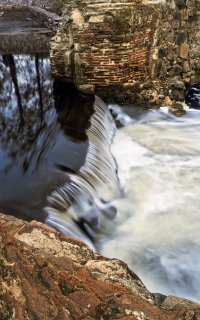
Admittedly this was shot on an overcast day without glaring highlights, and I really wanted to accentuate the waterfall's movement, so I used a Circ. Polarizer not for reflections control, but to add 2+ stops exposure in addition to lowering the ISO to 50. I don't yet have a decent ND filter set to accomplish the same thing.

I was please enough with the results shot at Mission Trails Park Old Padre Dam, built around 1800 and of the first Spanish irrigation structures in California on the San Diego River. No it is not Old Man river, but yes we have a flowing river here!

Certainly open to opinions and criticism. Specs: 5D MKIII 17-40 f4, ISO 50, @ 5 sec , @f18
 

Attachments

  • SDRiverHealing.07_Edit.jpg
    SDRiverHealing.07_Edit.jpg
    1.2 MB · Views: 803
Upvote 0
Aglet said:
Did I help clear anything up for anybody?

Nice try, but no. If you choose to believe that Mikael understands clearly and is simply communicating that in a way we aren't comprehending, you're certainly welcome to your belief. I see no evidence of that, quite the opposite...I see intransigent repetition of the same incorrect statements, but the statements themselves are articulated clearly. Even if your assumption is correct, I'd say that someone who chooses a specific case that is an exception to the norm to describe a process (and hammers that same point over and over) has at best a limited grasp of the concepts behind that process.
 
Upvote 0
jpthurston said:
I know there are a multitude of factors affecting the process in shooting in the 5D Mark III's expanded ISO 50;SNR, DR, electronics, physics, optics, post work in software, brand model specifications and hype, third party testing...on and on.
Many of those topics can be throughly argued far beyond my understanding of technical issues at hand, but actually prove nothing but a great debate topic amongst experts.

I think the real test of whether shooting @ ISO 50 with the 5D MKIII is usable or not is to actually go out and to test it yourself, not endlessly beat it to death without a single exposure to evaluate.

Admittedly this was shot on an overcast day without glaring highlights, and I really wanted to accentuate the waterfall's movement, so I used a Circ. Polarizer not for reflections control, but to add 2+ stops exposure in addition to lowering the ISO to 50. I don't yet have a decent ND filter set to accomplish the same thing.

I was please enough with the results shot at Mission Trails Park Old Padre Dam, built around 1800 and of the first Spanish irrigation structures in California on the San Diego River. No it is not Old Man river, but yes we have a flowing river here!

Certainly open to opinions and criticism. Specs: 5D MKIII 17-40 f4, ISO 50, @ 5 sec , @f18
Nice picture. I like the brick wall and the flow of the water.

I have a few questions:
[list type=decimal]
[*]Did you shoot raw or JPEG?
[*]Your file name has the word "edit" in it. What editing did you do?
[/list]
 
Upvote 0
Could I explore and investigate this a bit further?
We, or rather I, by now feel:
a) I was mistaken about noise advantage of ISO 50.
b) ISO 50 causes loss of highlights.
c) I will not use ISO 50 again.

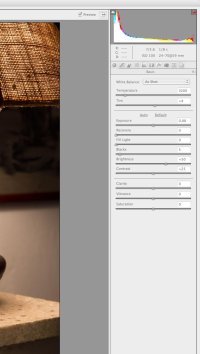
I examined the histograms of the two shots I posted earlier as test.
Although I exposed both shots equally, (And I cant be convinced otherwise) but the histogram on the 50 ASA shows that whites are clipping.... What does this mean? To my non technical mind it says: At ISO 50 the dynamic range gets reduced. Am I wrong?

I am not agree or disagreeing with many posts here, just exploring. Actually I do not even understand many posts fully to argue! :)
 

Attachments

  • 50 asa histo.jpg
    50 asa histo.jpg
    88.2 KB · Views: 647
  • 100 asa histo.jpg
    100 asa histo.jpg
    70.6 KB · Views: 651
Upvote 0
rpt said:
jpthurston said:
I know there are a multitude of factors affecting the process in shooting in the 5D Mark III's expanded ISO 50;SNR, DR, electronics, physics, optics, post work in software, brand model specifications and hype, third party testing...on and on.
Many of those topics can be throughly argued far beyond my understanding of technical issues at hand, but actually prove nothing but a great debate topic amongst experts.

I think the real test of whether shooting @ ISO 50 with the 5D MKIII is usable or not is to actually go out and to test it yourself, not endlessly beat it to death without a single exposure to evaluate.

Admittedly this was shot on an overcast day without glaring highlights, and I really wanted to accentuate the waterfall's movement, so I used a Circ. Polarizer not for reflections control, but to add 2+ stops exposure in addition to lowering the ISO to 50. I don't yet have a decent ND filter set to accomplish the same thing.

I was please enough with the results shot at Mission Trails Park Old Padre Dam, built around 1800 and of the first Spanish irrigation structures in California on the San Diego River. No it is not Old Man river, but yes we have a flowing river here!

Certainly open to opinions and criticism. Specs: 5D MKIII 17-40 f4, ISO 50, @ 5 sec , @f18
Nice picture. I like the brick wall and the flow of the water.

I have a few questions:
[list type=decimal]
[*]Did you shoot raw or JPEG?
[*]Your file name has the word "edit" in it. What editing did you do?
[/list]

I always shoot Full sized Raw for Landscapes @ 14 bit, Initially catalogue and process in 16-bit Adobe ProPhoto in Lightroom 4.3 using Process version 2012/ACR7, which in and off itself offers superior Highlight Recovery at any ISO. Image then is transferred to CS5 for further tonal edits, touchups, etc., and when it returns to Lightroom, it appends the filename with -edit.xxx. I export that to a JPEG for posting.
This is a real world workflow for producing printable imagery, not mind numbing photon counts in test images.

Pixel peepers might claim that the Lightroom and Photoshop edits obscures the Highlight clipping problems of shooting @ ISO 50. Perhaps so, but I dont know of a real world digital workflow that doesn't include noise reduction, sharpening, and highlight/shadow clipping control to produce not only a workable and viewable, but printable image.
Does anybody print unprocessed RAW images out of the camera?

In the end isn't it all about getting the final product looking the the way you want it to appear?
A photographer let alone a lay viewer of a print is never going to say "Oh my God this image has 1/2 stop too little DR, he used HTP", or "the sensor collected X Photons"
If one of my images had serious blown out highlights or shadow noise, and is therefore unacceptable, I simply wouldn't exhibit it.
 
Upvote 0
jpthurston said:
rpt said:
jpthurston said:
I know there are a multitude of factors affecting the process in shooting in the 5D Mark III's expanded ISO 50;SNR, DR, electronics, physics, optics, post work in software, brand model specifications and hype, third party testing...on and on.
Many of those topics can be throughly argued far beyond my understanding of technical issues at hand, but actually prove nothing but a great debate topic amongst experts.

I think the real test of whether shooting @ ISO 50 with the 5D MKIII is usable or not is to actually go out and to test it yourself, not endlessly beat it to death without a single exposure to evaluate.

Admittedly this was shot on an overcast day without glaring highlights, and I really wanted to accentuate the waterfall's movement, so I used a Circ. Polarizer not for reflections control, but to add 2+ stops exposure in addition to lowering the ISO to 50. I don't yet have a decent ND filter set to accomplish the same thing.

I was please enough with the results shot at Mission Trails Park Old Padre Dam, built around 1800 and of the first Spanish irrigation structures in California on the San Diego River. No it is not Old Man river, but yes we have a flowing river here!

Certainly open to opinions and criticism. Specs: 5D MKIII 17-40 f4, ISO 50, @ 5 sec , @f18
Nice picture. I like the brick wall and the flow of the water.

I have a few questions:
[list type=decimal]
[*]Did you shoot raw or JPEG?
[*]Your file name has the word "edit" in it. What editing did you do?
[/list]

I always shoot Full sized Raw for Landscapes @ 14 bit, Initially catalogue and process in 16-bit Adobe ProPhoto in Lightroom 4.3 using Process version 2012/ACR7, which in and off itself offers superior Highlight Recovery at any ISO. Image then is transferred to CS5 for further tonal edits, touchups, etc., and when it returns to Lightroom, it appends the filename with -edit.xxx. I export that to a JPEG for posting.
This is a real world workflow for producing printable imagery, not mind numbing photon counts in test images.

Pixel peepers might claim that the Lightroom and Photoshop edits obscures the Highlight clipping problems of shooting @ ISO 50. Perhaps so, but I dont know of a real world digital workflow that doesn't include noise reduction, sharpening, and highlight/shadow clipping control to produce not only a workable and viewable, but printable image.
Does anybody print unprocessed RAW images out of the camera?

In the end isn't it all about getting the final product looking the the way you want it to appear?
A photographer let alone a lay viewer of a print is never going to say "Oh my God this image has 1/2 stop too little DR, he used HTP", or "the sensor collected X Photons"
If one of my images had serious blown out highlights or shadow noise, and is therefore unacceptable, I simply wouldn't exhibit it.
Thanks. I am still learning the fine art of digital editing and so I am curious. I have LR 4.3 but not PS... As for pixel peeping or counting photons (or counting Half The Photons) I don't really care for that personally. To each their own...
 
Upvote 0
Status
Not open for further replies.