Lens for a big sun in the pictures

  • Thread starter Thread starter Heidrun
  • Start date Start date
Status
Not open for further replies.
H

Heidrun

Guest
Hello.
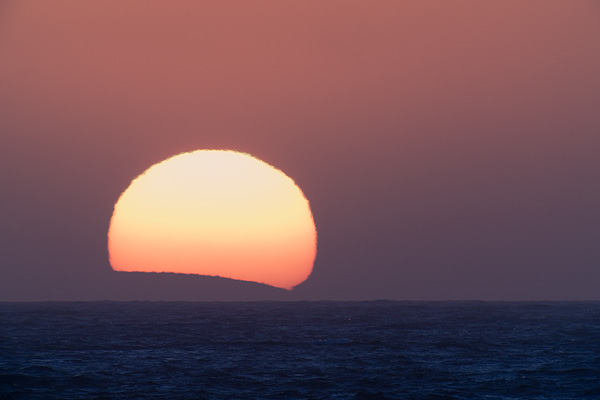
Sitting and pondering on a new lens with a tele converter. Maybe a 3 x converter. My idea here is to take pictures like this. This picture I took this summer. But I want a bigger sun in the picture. And as you see it's not just that the detail is so important.
Therefore, I think of something that must be cheap and relatively easy.
Maybe a 300 mm f / 4.0 L is. Or does anyone know of anything that is even better. Some time ago I know that there was something called mirror lens. Is this something that just might work. But here comes the problems with the bokeh i think. Do not know how to say this in English. Everything that is light will make a round bubble in the pictures
But the main point is more to get a really big sun or moon in the pictures in the evening or in the night.
Any proposals are received with thanks
 

Attachments

  • Sunset over Fira.jpg
    Sunset over Fira.jpg
    76.6 KB · Views: 1,160
Basically, the longer the better. 400mm? Good. 500mm? Better. 600mm, better still. No need for IS, you'll be using a tripod, especially for moon shots. Stay away from mirror lenses. Yes, there are 3rd party brands, they're cheap, and long, but optically they're generally not very good - might actually be ok for sunset shots, but moon shots need detail, and mirror lenses are soft and have lower contrast, plus as you mention the bokeh is really harsh. Not all mirror lenses are horrible - Tamron made a 500mm f/8 that wasn't horrible (could be adapted to EF mount). Canon made a mirror lens, too, once upon a time - a 5200mm lens, weighing 100 kg (not kidding!).

I use my 100-400mm for sunsets/moon shots. A 400mm f/5.6 + 1.4x TC remains decently sharp at 560mm (manual focus without a 1-series, but not a problem for those shots).

You could certainly try a mirror lens and not lose much if you don't like it - an Opteka 500mm f/8 is just $100, and an Opteka 800mm f/8 is only $200 - heck, you could get both for less than a Canon teleconverter!
 
Upvote 0
I wouldn't say there's anything wrong with using a mirror lens for shooting into the sun, you'll be focussed at infinity and won't really have a chance to see the doughnut-shaped bokeh. They're also really light and easy to hold (but i'd be using a tripod anyway).

There's some other really long lenses on ebay i wouldn't touch with a bargepole for IQ, but if you don't care how sharp it is, i've seen things like a Rokinon/Bower/Opteka/Phoenix (ie, all rebadged Samyang) 650-1300mm f/8-16 for about $200-300. Manual focus only (but so are mirror lenses and using heaps of teleconverters), really really slow so useless for wildlife (but you want to stop down a lot for pointing into the sun anyway).

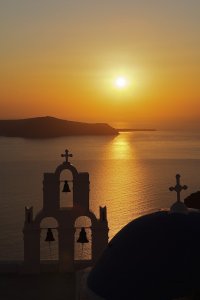
For a shot like you've got, a Graduated ND might be useful, you can darken the sun enough to get details in the buildings (if you didn't use one already, whatever you did for that first shot looks good).
And don't use live-view for focussing, i blame that for giving me dead pixels. (wear sunglasses for viewfinder focussing too maybe, so you don't ruin your eyes)
 
Upvote 0
Thanks.
I did not use a tripod or a ND filter. It was handheld with 24-70 2,8 L. Anyway. Im gonna try to get a good mirror refleks. Just wonder whats the best mirror refleks for Canon. And it doesent cost much either i think. So it wont be much money i loose
 
Upvote 0
You may find this information useful:

in full-frame camera shooting 3:2, the moon will occupy most of the height of a picture if you use a 2000mm lens
on APS-C, that translates into a 1250mm lens

so, on my APS-C camera, with my longest lens (300mm), the moon takes up around 1/4th to 1/5th of picture height

the sun is even smaller

oh, and by the way: not all mirror lenses are crap... but the good ones are really expensive
check this big boy!!:
http://cgi.ebay.es/Carl-Zeiss-Pentacon-Six-1-5-6-1000-mm-Prakticar-/230606968851?pt=DE_Foto_Camcorder_Objektive&hash=item35b13f1813
here you can get a sense of how shockingly big this lens is; those are medium format cameras and lenses (my 300mm is in the back row, second on the right; it is 25cm long, 10cm wide, and weights well over 2kg)
http://www.pentaconsix.com/1000mm.htm
 
Upvote 0
neuroanatomist said:
Basically, the longer the better. 400mm? Good. 500mm? Better. 600mm, better still. No need for IS, you'll be using a tripod, especially for moon shots. Stay away from mirror lenses. Yes, there are 3rd party brands, they're cheap, and long, but optically they're generally not very good - might actually be ok for sunset shots, but moon shots need detail, and mirror lenses are soft and have lower contrast, plus as you mention the bokeh is really harsh. Not all mirror lenses are horrible - Tamron made a 500mm f/8 that wasn't horrible (could be adapted to EF mount). Canon made a mirror lens, too, once upon a time - a 5200mm lens, weighing 100 kg (not kidding!).

I use my 100-400mm for sunsets/moon shots. A 400mm f/5.6 + 1.4x TC remains decently sharp at 560mm (manual focus without a 1-series, but not a problem for those shots).

You could certainly try a mirror lens and not lose much if you don't like it - an Opteka 500mm f/8 is just $100, and an Opteka 800mm f/8 is only $200 - heck, you could get both for less than a Canon teleconverter!


I have never heard of this lens (I only use canon lenses), but for $200 it interests me. How is the IQ on it? I could deal with the speed, and big DoF. I'm just curious how it holds up against say a 200 f2/8 Mk1 with a 2x TC. I guess for $200 I can't go wong. What are the opinions on this lens.
 
Upvote 0
Just a note on shooting the sun at long telephoto ranges. (and anything at those lengths)
The longer the lens the closer up you get to some of the weird things that happen in nature.
Atmospheric perspective, heat distortion, etc...
This will vary based on your location. If I shot this in Antarctica there would be less distortion due to clearer air and cooler climate.

1Ds Mark III + 600mm + 2X TC = 1200mm
PHFX8726.jpg
 
Upvote 0
philHolland said:
Just a note on shooting the sun at long telephoto ranges. (and anything at those lengths)
The longer the lens the closer up you get to some of the weird things that happen in nature.
Atmospheric perspective, heat distortion, etc...
This will vary based on your location. If I shot this in Antarctica there would be less distortion due to clearer air and cooler climate.

1Ds Mark III + 600mm + 2X TC = 1200mm
PHFX8726.jpg

Fantastic image!
Most people do not realize challenges involved shooting extreme tele or astro photography, it is as involved and complicated as extreme macro or micro.
Of course apart from people that can invest some serious money in to it, but than again what's the reason for "glory" than.
 
Upvote 0
Sunnystate said:
Fantastic image!
Most people do not realize challenges involved shooting extreme tele or astro photography, it is as involved and complicated as extreme macro or micro.
Of course apart from people that can invest some serious money in to it, but than again what's the reason for "glory" than.

Thank you! I totally agree. High end astro and micro work I would say is an entirely different ball game once you get into tracking mounts, stacking exposures, scopes, etc... I pretty much shoot anything telephoto that's landscape related with a tripod and am extremely careful about vibration. When you're dealing with motion or timelapse it's even more critical to lock things down properly. Focus isn't very forgiving at the extremes either.
 
Upvote 0
Actually, the moon and the sun are two subjects that are great for mirror lenses. They don't move very fast (manual focus, live-view), they're bright, and you won't see any bad bokeh.

As for 300/4, sure, that would be nice. But it's an expensive lens, and you won't need aperture; you'll be stopping down! So 70-300/4-5.6 gets you the same thing. That said, you could mount a 1.4x TC on a 300/4.
 
Upvote 0
I would bet that extremely high-contrast images and those with a very large depth of field set are decent candidates generally for mirror lenses - sun, moon, and other astrophotography pictures are a subset of that type of imagery. Mirror lenses tend to be slower, as well. Of course, it seems like a good idea to get a faster lens for astrophotography, but the telescopes tend to be slow, below f/8 - but that's another topic and I'm no expert :)

Of course, the first picture looks like it's handled best by a regular lens than a mirror type.

I imagine other regular posters are probably sick of my mentioning it, but for a very flexible solution, you can try a Sigma 120-300mm f/2.8 and get a 2X teleconverter for a 600mm f/5.6 lens, nothing to sneeze at. There is some visible color fringing in the new OS (optical stabilizer) lens with a Canon 2X extender on, in high-contrast situations, but a good solution to most telephoto situations nonetheless, and highly portable. The main reason I mention it is the price - have a look and see if it's to your liking. Definitely cheaper than many equivalents.
 
Upvote 0
I think that picture by philHolland is absolutely awesome, precisely because you get to feel the distance thanks to the atmospheric optical phenomena

about those cheap 800mm mirror lenses: it's not just the bokeh that is problematic, they're just not sharp at all, you may get similar results cropping an image taken with a 300mm
http://techreport.com/forums/viewtopic.php?f=37&t=75031
 
Upvote 0
AJ said:
Actually, the moon and the sun are two subjects that are great for mirror lenses. They don't move very fast (manual focus, live-view), they're bright, and you won't see any bad bokeh.

As for 300/4, sure, that would be nice. But it's an expensive lens, and you won't need aperture; you'll be stopping down! So 70-300/4-5.6 gets you the same thing. That said, you could mount a 1.4x TC on a 300/4.


That may be true, but not for $119.00 price, and 500-800 mm focal range. When you go in to some really large focal lengths, size and amount of heavy glass simply makes physically impossible to build classic telescopes.

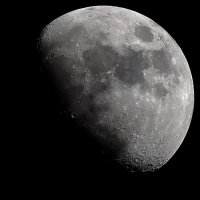
This is a shot taken with the basic Meade ETX125 mirror lens which is 1900mm and f15, taken of the flimsy tracking mechanism and mounted on old and pretty heavy Benbo tripod. The moon do not fit in the frame so this is composite of two shots, at manual exposure of 1/500s, some adjustments for sharpness and noise reduction.
 

Attachments

  • Boring Moon Shot.jpg
    Boring Moon Shot.jpg
    45.1 KB · Views: 2,342
Upvote 0
Sunnystate said:
AJ said:
Actually, the moon and the sun are two subjects that are great for mirror lenses. They don't move very fast (manual focus, live-view), they're bright, and you won't see any bad bokeh.

As for 300/4, sure, that would be nice. But it's an expensive lens, and you won't need aperture; you'll be stopping down! So 70-300/4-5.6 gets you the same thing. That said, you could mount a 1.4x TC on a 300/4.


That may be true, but not for $119.00 price, and 500-800 mm focal range. When you go in to some really large focal lengths, size and amount of heavy glass simply makes physically impossible to build classic telescopes.

This is a shot taken with the basic Meade ETX125 mirror lens which is 1900mm and f15, taken of the flimsy tracking mechanism and mounted on old and pretty heavy Benbo tripod. The moon do not fit in the frame so this is composite of two shots, at manual exposure of 1/500s, some adjustments for sharpness and noise reduction.
Nice photo.

I'm not saying that mirror lenses are the best tool for photographing the moon.
I'm saying that the moon is one of the best subjects for a mirror lens.

Here's some stuff on mirror lenses:
http://mirrorlens.blogspot.com/
 
Upvote 0
Status
Not open for further replies.