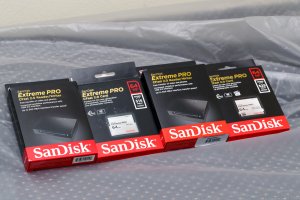
Mt Spokane Photography said:........CFast cards are much more expensive.
I got two for 'free'.

Upvote
0
Mt Spokane Photography said:........CFast cards are much more expensive.
privatebydesign said:Mt Spokane Photography said:........CFast cards are much more expensive.
I got two for 'free'.

RGF said:privatebydesign said:Mt Spokane Photography said:........CFast cards are much more expensive.
I got two for 'free'.
Do you mean you bought 2 1Dx Mark II when they were first released. Perhaps you should think you got the cameras for free and you paid a lot for the cards? :
When you outsource manufacturing to China, you get exactly the quality you specify in the contract if you don't pay until it passes your own QC. Specify and pay for high quality, get high quality. When everything is local, however, buyer had best beware because it can be hit or miss until the company's reputation becomes known.Antono Refa said:Manufacturing is moving east for decades, and there's sense in doing everything (from NANDs to slapping the sticker on) in one place.
LDS said:aceflibble said:And Canon will move to XQD. It's only a matter of time before CFast and XQD have completely taken over.
Canon will move, one day, to CFExpress. Smaller CFExpress card will have the XQD form factor (other form factors will be availabe, depending on the number of PCIe lanes), but they use a standard PCIe 3.0 (instead of XQD 2.0) and NVMe interfaces, making them compatible with a large number of devices without relying on proprietary standards.
Don't expect SD cards to be used on high-end devices, especially those needing high-speed and low latency.
RGF said:I am not an engineer but personally I hate (perhaps too strong a word) SD cards. Very small, high risk of losing one.
I would rather see faster/larger/cheaper CF, CFast cards. Dual slots in the camera so there can be an internal redundancy.

AvTvM said:And ... dual MicroSD card slots would easily fit into even the smallest cameras ...

magarity said:When you outsource manufacturing to China, you get exactly the quality you specify in the contract if you don't pay until it passes your own QC. Specify and pay for high quality, get high quality. When everything is local, however, buyer had best beware because it can be hit or miss until the company's reputation becomes known.Antono Refa said:Manufacturing is moving east for decades, and there's sense in doing everything (from NANDs to slapping the sticker on) in one place.
And there are several good reason to avoid a single supplier in a foreign country.AvTvM said:RGF said:I am not an engineer but personally I hate (perhaps too strong a word) SD cards. Very small, high risk of losing one.
I would rather see faster/larger/cheaper CF, CFast cards. Dual slots in the camera so there can be an internal redundancy.
Funny, i like 'em as small as possible and have pretty much standardized on MicroSD ... putting them into SD adapters in cameras with SD slot. Never lost one. Never had any failure. [I also never had a bent pin or failure with my CF cards.]
And ... dual MicroSD card slots would easily fit into even the smallest cameras ...
RGF said:In the winter, even with liner gloves, I find SD cards hard to handle. Rather not go bare handed with it subzero F or -20 C
AvTvM said:RGF said:In the winter, even with liner gloves, I find SD cards hard to handle. Rather not go bare handed with it subzero F or -20 C
on theory yes. in practice i cannot recall ever having to swap cards in the field. at least not since i am using microSD cards from 32 GB upwards. at least if one does not capture video.
even 128 GB microsd cards are quite affordable now. i'd love to get a camera with dual micro sd slots recording in parallel - both slots running at full uhs II (or soon uhs iii) speed, without slowing down camera (as in any current dual slot canon camera whete only 1 söot is fast and the other one is dead slow and 2 generations behind current standards).
AvTvM said:RGF said:In the winter, even with liner gloves, I find SD cards hard to handle. Rather not go bare handed with it subzero F or -20 C
on theory yes. in practice i cannot recall ever having to swap cards in the field. at least not since i am using microSD cards from 32 GB upwards. at least if one does not capture video.
even 128 GB microsd cards are quite affordable now. i'd love to get a camera with dual micro sd slots recording in parallel - both slots running at full uhs II (or soon uhs iii) speed, without slowing down camera (as in any current dual slot canon camera whete only 1 söot is fast and the other one is dead slow and 2 generations behind current standards).
RGF said:AvTvM said:RGF said:In the winter, even with liner gloves, I find SD cards hard to handle. Rather not go bare handed with it subzero F or -20 C
on theory yes. in practice i cannot recall ever having to swap cards in the field. at least not since i am using microSD cards from 32 GB upwards. at least if one does not capture video.
even 128 GB microsd cards are quite affordable now. i'd love to get a camera with dual micro sd slots recording in parallel - both slots running at full uhs II (or soon uhs iii) speed, without slowing down camera (as in any current dual slot canon camera whete only 1 söot is fast and the other one is dead slow and 2 generations behind current standards).
I don't erase cards till I get home. THey are my final backup. So it is not uncommon for me to fill a card in the field. For example, if I have 32 GB card that is 60% full, I can easily fill it if I have a great day in the field.