May 13: It’s Canon vs Sony

I am not convinced that it is likely.
I will believe it when I see it.
I can understand the skepticism because it would be a highly disruptive camera. A 67mp camera that can shoot FF images at 60fps? And 30mp 1.5x APS-C images at probably even higher frame rates? Combined with Sony's latest dual-readout system to increase DR? It's the dream camera for a lot people who do landscape or wildlife, or both. Or almost anything really. May 13 is going to be a very interesting day.
 
  • Like
Reactions: 1 users
Upvote 0
Even if they both announce on the same day, both cameras don't really compete. Sony aims for high-end photography professionals, and Canon targets the advanced video maker crowd (Gen Z TikTok kiddies).

Personally, I think Sony pushing for more and more megapixels is as silly as Fujifilm's 40MP.
At 67MP, the diffraction limit already sets in at f/5.6.

Even if they both announce on the same day, both cameras don't really compete. Sony aims for high-end photography professionals, and Canon targets the advanced video maker crowd (Gen Z TikTok kiddies).

Personally, I think Sony pushing for more and more megapixels is as silly as Fujifilm's 40MP.
At 67MP, the diffraction limit already sets in at f/5.6.
Even after diffraction begins to reduce absolute resolution, a higher-resolution sensor will still out-resolve and render higher-contrast detail than a lower-resolution sensor using the same lens and aperture. And for those of us shooting fast primes, we’re often well away from diffraction-limited apertures anyway (typically f/1.2–f/4).

Additionally, many of Canon’s RF primes (such as the 135mm f/1.8L, 85mm f/1.2L, and 50mm f/1.2L) would benefit from sensors well beyond 45 MP, even wide open.

So, if Canon is clearly producing glass that can take advantage of higher resolution, why isn’t it offering a body to match? This feels like a segment Canon may be under-serving.

There’s also a broader ecosystem effect. Wedding and portrait photographers using high-end bodies and lenses are highly visible and tend to influence downstream purchasing decisions. Anecdotally, a few years ago I saw most carrying two Canon DSLR or R5 bodies—a major factor in how I (and many others) ended up in the Canon system. Today, I’m seeing more of that community diversifying into Leica, Fujifilm medium format, and Sony systems. Ceding that segment and the visibility that comes with it signals a lack of commitment to that part of the market.

For me, image quality is priority one. Others will understandably prioritize speed or hybrid capability. But while a 40 fps R1 is impressive, I would personally be far more interested in a higher-resolution body that fully leverages Canon’s best glass.

This uncertainty about Canon’s long-term direction, particularly the emphasis on hybrid-focused VCM lenses and V-series bodies, gives me pause when considering further investment in the Canon system. I suspect I’m not alone

 
  • Like
Reactions: 1 users
Upvote 0
More pixels are mostly about flexibility. In good light, you keep the extra detail and cropping room. In lower light, you can downsample, which averages out random noise and improves SNR, giving a cleaner final image, especially in the shadows. So smaller pixels do not automatically mean worse real-world DR. Even if sensor DR does not increase, cleaner shadows can make the final image look like it has more usable dynamic range.
I agree but there were lots of reviewer comments about DR which were never really of practical consideration.

The A9iii had DR as its primary downside but it hasn't stopped sales of it. Even the slight decrease of R5ii vs R5 hasn't been a massive impact on real world usage.
That said, the R5ii isn't enough for me to upgrade. If I was doing weddings (priority AF) or wildlife (fps/14 bit) then perhaps but I will wait for my R5 to die or R5iii to come out.
I would probably keep my R5 as my backup even then.
 
  • Like
Reactions: 1 users
Upvote 0
Sony had already won this May fight!

We get „nothing“ from Canon… we have already the R6iii and C50! It’s best to have a R6V - BUT not necessary!? - I mean not yet right now… R7 II (and a R7V) would be more interesting in many ways!! For more user!


And the 100-400 should be really small for its f4.5? Like the 50-150 2.0? That’s nice!

I was looking for new tele and new wildlife crop camera… and we get a f4.0 video zoom with a video camera, where the most specs are already in two body’s!
 
  • Haha
Reactions: 1 user
Upvote 0
"It's a pricepoint that both Nikon and Sony are playing in, while Canon has a big gap between $2500 and $10000. We think that unicorn lens that we've written about ad nauseam would fit in nicely"

I'm probably more in the camp of @neuroanatomist that the 300-600 f/5.6L unicorn aether lens is somewhat unlikely to be under $10k. If it is under $10k, that would be amazing.

In any case, I'm definitely selfish here, and perhaps a little impatient, but Canon really needs to get some supertelephoto entries in that middle zone (let's say $4-8k). The Nikon 400mm f/4.5, 600mm f/6.3, and 800mm f/6.3 lenses you mentioned in a recent article (https://www.canonrumors.com/canon-shows-off-rf-500mm-f5-6-l-is-in-latest-patent/) definitely piqued my impatience lol. IMO Canon needs multiple entries here.

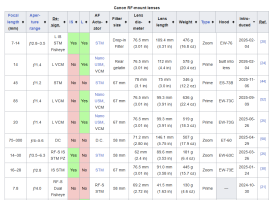
We've had quite a run of mostly wide/ultrawide stuff which I just dgaf about given I have the 24mm VCM and 50 f/1.2 L (and have no need for a 75-300 non-L). The 85 VCM is the only one I've considered, though with the 50mm f/1.2 L I just don't have enough need for something fairly close by. 1777646515296.png
 
Upvote 0
We've had quite a run of mostly wide/ultrawide stuff which I just dgaf about given I have the 24mm VCM and 50 f/1.2 L (and have no need for a 75-300 non-L).
That run is apparently continuing with the RF 20-50mm f/4L IS PZ. If the zoom ring is manual and motorized (like USM focus motors were for decades), then I'll quite likely order the 20-50/4L. However, if it's only zoom-by-wire then, to borrow your phrasing, IDGAF about it.
 
  • Like
Reactions: 1 user
Upvote 0
That run is apparently continuing with the RF 20-50mm f/4L IS PZ. If the zoom ring is manual and motorized (like USM focus motors were for decades), then I'll quite likely order the 20-50/4L. However, if it's only zoom-by-wire then, to borrow your phrasing, IDGAF about it.
Frankly, I first was skeptical about motorised focusing, till I bought my first lens with such a motorised system in manual focusing mode.
Canon did implement it so well that I no longer care whether it is mechanical or motorised. And, as you wrote, if focal changes are done the same way, please Canon, accept my order!
 
Last edited:
Upvote 0