More on the Upcoming Cinema EOS C300 Mark II

Canon Rumors

Who Dey
Canon Rumors Premium
Jul 20, 2010
12,628
5,441
279,596
Canada
www.canonrumors.com
HTML:
<p>With the announcement of the Cinema EOS C300 Mark II around the corner, more bits of information continue to trickle in.</p>
<p>We’re told the next iteration of the camera will have a “significant” increase in latitude, even “besting the Sony FS7″. The current C300 has about 12 stops of latitude and the FS7 sits at 14 stops. <del>We’re also told the maximum frame rate for 4K recording will be 60fps. There will be higher frame rates available at lower resolution capture, but we’re unsure what the frame rate will max out at. It was suggested at 1080p @ 240fps could be the max, but we can’t confirm that.</del></p>
<p>We have still not heard anything about price, but expect it to be more expensive than the Sony FS7.</p>
 
Frankly, having more than 12 stops of DR in the still world was never really an issue until Nikon/Sony made it an issue. I still think it's of dubious value unless you shoot sunsets for a living. In the video world, where it's much more difficult to lay a few clouds into an overexposed sky, dynamic range has been an issue for some time. Mostly because theres this race to make video "look" like film, which means the highlights have to roll off "just so".

The contest in the Video/Cinema world isn't resolution like it is in the still world (unless you're Red), but dynamic range.

It remains to be seen how Canon is going to pull this off. While Matt may be right relative to the Dual Gain Path approach, it could be something as simple (and suspect) as the HDR movie mode on the Rebel t6i. Or it could be a new chip, or it could be a new ADC, or it could be....who knows. Time will certainly tell.
 
Upvote 0
Becoming increasingly intrigued by this camera. I've been considering getting more into video because I have a market I could produce simple television spots for, and I've learned just what some of the other local guys charge to make the easiest of spots.

If this thing comes in around $9-10k, I'd be interested in looking at it to rent and mess with and possibly finance purchase. I really like the A7s but I'd much rather a full fledged pro grade body with the monitor, viewfinder, audio, etc this package could deliver with a native EF mount. I know it's industry norm, but dang I'd rather a FF sensor size.
 
Upvote 0
Policar said:
painya said:
Maybe I'm missing something, but why can they deliver a cinema camera with 14+ stops of dr, but can't manage that on dslrs's? Too much info to capture with a dslr? Something about 14 bit files? Please enlighten me.

Dual gain path. As I mentioned weeks ago. :)
Thank you sir, but can you link that to me?
 
Upvote 0
bgoyette said:
Frankly, having more than 12 stops of DR in the still world was never really an issue until Nikon/Sony made it an issue. I still think it's of dubious value unless you shoot sunsets for a living. In the video world, where it's much more difficult to lay a few clouds into an overexposed sky, dynamic range has been an issue for some time. Mostly because theres this race to make video "look" like film, which means the highlights have to roll off "just so".

The contest in the Video/Cinema world isn't resolution like it is in the still world (unless you're Red), but dynamic range.

It remains to be seen how Canon is going to pull this off. While Matt may be right relative to the Dual Gain Path approach, it could be something as simple (and suspect) as the HDR movie mode on the Rebel t6i. Or it could be a new chip, or it could be a new ADC, or it could be....who knows. Time will certainly tell.
I see your points but disagree slightly. Firstly most digital movie cameras are around 12-13 stops except Arri where the Alexa tops out at 14 stops. In all cases DOPs have pushed these cameras to breaking point and the result is either clipped highlights or crushed blacks. Remember also in movie theatres the lights are off so are eyes adjust after about 15mins normally during the pre-movie trailers and this adjustment means we see clipped light more easily. Our eyes can see up to 20 stops so weve still away to go before our dynamic range tops out.

Resolution is a funny thing in the movie industry with two opposing sides, in the red corner are the DOPs and Directors who want to dial back the resolution digital cameras & modern high contrast lenses can give them, but in the blue corner are visual effects that want all the resolution & colour space we can give them & if your a studio like Marvel visual effects wins out however if your an A-list director then they will likely win out.

You can always reduce resolution but its not so easy to increase it, you can always limit dynamic range but again you cannot simply increase it.
 
Upvote 0
bgoyette said:
Frankly, having more than 12 stops of DR in the still world was never really an issue until Nikon/Sony made it an issue. I still think it's of dubious value unless you shoot sunsets for a living..

Disagree. For event photography, being able to shoot in bright sunlight and recover detail in both the shadows and highlights is extremely important. I'd say around 15 stops is where it stops being useful.
 
Upvote 0
I am wondering what features they will cut back on the C300 II to protect the C500 line. Perhaps no 4K RAW recording or output? Maybe a highly compressed codec with 8 bit color? I guess we will find out soon.
 
Upvote 0
jeffa4444 said:
bgoyette said:
In the video world, where it's much more difficult to lay a few clouds into an overexposed sky, dynamic range has been an issue for some time. Mostly because theres this race to make video "look" like film, which means the highlights have to roll off "just so".
I see your points but disagree slightly. Firstly most digital movie cameras are around 12-13 stops except Arri where the Alexa tops out at 14 stops. In all cases DOPs have pushed these cameras to breaking point and the result is either clipped highlights or crushed blacks. Remember also in movie theatres the lights are off so are eyes adjust after about 15mins normally during the pre-movie trailers and this adjustment means we see clipped light more easily. Our eyes can see up to 20 stops so weve still away to go before our dynamic range tops out.
Actually, Red, Sony, Arri all have multiple cameras with 14+ stops of DR. Canon as measured tops out somewhere shy of 12. When the C300 came out, it was first compared to the 5dmarkII, and with 12 stops...looked damn good. The reality though is that in Clog, it clips highlights in the worst way (unevenly), and the 8bit codec makes it difficult...or should I say easy....to push the c300 to it's breaking point. The Arri, and some say the Dragon as well, are capable of giving something like films characteristic highlight compression and roll off (Arri actually has it baked into it's curve). One of the most beautifully shot films last year (A Most Violent Year) was shot largely with natural light in some pretty challenging situations on an Alexa, and that camera was doing everything film could do and more.

HurtinMinorKey said:
bgoyette said:
Frankly, having more than 12 stops of DR in the still world was never really an issue until Nikon/Sony made it an issue. I still think it's of dubious value unless you shoot sunsets for a living..

Disagree. For event photography, being able to shoot in bright sunlight and recover detail in both the shadows and highlights is extremely important. I'd say around 15 stops is where it stops being useful.

I hear you. We can all benefit from more DR...I think my point was that there was hardly ever any discussion of it on these or any boards until sony came out with that sensor. And I amend my previous post to "those who shoot sunsets and women in white dresses at noon". :-)
 
Upvote 0
sheedoe said:
I am wondering what features they will cut back on the C300 II to protect the C500 line. Perhaps no 4K RAW recording or output? Maybe a highly compressed codec with 8 bit color? I guess we will find out soon.

I'm not sure there's that much there to protect. I don't think Canon ever sold a lot of C500's. It really didn't have the specs to compete with cameras in its category. We often forget that the C300 was designed as a "broadcast" camera. For that market, it was perfectly specified. the C500 was the true cinema Camera, but it didn't have the guts to hang with Arri, Red or Sony.

If Canon re-ups the C500, my guess is they won't make that mistake again. (and for the record, I highly doubt we'll see raw recording on the C300, but not to protect the C500, but rather just based on the c300's roots in the broadcast/doc segment).
 
Upvote 0
For what it's worth, I don't have any firsthand inside information. But if I did it would point toward 15+ stops of latitude either through a dual gain path Alexa-type architecture or a much more robust HDRx-type algorithm, 4k XAVC, and more-or-less the specs rumored here. The slow motion specs seem a bit bullish, but I have my fingers crossed.

Price-wise, I don't have any firsthand information that's pointing toward $17,000.
 
Upvote 0
Policar said:
For what it's worth, I don't have any firsthand inside information. But if I did it would point toward 15+ stops of latitude either through a dual gain path Alexa-type architecture or a much more robust HDRx-type algorithm, 4k XAVC, and more-or-less the specs rumored here. The slow motion specs seem a bit bullish, but I have my fingers crossed.

Price-wise, I don't have any firsthand information that's pointing toward $17,000.

With a C100 mkII at $5800 thats a big price jump to the C300. I hope you're wrong.
 
Upvote 0
dilbert said:
Policar said:
painya said:
Maybe I'm missing something, but why can they deliver a cinema camera with 14+ stops of dr, but can't manage that on dslrs's? Too much info to capture with a dslr? Something about 14 bit files? Please enlighten me.

Dual gain path. As I mentioned weeks ago. :)

It will be interesting to see if Canon use that tech on DSLRS or reserve it for EOS Cinema. Then again, maybe EOS Cinema is where Canon will look to recouping their R&D costs in sensors?

It seems as though the specs have leaked!

15 stops of dynamic range with sensor rated at 800 ISO native. This means those three extra stops are in the highlights. Fantastic. 4K XAVC-like codec with 410Mbps I-frame (crazy!) and 10 bit recording.

120fps crop (meh) and 30fps max at 4k.

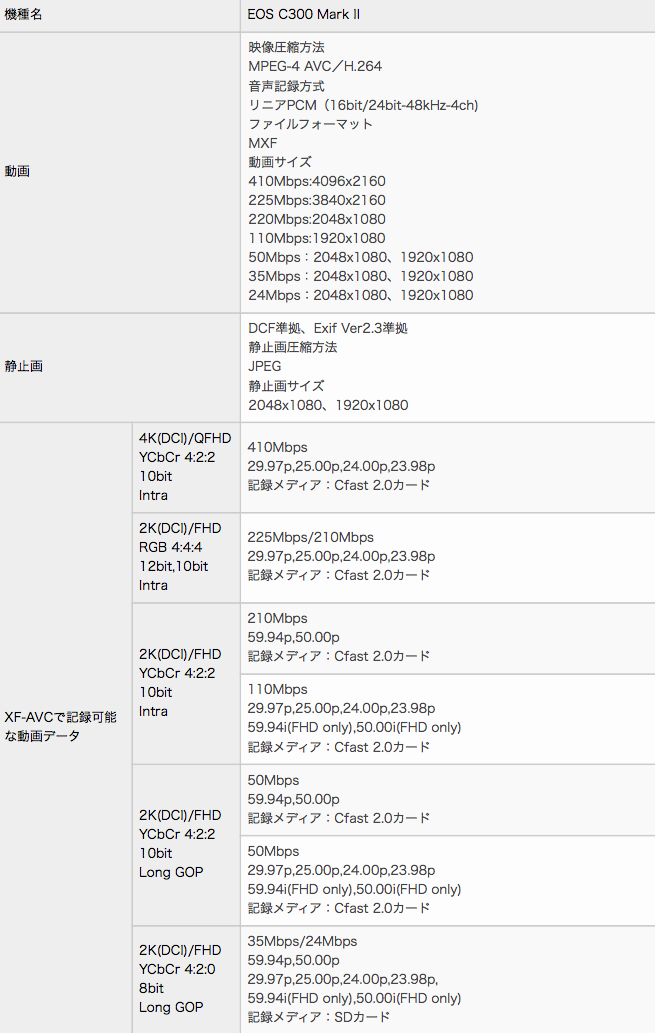
No 50Mbps XF codec. Insane! This is so dumb.
 
Upvote 0
Policar said:
No 50Mbps XF codec. Insane! This is so dumb.

Read carefully:

Screen-Shot-2015-04-08-at-2.14.10-PM.png
 
Upvote 0