Need help with video lighting!!!

Status
Not open for further replies.
LED grids are also murder on the talent's eyes. Tungsten carries a lot of heat of course and 1K's can easily make people sweat. Plus you can easily overload a circuit breaker with Tungsten, which wastes most of its energy in the IR (heat) band, and the bulbs burn out fairly quickly so you need spares.

There is no ideal video light but tungsten is definitely the best looking and easiest to grade in post. For lighting up a green screen use fluorescents, the green spike helps in that case.
 
Upvote 0
thepancakeman said:
Can anyone recommend a good book on the topic (video lighting)? Clearly there's a bit more of a learning curve that I anticipated. :o

Not sure about the book.

But one thing, as a noob I CAN speak of....if you can get the lights to match at same temp..DO THAT FIRST!!

I don't care what temp, indoors especially, but if you can get them all one temp, that will save you so much grief in post.

I speak from experience starting off......

HTH,

cayenne
 
Upvote 0
I reckon you cannot beat the basics...

800w Redheads
600w/300w Fresnels

Get a combination as per your budget. You can buy them pretty cheap from China on eBay. You get what you pay for though. I've used some of those Chinese redheads - just don't use the cheap globes they come with - they don't last long and melt over their connectors! Use high quality globes (GE/Osram/Philips) and you'll have few problems.

You will find yourself steadily building a collection of lights. I use all kinds of lights now - Par56s, LEDs, chinese balls, homemade scoops - you name it.

Funnily enough, for most of my short films I tend to fall back to a 800w Redhead, 300w Fresnel and a 300w PAR56 (as a kicker). I just like that light combo!

I hope that helps!
 
Upvote 0
dirtcastle said:
Good stuff! These are very helpful responses.

To make my question easier to answer, I have refined it...

If you were just starting out with video and needed an inexpensive lighting kit for indoor shooting... what would it be?

Thanks!

I'd go for a Ianiro 3 lamps + 3m stands + bag set: http://www.ianiro.com/
The 3x800w cost 800 $ (that's the set I bought when I started) but the 3x500w set should cost around 500 $, so it should be in your price range. And there's always the "hand market"...
Tungsten light is the kind of artificial light I like most. Discharge lamps are very heavy and expensive, while led lights are not beautiful at all (to me) and the led frequency could cause some flickering trouble with some shutter speeds if you'r not using very good (and expensive) lamps.
I worked even with several cheap corean and chinese tungsten lamps, but their built and contacts quality was always terrible, I definitely wouldn't recommend them.
The downsides of tungsten lamps are 3:
1- They are much bigger than led lights.
2- They need much more power than led and discharge lamps to produce the same amount of light.
3- If you need to mix them with natural light (unless it's sunset light...) you'll need to convert them with a gel, which means that you have to buy a lot of blue gels and that, using blue conversion gels, you're gonna loose a lot of lighting power.
 
Upvote 0
thepancakeman said:
Can anyone recommend a good book on the topic (video lighting)? Clearly there's a bit more of a learning curve that I anticipated. :o

Read the bible.... "Set Lighting Technicians Handbook". Until you understand all types of light, you cannot sit down and talk about experience with one type of light, because you have NO reference.

LEDs were never meant to have punch. They are designed for headshot type videos where your crop is so tight that you can move the light in close. Most of the newer LED panel types these days carry the diffusion plates that will soften the light up and make it more pleasant to look at.

In regards to matching up lights... there is absolutely no rule about that. In regards to post, well... if you chose to mix lights in the first place, you probably have a reason and wont need to match them up in post.
I kinda like a 3400K/4000K indoor setting, light with 3200K lights and have the daylight do color contrast in the background.

Each light serves a diferent purpose.

Oh and gelling... gelling LEDs is a lot different from gelling tungsten, flour or HMIs. The color spectrum is still not perfect and gelling could create problems with the already present spikes in the spectrum.

But I would just test the lights rigth away, make sure they match up. If not, then return the crap and get a new set.

Regarding power.... yeah, proper batteries for LEDs are expensive. They will, including charger, set you back as much as the K4000 ligths. But only needed if you are doing shoots where you can't draw power.

 
Upvote 0
leGreve said:
Read the bible.... "Set Lighting Technicians Handbook". Until you understand all types of light, you cannot sit down and talk about experience with one type of light, because you have NO reference.

Thanks for the heads-up on this book. I just grabbed it.

After considering tungsten, then LED, and then back to tungsten... I finally decided to go with some fluorescents.

The primary factor was cost: fluorescent is cheap.

The second factor was brightness: fluorescent can definitely pack some punch.

The third factor was heat: my apartment already gets hot as it is (no AC).

The trick with fluorescent is to get the right bulbs and to be ready to do some color correction in post. I am the first to admit that most fluorescent bulbs give off crap light (often accompanied by a flicker and/or green/blue/purple spikes). I had to ditch some bulbs because they flickered and had a purple spike. But I've been doing my homework and I've already found one bulb that I'm reasonably happy with (Eiko 105w); and more are on the way (Alzo). My only major complaint is how hard it is to find 5000k bulbs (my preferred color temp) with a CRI over 90. It seems like their are a lot more options at 5500k and 5600k.

Another bonus about fluorescents is their power draw. It feels good to be efficient and I'm actually using some of these bulbs for everyday house lighting (I prefer white light over yellow).

Having said all that, when my budget permits I will definitely be ordering some tungsten lamps to get better quality light. But for now I'm still learning and I'd like to see how far I can go with fluorescent.
 
Upvote 0
dirtcastle said:
After doing a ton of research (and raising my budget a little), here's what I think I'm going to get...

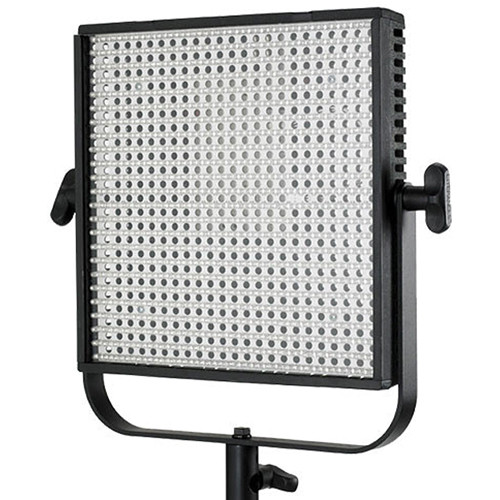
880837.jpg

Litepanels 1x1 LS Daylight Flood LED Panel
http://www.bhphotovideo.com/bnh/controller/home?O=&sku=880837&is=REG&A=details&Q=

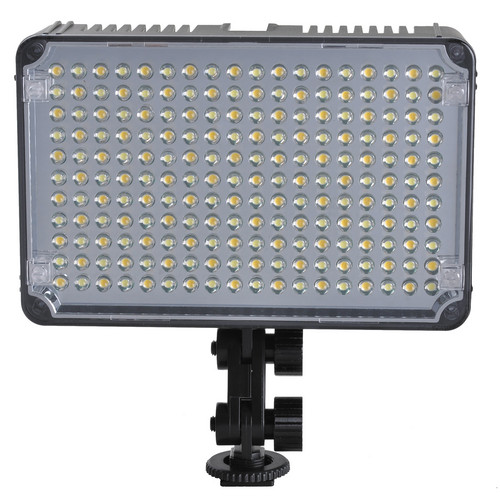
863687.jpg

GiSTEQ Flashmate F-198C LED Video Light
http://www.bhphotovideo.com/c/product/863687-REG/GiSTEQ_C8_03_F198C_01_Flashmate_F_198C_LED_Video.html

And when my funds replenish, I'll get this one for my third light...

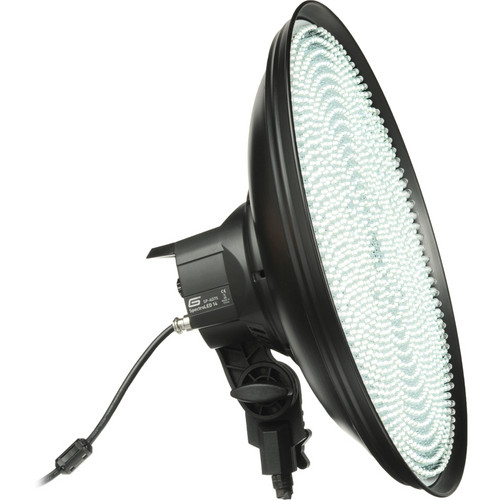
850293.jpg

Genaray SpectroLED-14 Light (100-240VAC/12VDC)
http://www.bhphotovideo.com/c/product/850293-REG/Genaray_SP_AD75_SpectroLED_14_Light_100_240VAC_12VDC_.html

I know this won't be the most powerful/sexy light kit. But whatever I lose in light quality... I should get back with other benefits: low temperature in my no-AC-having L.A. apartment, super easy to move and pack, and low power draw. The only thing I'm not sure about is color. But as long as the colors aren't noticeably bad, I'm okay with it.

I'm not looking for the ultimate/perfect lights. I just want something that gets me in the ballpark of good quality, and isn't a buzzkill to use. I feel like tungsten would be too much of a hassle for the type of shooting I'll be doing. The heat alone sounds awful. And for on-the-go, it would also be a pain in the ass.

Any thoughts?


There are china made non-branded ones that cost USD100-200. go and search around. Also some 30W-50W LED garden flood light are quite affordable. approx 70 USD?

Take a look at the ECO wash photo on page 34 of this http://www.mtr.com.hk/eng/sustainability/2012rpt/files/sustainabilityreport2012.pdf

I went to bought 4 of these to light up the lower part of that photo.
 
Upvote 0
Status
Not open for further replies.