Nikon's Continual Stream of New Models - Good or Bad?

I recognize that we are a Canon community, but I am interested in your reaction to the seemingly continual updates to Nikon's camera bodies (D810, D800E, D800S, D610, potential D620, etc...) Their market strategy seems very different than Canon. Canon never seems to be in a hurry to release new bodies (other than the Rebel series), and has often had at least 4 years between major model releases (more in the case of the 7D).

So, in your opinion, is Nikon's approach to continually releasing incremental upgrades to existing models a good thing or a bad thing? I can see pros and cons, but as a consumer I'm not sure that I would be crazy about my camera being outmoded so quickly. You would be stuck either using "inferior" tech or very possibly taking a pretty big financial hit because the resale value of your equipment has been eroded. The thought of getting upgraded technology more quickly is also appealing, and I know that many of you feel that Canon's development cycles are often too long.

Your thoughts?
 
TWI by Dustin Abbott said:
I recognize that we are a Canon community, but I am interested in your reaction to the seemingly continual updates to Nikon's camera bodies (D810, D800E, D800S, D610, potential D620, etc...) Their market strategy seems very different than Canon. Canon never seems to be in a hurry to release new bodies (other than the Rebel series), and has often had at least 4 years between major model releases (more in the case of the 7D).

So, in your opinion, is Nikon's approach to continually releasing incremental upgrades to existing models a good thing or a bad thing? I can see pros and cons, but as a consumer I'm not sure that I would be crazy about my camera being outmoded so quickly. You would be stuck either using "inferior" tech or very possibly taking a pretty big financial hit because the resale value of your equipment has been eroded. The thought of getting upgraded technology more quickly is also appealing, and I know that many of you feel that Canon's development cycles are often too long.

Your thoughts?
I think you're spot on when saying it's a different marketing strategy.
My feeling is that they are working hard to be mentioned on sites with a broad approach - to such an extent that I sometimes think there might be money involved in getting certain biased info published. I would not be amazed if Nikon pays a few bloggers, forum visitors and so on to have their name mentioned. If you constantly release new models you can be sure that magazines will at least mention it, and possibly also try to get one of the recent models to be in a test against older known models currently on the market.
It's good to evolve and grow - but sometimes you can grow too quickly... I, personally, prefer Canon's method of slow and steady. They have loads of goodwill in their brand, and they seem to care about it and their various customers.

None of this is based on any hard facts that I possess, but it's my opinion based on what I've seen/heard over the years.
 
Upvote 0
Nikon has been trying everything they can to get their train back on the tracks. Their stock value is in the dumps, and sales are dropping even faster than other camera makers.

The new models may attract buyers who want the latest thing, but it may deter buyers who will wait for a year to see what comes next.

I suspect that more than a few are disappointed to buy a model that is 8 months old, and then find out its obsoleted by a upcoming new model that is not really different except for the model number.

It really hurts the resale values for those who plunk down big $$ only to find the value of their cameras drops faster than expected.
 
Upvote 0
I, for one at least, would love to see this endless stream of new models slow down. I like what Canon is doing which is to pop out something new every three years or so (for the high end ones at least). In the film days, we used a camera for 5 years or more w/o feeling the need to upgrade. The feature set in most of these things is pretty comprehensive at this point, IMO.

my $.02 anyway.
 
Upvote 0
I buy gear when I need it, not on a schedule (e.g. every x years). If for example I needed a really high res DSLR, I'd be glad that I have the significantly better option of the D810 rather than the D800 or E.

Setting aside whether it's a bad indicator for the health of Nikon, as a consumer I like it.
 
Upvote 0
It's a good thing for Nikon right now. More frequent updates require larger engineering/tooling departments, but the constant work keeps the workforce sharper and allows technology risk to be spread out more evenly. Features that are not developed in time for the current model can be assigned to the next update rather than delaying the entire product development.

However, as the technologies mature, it takes longer to develop the same incremental improvement, and the ROI for such a strategy will not make sense then.
 
Upvote 0
TWI by Dustin Abbott said:
I recognize that we are a Canon community, but I am interested in your reaction to the seemingly You would be stuck either using "inferior" tech or very possibly taking a pretty big financial hit because the resale value of your equipment has been eroded.

I question the legitimacy of this. Just because a newer model of camera (or any TechToy) comes out does not mean that the present modes is inferior in any way. The marketing department may want one to think so. ;D

I upgrade my technology when the camera (for example) I have no longer meets my current requirements. Or to be more honest, I upgrade my cameras when it is the camera that is holding me back. Good thing my cameras can't up grade ME. ;D

Upgrading simply because there is a newer model never made sense to me.

From a purely selfish position, I prefer other customers to "gamma" test new technology as it appears that manufacturers of TechToys (not limited to cameras) seem to release products that are almost quality controlled. >:(

With the current Nikon models, there is not enough improvement for me to upgrade so the pace they release new models really does not affect me.

As I have posted before, it is my opinon that Nikon came out with the D810 as a cost savings measure over making two almost identical models -- D800 and D800E. I really don't think that Nikon expected to sell as many D800E's as they have. I think Nikon expected most people to buy the D800 and only a few fanatics to go for the D-800E.

So Nikon combined both model lines into one and added a few improvements that were probably on the drawing board for a while. It has to be less expensive to make the D810 instead of making both the D800 and the D800E.

I am sure there are those who want to believe that Nikon coming out with the D810 is an admission that the D800 and D800E were "broken" models. I think it was more an economic decision.
 
Upvote 0
There always seems to be no shortage of hand wringing and debate here about Nikon's latest and greatest vs. Canon's not latest and not greatest. I read some of it, ignore more of it, and go about my business. That said, here's my $0.02. One thing that I perceive that gets lost in all of this is the engine that drives these two companies (and most others that sell goods purchased by everyone from pros, to enthusiasts, to budding amateurs). For every 5D Mk. III or D810 that these companies sell, there are many, many other, less expensive cameras in their stables that are purchased by the masses. That's what drives sales and stock prices (not L lenses and pro bodies), and that's where Canon has been eating Nikon's lunch. Next time you're at the zoo, ball game, DisneyuniversalMGM theme park, etc., look at the brands of cameras. That's what makes it possible for us to buy all the stuff that we love.

However, that being said, if Canon waits five years to bring out a 36 megapixel sensor then their trickle down technology will dry up and their consumer sales will suffer accordingly. I am sure we will see Canon's high MP body sometime next year and we will all forget we had this debate.
 
Upvote 0
TWI by Dustin Abbott said:
I recognize that we are a Canon community, but I am interested in your reaction to the seemingly continual updates to Nikon's camera bodies (D810, D800E, D800S, D610, potential D620, etc...)


Interestingly, it is expected that Nikon will feature 5 (five) Full Frame bodies: DF, D4, D810, D610 and D750 (the 24Mpx 8fps competitor of the 5D MkIII).


It can be a bit confusing. It can impact on prices of used bodies. It seems too "sonysh" to me.
 
Upvote 0
I'd prefer a predictable update schedule, be it yearly, or every X years so I can plan all of my system purchases rather than never knowing if a new update is something /I should budget for.

Three years seems like long enough to develop new features. Most features in a new camera are already designs that are two years old by the time the camera hits the market, and drops enough in price for me to buy it.

If its a 4 or 5 year cycle, I most likely will pre-order, since my current camera is getting old.

However, if some significant new technology becomes available, then a short cycle as a one off makes sense.

I'm still wondering how much they can improve the dual pixel system. There is a huge potential, but as I understand it, its very difficult to develop the software to do things like autofocus while tracking at 10fps. That's easier to do with small sensors and the additional depth of field, since focus errors are not as apparent as with FF
 
Upvote 0
I'm not sure what you mean. The 610 is just a rebranded 600 to put behind the QA fiasco. The 750 is a replacement that is overdue, in fact contradicting your statement. The 810 is just a unification of two lines which were a pain to market and stock. They did some improvements while they were at it but this is NOT a new camera.

I think you're seeing the result of a QA problem and an experiment: nikon thought the AA filter was still needed with high resolution bodies, and found the market doesn't care for it thus killed the AA filter for good. I don't see how this represents a change and I don't believe a 620 or 850 are going to show up this year at all.
 
Upvote 0
psolberg said:
I'm not sure what you mean. The 610 is just a rebranded 600 to put behind the QA fiasco. The 750 is a replacement that is overdue, in fact contradicting your statement. The 810 is just a unification of two lines which were a pain to market and stock. They did some improvements while they were at it but this is NOT a new camera.

I think you're seeing the result of a QA problem and an experiment: nikon thought the AA filter was still needed with high resolution bodies, and found the market doesn't care for it thus killed the AA filter for good. I don't see how this represents a change and I don't believe a 620 or 850 are going to show up this year at all.

I see your point, but it doesn't change the reality that those who bought a D600, a D800, or a D700 are all of a sudden using "older models". The motivation for the replacement cameras does not change their reality (Nikon isn't sending them an upgraded/fixed model). If you bought a MKIII when it was released and Canon released a MKIIIa a year later, what would your reaction be to that (regardless of the reason for the new release)?
 
Upvote 0
There are two issues - releases to fix an issue, and releases to add confusion/options.

The D600/D610 & D800/D810 jumps really hurts early adopters, and devalued the prior body since it has 'known issues'. It will cause folks to wait for the second release of a camera before purchasing.

The addition of the Df and the D750 really adds confusion to what a FF Nikon is, or isn't. Add in the D800E and you have 7 FF Nikon cameras in how short of a time period? You almost need a cheat sheet of the frame rates if it does video, or what the frame rate in burst mode is.

I feel bad for the sales staff whom have to help those at the used counter debate between the features between the models. Retail is already hard enough.
 
Upvote 0
Nikon are forced to release new models, mainly to fix the problems of their older models.
Canons are usually well sorted before release.
I bought my 5D3 just after its release, and I haven't had one problem with it.
If a new 5D3 had come out 12 months after I had bought a new model, I'd be pretty upset about it.

The constant release of new pro bodies would make me nervous about buying.
 
Upvote 0
As a professional, it doesn't matter much because we can make money with older bodies and systems. I tend not to change or upgrade unless it's super significant or my camera died.

However to the amateur, it sucks because that top end body you paid 3k for is instantly degrade to 2k when you sell it. They don't make money with it and can wear away their photo funds.
 
Upvote 0
The way I see it, Canon and Nikon are responding in fundamentally different ways to the crisis that is impacting the camera industry in the form of the hegemony of camera-phones.

Canon have basically turned their attention to cost cutting, by recycling components, not moving to new sensor tech fab, etc. What innovation they are engaging in is mostly directed at lenses, such as the 16-35 f4, 400 DO, 40 pancake, etc. Nikon is seeing Canon sluggishness in the realm of bodies as an opportunity to gain market share and is both cutting costs but also attacking with bold body releases. Both strategies entail risk (as Nikon's QC problems reveal).

I'm reminded of a time when I was watching the Tour de France and two riders approached a refreshment station. As one of them slowed down and pulled over for a homologous blood transfusion drink the other guy launched a sudden breakaway behind his back. Such is the state of the camera market. Canon are on the side of the road drinking their own Koolaid, Nikon are pedalling like crazy (but with the occasional flat tyre, busted chain, etc) and Sony are still learning how to ride a bike in the first place.
 
Upvote 0
TWI by Dustin Abbott said:
If you bought a MKIII when it was released and Canon released a MKIIIa a year later, what would your reaction be to that (regardless of the reason for the new release)?

Mine would be to evaluate the MKIIIa and determine whether it's compelling enough to spend money on. If so, considering spending the money. If not, don't. Just like any time I buy anything.

If something is compelling, and if I can afford it, I'd rather get it sooner than later.

If something isn't compelling, eg if the MKIIIa doesn't bring anything unique to the table that I feel I absolutely must have, I'll keep using the MKIII until it breaks or until something else comes around which does bring something to the table. If MKIIIa brings only GPS or WIFI, I will not be interested; those aren't compelling to me. If it brings 35MP, I will be interested and will consider buying.

The fact that there is a newer model doesn't somehow break the one I have now. It still has everything I bought it for.


Let's look at it another way. Say someone had a D7000 and wanted to shoot FX. When the D800 debuted, they jumped on it and used it. Then the D810 came out. Would that person be willing to trade out all the photos they took over two years with the D800 (i.e. have taken them with the D7000 instead) in exchange for having later bought the D810? Possibly, but only if they didn't buy the D800 for a compelling reason.
 
Upvote 0
jrista said:
Mt Spokane Photography said:
Nikon has been trying everything they can to get their train back on the tracks. Their stock value is in the dumps, and sales are dropping even faster than other camera makers.

Sales on the P&S front are dropping faster. I haven't read everything yet, but it looks as though Nikon's ILC sales are still in growth, including their MILCs. They grew a ton last year, and are talking about continued growth to the point where they own 45% of the market for ILC cameras by 2016.

Where did you get numbers sold for Canon ILC's, I've just seen dollar values, and they lump in products that may be different from those in the figures Nikon gives.

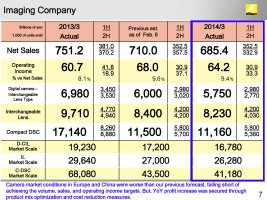
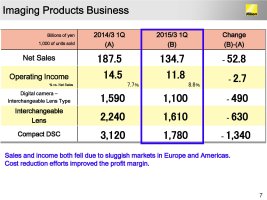
Nikon does give numbers, and their ILC sales (Numbers of Cameras plus lenses) dropped a significant amount for the latest quarter (1st 2015). From 3,830,000 last year to 2,710,000 this year. A 29+% drop!

I checked their fy financial reports for 2014 and for 2015 to date, there has been a significant drop.


attached are the FY 2014 reports (ILC + lenses) dropped for 2014 from 16,690,000 units in 2013 to 13,980,000 units in 2014 a 16+% drop.

and the FY 2015 report (to date) shows a drop of 29+% so far.

The only thing that's growing is the amount of drop in sales.
 

Attachments

  • nikon 2014_Page_07.jpg
    nikon 2014_Page_07.jpg
    364.9 KB · Views: 221
  • nikon 2015_Page_6.jpg
    nikon 2015_Page_6.jpg
    233.7 KB · Views: 232
Upvote 0