
Official release of Nikon D850

AlanF,

thank you so much for the images provided.
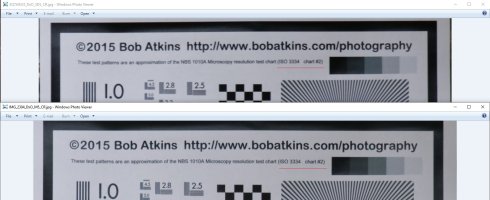
I review both images side by side on a large screen (75") and it appears that m5 image is a fair bit crispier around contrasty areas of the image. i.e.: please compare "100mm" on both images and especialy "(ISO 3334 #chart 2)"
the round bracket sign following the "chart 2" on 5DsR produced image is quite blury in comparison to the M5 one. "3334" is also quite a bit blurier on 5DsR. I am looking at your images now. It could be due to something as simple as a slight camera shake due to mirror shock of a slight AF miss.
M5 image is also crispier around the check patterned area. it is quite noticable. I have attached a crop of the print screen just to demonstrate what I am referring to.. thanks again.


AlanF said:
I spent a few hours doing FoCal and resolution measurements on the 5DSR and the M5, which has the same sensor as the 80D. I had to fool FoCal to analyse the M5, which I could do for jpegs but not raw. I used the manual proedure of recording images and feeding them into FoCal. This allowed me to do the measurements at iso640, not base, as that is the most common one for me, and also use the M5. I used a Bob Atkins chart and the 100-400mm II,

1, there were no significant differences in QoF for the 5DSR using jpeg or RAW.
2, the average QoF for the 5DSR was 1864 ± 60, and for the M5 1823 ± 27. The best for the 5DSR was 1977 and for the M5 was 1912. The scatter was because I hand held and refocussed each shot because that is my usual technique.
3, the resolution of the best two (5DSR on top) was very similar. The pixel pitch of the M5 is 3.72 µ , and 4.14 µ for the 5DSR, so you would expect an 11% higher resolution if neither had an AA filter. The lack of AA filter on the 5DSR makes up for its slightly larger pixels.

The attachments below are the output from DxO Optics Pro with PRIME noise reduction and no sharpening. The target was 20m from the camera, and the crops are the actual number of pixels on the sensor (100% crops).

The m5/80D is very good and would scale up nicely to give a 60 mpx FF, preferably with a switchable on/off AA fliter.
 

Attachments
  • 1.jpg
    1.jpg
    212.5 KB · Views: 182
Upvote 0
Here we go again. You over-interpret just one comparison from a series of experiments that weren’t designed to be interpreted in that detail. Ironically, your own subjective analysis gives opposite conclusions from the FoCal numbers.

What I designed the experiments to do were:
1, compare QoF measured by jpeg and RAW, which I can do accurately because I measure jpeg and RAW from the same image, so most errors cancel out. The result from 6 measurements was that the ratio jpeg:RAW is 1.017 ± 0.012 (mean and standard error), which is close enough to 1 not to worry. So, my data support the contention that it doesn't make any significant difference using RAW and jpeg for the 100-400mm II.
2. To do a rough comparison between the M5 and 5DSR, which wasn’t a particularly good one because, as stated, they were hand held, depended on AF, and as not mentioned, I used mechanical shutter on the 5DSR and live view on the M5. I have done these many times in the past and know that the two are roughly similar, which they are in resolution and IQ.

I stated clearly those conclusions. Also, I have looked at just one sensor of each type, though the quality should not vary in the same large way between lenses. I have just repeated the ratio of QoF jpeg:RAW using the 400mm DO II + 2xTC, where there is usually a greater variation between channels and found it to be 1.028 ± 0.017. Again, close to 1.

AlanF said:
SecureGSM said:
Mike,
If you have not used the Focal, then perhaps it would be good to familiarise yourself prior to start throwing the weight around. That’s not what a scientist will typically would do. ........

Secondly, it appears that you have just downloaded data from dpr and analysed it by a black-box program whose details you do not know. If that is so, then it is scientifically horrible. You don't know how carefully dpr performed its experiments - they weren't intended for what you are analysing, you don't know how the conditions changed between experiments done at different times. You haven't even done a statistical analysis and yet you draw conclusions between numbers that can be close.

AlanF said:
SecureGSM said:
now, can I ask you: what happens with all the lens reviewers who evaluate a single copy of the lens and yet considered as a serious researches? oh, this lens beats that lens..

AlanF said:
You haven't even done a statistical analysis and yet you draw conclusions between numbers that can be close.

If you read my posts, which I do not expect people to do, I complain incessantly about reviewers who look at just one copy of lens and especially when viewers make comparisons between two lenses based on reviews of one copy of each.
 
Upvote 0
Focal has stated a goal of:

"There is another possible benefit to this as well – you may be able to compare results across different FoCal tests. This needs further proving, but results from our testing suggest that the numbers from various tests can be compared as long as they are from the same camera, under similar lighting and using the same Image Capture Mode (i.e. Raw or JPEG)."

https://blog.reikanfocal.com/2014/02/reikan-focal-rgb-analysis/


How can someone compare results from different camera models, when Focal is hoping to develop their calculation to be compatible across different tests on the SAME MODEL.

Has FoCal publishing anything recently that would justify comparing QOF results across different models, much less across tests on the same camera?
 
Upvote 0
I emailed Focal about using their numbers to compare lenses on the same body and the same body on different lenses. Their reply was:

Yes, FoCal can be used to understand how well a lens performs, both in terms of absolute sharpness as well as it's ability to focus consistently.

When switching the same lens between different cameras (if they are not the same camera model) FoCal won't really take into account differences in things like resolution so that is not quite so clear cut.

The QoF or quality of focus numbers are used by FoCal to understand the difference in sharpness between different images by looking at the image crops. There are not explictly designed to allow comparison between different lens (models) or different cameras (models). If the lens is the same and the camera is the same the QoF values are more comparable.

So even Focal seem to be downplaying its use as a tool to compare the same lens on different bodies, and even less when comparing different lenses on different bodies. I would have thought that if this really could be used to compare bodies they would be touting it quite loudly.
 
Upvote 0