
You are using an out of date browser. It may not display this or other websites correctly.
You should upgrade or use an alternative browser.
You should upgrade or use an alternative browser.
One is the loneliest number...
- Thread starter Shootitalready
- Start date


Some shoots I carry two full frame bodies, for instance a WA prime on one and a telezoom on the other. Often I think of what I'll need and have those lenses on the bodies already before I go to the shoot. This saves swapping lenses and potential of dust getting in the camera. Sometimes I have an extra contingency lens in the bag.
Other times I'll just carry one body, or my mirrorless with several lenses. When traveling it's mostly one gripless body though with the bare minimum 3 or 4 lenses I think I'll need.
One rule I have is everything I take HAS to fit in my Lowepro Minitrekker AW. Taking choices what to bring helps me concentrate on what and how to shoot before actually going there. This has really helped me improve my photography. It also limits the volume and weight I carry, saving my back and helping my mobility.
Example of a recent outing with 5DIII + Samyang 14mm and 5DII + 24-105L: http://www.mrsfotografie.nl/evenementen/stadskanaal-onder-stoom/
Notice how using the two bodies allows a mix of focal length ranges throughout the series without swapping lenses.
Other times I'll just carry one body, or my mirrorless with several lenses. When traveling it's mostly one gripless body though with the bare minimum 3 or 4 lenses I think I'll need.
One rule I have is everything I take HAS to fit in my Lowepro Minitrekker AW. Taking choices what to bring helps me concentrate on what and how to shoot before actually going there. This has really helped me improve my photography. It also limits the volume and weight I carry, saving my back and helping my mobility.
Example of a recent outing with 5DIII + Samyang 14mm and 5DII + 24-105L: http://www.mrsfotografie.nl/evenementen/stadskanaal-onder-stoom/
Notice how using the two bodies allows a mix of focal length ranges throughout the series without swapping lenses.
Upvote
0
I would tend to side with the one body option for hiking, though I do like to slip a waterproof compact Lumix that I have into my bag as another option/insurance.
As far as taking a bunch of lenses, I can say that on a multi-day trip to Yosemite last year, most of my lenses went unused. I found myself using my 24-105 for 90 percent of my shots, with a few coming from my 200mm with and without a 2x. I didn't have my 14mm at the time, and I think I would have used that also, but the rest of my kit was either dragged around and not used, or locked in my trunk (we were making a series of day hikes from a fixed location).
The things that proved more important were a good tripod, camera remote, filters, good day-pack, day-pack rain cover, camera rain cover, extra memory cards and batteries, lens cleaning supplies, rain gear, extra layers/gloves, general hiking equipment, sunscreen, and a lot of water. I'm not sure about Ireland, but I know the weather changed rapidly where I was.
Oh, and as JD says, a bit of the Irish Whiskey would be welcome. Perhaps some Paddy's.
As far as taking a bunch of lenses, I can say that on a multi-day trip to Yosemite last year, most of my lenses went unused. I found myself using my 24-105 for 90 percent of my shots, with a few coming from my 200mm with and without a 2x. I didn't have my 14mm at the time, and I think I would have used that also, but the rest of my kit was either dragged around and not used, or locked in my trunk (we were making a series of day hikes from a fixed location).
The things that proved more important were a good tripod, camera remote, filters, good day-pack, day-pack rain cover, camera rain cover, extra memory cards and batteries, lens cleaning supplies, rain gear, extra layers/gloves, general hiking equipment, sunscreen, and a lot of water. I'm not sure about Ireland, but I know the weather changed rapidly where I was.
Oh, and as JD says, a bit of the Irish Whiskey would be welcome. Perhaps some Paddy's.
Upvote
0

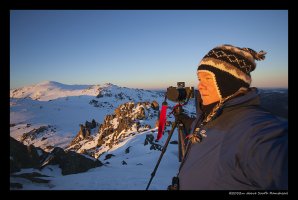
I have two digital bodies 1D4 and 5D2 .. and use a Linhof 617s film, but when I am going out for a full on serious overnight walk for landscape, I take the Linhof of course, and I take the 5D2 without the battery base, just take the batteries.
Weight is a killer so to take anymore than needed will kill you every step you take... you'll soon learn to go light.
I have all the lightest high tech camping gear, and then have to take the camera gear, you need to pack light.
I have the Linhof 617s with the 90mm lens, a Sekonic L-758dr light meter, then the digi body and one wide to med zoom, or my 35mm 1.4, maybe my 14mm 2.8 for night star stuff. But keep it tight depending on where I am going, I also have a carbon manfrotto tripod, nothing too flimsy either.
Pic taken on the 5D2 holding the Linhof after a good 3-4 hour walk in snow shoes, camping gear on back pack on my back camera gear in pack on my front.
Weight is a killer so to take anymore than needed will kill you every step you take... you'll soon learn to go light.
I have all the lightest high tech camping gear, and then have to take the camera gear, you need to pack light.
I have the Linhof 617s with the 90mm lens, a Sekonic L-758dr light meter, then the digi body and one wide to med zoom, or my 35mm 1.4, maybe my 14mm 2.8 for night star stuff. But keep it tight depending on where I am going, I also have a carbon manfrotto tripod, nothing too flimsy either.
Pic taken on the 5D2 holding the Linhof after a good 3-4 hour walk in snow shoes, camping gear on back pack on my back camera gear in pack on my front.
Attachments
Upvote
0

I try to carry just what I need. In most cases, I want a focal range of 24-200 with fast lenses. So, I carry two bodies and two zooms -- a 5D3 w/24-70 f2.8L II and a 5D3 w/70-200 f2.8L II. For some sports events, all I really need is the 70-200, so I will just carry the one 5D3, the 70-200, and 40 pancake -- just in case.
I don't like changing lenses. It often wastes time and risks losing a shot. Plus, it increases the risk of dust on the sensor. So, for me, the second body is one half of my system and not just a backup.
I also don't like carrying more than I really need. I'm not that good at this yet and often grab a third lens when shooting at a new venue.
For those landscape hunts, my impulse would be to carry the same two 5D3's and zooms -- the 24-70 for landscapes and the 70-200 in the hopes of an encounter with wildlife (at a safe distance, of course). If moving water is part of the hike, then I'd swap out the 24-70 for a 24-105 4.0 with IS. I prefer the controlled motion blur of the water that the IS allows. Odds are good, however, that I would leave a 5D3 and the longer zoom behind and stick with the 24-105.
I don't like changing lenses. It often wastes time and risks losing a shot. Plus, it increases the risk of dust on the sensor. So, for me, the second body is one half of my system and not just a backup.
I also don't like carrying more than I really need. I'm not that good at this yet and often grab a third lens when shooting at a new venue.
For those landscape hunts, my impulse would be to carry the same two 5D3's and zooms -- the 24-70 for landscapes and the 70-200 in the hopes of an encounter with wildlife (at a safe distance, of course). If moving water is part of the hike, then I'd swap out the 24-70 for a 24-105 4.0 with IS. I prefer the controlled motion blur of the water that the IS allows. Odds are good, however, that I would leave a 5D3 and the longer zoom behind and stick with the 24-105.
Upvote
0
As an experienced semi-pro (I do sell prints, but the majority of my income is not derived from it), I think I am best placed to answer this question so far.
First, I don't know how experienced you are with backpacking, but in general, the lighter your pack weight, the more enjoyable the trip, all else being equal. Some clearly inexperienced people have posted that you should replace the 2nd camera instead with spare clothing/socks/underwear etc. No. No matter what, you should have spare clothing.
Second, your day is not going to be filled with scenes that will drop jaws. You will have time to switch lenses. What I do is carry a small point and shoot for those scenes I want pictures of, but clearly won't be good enough for printing. Most pictures will reside on your hard drive and nothing more. Some will be shown on the internet. Even less will actually be printed. If you have even a bit of experience, you'll know when you take the photo if it has potential or not.
Third, in about 30 years of doing photography, I've never had a camera fail to work for me. It is so incredibly rare, that if this is your worry, you're likely never to experience it in the field and don't need a backup.
Fourth, KISS. Never heard of it, I'm guessing? It stands for Keep It Simple Stupid. Two bodies and multiple lenses is not only heavy, but complicated. When you have so many options, it can get confusing for you beginners about which lens + body to use. If you miss a shot, then you it bugs you that you may have gotten it with another combination. Or the added weight is tiring, and you don't take the shot because you are tired, but then you might be filled with regret about the lost opportunity. One camera, one or two lenses. That is a successful formula. The landscape photography mentors I have all use the same approach, and they do this for a living, where their livelihood is based on the work they produce. Since most people don't follow advice until they learn the hard way anyway, I recommend you try taking two cameras (if you have them) and multiple lenses. You'll find that you have one workhorse lens, another that you use, and the rest don't even get touched. Figure out which lenses those are (some like ultra wide angle, some like telephoto, etc), and then bring that one or two with you.
I myself use the world-class Canon EF 16-35mm f/4 IS USM L myself. I either bring only that lens, or with the Samyang 14mm Ultra Wide-Angle f/2.8 IF ED UMC if I will be doing star photography, or the Canon EF 70-200mm f/4L IS USM if I think there will be good telephoto opportunities. Remember, a maximum of two lenses. This keeps weight down. This increases your enjoyment while you are on trail, which is an important mindset to maximizing your creativity.
Now, if you do other types of photography than just landscape, you are more than welcome to have more than one body. It can be very useful in event photography, for instance. But for backpacking, one camera. Of course, when I say camera, I refer to DSLR. In reality, what you should have is one DSLR + one P&S.
Good luck! Please post pictures once you get to Ireland! That's definitely a place we all have on our bucket list. Gorgeous place from what I've seen!
First, I don't know how experienced you are with backpacking, but in general, the lighter your pack weight, the more enjoyable the trip, all else being equal. Some clearly inexperienced people have posted that you should replace the 2nd camera instead with spare clothing/socks/underwear etc. No. No matter what, you should have spare clothing.
Second, your day is not going to be filled with scenes that will drop jaws. You will have time to switch lenses. What I do is carry a small point and shoot for those scenes I want pictures of, but clearly won't be good enough for printing. Most pictures will reside on your hard drive and nothing more. Some will be shown on the internet. Even less will actually be printed. If you have even a bit of experience, you'll know when you take the photo if it has potential or not.
Third, in about 30 years of doing photography, I've never had a camera fail to work for me. It is so incredibly rare, that if this is your worry, you're likely never to experience it in the field and don't need a backup.
Fourth, KISS. Never heard of it, I'm guessing? It stands for Keep It Simple Stupid. Two bodies and multiple lenses is not only heavy, but complicated. When you have so many options, it can get confusing for you beginners about which lens + body to use. If you miss a shot, then you it bugs you that you may have gotten it with another combination. Or the added weight is tiring, and you don't take the shot because you are tired, but then you might be filled with regret about the lost opportunity. One camera, one or two lenses. That is a successful formula. The landscape photography mentors I have all use the same approach, and they do this for a living, where their livelihood is based on the work they produce. Since most people don't follow advice until they learn the hard way anyway, I recommend you try taking two cameras (if you have them) and multiple lenses. You'll find that you have one workhorse lens, another that you use, and the rest don't even get touched. Figure out which lenses those are (some like ultra wide angle, some like telephoto, etc), and then bring that one or two with you.
I myself use the world-class Canon EF 16-35mm f/4 IS USM L myself. I either bring only that lens, or with the Samyang 14mm Ultra Wide-Angle f/2.8 IF ED UMC if I will be doing star photography, or the Canon EF 70-200mm f/4L IS USM if I think there will be good telephoto opportunities. Remember, a maximum of two lenses. This keeps weight down. This increases your enjoyment while you are on trail, which is an important mindset to maximizing your creativity.
Now, if you do other types of photography than just landscape, you are more than welcome to have more than one body. It can be very useful in event photography, for instance. But for backpacking, one camera. Of course, when I say camera, I refer to DSLR. In reality, what you should have is one DSLR + one P&S.
Good luck! Please post pictures once you get to Ireland! That's definitely a place we all have on our bucket list. Gorgeous place from what I've seen!
Upvote
0
If it is a long walk (more than an hour), I'll usually only take one camera. But if I'm not going too far, two cameras works well. I'll typically have a Fuji mirrorless camera set up on a tripod to capture a landscape, timelapse etc. And I'll try my luck with wildlife with ye olde Canon.
Upvote
0

Tabor Warren Photography
I want to go shoot something with a Canon...
I have two 5d3s with me on any and every gig. One has a 24 or 35 on with a 600EX, the other has the 85 or 70-200 on with a 600EX. We also bought another 5D3 to go alongside our second shooter's 5D2. I find it extremely handy to have two bodies on at any time. We carry our equipment around with double-harness Black Rapid Straps which are also extremely handy to have when carrying two bodies.
All that being said, I don't believe you will need two bodies for landscape. Instead, I would invest those dollars into either a supreme camera body or awesome glass.
I mainly shoot weddings, portraits of various types, and corporate events. I have found two bodies to be extremely useful during those times, however, on the rare occasion I shoot landscape, I take an extra lens and keep the second body behind.
I hope this helps!
Cheers,
-Tabor
All that being said, I don't believe you will need two bodies for landscape. Instead, I would invest those dollars into either a supreme camera body or awesome glass.
I mainly shoot weddings, portraits of various types, and corporate events. I have found two bodies to be extremely useful during those times, however, on the rare occasion I shoot landscape, I take an extra lens and keep the second body behind.
I hope this helps!
Cheers,
-Tabor
Upvote
0

+1, travel light is essential. One body and two lenses (UWA & medium light telephoto, e.g. 70-200 f4L) is all what you need. Most people chose to carry all in a weather-proof backpack and sometimes a GOOD P&S is your best back up. Water, energetic snacks, extra socks and some extra light clothing for changing is convenient.BL said:Save 2 cameras for events and sports.
If you're backpacking great distances, bring as little as you possibly can get away with - 1 body with an UWA zoom, CF tripod, and lots and lots of batteries. If you have a small backup that can share with your kit, bring that too if you can afford the weight.
Use that extra space for more dry socks and underwear, seriously ;D
Upvote
0
My answer most probably doesn't count much but yes, almost all of the time I use both.
I do photo/video fusion so one is shooting video, the other one alternates between photo and video.
When I shoot sport, one is configured for that sport, the other one is configured for the surroundings or when the ref declares the result (with a flash).
I use only one when streetphotographying and I don't even bring the other with me.
I do photo/video fusion so one is shooting video, the other one alternates between photo and video.
When I shoot sport, one is configured for that sport, the other one is configured for the surroundings or when the ref declares the result (with a flash).
I use only one when streetphotographying and I don't even bring the other with me.
Upvote
0


