Opinion: Love it or Hate it, Digital Correction is here to Stay

Yes, a poor choice of word on my account. Interpolation is ‘creating’, but it’s creating directly around the same data that has already been captured. I was referring to adding unrecorded data / AI generation rather than correcting distortion and of course this has been an easily accessible post processing option to correct for at least fifteen years or so.
A case in point; a couple of years ago an acquaintance of mine was unfortunate enough to have a malignant tumour develop behind one of his eyes. His eye and part of his skull was removed and the surgeons took a lump of his thigh and stitched it over the poor guy’s face, they must have known he wasn’t going to last long. You can imagine what it looked like. Anyway, his wife had taken a picture of him on her iPhone, and it had tried to generate the outline of an eye over the patch. Quite horrible, and the sort of computational photography that we don’t want in proper cameras.
While I 100% agree with what you are saying, what concerns me is that it is reasonable to assume the next generation of camera bodies will use AI based interpolation instead of convolution to retain and/or enhance sharpness for lens corrections… no I don't think thats the same as what you said about the camera adding an eye, but I dont know how I feel about AI enhancing sharpness.. noise, sure.. you can train an neural network to understand/compensate for a noise profile.. thats simple and understandable.. but enhancing sharpness is, IMO, creating data that originally wasnt recorded by the sensor.

I know I’m way off topic now..
 
Last edited:
  • Like
Reactions: 1 user
Upvote 0
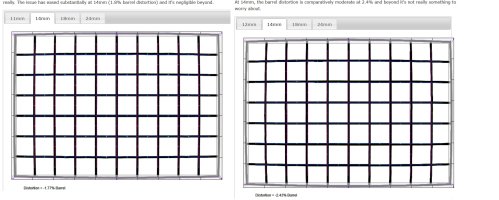
To be just the distortion of Canon 11-24 and Sigma 12-24 must be compared at 14mm not at 11 and 12 respectively

Having said that I do have the RF14-35 f/4L lens and I like it a lot. It is very sharp and compact at the same time.
canon-11-24-sigma-12-24-barrel-distorion.jpg
 
Upvote 0
I appreciate that Canon are trying to achieve excellent optical quality with reduced complexity. This means:
  • Smaller and lighter; less imposing for subjects and more enjoyable to use
  • Less complex to repair / cheaper to repair - maybe?
  • Reduced flare due to less elements
  • Reduced transmission loss due to less elements (each piece of glass WILL soak up SOME light)
  • Smaller lenses also mean smaller and cheaper filters
  • Less glass to move resulting in quicker autofocus
  • Having lenses the same size/weight profile makes it FAR easier to swap on gimbals/cinema rigs without having to re-adjust everything

But I still don't like it. The reasons are thus::
  • On the RF 35 f/1.4L VCM, Adobe Lightroom's profiles leave more barrel distortion post-correction than an un-corrected image from the EF 35 f/1.4L II, so I am SOL, and Canon's software is still stuck in 2005.
  • I shoot at high ISO (12800+) and distortion correction creates artifacts in the noise profile across the image.
  • There's some increased vignetting, too. This is not great when the R1 sensor falls apart when boosting shadow or exposure at high ISOs which makes my corner correction looks much worse than they need to be.
  • Compared to the Sony 35 f/1.4 GM lens, the Canon delivers poorer contrast, is heavier, and has significantly more optical distortion - so if Sony can do it, then what's going on over at Canon? Yes, the Sony distorts a little, but nowhere near the Canon and I can get away with it comfortably.
  • Loss of resolution on the corners for extreme corrections. Sure, 24 megapixels isn't small, but it's not exactly winning any awards so I'm already limited in what I can do with it.
Some lenses like the 14 1.4 I can see a very good case for that compromise, to achieve a result that would be otherwise unmerchantable. The RF VCM lenses relying on digital correction makes sense if you're shooting video in-camera. The RF 14-35 is an interesting product; I'd shoot with the 15-35 any day of the week in lieu (and I'm in the market for that lens actually) - solely so I don't need to rely on software correction.

I was ready to insta-buy the 24 1.4L VCM, but after seeing the barrel distortion and running a few tests, I'm not jumping out of my seat to buy it.

If Sony are able to get away with it, why are Canon having so much trouble getting a good optical image out of a lens?
 
  • Like
Reactions: 1 users
Upvote 0
Have you tried DXO Photolab?
I haven't. I shouldn't have to. If Canon gave me options that weren't riddled with distortion, I wouldn't need to worry about this. If I can't even correct my lenses with the most popular photo post-processing tool around, then there's a big problem.

Every image I've ever shot is in Lightroom for dating back from my 1Ds Mark II and 20D. I'm somewhat wedded to that platform. LR's library management is critical to me.

I'll give it a test at some point to see how their profiles compare, but rather than uprooting my entire digital workflow, it would be simpler for me to buy lenses that don't require these corrections (and even if the geometry correction was functional, the noise pattern issues still remain).
 
  • Like
Reactions: 1 users
Upvote 0
To be just the distortion of Canon 11-24 and Sigma 12-24 must be compared at 14mm not at 11 and 12 respectively
My point was comparing them at the wide end of their respective ranges, which is where each lens has maximal distortion. But you can compare them however you want.

The ones that need 14mm.
Lol, sure. I bought the 10-20/4 to use it at 14mm f/4. And I’m going to sell it now that I’ve ordered the 14mm f/1.4 and just use the prime at f/4.
 
  • Like
Reactions: 1 user
Upvote 0
My point was comparing them at the wide end of their respective ranges, which is where each lens has maximal distortion. But you can compare them however you want.


Lol, sure. I bought the 10-20/4 to use it at 14mm f/4. And I’m going to sell it now that I’ve ordered the 14mm f/1.4 and just use the prime at f/4.
Lol, you bought it to use it at 10-20 range I guess. Some focal lengths more some less. I do not believe you use it strictly at 10mm and nothing more. Of course 10mm is mostly impressive but I am sure you have made good use of the full focal range too.
 
Last edited:
Upvote 0
Lol, you bought it to use it at 10-20 range I guess. Some focal lengths more some less. I do not believe you use it strictly at 10mm and nothing more. Of course 10mm is mostly impressive but I am sure you have made good use of the full focal range too.
Weren't you the person implying you only use it at 14mm?
 
Upvote 0
I said I have the RF14-35 and I like a lot.

I also said that a more apples to apples - if you want - comparison is to compare lenses at the same focal length.

Now, instead of talking with irony (mostly) @neuro and you, you could compare with other zoom lenses with the same starting FL. Like say Sigma 14-24.

You would get your point just fine.

Just like you could prove your point if you compared 10-20 with EF 11-24 which are closer FLwise.

Some people attack with no reason. Of course their behavior characterizes them.
 
Upvote 0
If I were to buy more lenses with this characteristic (like the RF14-35) I would chose 10-20 (I am impressed with its size) and 14/1.4 for astro.

Since I have the ef 11-24 and sigma 14/1.8 for canon I will have to wait for now. I wonder how canon 14/1.4 resists to flare (a rather weak point of sigma).
 
Upvote 0
I also said that a more apples to apples - if you want - comparison is to compare lenses at the same focal length.

Now, instead of talking with irony (mostly) @neuro and you, you could compare with other zoom lenses with the same starting FL. Like say Sigma 14-24.
The main topic of this thread is digital correction of distortion, not image quality at a given focal length. I’m not sure why we would compare one lens at the extreme of its focal range with another lens somewhere in the middle of its focal range, where for the latter the distortion is much reduced.

I mean, we could compare the RF 14-35/4 to the RF 24-50/4.5-6.3 with both lenses at 24mm, but why…especially in the context of this topic? At 24mm, the RF 14-35/4 has essentially no distortion, while the 24-50/4.5-6.3 has lots.
 
Upvote 0
Every image I've ever shot is in Lightroom for dating back from my 1Ds Mark II and 20D. I'm somewhat wedded to that platform. LR's library management is critical to me.
There's a really easy facility to export from LR to stand-alone applications like DxO. The result of which can then easily be imported back into LR. Traditionally, a lot of people (including me) used LR mainly as a cataloguing tool, with the ability to do some basic manipulation. Frankly, the level of adjustments you can do no the latest LR version means that I rarely venture out. But a lot of people will still do so to get particular results, especially noise reduction at high ISOs, but also decent stacking. Raw conversion with lens correction profiles is very much a matter of individual taste, and people will use whatever software they think gives THEM the best result.
 
  • Like
Reactions: 1 user
Upvote 0
And instead of trying to

I never said that I use it at 14mm ONLY. I have the RF14-35. I use if for landscapes at full range, some more some less.
You were saying to test it 14mm. As both the 11mm and 12mm don't stop at 14mm, I interpreted your meaning as "ONLY." My sincere apologies.
 
  • Like
Reactions: 1 user
Upvote 0
Direct comparison with the EF era is tricky because the overall size of the market has shrunk so much. The economics of the thing must have changed a fair bit over the past couple of decades.
I don't think that we can compare directly at all now. Materials cost/technologies, exchange rates/tariffs, manufacturing techniques, marketing and profit expectations, volume changes, competitive landscape and of course buyer demographic changes.

The increase in disposable income in middle classes especially in China, the reduction in media staff photographers and of course the rise of the essential smart phones and computational photographer.

So what can we compare with EF?? Focal range, aperture and sharpness seems about it.
 
Upvote 0
The future is near! Over the years Hardware is getting les important and software is getting better and cheaper.
How do I get an uncorrupted picture? For canon it’s hard to migrate to more software without loosing your Core business.
AI is coming fast and change the game(s) The distance between an IPhone and the R1 is getting closer and shows the direction it all moves. Your pictures won’t developed in your camera. They go online (cloud)in big Data Centers to be converted. The next R1 has a Uni Lens that can converted by software in any lens….
We will see simple steps like Extender that will be replaced by software soon.
Nothing is impossible. And tks to Richard to share his thoughts.
And yes I am an old style and came from analog photography ;-))
Just as MP3 players replaced discmans, users preferred convenience vs quality. Same is today with photos except smart phones have computational improvements in-phone on the fly.

One thing that will improve but isn't there yet is constant and fast internet speed vs battery life.
Starlink is creating a different option for remote shooting but battery life is an issue. GPS in camera is hard enough.
Tethered cameras to phones for that reception and GPS location information seems to have a variable experience.
If Apple provided their latest BT etc technology for connectivity to a camera then this last point would be improved a lot.
 
Upvote 0
Some debates will never die, they feed too many click loving "experts". ;)
We have to debate about something - right?
Bad enough for keyboard brand warriors but worse in cases (like distortion correction) to get empirical data.
Even photons to photos has problems identifying in-camera noise reduction in raw files.
 
  • Like
Reactions: 1 user
Upvote 0