Patent: Canon EF 24-105mm f/4L IS II

I think it'll be nice to see a new version. I've been pleased with the copies I have of new Canon lenses that have been coming forth. I had the original 24-105L and really liked it but I didn't ever love it, until I sold it! It was a solid performer and was on my gear quite a bit for a long time.

After selling it, I later ended up with the new 16-35 F/4 as well as the 24-70 F/4 a little later on. Very pleased with both of them. I sometimes wish there was a need for a new 24-105 f/4 in my bag but there's really not, suppose it's just g.a.s... If I need a little more FL, I can drop on the 70-200 F/2.8 and boom, it's covered.

Anyway, I'm certain this will be an excellent replacement lens for the old 24-105mm workhorse and look forward to seeing everyone very happy with their purchases and their image samples. I think the new version will be like most of the other new Canon offerings and be the cream of the crop for it's category until some newer lens technology with one of the other manufacturers takes it to the next level. Very happy with my Canon lens stable so far, adding next gen prime versions is my next goal.. ::)
 
Upvote 0
TeT said:
aceflibble said:
... The Sigma one beats the existing Canon 24-105 in every department.... and that Canon 24-105 was really only designed for the 12mp 5D and, in my eyes, totally fallen apart since pixel density has risen.

The Sigma beats the Canon at 24mm f/4, as you get longer they pretty much even out in sharpness and both show strengths and weaknesses in different areas.

If the Canon has fallen apart since the 5D, What makes the Sigma bullet proof? It is at best marginally better than the Canon. Neither is as good optically as the Canon 70 200 4 L (another dinosaur that sees a lot of use in the real world)

As an owner of both lenses, each have their pros and cons, but I'd say the Sigma is definitely better than the Canon overall. Not significantly better, but certainly more than marginally better.

Sigma - noticeably better sharpness wide open throughout focal range; IS is at least one stop better if not more; IS is silent.

Canon - better battery life; 77mm filter; lighter weight; zoom ring in more natural location; less vignetting.

In the end, I get better pictures from the Sigma.
 
Upvote 0
I probably wouldn't buy the kit, but I've thought for some time that a new 24-105 f4 would be the obvious and excellent match for the new 5D. Even by Canon's standards, the lens is more than ready for a refresh, and that zoom range makes a very nice walkabout lens. Modern optical technology should enable Canon to build a solid-performing lens at a reasonable price and weight. And with only an f4 design barrier to hurdle, it might even come close to the 24-70 II in IQ. Sort of an entry level L.

In fact, given the advances in sensor design and related technologies, the new combo might make even more sense than the original 5D 24-105 kit. Improvements in IS and the ability of modern bodies to shoot cleanly at much higher ISOs should make the relatively slow speed less of a handicap than it was on the original 5D.
 
Upvote 0
Is it just me or does it look like Canon have dropped the BR technology that they looked ready to roll out with all upcoming L series lenses?
I thought it was an all singing all dancing new tech that would rolled out on all future/upgraded releases, and help Canon justify their normal high prices for their L lenses!
Was it just a one off gimmick?????
 
Upvote 0
Stewart K said:
Is it just me or does it look like Canon have dropped the BR technology that they looked ready to roll out with all upcoming L series lenses?
I thought it was an all singing all dancing new tech that would rolled out on all future/upgraded releases, and help Canon justify their normal high prices for their L lenses!
Was it just a one off gimmick?????
I think BR is a coating, and may not need to be on a patent
 
Upvote 0
Meatcurry said:
Stewart K said:
Is it just me or does it look like Canon have dropped the BR technology that they looked ready to roll out with all upcoming L series lenses?
I thought it was an all singing all dancing new tech that would rolled out on all future/upgraded releases, and help Canon justify their normal high prices for their L lenses!
Was it just a one off gimmick?????
I think BR is a coating, and may not need to be on a patent
AHH, thanks for that, makes sense!!
 
Upvote 0
Stewart K said:
Is it just me or does it look like Canon have dropped the BR technology that they looked ready to roll out with all upcoming L series lenses?
...
Was it just a one off gimmick?????
I don't think so.

I don't know how BR works in detail and if it is possible to use it in a zoom lens.
Maybe it must be optimized to a certain focal length and used in a zoom the advantages get so low that the higher price can not be justified.

And as the 24-105L has been a typical kit lens - although of high quality - I'd expect Canon to make it easy to built in higher numbers and therefore less expensive.
If BR could be used in zoom lenses, I'd expect it to be announced with a top notch zoom like a 24-70 or 16-24 f2.8.

If it will not be used in future primes like the anticipated 50L or 85L, then it was something like a gimmick.

And no...
Meatcurry said:
I think BR is a coating, and may not need to be on a patent
Please check the Canon information on that. They say something like it is an "organic optical material", call it an "organic lens". Not just a thin coating.
http://cpn.canon-europe.com/content/product/lenses/ef35mm_f1_4l_ii_usm.do
-> Key Technologies
 
Upvote 0
Maximilian said:
Stewart K said:
Is it just me or does it look like Canon have dropped the BR technology that they looked ready to roll out with all upcoming L series lenses?
...
Was it just a one off gimmick?????
I don't think so.

I don't know how BR works in detail and if it is possible to use it in a zoom lens.
Maybe it must be optimized to a certain focal length and used in a zoom the advantages get so low that the higher price can not be justified.

And as the 24-105L has been a typical kit lens - although of high quality - I'd expect Canon to make it easy to built in higher numbers and therefore less expensive.
If BR could be used in zoom lenses, I'd expect it to be announced with a top notch zoom like a 24-70 or 16-24 f2.8.

If it will not be used in future primes like the anticipated 50L or 85L, then it was something like a gimmick.

And no...
Meatcurry said:
I think BR is a coating, and may not need to be on a patent
Please check the Canon information on that. They say something like it is an "organic optical material", call it an "organic lens". Not just a thin coating.
http://cpn.canon-europe.com/content/product/lenses/ef35mm_f1_4l_ii_usm.do
-> Key Technologies

Ok, so one of the elements is actually made from this material, I guess then it wouldn't need to state on the patent whether the lens had BR or not
 
Upvote 0
Maximilian said:
I don't know how BR works in detail and if it is possible to use it in a zoom lens.
Maybe it must be optimized to a certain focal length and used in a zoom the advantages get so low that the higher price can not be justified.

And as the 24-105L has been a typical kit lens - although of high quality - I'd expect Canon to make it easy to built in higher numbers and therefore less expensive.
If BR could be used in zoom lenses, I'd expect it to be announced with a top notch zoom like a 24-70 or 16-24 f2.8.

Even if a BR element is more expensive to produce than a normal glass lens, it might still reduce overall production cost. If the BR element takes care of a large chunk of CA, it is likely possible to use less expensive glass for the other lenses, reduce lens count or have less tight manufacturing tolerances. In these cases the BR element is not used to reduce CA to a minimum but to have more options for the rest of the lens design while still having only normal levels of CA.
 
Upvote 0
midluk said:
Even if a BR element is more expensive to produce than a normal glass lens, it might still reduce overall production cost.
...
Maybe you're right and maybe we'll see this tech trickle down into consumer products soon. I'd like to see that.
But I sadly don't believe that.
 
Upvote 0
BR optics and speculating on the tecnology

The organic material which they sandwich between concave and convex glass elements is likely made of some type of CR39 derivertive like Rav 7 which is optically clear & close to crown glass and has been treated with a nano coating that cuts blue spectrum light between 450-495nm a bit like the way IR cut filters work in principle. The optical formula relies equally on the design & placement of the two glass elements in the group but with computer modelling before a lens is ever made these kinds of design will be more previlent.
Optics took a step back when lead was banned as lead provided great clarity and helped in the construction of moulded elements and not all the substitutes were as good or effective.
CR39 and the much newer types have transformed our specticles as have the advancements in optical coatings and we know cheaper lenses have used CR39 type elements for some time.
 
Upvote 0
jeffa4444 said:
BR optics and speculating on the tecnology

The organic material which they sandwich between concave and convex glass elements is likely made of some type of CR39 derivertive like Rav 7 which is optically clear & close to crown glass and has been treated with a nano coating that cuts blue spectrum light between 450-495nm a bit like the way IR cut filters work in principle. The optical formula relies equally on the design & placement of the two glass elements in the group but with computer modelling before a lens is ever made these kinds of design will be more previlent.
Optics took a step back when lead was banned as lead provided great clarity and helped in the construction of moulded elements and not all the substitutes were as good or effective.
CR39 and the much newer types have transformed our specticles as have the advancements in optical coatings and we know cheaper lenses have used CR39 type elements for some time.
A Japanese chemical company Mitsui for instance makes Thiourethane based monomers the MR series with a high refractive index which can include UV and 420nm cut filtration and these can be made very thin unlike the original CR-39. These can be formed & cured into the type of shape Canon show which is not too disimilar to specticle lenses.
 
Upvote 0
jeffa4444 said:
BR optics and speculating on the tecnology

The organic material which they sandwich between concave and convex glass elements is likely made of some type of CR39 derivertive like Rav 7 which is optically clear & close to crown glass and has been treated with a nano coating that cuts blue spectrum light between 450-495nm a bit like the way IR cut filters work in principle.

jeffa4444 said:
A Japanese chemical company Mitsui for instance makes Thiourethane based monomers the MR series with a high refractive index which can include UV and 420nm cut filtration and these can be made very thin unlike the original CR-39.

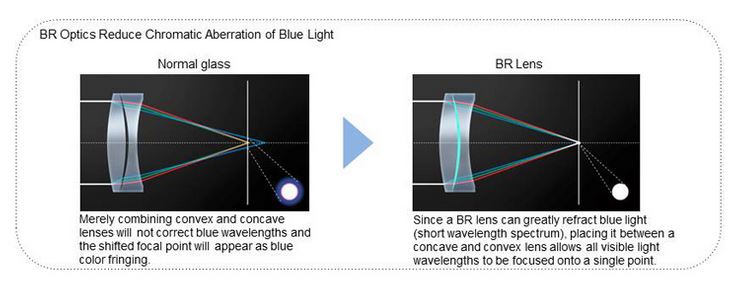
While your knowledge of optical materials is appreciated, I think you have a fundamental misunderstanding of the function of the BR element, or of how chromatic aberration (CA) occurs, or both. Or perhaps it's as simple as misinterpreting the abbreviation – BR is blue refractive, not blue reflective.

Simply put, CA occurs because different wavelengths of light are refracted ('bent') by different amounts when passing through a lens (think prism and spectrum). As a result, not all wavelengths are focused at the same point – some are behind the focal plane (sensor), others in front. Canon's BR element refracts short ('blue') wavelengths more strongly, so that they are (ideally) superimposed on the longer wavelengths, reducing CA.

Canon%2BDevelops%2BNew%2BCamera-Lens%2BOptical%2BElement%2BThat%2BEnables%2BExtremely%2BHigh%2BLevels%2BOf%2BChromatic%2BAberration%2BCorrection%2B00.JPG


In this case, your comparison to an IR cut filter is not apt – the BR material transmits blue light (ideally without significant loss).
 
Upvote 0
j-nord said:
Anyone determine the front element size from these patents? (I'm new to reading them so I'm not entirely sure what all the numbers/abbreviations represent). Are we looking at 77mm or 82mm filter size?
I did copy, resize and measure the drawing of the optical formula.
If I did measure right and my rule of three the front element has a diameter of 67 to 68 mm.
This seems to be slightly bigger than the front element of the current version.
So I'd put my bets on 77 mm filter thread.
 
Upvote 0
I think I'm possibly the only one who believes that the new lens is intended to cost less to manufacture, rather than be optically a lot better. Those resolution curves in the patent did not impress me as being a whole lot better. For a 4-1 zoom, its difficult to gain a whole lot in IQ, but since the existing lens price has dropped so much, one that costs less to build is probably where we are headed.

As for the blue refractive coating, it may affect the lens formula and the curves, so I'd think it would be mentioned.
 
Upvote 0
Mt Spokane Photography said:
I think I'm possibly the only one who believes that the new lens is intended to cost less to manufacture, rather than be optically a lot better. Those resolution curves in the patent did not impress me as being a whole lot better. For a 4-1 zoom, its difficult to gain a whole lot in IQ, but since the existing lens price has dropped so much, one that costs less to build is probably where we are headed.

As for the blue refractive coating, it may affect the lens formula and the curves, so I'd think it would be mentioned.

Interesting, that puts my earlier excitement into a different perspective :-\

My 24-105 is a killer lens, it made me sell my MkI f/2.8 24-70L and remains my #1 go-to lens especially when traveling. FWIW if a replacement is better (optically but also updated IS), I will be very excited to get one.
 
Upvote 0