Patent: Canon EF 300-600 f/5.6 w/1.4x TC

CarlTN said:
You still didn’t tell me if you were in servo mode for the bittern shot. I assume you were. 12 pounds...so this was the series 1 600mm lens?

AI Servo mode.

I have the 600/4L IS II lens. It weighs 8.6 lbs by itself. I'm not sure why some people seem to think that because a lens is big and expensive, it can record images all by itself. Carl, please don't tell me you're like dilbert, who thinks that lenses are cameras... The 1D X is ~3.4 lbs (so in fact, the 1D X + 2xIII + 600 II combo comes to ~12.7 lbs).
 
Upvote 0
CarlTN said:
Yes I would be all over a 1.7x TC too. But I guess since Nikon has had one for a decade, Canon needs to wait another couple of decades before they bring one to market. You know, just to make sure they get it right!

Oh, you mean like ultrasonic motors (Canon: 1987, Nikon: 1998)?
Or image stabilization in 35mm lenses (Canon: 1995, Nikon: 2000)?
Or electromagnetic aperture mechanisms (Canon: 1987, Nikon: 2008)?
How about full frame digital sensors (Canon: 2002, Nikon: 2007)?
Or CMOS sensors for DSLRs (Canon: 2000, Nikon: 2004)?
Built in teleconverter (Canon: 1984 [2012 for AF], Nikon: never)?

Yeah, like those.

I know I have cherry-picked a few examples, but you can't possibly think that Nikon is a substantially faster-moving and more innovative company overall. And that 1.7x TC you desire, there are two versions for Nikon: 1) that works only with AF-S and AF-I lenses, and 2) a version that is manual focus only for all lenses. Own an nice AF 300mm f/2.8 or 80-200mm f/2.8D? Tough luck, no AF for you (not that Nikon AF lenses are fast by anyone's definition).

Grass still greener?
 
Upvote 0
jrista said:
Eldar said:
neuroanatomist said:
The point was that it's possible to shoot BIF handheld with the 600 II + 2xIII. Hit rate was ~50%, due to the difficulty of keeping the center + 4 AF points on the bird, but it can be done.

The bittern shot is cropped by about a third,...it was a gray, ugly day at the end of October, 2012. This shot from 40 minutes later that day (also with the 600 II + 2xIII) shows the rain that started falling on us, being blown nearly sideways by the strong winds…it was the outskirts of Hurricane Sandy.
I agree that it is possible, but AF is too limited. Keeper rate is low and 1200mm is difficult on anything that moves, regardless of AF functionality.

You guys must not pay much attention to professional bird photographers. Many of them use the 600II + 2xTC III. Some of them rarely ever use anything else! Most of them used the 800/5.6 before, many never removed their 1.4x TC's from it. One of the primary reasons professional bird photographers buy 1D series is for the f/8 AF, because they use it CONSTANTLY.

Keep in mind, the 1D officially supports f/8 AF. It isn't like the makeshift f/8 AF you can get with a Kenko slapped onto a 400mm f/5.6 on a 7D, where your luck is basically a roll of the dice, and AF performance is excruciating. Nor is it even like the 5D III, which supports f/8 AF, but isn't as fast as the 1D series. I am guessing, at best, most of you calling f/8 AF slow have only used the 5D III. Try rending a 1D IV sometime, or if you know a friend with one, see if you can borrow it. When it is officially supported, especially these days with support for expansion mode (where a total of five central AF points are used in the 1D X/5D III), it is fast, accurate, and very usable.

Now, granted, f/8 lenses aren't ideal for tracking birds in flight. Usually, if a bird is flying towards you or angled across your field of view, f/8 lenses, which are usually over 800mm in length, are just too long...you need something wider anyway to compose properly and leave a little room for some of that necessary cropping and straitening. So it isn't like anyone expects f/8 AF to be used to track one of the most complex and difficult subjects that you can track. That's the reason f/4 supertelephotos exist...LOT of light, FAST af...you track BIF with a 500mm or 600mm f/4. The f/8 is most frequently used for perching birds, shorebirds, waders like herons, waterfowl, distant wildlife, etc. where you don't have to bother tracking...you just point, focus, and shoot. Both the 5D III and 1D X are MORE than capable of doing that with an f/8 lens.

I've tried a 2X a few times. And I see the pro's using it.
It drives me to drink. I finally just gave up. LOL
I cannot get the hang of it. I am 2x challenged for sure.
 
Upvote 0
neuroanatomist said:
Eldar said:
CarlTN said:
Still at f/8, that's only one single tiny center point for AF, is it not?
Yes, and to me at least, that makes focusing quite a challenge on action oriented shooting. It is OK to shoot a musk ox grassing, but hopeless on something running or flying. I hardly ever use the 2x extender on the 600 f4 because of that.

American Bittern in flight, shot handheld with the 1D X, 600mm f/4L IS II + 2xIII, 1/1600 s, f/8, ISO 3200.

index.php

Mind if I ask, why did you stick with f/8? I always stop down the 500+2x to f/10 as I find it gives a little extra sharpness. The only exception would be in extreme low light.
 
Upvote 0
jrista said:
Eldar said:
neuroanatomist said:
The point was that it's possible to shoot BIF handheld with the 600 II + 2xIII. Hit rate was ~50%, due to the difficulty of keeping the center + 4 AF points on the bird, but it can be done.

The bittern shot is cropped by about a third,...it was a gray, ugly day at the end of October, 2012. This shot from 40 minutes later that day (also with the 600 II + 2xIII) shows the rain that started falling on us, being blown nearly sideways by the strong winds…it was the outskirts of Hurricane Sandy.
I agree that it is possible, but AF is too limited. Keeper rate is low and 1200mm is difficult on anything that moves, regardless of AF functionality.

You guys must not pay much attention to professional bird photographers. Many of them use the 600II + 2xTC III. Some of them rarely ever use anything else! Most of them used the 800/5.6 before, many never removed their 1.4x TC's from it. One of the primary reasons professional bird photographers buy 1D series is for the f/8 AF, because they use it CONSTANTLY.

Keep in mind, the 1D officially supports f/8 AF. It isn't like the makeshift f/8 AF you can get with a Kenko slapped onto a 400mm f/5.6 on a 7D, where your luck is basically a roll of the dice, and AF performance is excruciating. Nor is it even like the 5D III, which supports f/8 AF, but isn't as fast as the 1D series. I am guessing, at best, most of you calling f/8 AF slow have only used the 5D III. Try rending a 1D IV sometime, or if you know a friend with one, see if you can borrow it. When it is officially supported, especially these days with support for expansion mode (where a total of five central AF points are used in the 1D X/5D III), it is fast, accurate, and very usable.

Now, granted, f/8 lenses aren't ideal for tracking birds in flight. Usually, if a bird is flying towards you or angled across your field of view, f/8 lenses, which are usually over 800mm in length, are just too long...you need something wider anyway to compose properly and leave a little room for some of that necessary cropping and straitening. So it isn't like anyone expects f/8 AF to be used to track one of the most complex and difficult subjects that you can track. That's the reason f/4 supertelephotos exist...LOT of light, FAST af...you track BIF with a 500mm or 600mm f/4. The f/8 is most frequently used for perching birds, shorebirds, waders like herons, waterfowl, distant wildlife, etc. where you don't have to bother tracking...you just point, focus, and shoot. Both the 5D III and 1D X are MORE than capable of doing that with an f/8 lens.
FWIW (and bearing in mind the replies since this post) I was on tenterhooks waiting for the 5D3 f/8 autofocus update, and swapped from the 500+1.4x to 500+2x without looking back. The extra focal length is almost cancelled out, but not quite, so it's worth it.

That being said, autofocus is something I'd love to see improved. It works, and that's brilliant - before, I was manually focusing sometimes (e.g. at 1400mm with both extenders mounted), even on birds in flight, but the hit rate was tiny. Any improvement is good, and what the update in April provided was very welcome. But it is inaccurate, as you might imagine - birds in flight are more often than not impossible. I'm torn between frustration and gratitude.

Still the ability to do it at all is awesome, so on balance I am happy.
 
Upvote 0
jrista said:
scyrene said:
jrista said:
For birds, which is also what I mostly do, 840mm is enough if you know how to get close, and 600mm on FF is enough if you have exceptional sneaking skills. ;P Cropping is just as much an artistic factor as it is sometimes a necessity. Personally, I find that completely filling the frame with a bird limits your ability to fix composition errors in post, so I try to leave some space around my subjects. Reduces pixels on subject, but it gives you the option of fixing rotation, using crop to shift the subject toward one side to improve composition, or if you print on canvas like I do, gives you that extra bit of necessary room for the wrapped edges in gallery wraps. The only reason I would likely use 1200mm f/8 on a 5D III would be to give the birds more space, instead of crowding them (although it entirely depends on the bird and the environment whether that improves their behavior or not...many birds don't care about proximity, some care very much, but only in certain circumstances or times of the year.)

Nice insight on the canvas printing. I've done it, but not yet mounted them, that's worth bearing in mind, thanks :)

As far as birds are concerned, I dunno. Maybe it's me. Maybe it's the birds. Some are very confiding, of course, but in that case you can get incredible detail at 1000mm near the minimum focus distance. Many species, in most circumstances, see you and skedaddle. In open situations, like beaches or beside open water, it can be very difficult indeed (I do have a portable hide, perhaps I should start using it more - but that seems rather extreme most of the time). Either way, having the focal length is better than not; if I get closer to the birds, I can always take off the teleconverter.

Birds take patience, and maybe some camo clothing (but NOT a hide, unless you have somewhere to hide the hide...if it stands out in the open, birds will take notice and stay clear.) My closest shots always come about an hour after I head out. I tend to stay low, usually laying in the sand, with my tripod set up such that the legs are collapsed and angled flat, so I get the lowest clearance from the ground possible. I wear a camo jacket and this cheap camo net overlay to pull over my pants. Then I just wait. Shorebirds, for example, move up and down and back up the shore. If you set yourself up with the sun behind you, it is really just a matter of time before the birds come wading right up to you, then past you, then back again. In between encounters, you can shift your position, or creep in closer by a few feet at a time. Eventually you can get so close that you'll take the TC off! :)


I think partly it's that I don't tend to go out for a given species; I photograph what I see. Then there's the not wanting to look ridiculous - I know that's holding me back. Camouflage, I suppose I'll give into; getting dirtier seems inevitable (and that's fair enough).

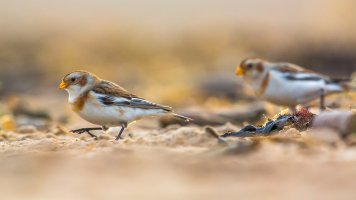
I had what you said in mind when I went to photograph snow buntings on the shore the other day, and it worked well. Lying on my belly, they came close, and I got good shots (see below), albeit at the expense of a couple of days' neck pain. I'll try this with waders next time I get the chance, thanks :)
 

Attachments

  • 11294592245_8541550389_b.jpg
    11294592245_8541550389_b.jpg
    205.7 KB · Views: 461
Upvote 0
scyrene said:
FWIW (and bearing in mind the replies since this post) I was on tenterhooks waiting for the 5D3 f/8 autofocus update, and swapped from the 500+1.4x to 500+2x without looking back. The extra focal length is almost cancelled out, but not quite, so it's worth it.

Hmm....I'm not sure it is possible for a 2x TC, even a bad one, to cancel out the benefit of the extra focal length. Subject size in the frame is the square of the ratio of the focal lengths. In your case, you went from 500mm to 1000mm, so your subject quadrupled in size in the frame ((1000/500)^2 = 4). There is no way that the TC is introducing so much CA that it is overpowering having FOUR TIMES as many pixels on subject...that would mean your CA was like 13µm in size...which I simply don't believe. Not to mention that CA adds color fringing, which can be corrected, and the overall general softening due to the 2x TC III is relatively low. I mean, it definitely has an impact, but it isn't entirely canceling the benefit of having twice the focal length.

scyrene said:
That being said, autofocus is something I'd love to see improved. It works, and that's brilliant - before, I was manually focusing sometimes (e.g. at 1400mm with both extenders mounted), even on birds in flight, but the hit rate was tiny. Any improvement is good, and what the update in April provided was very welcome. But it is inaccurate, as you might imagine - birds in flight are more often than not impossible. I'm torn between frustration and gratitude.

Still the ability to do it at all is awesome, so on balance I am happy.

It's expected that f/8 AF for BIF is pretty much a no-go unless you are exceptionally skilled (and there are a few who are that skilled.) Even with the 100-400 + 1.4x Kenko on my 7D (which is atrocious), for stationary subjects I was still able to AF a reasonable amount of time. That is with a Kenko TC on a 7D...WORLDS different than a 1D X with an EF 2x TC III mounted on a Mark II telephoto. The 5D III runs circles around the 7D+Kenko. It isn't blazing fast instantaneous focus, but it doesn't take minutes either. On the 5D III f/8 AF is fast enough, and consistently functional, which is all you really need for stationary birds, or birds that are slowly moving rather than flying. And that is what f/8 AF is usually used for in the birding world.

Don't expect to be able to f/8 AF for fast moving subjects. It just isn't practical, isn't realistic, and isn't expected (and yet, that seems to be what most people are referring to when talking about how bad f/8 AF is, not even just here on CR...any time I hear someone complaining about f/8 AF they are either trying to BIF, or photograph rutting elk or something of the fast action sort...which is just not gonna happen.)
 
Upvote 0
scyrene said:
Mind if I ask, why did you stick with f/8? I always stop down the 500+2x to f/10 as I find it gives a little extra sharpness. The only exception would be in extreme low light.

I was in a hurry... :-[ I looked over as the bird took flight, raised the camera and shot. It was in standby mode, but when birding I walk around with it in my BIF mode (C3), which is 1/1600 s, f/6.3, Auto ISO. That's set for the bare 600 or with the 1.4xIII, so it defaulted to the wide open f/8 with the 2xIII attached.
 
Upvote 0
jrista said:
9VIII said:
jrista said:
Lee Jay said:
jrista said:
Lee Jay said:
The FD version was 150-600/5.6. So should this be. 300/420 at the WIDE end isn't wide enough. Sigma and Tamron both have super tele's with wider zoom ranges than 2x.

You have to figure there would have to be IQ compromises to support 150-600 though. In the film era, the difference would probably not have been noticeable. With constantly increasing sensor resolution these days, I'd rather have a 300-600 f/5.6 if it means the lens is sharper with better contrast.

The 70-200/2.8L IS II shows the folly of that thinking. Building an f/5.6 lens to be optically excellent is much easier than building an f/2.8 lens.

I would also bet that no FD lens that Canon ever designed came even remotely close to producing the kind of IQ that a modern Mark II supertele produces. An f/5.6 aperture at 600mm is also quite a bit larger than f/2.8 at 200mm (102mm vs. 71mm), so from the get go we are talking about a particularly non-trivial front element.

Zooms require compromise, and the greater the zoom ratio, the greater the compromise (especially when the wide end varies so much, in terms of AoV, from the long end.) The 70-200 has a 2.77x AoV factor (34.4°/12.4°), where as a 150-600 would have a 4.32x AoV factor (17.8°/4.13°). They aren't similar enough to be compared, and even though the patent is for an f/5.6, I would be willing to bet hard money that a 300-600mm focal range (which has a mere 2x AoV factor (8.25°/4.13°) is more amicable to modern Mark II IQ than a 150-600mm focal range.

It's unfortunate that third party manufacturers seem to sell more lenses with a big zoom range than high quality primes, or good zooms with a short zoom range. I guess we need more people birding. All it would take is a good 600f5.6 lens and most of the large supertelephoto lenses would become practically obsolete (or at least redundant), but it sounds like there will never be a big enough market for that without company pride on the line.

I dunno. Personally, I'd still buy the 600/4 over a 600/5.6 (or even a 300-600/5.6). I wouldn't want to sacrifice the extra stop of light, which is really the primary draw of a lens like the 600/4 (and often essential to get good IQ, especially in the kinds of circumstances you frequently find with bird photography). Same reason I would buy the 300/2.8 over a 300/4. The 300/4 is certainly cheaper, but the 300/2.8 cannot be beat for the balance of sharpness & AF speed vs. portability...not to mention it's versatility with teleconverters. It is the ideal wildlifers lens if you have a few thousand dollars to spend.

It seems to me that stopping down on big whites is actually fairly common (as seen above). I'm constantly surprised at the high apertures people actually use when shooting wildlife. Sometimes you even see relatively extreme apertures that, on paper at least, I would want to avoid due to diffraction.
I'm sure the option of using f4 comes in handy every once in a while, but in practice it looks like the wide apertures get used for TC compatibility more than anything. Options are nice but getting the lens at the focal length you want is still the best choice. The 600f4+TC is top dog for birding right now, but if/when a new 800f5.6 comes out I don't think many people will miss the extra stop of light.
 
Upvote 0
This lens may appeal to some but with the embedded teleconverter it will have many major handicaps. Size, Weight, price. Well regarding the latter I am not in a position to know how much more it would cost due to the teleconverter. However, the first two factors would be affected so much as to negate every portability advantage due to the f/5.6 max aperture. A 300-600 f/5.6 lens would be much smaller (judging from the tamron and assuming that it would be retractable) so it would make the perfect travel super telephoto...
 
Upvote 0
9VIII said:
jrista said:
9VIII said:
jrista said:
Lee Jay said:
jrista said:
Lee Jay said:
The FD version was 150-600/5.6. So should this be. 300/420 at the WIDE end isn't wide enough. Sigma and Tamron both have super tele's with wider zoom ranges than 2x.

You have to figure there would have to be IQ compromises to support 150-600 though. In the film era, the difference would probably not have been noticeable. With constantly increasing sensor resolution these days, I'd rather have a 300-600 f/5.6 if it means the lens is sharper with better contrast.

The 70-200/2.8L IS II shows the folly of that thinking. Building an f/5.6 lens to be optically excellent is much easier than building an f/2.8 lens.

I would also bet that no FD lens that Canon ever designed came even remotely close to producing the kind of IQ that a modern Mark II supertele produces. An f/5.6 aperture at 600mm is also quite a bit larger than f/2.8 at 200mm (102mm vs. 71mm), so from the get go we are talking about a particularly non-trivial front element.

Zooms require compromise, and the greater the zoom ratio, the greater the compromise (especially when the wide end varies so much, in terms of AoV, from the long end.) The 70-200 has a 2.77x AoV factor (34.4°/12.4°), where as a 150-600 would have a 4.32x AoV factor (17.8°/4.13°). They aren't similar enough to be compared, and even though the patent is for an f/5.6, I would be willing to bet hard money that a 300-600mm focal range (which has a mere 2x AoV factor (8.25°/4.13°) is more amicable to modern Mark II IQ than a 150-600mm focal range.

It's unfortunate that third party manufacturers seem to sell more lenses with a big zoom range than high quality primes, or good zooms with a short zoom range. I guess we need more people birding. All it would take is a good 600f5.6 lens and most of the large supertelephoto lenses would become practically obsolete (or at least redundant), but it sounds like there will never be a big enough market for that without company pride on the line.

I dunno. Personally, I'd still buy the 600/4 over a 600/5.6 (or even a 300-600/5.6). I wouldn't want to sacrifice the extra stop of light, which is really the primary draw of a lens like the 600/4 (and often essential to get good IQ, especially in the kinds of circumstances you frequently find with bird photography). Same reason I would buy the 300/2.8 over a 300/4. The 300/4 is certainly cheaper, but the 300/2.8 cannot be beat for the balance of sharpness & AF speed vs. portability...not to mention it's versatility with teleconverters. It is the ideal wildlifers lens if you have a few thousand dollars to spend.

It seems to me that stopping down on big whites is actually fairly common (as seen above). I'm constantly surprised at the high apertures people actually use when shooting wildlife. Sometimes you even see relatively extreme apertures that, on paper at least, I would want to avoid due to diffraction.
I'm sure the option of using f4 comes in handy every once in a while, but in practice it looks like the wide apertures get used for TC compatibility more than anything. Options are nice but getting the lens at the focal length you want is still the best choice. The 600f4+TC is top dog for birding right now, but if/when a new 800f5.6 comes out I don't think many people will miss the extra stop of light.

The wide aperture affects AF speed and AF point precision and capability. Remember, particularly in the 61pt AF system, there are f/2.8 double cross type points, f/4 cross type points, f/5.6 line points, and the center expansion f/8 points. With an f/4 lens, you ALWAYS AF at f/4, no matter what you stop down to for actual shooting. The extra stop of light allows the AF system to operate more quickly and more accurately. When f/4 AF points are used, they tend to be more precise than f/5.6 points, which need larger pixels in order to sense as well as f/4 pixels.

The point of an f/4 lens isn't that you always shoot wide open (although in the evening, it isn't uncommon...I tend to be around f/8 aperture for shooting during daytime, and f/4-5.6 for shooting around sunset, for wildlife.) It's that you ALWAYS AF wide open (by design.) And yes, with an f/4 lens, when you slap on a 1.4x TC, you still AF at f/5.6, which is still better than AF at f/8, no question.
 
Upvote 0
Bingo.. I was wondering when someone was going to mention this. When shooting in good light I sometimes use a 1.4.

Most of my shooting is in dismal light. Making T.C. work miserable for me.

I was in a hide shooting pittas about two months ago. With my F/2.8, 300mm using the 2.8 focus points of the Mark IV. I was running circles around the other photographers. There was no comparison. I ended up with the best shots by far in a few minutes. Where most hard core birders had been there for days.

Moving from F/2.8 to F/4.0. Makes a noticeable difference in AF performance. Simple things like this will get the shots others will not. I have run circles around guys shooting 500 + 600 mm F/4.0 lenses in very poor light. Many ask me why aren't you using your 500? I just smile and start shooting the eyes out of the birds. While they are having to move back and suffer the handicapped AF performance of F/4.0.

It is the main reason I own a 300 2.8 lens. Over here the guys that run down the 300 2.8 saying it is to short. Loose big time in low light close quarter shooting which is common in the jungle.

I am looking forward to the next generation of cameras. I skipped the IDx. But would love to try one just to play with the AF.

Great hobby. Just a lot of fun...

www.flickr.com/photos/avianphotos
www.birdsthatfart.com
 
Upvote 0
jrista said:
9VIII said:
jrista said:
9VIII said:
jrista said:
Lee Jay said:
jrista said:
Lee Jay said:
The FD version was 150-600/5.6. So should this be. 300/420 at the WIDE end isn't wide enough. Sigma and Tamron both have super tele's with wider zoom ranges than 2x.

You have to figure there would have to be IQ compromises to support 150-600 though. In the film era, the difference would probably not have been noticeable. With constantly increasing sensor resolution these days, I'd rather have a 300-600 f/5.6 if it means the lens is sharper with better contrast.

The 70-200/2.8L IS II shows the folly of that thinking. Building an f/5.6 lens to be optically excellent is much easier than building an f/2.8 lens.

I would also bet that no FD lens that Canon ever designed came even remotely close to producing the kind of IQ that a modern Mark II supertele produces. An f/5.6 aperture at 600mm is also quite a bit larger than f/2.8 at 200mm (102mm vs. 71mm), so from the get go we are talking about a particularly non-trivial front element.

Zooms require compromise, and the greater the zoom ratio, the greater the compromise (especially when the wide end varies so much, in terms of AoV, from the long end.) The 70-200 has a 2.77x AoV factor (34.4°/12.4°), where as a 150-600 would have a 4.32x AoV factor (17.8°/4.13°). They aren't similar enough to be compared, and even though the patent is for an f/5.6, I would be willing to bet hard money that a 300-600mm focal range (which has a mere 2x AoV factor (8.25°/4.13°) is more amicable to modern Mark II IQ than a 150-600mm focal range.

It's unfortunate that third party manufacturers seem to sell more lenses with a big zoom range than high quality primes, or good zooms with a short zoom range. I guess we need more people birding. All it would take is a good 600f5.6 lens and most of the large supertelephoto lenses would become practically obsolete (or at least redundant), but it sounds like there will never be a big enough market for that without company pride on the line.

I dunno. Personally, I'd still buy the 600/4 over a 600/5.6 (or even a 300-600/5.6). I wouldn't want to sacrifice the extra stop of light, which is really the primary draw of a lens like the 600/4 (and often essential to get good IQ, especially in the kinds of circumstances you frequently find with bird photography). Same reason I would buy the 300/2.8 over a 300/4. The 300/4 is certainly cheaper, but the 300/2.8 cannot be beat for the balance of sharpness & AF speed vs. portability...not to mention it's versatility with teleconverters. It is the ideal wildlifers lens if you have a few thousand dollars to spend.

It seems to me that stopping down on big whites is actually fairly common (as seen above). I'm constantly surprised at the high apertures people actually use when shooting wildlife. Sometimes you even see relatively extreme apertures that, on paper at least, I would want to avoid due to diffraction.
I'm sure the option of using f4 comes in handy every once in a while, but in practice it looks like the wide apertures get used for TC compatibility more than anything. Options are nice but getting the lens at the focal length you want is still the best choice. The 600f4+TC is top dog for birding right now, but if/when a new 800f5.6 comes out I don't think many people will miss the extra stop of light.

The wide aperture affects AF speed and AF point precision and capability. Remember, particularly in the 61pt AF system, there are f/2.8 double cross type points, f/4 cross type points, f/5.6 line points, and the center expansion f/8 points. With an f/4 lens, you ALWAYS AF at f/4, no matter what you stop down to for actual shooting. The extra stop of light allows the AF system to operate more quickly and more accurately. When f/4 AF points are used, they tend to be more precise than f/5.6 points, which need larger pixels in order to sense as well as f/4 pixels.

The point of an f/4 lens isn't that you always shoot wide open (although in the evening, it isn't uncommon...I tend to be around f/8 aperture for shooting during daytime, and f/4-5.6 for shooting around sunset, for wildlife.) It's that you ALWAYS AF wide open (by design.) And yes, with an f/4 lens, when you slap on a 1.4x TC, you still AF at f/5.6, which is still better than AF at f/8, no question.

Jrista....help me better understand this. If I have two 1dx cameras(same settings) each with a 300 2.8 attached, but one set at 2.8 and one set at f5.6....are you saying that the one set at 2.8 will have faster more accurate AF capabilities?
 
Upvote 0
Northstar said:
jrista said:
9VIII said:
It seems to me that stopping down on big whites is actually fairly common (as seen above). I'm constantly surprised at the high apertures people actually use when shooting wildlife. Sometimes you even see relatively extreme apertures that, on paper at least, I would want to avoid due to diffraction.
I'm sure the option of using f4 comes in handy every once in a while, but in practice it looks like the wide apertures get used for TC compatibility more than anything. Options are nice but getting the lens at the focal length you want is still the best choice. The 600f4+TC is top dog for birding right now, but if/when a new 800f5.6 comes out I don't think many people will miss the extra stop of light.

The wide aperture affects AF speed and AF point precision and capability. Remember, particularly in the 61pt AF system, there are f/2.8 double cross type points, f/4 cross type points, f/5.6 line points, and the center expansion f/8 points. With an f/4 lens, you ALWAYS AF at f/4, no matter what you stop down to for actual shooting. The extra stop of light allows the AF system to operate more quickly and more accurately. When f/4 AF points are used, they tend to be more precise than f/5.6 points, which need larger pixels in order to sense as well as f/4 pixels.

The point of an f/4 lens isn't that you always shoot wide open (although in the evening, it isn't uncommon...I tend to be around f/8 aperture for shooting during daytime, and f/4-5.6 for shooting around sunset, for wildlife.) It's that you ALWAYS AF wide open (by design.) And yes, with an f/4 lens, when you slap on a 1.4x TC, you still AF at f/5.6, which is still better than AF at f/8, no question.

Jrista....help me better understand this. If I have two 1dx cameras(same settings) each with a 300 2.8 attached, but one set at 2.8 and one set at f5.6....are you saying that the one set at 2.8 will have faster more accurate AF capabilities?

That is actually exactly the opposite of what I said. Let me quote myself, for clarity:

"With an f/4 lens, you ALWAYS AF at f/4, no matter what you stop down to for actual shooting."

If you have two 1D X bodies both with a 300mm f/2.8 attached, BOTH will AF at exactly the same speed, with exactly the same capabilities...REGARDLESS of whether one of them is stopped down to f/5.6.

When it comes to AF, only the MAXIMUM aperture matters, because Canon bodies always, ALWAYS AF at the maximum aperture, then stop down the aperture and actuate the shutter after AF has locked.
 
Upvote 0
garyknrd said:
Bingo.. I was wondering when someone was going to mention this. When shooting in good light I sometimes use a 1.4.

Most of my shooting is in dismal light. Making T.C. work miserable for me.

I was in a hide shooting pittas about two months ago. With my F/2.8, 300mm using the 2.8 focus points of the Mark IV. I was running circles around the other photographers. There was no comparison. I ended up with the best shots by far in a few minutes. Where most hard core birders had been there for days.

Moving from F/2.8 to F/4.0. Makes a noticeable difference in AF performance. Simple things like this will get the shots others will not. I have run circles around guys shooting 500 + 600 mm F/4.0 lenses in very poor light. Many ask me why aren't you using your 500? I just smile and start shooting the eyes out of the birds. While they are having to move back and suffer the handicapped AF performance of F/4.0.

It is the main reason I own a 300 2.8 lens. Over here the guys that run down the 300 2.8 saying it is to short. Loose big time in low light close quarter shooting which is common in the jungle.

I am looking forward to the next generation of cameras. I skipped the IDx. But would love to try one just to play with the AF.

Great hobby. Just a lot of fun...

www.flickr.com/photos/avianphotos
www.birdsthatfart.com

In jungle quarters, I'd be using a 300/2.8 as well. No contest there, as the rainforest canopy is almost total in coverage...it can get quite dark underneath all that foliage.

In more "normal" circumstances, 300mm is reach limited, especially when it comes to shy birds. Most of what I have the opportunity to shoot here in Colorado (which is really only two times a year, spring and fall migration) are jittery migrants...wading birds, shorebirds, waterfowl, raptors, etc. None of these birds like your proximity, and it takes a hell of a lot of skill to get close. A long lens, even one with an f/5.6 aperture, is generally preferable to a short lens with a monster aperture. With my 7D, I certainly suffer from ISO problems, but with bodies like the 5D III and 1D X, using higher ISO to compensate for the narrower aperture isn't such a big deal, and overall you still generally have more light (often CONSIDERABLY more light) than you do in a rainforest, even with teleconverters attached. When it comes to BIF, I prefer to use 300 f/2.8 (sometimes with a 1.4x TC for 420 f/4) and at times a 500 or 600 f/4 (depends, but sometimes even though the AF performance is better with the 300, the birds just end up too small in the frame.)
 
Upvote 0
jrista said:
Northstar said:
jrista said:
9VIII said:
It seems to me that stopping down on big whites is actually fairly common (as seen above). I'm constantly surprised at the high apertures people actually use when shooting wildlife. Sometimes you even see relatively extreme apertures that, on paper at least, I would want to avoid due to diffraction.
I'm sure the option of using f4 comes in handy every once in a while, but in practice it looks like the wide apertures get used for TC compatibility more than anything. Options are nice but getting the lens at the focal length you want is still the best choice. The 600f4+TC is top dog for birding right now, but if/when a new 800f5.6 comes out I don't think many people will miss the extra stop of light.

The wide aperture affects AF speed and AF point precision and capability. Remember, particularly in the 61pt AF system, there are f/2.8 double cross type points, f/4 cross type points, f/5.6 line points, and the center expansion f/8 points. With an f/4 lens, you ALWAYS AF at f/4, no matter what you stop down to for actual shooting. The extra stop of light allows the AF system to operate more quickly and more accurately. When f/4 AF points are used, they tend to be more precise than f/5.6 points, which need larger pixels in order to sense as well as f/4 pixels.

The point of an f/4 lens isn't that you always shoot wide open (although in the evening, it isn't uncommon...I tend to be around f/8 aperture for shooting during daytime, and f/4-5.6 for shooting around sunset, for wildlife.) It's that you ALWAYS AF wide open (by design.) And yes, with an f/4 lens, when you slap on a 1.4x TC, you still AF at f/5.6, which is still better than AF at f/8, no question.

Jrista....help me better understand this. If I have two 1dx cameras(same settings) each with a 300 2.8 attached, but one set at 2.8 and one set at f5.6....are you saying that the one set at 2.8 will have faster more accurate AF capabilities?

That is actually exactly the opposite of what I said. Let me quote myself, for clarity:

"With an f/4 lens, you ALWAYS AF at f/4, no matter what you stop down to for actual shooting."

If you have two 1D X bodies both with a 300mm f/2.8 attached, BOTH will AF at exactly the same speed, with exactly the same capabilities...REGARDLESS of whether one of them is stopped down to f/5.6.

When it comes to AF, only the MAXIMUM aperture matters, because Canon bodies always, ALWAYS AF at the maximum aperture, then stop down the aperture and actuate the shutter after AF has locked.

Good....because thats what i always had thought. Somehow i misunderstood what u wrote.
 
Upvote 0
Northstar said:
jrista said:
Northstar said:
jrista said:
9VIII said:
It seems to me that stopping down on big whites is actually fairly common (as seen above). I'm constantly surprised at the high apertures people actually use when shooting wildlife. Sometimes you even see relatively extreme apertures that, on paper at least, I would want to avoid due to diffraction.
I'm sure the option of using f4 comes in handy every once in a while, but in practice it looks like the wide apertures get used for TC compatibility more than anything. Options are nice but getting the lens at the focal length you want is still the best choice. The 600f4+TC is top dog for birding right now, but if/when a new 800f5.6 comes out I don't think many people will miss the extra stop of light.

The wide aperture affects AF speed and AF point precision and capability. Remember, particularly in the 61pt AF system, there are f/2.8 double cross type points, f/4 cross type points, f/5.6 line points, and the center expansion f/8 points. With an f/4 lens, you ALWAYS AF at f/4, no matter what you stop down to for actual shooting. The extra stop of light allows the AF system to operate more quickly and more accurately. When f/4 AF points are used, they tend to be more precise than f/5.6 points, which need larger pixels in order to sense as well as f/4 pixels.

The point of an f/4 lens isn't that you always shoot wide open (although in the evening, it isn't uncommon...I tend to be around f/8 aperture for shooting during daytime, and f/4-5.6 for shooting around sunset, for wildlife.) It's that you ALWAYS AF wide open (by design.) And yes, with an f/4 lens, when you slap on a 1.4x TC, you still AF at f/5.6, which is still better than AF at f/8, no question.

Jrista....help me better understand this. If I have two 1dx cameras(same settings) each with a 300 2.8 attached, but one set at 2.8 and one set at f5.6....are you saying that the one set at 2.8 will have faster more accurate AF capabilities?

That is actually exactly the opposite of what I said. Let me quote myself, for clarity:

"With an f/4 lens, you ALWAYS AF at f/4, no matter what you stop down to for actual shooting."

If you have two 1D X bodies both with a 300mm f/2.8 attached, BOTH will AF at exactly the same speed, with exactly the same capabilities...REGARDLESS of whether one of them is stopped down to f/5.6.

When it comes to AF, only the MAXIMUM aperture matters, because Canon bodies always, ALWAYS AF at the maximum aperture, then stop down the aperture and actuate the shutter after AF has locked.

Good....because thats what i always had thought. Somehow i misunderstood what u wrote.

Yeah, it's generally common knowledge...but sometimes people don't quite make the connection. ;) Just wanted to be clear...I like my 600/4 because it is f/4...for AF. I can choose to stop down to whatever is necessary to get the DOF I need, but it will always AF at f/4. I don't want to lose that extra stop of light "for AF" first and foremost by going to something like a 300-600 f/5.6. That was what I was trying to say before.
 
Upvote 0
jrista said:
The wide aperture affects AF speed and AF point precision and capability. Remember, particularly in the 61pt AF system, there are f/2.8 double cross type points, f/4 cross type points, f/5.6 line points, and the center expansion f/8 points. With an f/4 lens, you ALWAYS AF at f/4, no matter what you stop down to for actual shooting. The extra stop of light allows the AF system to operate more quickly and more accurately. When f/4 AF points are used, they tend to be more precise than f/5.6 points, which need larger pixels in order to sense as well as f/4 pixels.

The point of an f/4 lens isn't that you always shoot wide open (although in the evening, it isn't uncommon...I tend to be around f/8 aperture for shooting during daytime, and f/4-5.6 for shooting around sunset, for wildlife.) It's that you ALWAYS AF wide open (by design.) And yes, with an f/4 lens, when you slap on a 1.4x TC, you still AF at f/5.6, which is still better than AF at f/8, no question.

Jrista, thank you.
I actually completely forgot about the difference between f4 AF points and f5.6 ones. The high precision f2.8 AF points are referenced so much I guess I clumped all the others into the same group. (After reading multiple articles detailing all the AF points, and watching the entire B&H Canon AF seminar [ ww.youtube.com/watch?v=iAx86nblZ2g ][great video BTW], you would think that someone would remember something like that. I guess a guy can only fill his head with so much.)
That changes my perception of the TCs quite a bit. I've been assuming that you get "worse AF" when using a TC because of a combination of optical performance and some kind of interference in the circuitry, if on the other hand it's actually just due to the change in the type of AF points used, then the 600f4+1.4xTC is actually going to AF exactly the same as the 800f5.6. I was assuming the latter would have an advantage.
Indeed that does make a very good case for the 600f4, and makes the 300f2.8 more appealing now that I know it's not some mystical interference from the teleconverter making AF worse at 600mm.
 
Upvote 0
9VIII said:
jrista said:
The wide aperture affects AF speed and AF point precision and capability. Remember, particularly in the 61pt AF system, there are f/2.8 double cross type points, f/4 cross type points, f/5.6 line points, and the center expansion f/8 points. With an f/4 lens, you ALWAYS AF at f/4, no matter what you stop down to for actual shooting. The extra stop of light allows the AF system to operate more quickly and more accurately. When f/4 AF points are used, they tend to be more precise than f/5.6 points, which need larger pixels in order to sense as well as f/4 pixels.

The point of an f/4 lens isn't that you always shoot wide open (although in the evening, it isn't uncommon...I tend to be around f/8 aperture for shooting during daytime, and f/4-5.6 for shooting around sunset, for wildlife.) It's that you ALWAYS AF wide open (by design.) And yes, with an f/4 lens, when you slap on a 1.4x TC, you still AF at f/5.6, which is still better than AF at f/8, no question.

Jrista, thank you.
I actually completely forgot about the difference between f4 AF points and f5.6 ones. The high precision f2.8 AF points are referenced so much I guess I clumped all the others into the same group. (After reading multiple articles detailing all the AF points, and watching the entire B&H Canon AF seminar [ ww.youtube.com/watch?v=iAx86nblZ2g ][great video BTW], you would think that someone would remember something like that. I guess a guy can only fill his head with so much.)
That changes my perception of the TCs quite a bit. I've been assuming that you get "worse AF" when using a TC because of a combination of optical performance and some kind of interference in the circuitry, if on the other hand it's actually just due to the change in the type of AF points used, then the 600f4+1.4xTC is actually going to AF exactly the same as the 800f5.6. I was assuming the latter would have an advantage.
Indeed that does make a very good case for the 600f4, and makes the 300f2.8 more appealing now that I know it's not some mystical interference from the teleconverter making AF worse at 600mm.

IMO a teleconverter, no mater how good it is ( and how sharp the lens is ) degrades the image. And that also has an effect on AF accuracy and speed. As well as the loss of 1 or two stops of light.
I would love to see a auto-focus test using the 600 II with a 1.4 against the bare 800 F/5.6 lens. With the same camera it is my guess! The 800 would win. Not only being faster ( though very slightly ) but more important more accurate. Looking at the MTF charts of the two lenses it would be a very close race for sure.

Look at this link 1.4 tc III on the 200 f/2.8 lens. http://slrgear.com/reviews/showproduct.php/product/1367/cat/62

And here for the 2.0tc III: http://slrgear.com/reviews/showproduct.php/product/1366/cat/62

Looking at that data. Pretty much clears things up for me when using a t.c. I wish these guys would test the 600 II and 500 II using T.C.'s.

But even if that is true. I would much rather have a 600 II with a teleconverter any day... ;D
 
Upvote 0