Patent - EF 135 f/2.8 & 180 f/3.5 with Apodization Filter

Status
Not open for further replies.

Canon Rumors

Who Dey
Canon Rumors Premium
Jul 20, 2010
12,622
5,441
279,596
Canada
www.canonrumors.com
HTML:
<div name="googleone_share_1" style="position:relative;z-index:5;float: right; /*margin: 70px 0 0 0;*/ top:70px; right:120px; width:0;"><g:plusone size="tall" count="1" href="http://www.canonrumors.com/?p=10634"></g:plusone></div><div id="fb_share_1" style="float: right; margin: 0 0px 0 10px;"><a name="fb_share" type="box_count" share_url="http://www.canonrumors.com/?p=10634" href="http://www.facebook.com/sharer.php">Share</a></div><div><script src="http://static.ak.fbcdn.net/connect.php/js/FB.Share" type="text/javascript"></script></div><div class="tweetmeme_button" style="float: right; margin-left: 10px; margin-bottom: 70px;"><a class="tm_button" rel="&style=normal&b=2" href="http://www.canonrumors.com/?p=10634"></a></div>
<strong>New lens patents


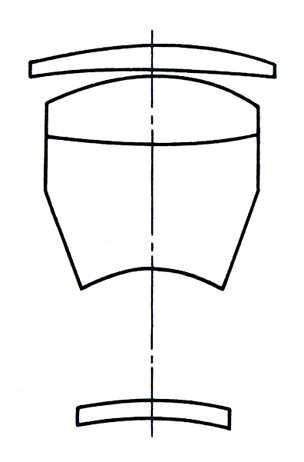
</strong>A new patent showing two lenses, the 135 f/2.8 and 180 f/3.5 has appeared. The interesting part of these patents is something called a apodization filter on the lenses. This improves the bokeh performance of the lenses.</p>
<div id="attachment_10635" class="wp-caption alignnone" style="width: 422px"><a href="http://www.canonrumors.com/wp-content/uploads/2012/07/135apo.png"><img class="size-full wp-image-10635" title="135apo" src="http://www.canonrumors.com/wp-content/uploads/2012/07/135apo.png" alt="" width="412" height="146" /></a><p class="wp-caption-text">EF 135 f/2.8</p></div>
<p>Could either of these lens patents translate into a new 135 f/2L or 180 f/3.5L Macro? Only time will tell.</p>
<p>Read more after the break…</p>
<p><!--more--></p>
<p><strong>Patent Publication No. 2012-128151</strong></p>
<ul>
<li>2012.7.5 Release Date</li>
<li>2010.12.15 filing date</li>
</ul>
<p><strong>Example 1</strong></p>
<ul>
<li>137.2mm – f = 135.0 focal length</li>
<li>Fno 2.83 -. 3.90</li>
<li>9.1 deg half each painting.</li>
<li>Image height 21.60mm</li>
<li>186.7mm – 150.0 full-length lens</li>
<li>BF 47.4 – 80.7mm</li>
<li>Lens Construction 10 elements in 7 groups sheet</li>
<li>1 UD glass sheet</li>
<li>0.25 times the maximum magnification ratio</li>
</ul>
<p><strong>Example 6</strong></p>
<ul>
<li>179.1mm – f = 180.0 focal length</li>
<li>Fno 3.50 -. 4.00</li>
<li>6.9 deg half each painting.</li>
<li>Image height 21.60mm</li>
<li>218.0mm – 199.8 full-length lens</li>
<li>BF 70.0 – 89.8mm</li>
<li>Lens Construction 11 elements in 7 groups sheet</li>
<li>1 UD glass sheet</li>
<li>0.11 times the maximum magnification ratio</li>
</ul>
<p><strong>Appearance of (Bokeh) is important out of focus</strong></p>
<p><strong>Apodization filter</strong></p>
<ul>
<li>The periphery of the filter transmittance is reduced</li>
<li>Added to the luminous flux intensity distribution</li>
<li>Bokeh is beautiful and the outline of the</li>
</ul>
<p><strong>Apodization element variable</strong></p>
<ul>
<li>If the liquid of same refractive index as the shape of the interface, no variation occurs in aberration</li>
<li>To be the same refractive power of the two liquids, the Abbe number is difficult</li>
</ul>
<p><strong>Canon ‘s patented</strong></p>
<ul>
<li>Variable element shape</li>
<li>Voltage is applied, changing the shape of the interface</li>
<li>Obtain the effect of apodization</li>
<li>Varying refractive power, the Abbe number</li>
<li>To reduce the time variable aberrations of shape</li>
<li>By a twist of the material performed, to optimize the absorption coefficient, to suppress the generation of aberration to moderate the curvature of the interface</li>
<li>To reverse the two materials (such as liquid), the amount of chromatic aberration, do the negation</li>
<li>Suppress the two materials (such as liquid), refractive index, the difference between the Abbe number</li>
<li>The entire feeding (with floating)</li>
</ul>
<div>Source: [<a href="http://egami.blog.so-net.ne.jp/2012-07-14" target="_blank">EG</a>]</div>
<div><strong><span style="color: #ff0000;">c</span>r</strong></div>
<p> </p>
 
Look up the Sony 135 STF if you want an idea of what it could do to the bokeh.

I can never read patent speak well. The impression I get is that in this case is, unlike the Sony, the filter can be turned on or off as needed. In the Sony, the filter is fixed and the lens is manual focus only as the fixed filter does not allow the phase information through. If the filter can be turned on and off at will, you can still allow AF.

I don't see this as a 135SF replacement since the effect and usage is more different. At a stretch it could be a 135L replacement, if bokeh quality is the priority, but I think it is different enough for both to exist side by side.
 
Upvote 0
Daniel Flather said:
RLPhoto said:
This is not a 135L replacement but a 135 SF replacement.

The 135L replacement would be to increase the aperture to f1.8 and adds IS w/o losing IQ.

+1

+2... that would make the lens an absolute beauty. The 135 mm usually takes the place of my 70-200mm as my walkabout lens. Love that lens to bits
 
Upvote 0
Andy_Hodapp said:
Really hope this means that a new 135mm f2 L comes out, I have been dying to get one but can't afford it, hopefully they will come out with a new one and I can pick up an old one on ebay on the cheap!

The old one is one of the cheapest L lenses out there. It's so good that I doubt the price will drop much unless the new one is the same price...which I doubt.
 
Upvote 0
Andy_Hodapp said:
Really hope this means that a new 135mm f2 L comes out, I have been dying to get one but can't afford it, hopefully they will come out with a new one and I can pick up an old one on ebay on the cheap!

It's cheap for an L lens, and it has really good IQ - I can easily recognize which photos I took with it because the colors, sharpness, and contrast are much better than those of my other lenses.

Canon would have to really out-do itself to make me upgrade this one.
 
Upvote 0
Andy_Hodapp said:
Really hope this means that a new 135mm f2 L comes out, I have been dying to get one but can't afford it, hopefully they will come out with a new one and I can pick up an old one on ebay on the cheap!
The new one will cost at least double. So you will be lucky if you find the original one used for the price that costs now new... (You only have to see what happened to 24-70 f/2.8L, 300 2.8L IS, 400 2.8L IS, 500 4L IS, 600 4L IS)
 
Upvote 0
The main thrust of the patent is the variable Apodization filter, and it will be expensive.
A different translation of the patent:
Especially the present invention is using the shape variable element which made variable form of the interface which two different media form about an optical system, and it is related with the imaging optical system which makes it possible to control the light volume of the light flux which passes an optical system.
The technique of making the apodization effect variable is disclosed by the Patent document 2. In the Patent document 2, by transmissivity's differing, and arranging two kinds of mutually unmixed liquids in a closed space via the interface of an approximate sphere surface, and controlling the output of impressed electromotive force, liquid interface shape is changed and the optical element which made the apodization effect variable is proposed.

There is a ton of very technical calculations in the patent, and it gives me a feeling that it is not something that will be cost effective to build and sell for a acceptable price.
I really don't expect to see one on the market.
 
Upvote 0
AdamJ said:
I can't see either of these designs ever making production. Look at the elements. The third element from the front in particular is insane.

Large elements didn't stop the Soviets:

Jupiter 250mm f/3.5 for 6x6cm image format, and today you can get them on ebay for $50 or less. (although to be fair, it is rather heavy, if someone broke into my house i'm grabbing this lens as defence instead of a baseball bat).

Also, for further reading, here's the photozone review of Sony's 135 f/2.8 STF lens, which is basically the same idea, has an Apodisation filter/element in it to make creamy bokeh.

But Sony's lens is just a single element, and varying the aperture varies the bokeh and dof the same as any other lens.
This one has a voltage-controlled liquid which changes shape and affects the bokeh? As a tech nerd, an electrical engineer, and a photographer, my pants are already as creamy as the bokeh this would make...
 
Upvote 0
Reading the machine translations, my guess is that the technique involves something like 2 immiscible liquids, one coloured, i.e. semi-opaque, in a gap between 2 glass elements. Within the gap between the 2 outer glass surfaces, the clear liquid is in the middle (the optical axis passes through the middle of the zone of clear liquid), and the opaque liquid is in a ring around the edge, outside the clear liquid.

A force, controlled electronically, perhaps via piezo actuators, moves the glass elements apart or together, changing how the liquids are dispersed in the liquid gap, and thereby changing the "width"/"aperture" of the "iris" formed by the opaque liquid. Also, towards the edge of the opaque liquid, it is thinnest there, so its optical attenuation is lower at that edge, so optically, the attenuation at that edge is not a step function, but rather a function of the shapes of the enclosing movable glass surfaces.

Or not.

I dunno. I'm guessing!
 
Upvote 0
Ellen Schmidtee said:
Why is the aperture's position not marked, as in other patents?

Well spotted.
In the Sony STF, the aperture is close to the APO element.
Maybe there is no aperture, and this 'electronically controlled liquid' is an Apodisation filter/element that can also act as the aperture control?
 
Upvote 0
dr croubie said:
Ellen Schmidtee said:
Why is the aperture's position not marked, as in other patents?

<snip>

Maybe there is no aperture, and this 'electronically controlled liquid' is an Apodisation filter/element that can also act as the aperture control?

Fleetie's reponse made me think the same.

Also, there's very little space between the elements, though I'm hardly in position to rule out the possibility that there's enough space between the 2nd & 3rd elements from the right.
 
Upvote 0
Status
Not open for further replies.