Patent: Lens Tilt Shift Mount Adaptor

Canon Rumors

Who Dey
Canon Rumors Premium
Jul 20, 2010
12,851
5,691
279,596
Canada
www.canonrumors.com
HTML:
Another patent showing a tilt-shift mount adaptor for the EF mount has appeared.</p>
<p>Patent Publication No. 2015-172745 (Google Translated)</p>
<ul>
<li>Published 2015.10.1</li>
<li>Filing date 2014.2.20</li>
<li>Mount adapter with a tilt</li>
<li>Tilt and shift</li>
<li>Lens of long flange back</li>
<li>Short flange back of the body</li>
<li>Wide image circle lens</li>
<li>Narrow of the image circle body</li>
</ul>
<p>Another <a href="http://www.canonrumors.com/patent-canon-tilt-shift-adaptor-for-all-ef-lenses/" target="_blank">patent showing a tilt-shift adaptor</a> for EF lenses appeared back in August.</p>
 
Would this work for a FF EF lens on a FF mirrorless body or would the sensor have to be smaller, perhaps APS-C sensor in an M-mount body? The current TS lenses only provide good images when tilted and/or shifted because their optics' output image size is much larger than the sensor/film size in the camera.

Update: Added "when tilted and/or shifted"
 
Upvote 0
Bob Howland said:
Would this work for a FF EF lens on a FF mirrorless body or would the sensor have to be smaller, perhaps APS-C sensor in an M-mount body? The current TS lenses only provide good images when tilted and/or shifted because their optics' output image size is much larger than the sensor/film size in the camera.

Update: Added "when tilted and/or shifted"

Wouldn't the increased distance to the sensor "automatically" cater for a larger image circle? At least for wide angle lenses...
 
Upvote 0
Most probably a tilt-shift-adaptor for the EOS M and EF lenses ...

If that thing is fully motorized (what can be seen from another patent which might have some connections to this one) I see DPAF as a condition for it's effective use: Define two AF fields which define the "from" and the "to" of the sharpness requirements and the lens is tilted this way. EF-S lenses could do the tilt effectively because the image circle isn't affected for moderate tilts (optical axis of the lens goes through the sensor center).

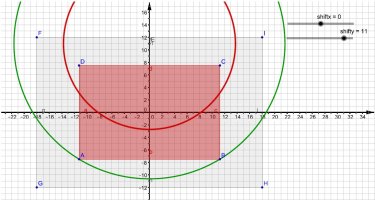
For shifting some EF lens is the minimum requirement depending on the amount of shifting. But a smaller sensor will be good for sth like 11 mm vertical shifting in portrait mode and 9 mm vertical shifting in landscape orientation (modeled it into geogebra). See attached pic: gray rectangle: FF sensor area, red rectangle: APS-C sensor area (22.5 x 15 mm), red circle: APS-C lens image circle, green circle: FF lens image circle (EDIT: generated with the great geogebra math visualization tool!)
 

Attachments

  • shift_EF_EF-S_adapter.jpg
    shift_EF_EF-S_adapter.jpg
    123.7 KB · Views: 218
Upvote 0
I imagine this would have to be something like a 1.4xTC in that it would increase the focal length which would also then change the aperture. I am assuming this additional focal length gives the larger image circle needed for a TSE lens. What seems odd to me is that it seems like special lenses are needed.
But, if this comes to market, within reason....I would buy this so fast.
 
Upvote 0
I think there will be two coming to market:
One will accept EF lenses and attach to EF-M cameras,
and the other will accept EF lenses and attach to an
upcoming full frame mirrorless by Canon.

In both cases they will not have converter functions,
they simply make use of the smaller flange distance
a mirrorless can sport.
 
Upvote 0
Quackator said:
I think there will be two coming to market:
One will accept EF lenses and attach to EF-M cameras,
and the other will accept EF lenses and attach to an
upcoming full frame mirrorless
by Canon.

In both cases they will not have converter functions,
they simply make use of the smaller flange distance
a mirrorless can sport.

That doesn't explain how the image circle is increased, which it would need to be. The image circle is measured at the flange distance, the distance from the sensor to the rear edge of the lenses mount, this remains constant for the EF lens (42mm) so the image circle remains the same and not able to cover a ff sensor when shifted.
 
Upvote 0
Couldn't such an adaptor be detected by the host camera, and then use smart cropping as required...

That way you could have a 135 format sensor mirrorless (if you wanted such a thing) giving you a nice large sensor for straight photography with your ef (or adapted ef) lenses, , but when you start shifting a crop could be introduced relative to the shift.. in that if you shift 1mm you are going to need to use less cropping than if you use 9mm?

A progressive (perhaps even suggested in exif / meta) crop, rather than a hard jump between 135 and aps-c?
Have the option for a full raw for more advanced users with a progressively cropped jpeg for less specialist users?

The challenge, as with present TS-e lenses is keeping up a free 360 degree rotation and maintaining electrical contact for af and for the additional issue of mounted / adapted lenses aperture control. Could a rotation lock be set in at 359 degrees to avoud the twisting of ribbons etc? Or make use of blurtooth or wifi or similar so that the mounted lens is controlled wirelessly?
 
Upvote 0
Tinky said:
Couldn't such an adaptor be detected by the host camera, and then use smart cropping as required...

That way you could have a 135 format sensor mirrorless (if you wanted such a thing) giving you a nice large sensor for straight photography with your ef (or adapted ef) lenses, , but when you start shifting a crop could be introduced relative to the shift.. in that if you shift 1mm you are going to need to use less cropping than if you use 9mm?

A progressive (perhaps even suggested in exif / meta) crop, rather than a hard jump between 135 and aps-c?
Have the option for a full raw for more advanced users with a progressively cropped jpeg for less specialist users?

The challenge, as with present TS-e lenses is keeping up a free 360 degree rotation and maintaining electrical contact for af and for the additional issue of mounted / adapted lenses aperture control. Could a rotation lock be set in at 359 degrees to avoud the twisting of ribbons etc? Or make use of blurtooth or wifi or similar so that the mounted lens is controlled wirelessly?

That is exactly the same thing as cropping in post, no need for a fancy shifting adapter to do that.
 
Upvote 0
romanr74 said:
Wouldn't the increased distance to the sensor "automatically" cater for a larger image circle? At least for wide angle lenses...

The sensor-lens distance is defined by the focal distance, no matter if it is an slr or an adapted mirrorless the lens picture plane is put on.
Of course the shift wouldn't work with tight image circle, but tilt could work, if the shift can compensate that the lens is not rotating around the nodal point.
 
Upvote 0
privatebydesign said:
That doesn't explain how the image circle is increased,
which it would need to be.

The image circle will limit the max amount of tilt and/or shift, of course.
However, many EF lenses have more image circle than necessary when
not shifting/tilting, and of course cropping off sensor is a viable way as well.

The pot of gold is that Canon will make use of the room they win with
the shorter flange distance of a mirrorless system. Wonderful. I'll buy one.
 
Upvote 0
privatebydesign said:
Tinky said:
That way you could have a 135 format sensor mirrorless (if you wanted such a thing) giving you a nice large sensor for straight photography with your ef (or adapted ef) lenses, , but when you start shifting a crop could be introduced relative to the shift.. in that if you shift 1mm you are going to need to use less cropping than if you use 9mm?

That is exactly the same thing as cropping in post, no need for a fancy shifting adapter to do that.

No. It is not.

Either you don't understand ts lenses or you have misread my post.

I am not talking about simply cropping. I am talking about shifting and cropping.

If you crop within the same image projection it is a basic crop.

If you shift the image projection (by shifting the lens) you are projecting a different image, and cropping that.

Do you see the difference? Do you understand the difference?

(I can use fancy colours too you know!)

An Xmm optical shift of the lens does not equate directly to an Xmm shift in the borders of the field of view, (unless, say, you are using a life size macro lens)

I concede that my idea is a little bit far-fetched.. but it would avoid an automatic 'hard' crop, which for some, might also be a little far fetched.

The issue it seeks to solve is that the projected image circle of a given EF lens is going to be less usable at the borders of the circle, but it's not always going to be 1.6x less usable, and certainly not at minor shifts.

Of course, we could take your advice, and just do everything in photoshop, haha!

Seriously though, I can't help but think the folk who need TS lenses would just buy the tool for the job, and occassional users or one-offs would be better just to hire. We are assuming an EF-m mount, but this could be an industrial application device to go with the industrial high-iso cameras and high MP chips we have seen recently (remember that the high MP chip was APS-H... would give some scope for shift)

I've toyed with the m42/EF-m TS mount made by Kippon, but even it is expensive (for an unknown quantity) and then you've the cost of tracking down WA and UWA optics in good conditions, but often putting up with old nasty shaped oily diaphragms, scratched or mouldy coatings and optics etc...

 
Upvote 0
Quackator said:
privatebydesign said:
That doesn't explain how the image circle is increased,
which it would need to be.

The image circle will limit the max amount of tilt and/or shift, of course.
However, many EF lenses have more image circle than necessary when
not shifting/tilting, and of course cropping off sensor is a viable way as well.

The pot of gold is that Canon will make use of the room they win with
the shorter flange distance of a mirrorless system. Wonderful. I'll buy one.

Name me one that isn't already a T/S lens.
 
Upvote 0
privatebydesign said:
Quackator said:
privatebydesign said:
That doesn't explain how the image circle is increased,
which it would need to be.

The image circle will limit the max amount of tilt and/or shift, of course.
However, many EF lenses have more image circle than necessary when
not shifting/tilting, and of course cropping off sensor is a viable way as well.

The pot of gold is that Canon will make use of the room they win with
the shorter flange distance of a mirrorless system. Wonderful. I'll buy one.

Name me one that isn't already a T/S lens.

Any EF zoom even just slightly away from it's widest angle setting...
 
Upvote 0
cayenne said:
I see all the posts here seem to be talking about mirrorless cameras.

Will this T/S adapter not work on FF cameras with EF lenses?

TIA,

cayenne

Not without an optical element to maintain infinity focus. There is no room between an EF lens and an EF mount without affecting the flange distance. This is why ebay is full of cheap shift and tilt adaptors that only work for macro images, they are basically extension tubes with movements.

This design seems to make use of the space that would otherwise be taken up with the EF-m to EF adaptor, and where the mirrorbox would typically be on 135 format DSLRs
 
Upvote 0
Tinky said:
privatebydesign said:
Quackator said:
privatebydesign said:
That doesn't explain how the image circle is increased,
which it would need to be.

The image circle will limit the max amount of tilt and/or shift, of course.
However, many EF lenses have more image circle than necessary when
not shifting/tilting, and of course cropping off sensor is a viable way as well.

The pot of gold is that Canon will make use of the room they win with
the shorter flange distance of a mirrorless system. Wonderful. I'll buy one.

Name me one that isn't already a T/S lens.

Any EF zoom even just slightly away from it's widest angle setting...
I'll reply to your other post when I have more time, but as for this one, what about all the baffles and the fact that the rear element retracts on zoom on some lenses? Making a bigger image circle is difficult and expensive and is a key original design element.

While I am busy you might want to read up on T/S lenses because I am fairly sure you are the one not understanding how the shift aspect works.
 
Upvote 0
Read up on them many years ago. Used them for many years as well. I think I've got a handle on them thanks.

I sincerely think you have misunderstood my earlier post. I mean that earnestly without conceit. It may be semantics, it may be phrasing, I'm prepared to accept that maybe I could be clearer at time, but the nub is you are arguing against something I didn't say, and theres not enough hours in the day.

Maybe, as you allude to superior knowlegde, you could tell us the EF lenses who's projected image circle diameter never ever exceeds the diagonal of a given EOS sensor size. I don't care that much, it wasn't my point that I'm arguing, just that I don't think you can talk in absolutes on this one.
 
Upvote 0