

Yeah, I was wondering if he was shooting from a shelter. If not, definitely testing the weather sealing.This guy takes “RAIN “ forest to another level. Thats as bad as it gets environment with not just the rain but the humidity.
Upvote
0
Yeah, I was wondering if he was shooting from a shelter. If not, definitely testing the weather sealing.This guy takes “RAIN “ forest to another level. Thats as bad as it gets environment with not just the rain but the humidity.
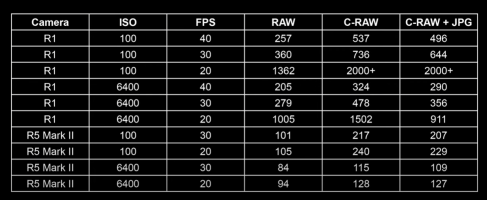

Not sure how/when those extra images will come in handy, but I’m glad I got a few CFe 4.0 cards for my R1.BYU photo is at it again. This is the most detailed assessment of the R1 and R5 II buffers I have seen. Here is a screenshot.
View attachment 221552
He also looked at CFe 2.0 vs 4.0. He did not observe in increase in buffer, but did observe a slight increase in the rate at which the buffer was cleared once full with 4.0 cards. He captured 80 extra images with CFe 4.0 cards in his test.
 youtu.be
He hasn’t posted much yet but Jared Polin often shares RAWs. He just took the R1 to Africa, so hopefully some good ones.I like the comparison but I would prefer to get some RAW samples to process and compare myself.

"I don't care if you have 45MP if all that extra resolution is obliterated by noise." He sums it up succinctly for low-light, high-ISO situations.I like the comparison but I would prefer to get some RAW samples to process and compare myself.
Better performance at high ISO is one of those marketing brags. But I am seeing good data out of the R1. I hadn’t yet completed a specific side by side comparison against my R5 as Ron did against the R5 II. But I am thinking one of the strengths of the R1 will be high ISO."I don't care if you have 45MP if all that extra resolution is obliterated by noise." He sums it up succinctly for low-light, high-ISO situations.
I'll take as much improvement there as I can get. ISOs from my R3 shots, where I go up to 25600:But I am thinking one of the strengths of the R1 will be high ISO.
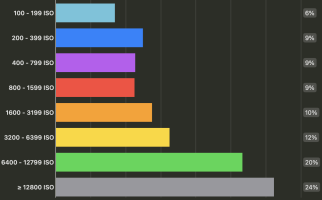
curious as to how you generated that neuro.I'll take as much improvement there as I can get. ISOs from my R3 shots, where I go up to 25600:
View attachment 221571
Canon setting 51200 as the top of the default Auto ISO range, up from 25600 on the R3, suggests there will be some improvement at the high end.

I suspect https://bristolbaycodefactory.com/photoStatistica.htmlcurious as to how you generated that neuro.
curious as to how you generated that neuro.
Correct, downloaded from the Mac App Store.
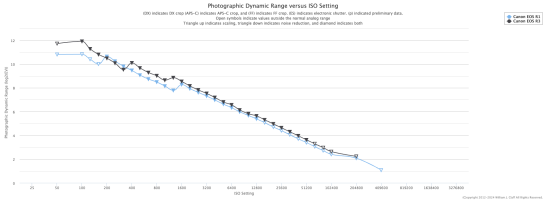
At equivalent ISOs, it is about even to 1/3 stop better than the Sony A93 — depending on whether it is in the 2nd step of gain. The A1 is in the middle between the two cameras at higher ISO ranges.R1 data on photonstophotos
Apparently base ISO of 200. Dynamic range from ISO200 onward basically the same as the R3, but R3 has overall more DR at ISO100 (especially in mech shutter)
View attachment 221574
If accurate, sounds like Canon had to make some concessions to get such a fast sensor readout.
Sacrificing DR for speed would be understandable, but with the R1, it's not only that. Base ISO 200 for a flagship is... unexpected.I guess in the end if you want a very fast read out sensor (whether stacked or GS) there is a penalty to be paid in terms of DR, and the faster the readout the more penalty you have to pay.
If it’s actually 200, only a relative handful of people will know (and probably not all of them will care).Sacrificing DR for speed would be understandable, but with the R1, it's not only that. Base ISO 200 for a flagship is... unexpected.
The Sony A9III has a base ISO of 250, so not exactly unprecedented.Sacrificing DR for speed would be understandable, but with the R1, it's not only that. Base ISO 200 for a flagship is... unexpected.
I think the more interesting thing from his data is that it seems the difference in DR between the A1, A9III, and R1 between ISO 800 and 12800 shows a 1/3 stop gap between the best camera and the worst. Everyone is probably running into similar limitations with stacked sensors here, so sensor advantages between brands are pretty minimal right now.If it’s actually 200, only a relative handful of people will know (and probably not all of them will care).
The Canon specs state the native ISO range is 100-102400. Bill Claff shows ISO 100 as a pull from 200. He also indicates NR or other ‘cooking’ based on the energy spectrum, but that really looks no different from the Sony a1…except he plots that with circles instead of triangles on the PDR plot, indicating no NR. Let’s just say I’m not convinced the R1 base ISO is 200.
Indeed, and Sony lists the native ISO range of the a9 III as 250-25600. As I pointed out, Canon lists 100-102400 for the R1. So either Canon is lying, or Bill Claff is incorrect. Thus my skepticism of his results.The Sony A9III has a base ISO of 250, so not exactly unprecedented.


