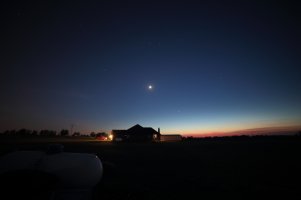
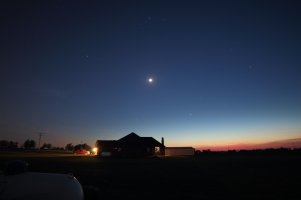
Something to remember when you hear people talking about star trails forming after so many seconds at a focal length...you really may not want to trust them, since they likely don't know what they're talking about. It really depends on where in the sky you are shooting. You'll get more star trails shooting perpendicular to Polaris at 17mm than you will shooting directly towards or away from Polaris at 24mm. Don't put a figure in your head, because you'll be disappointed when it turns out it's not necessarily true. Even at 14mm, which is really wide, you can start to see the stars beginning to trail if you're shooting east or west at 30 seconds.
That being said, I believe the 14mm is amazing for night photography. It's a sharp lens on it's own. It's relatively fast. I like the 14mm over 24mm focal length for night photography because I can include more stars in the scene while still having an interesting foreground. You can, of course, do night photography at 24mm, and I've done it, but I personally just like to be able to include more of the sky than 24mm allows. It really depends on how you shoot. Besides night photography, the 14mm is stellar (roflmao, get it?) during the day too. It's true that it's not easy to put a filter system on it, but I've found little use to do so. There have been a few cases where I would have liked to use an ND filter, but in the end, I just whipped out my 16-35mm. I've also, with some success, although a lot more post processing, placed my already existant 77mm ND filter in front of the 14mm in several different spots to cover the image, and gotten a series of images I can blend together which is in essence one shot from the 14mm. This doesn't work with every scene, obviously, but it is one of those last-resort options that you should be aware of.