privatebydesign said:Pit123 said:jrista said:Pit123 said:Nice. I see you change your mind. You now admit to not have use a 2.6x tc to compensate, as you said before,, but a 1.6x.jrista said:ifp said:Pit123 said:Have you the Tammy? Can you contribute for anything here at all?
You said it. You don't own it, and you've rejected the postings that are contrary to your opinions from owners of the lens.
jrista said:In the case of the 1D X, you have 6.95µm pixels, or an area of 6.95^2µm: 48.3µm^2. The 7D has 4.3µm pixels, or an area of 4.3^2µm: 18.49µm^2. Again, because were working in two dimensions here, it's not a linear scale, you can fit 48.3/18.5 7D pixels into one 1D X pixel. That comes out to 2.61x 7D pixels per 1D X pixel. You would need a 2.6x TC in in order to completely normalize the crop difference between the 7D and 1D X, all else being equal.
Wouldn't that be a sqrt(2.6)x teleconverter? Every teleconverter I've seen lists their focal length multiplier, meaning a 2x teleconverter puts 4x the pixels on a target.
You are correct. That should actually read:
"That comes out to 2.61x 7D pixels per 1D X pixel. You would need a 1.6x TC in in order to completely normalize the crop difference between the 7D and 1D X, all else being equal."
If I have a 1dx and want the same pixels on the subject as the 7d, I have two choices. Put a 1,6x TC on the lens or upscale the image by 1.6x. When talk about upscaling you always talk about upscaling in both direction. Everything is upscaled 1.6x. Ok? Same with lenses. If I want a 400mm to act as a 600mm I put a 1.5x TC on it. Normally an upscaled image will not be as good as putting a tc on, or having a longer FL. But sometimes it does. And that not a claim for me that I can upscale the C400mm to give same IQ as the soft tammy @6.3. Its a question and a guess..Thats it!.
And now I'm out.
Thanks!
First off, my bad. It was a typo. Not a change of mind. But still, my bad.
Second, your still not understanding. Things are magnified 2.61x. The LENS FOCAL LENGTH, and ONLY the lens focal length, is scaled by 1.6! It's the same deal in the end. If you square 1.615 (the actual focal ratio), what do you get? 2.61! The 7D resolves 2.61x more detail than the 1D X. To compensate for that difference, you need a focal length 1.6x as long. A 646mm lens results in 2.61x more 1D X pixels falling on the same subject area as a 400mm lens on the 7D. Don't get too caught up on the simple and scalar ratio of focal lengths...that doesn't tell you enough about the actual differences involved.
The difference in focal length is linear (1.615x), the difference in magnification is squared (2.61x). The value that really matters, from a detail perspective, is the magnification factor. If you use a 400mm lens on both a 1D X and a 7D, the 7D will resolve 2.61x MORE DETAIL. It sounds like a lot. It really IS a lot!
If you still don't believe me, maybe you will believe a well-known professional in the field of bird photography:
Size Does Matter; The Power of the Square of the Focal Length
[quote author=Art Morris]"In the original “The Art of Bird Photography” I wrote something to this effect: the size of the bird in the frame is not a factor of the focal length but rather a factor of the square of the focal length. In other words, if you go from a 400mm lens to an 800 mm lens, the bird will be four times bigger in the frame (not twice as big). "
The focal ratio between 800mm and 400mm is 2x, but the subject is enlarged in the frame by 4x! Subject size in the frame is related to the SQUARE of the Focal Ratio, it is not a linear relationship. You can clearly see that in Art's animated image of the bird...one was taken at 700mm, the other at 1120mm. The square of that ratio, 1120/700^2 or 1.6^2 is, yup, you've got it, 2.6x! The animated bird jumped in size in the frame by 2.6x, not by 1.6x. You can even download the animated image and do some area measurements yourself if you want. Draw a box around the bird when it's smaller, draw a box around the bird when it's larger, and compare the areas.
WOW! If you really believe that double the focal length will enlarge the subject by 4x, then I have lost all respect for your skills! Sorry man!
It will enlarge the subject by 2x of course, nothing more, nothing less. Do you even own a camera? Or a lens?
Of course it does, the subject becomes twice as wide and twice as tall, that makes it cover four times the area it did before. You are forgetting you are going from a one dimensional measurement to a two dimensional representation of the subject. If it was a three dimensional model it would be doubled again for depth.
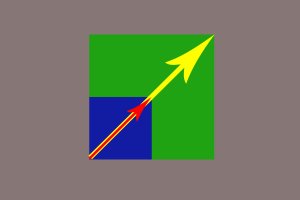
Here is a diagram, the image is a 3 x 2 format image, the blue square a subject, the green square is what happens if you either double the focal length or halve your subject distance, both edges are double the blue squares edges in length, the green square covers four times the area the blue square does.
Time to eat some humble pie

[/quote]
LOL
Lets say the subject is an arrow that goes from lower left corner to upper right corner on the blue area. How much bigger will the subject (arrow) be on the green area? Tell me!!! Obvious you cant. Exactly twice the length. So that gives me 2x magnification. Not?
What is wrong with you guys? Really!
Upvote
0