Pit123 said:
jrista said:
Well, you seem to sort of get it now. To determine the difference in pixels per area (magnification factor for sensors) between the 1D X and the 7D, you need to factor in pixel pitch, rather than crop factor. Crop factor is a constant based on total area of each sensor. Since FF and APS-C always have the same total areas regardless of pixel pitch, using crop factor is insufficient to determine the REAL magnification difference that smaller pixels can offer.
In the case of the 1D X, you have 6.95µm pixels, or an area of 6.95^2µm: 48.3µm^2. The 7D has 4.3µm pixels, or an area of 4.3^2µm: 18.49µm^2. Again, because were working in two dimensions here, it's not a linear scale, you can fit 48.3/18.5 7D pixels into one 1D X pixel. That comes out to 2.61x 7D pixels per 1D X pixel. You would need a 2.6x TC in in order to completely normalize the crop difference between the 7D and 1D X, all else being equal.
I mean, seriously...this isn't complicated stuff. It's rather basic geometry: Two dimensions. All pixels have two dimensions. You can't compute a simple scalar linear difference between pixel pitch (a ONE dimensional measure) or focal lengths (again, a ONE dimensional measure) and assume "that's it!". Images are resolved in two dimensions, across the horizontal and vertical height of the sensor. Regardless of whether you reduce FoV or reduce pixel size, its all still in two dimensions. So, you have to square whatever scalar measure your working with in order to determine the real two-dimensional difference.
Well, its obvious too complicated for you!
1dx=FF =18 MP, 7D=1.6 crop= 18MB
So the only and simple difference between them is the 1,6x crop factor. In this case you don’t even need to calculate the pixel pitch on each.( Because they have the same mp) Hence if you put a 1.6x TC on the 1dx you will have the same amount of pixels on the subject as the 7D. You claim 2.6x TC. That means you are so way off. Sorry man!
Another example: 7D vs 5DIII
According to your calculation you have to put a 2.1x TC on the 5d3 to compensate for the extra pixel density on 7D.
That is also far off. I think many people can confirm that the correct number is a 1.45x TC.
Come on guys! If you don't have the balls and confirm this, I am lost!
Just compare 100% crops from the 5d3 with a lens + 1,4 tc and a 7d with same lens. They will show almost the exact same magnification. Please confirm (if you have the balls), so I once and for all can say that his magnification “math” is wrong!
If I have the balls, eh? LOL
Math is math. It doesn't lie.
Now, you've changed things up a bit here, by throwing the 5D III into the mix. You've also switched from a 2x TC to a 1.4x TC!! The 5D III pixel pitch is 6.25µm, vs. the 1D X 6.95µm. That means the magnification difference between the 5D III and 7D will be different than the magnification difference between the 1D X and 7D. So, what do you want...a test with the 1D X and a 2x TC or a test with the 5D III and a 1.4x TC? You can't keep mixing and matching things.
In the case of the 5D III. The scaling difference is 6.25^2/4.3^2, or 2.11. A 5D III with a 1.4x TC and a 7D, with the same lens, will produce roughly identical results. The 5D III technically needs a 1.5x TC, however in reality the 7D has a slightly strong AA filter. So in the end we can call it even. A cropped 5D III w/ 1.5x TC and a 7D using the same lens to image the same subject from the same distance will resolve the same amount of detail per pixel when viewed at 100%. That's what the math says. This isn't a crop factor thing. Framing doesn't matter a wit. You could assume both sensors are infinitely large if you wanted to, because "crop factor" has nothing to do with resolved detail at 100%. All that matters is the difference in pixel size.
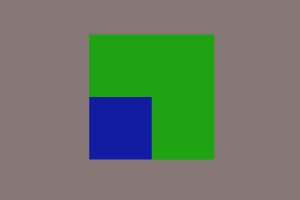
Here is a picture that demonstrates this concept in two dimensions, with the math broken down on a per-area basis for 7D vs. 5D III pixels:
Were not just talking pure math anymore. Here it is spelled out in literal geometric terms that are TO SCALE. The orange represents a 7D pixel (it is exactly 430x430 pixels in size). The blue represents a 5D III pixel (it is exactly 625x625 pixels in size). I've drawn two orange lines extending out from the lower right corner of the 7D pixel to show where the neighboring 7D pixels would lie on the actual sensor die. The area of those three blue boxes, now, represents the portions of EXTRA 7D pixels that will be resolving detail at a finer level than the single 5D III pixel. The total area of those three blue boxes is 20.5725µm. The total area of one single 7D pixel is 18.49µm. That means a total of 1.113 more 7D pixels
in addition to the full pixel shown in orange, are being used to resolve detail that falls into the area of a SINGLE pixel in the 5D III. If you add the 1 pixel for the orange, and the 1.113 additional pixels, you have 2.113. The 7D resolves 2.113x more detail than than the 5D III in reach-limited scenarios.
This 2.113x pixels is basically the same thing as increased lens magnification. You would need a lens that produces a similar magnification difference. That comes down to
sqrt(pixelRatio) * focalLength. If you have a 400mm lens on the 7D, you would need a 581mm focal length on the 5D III (
sqrt(2.113) * 400). Break that down to actual lenses, you need a 600mm lens on a 5D III to compare to a 400mm lens on a 7D. In the case of the 1D X, you need a sqrt(2.61) * 400, or 646mm lens to compare to a 400mm lens on a 7D.
In full color, mathematics and geometry, all spelled out for you. This isn't some kind of joke. It isn't a misunderstanding. This isn't just pure abstract theory. This is how it works. If you really need me to, I can produce a diagram showing the geometry for different focal lengths, and prove why a 600mm lens enlarges subjects by 2.25x vs. a 400mm lens. It's all the same general stuff.
Just to make absolutely certain we are on exactly the same page, this is the case when two different cameras are used with the same lens,
at the same distance. That is not the same as shooting the same subject with the same lens and different cameras with
the same framing. In the same framing case, the only thing that matters is total pixels. The 5D III will win hands down over the 7D every single time because it has more pixels. In the case of the 1D X vs. 7D, there wouldn't be much difference, with the exception of the 7D's strong AA filter which will cause it to be softer.