Shallow Review: Tamron 150-600 f/5-6.3 VC vs 300mm/2.8 II +2xTC III

Both the 100-400 and the Tammy are much worse on the 7D than on the 5DIII, as shown by DxO. I was surprised how much better my 100-400 became when I upgraded to the 5DIII. It's the old story - crop sensors need sharp lenses. If the Tammy is considered as "confirmed soft" at 600mm on the 7D, then I am afraid the 100-400 is also "confirmed soft" as well.

The Tammy wins on the 5DIII

see: http://www.dxomark.com/Reviews/Tamron-150-600mm-f5-6.3-Di-VC-USD-Canon-mount-lens-review-New-contender/Tamron-150-600mm-f5-6.3-Di-VC-USD-vs.-Sigma-150-500mm-f5-6.3-APO-DG-OS-HSM-vs.-Canon-EF100-400mm-f4.5-5.6L-IS-mounted-Canon-EOS-5D-Mk-III-Good-overall-IQ

On the 7D it is much closer.

see: http://www.dxomark.com/Reviews/Tamron-150-600mm-f5-6.3-Di-VC-USD-Canon-mount-lens-review-New-contender/Tamron-150-600mm-f5-6.3-Di-VC-USD-vs.-Sigma-150-500mm-f5-6.3-APO-DG-OS-HSM-vs.-Canon-EF100-400mm-f4.5-5.6L-IS-mounted-Canon-EOS-7D

"The same three lenses tested on the Canon EOS 7D reveal similarly that the Tamron is the better performer overall."
 
Upvote 0
Jon
I see you have a 5DIII or 7DII on your buy list to replace your 7D. Your 600mm is so sharp that it doesn't take the crop hit, but the 100-400 does. I forked out on the 300mm f/2.8 because my 100-400 wasn't sharp enough on the 7D, and there was a huge leap in resolution with the 300/2.8 + 2xTC. Have you tried the 5DIII? It won't be as good for your astro-photography as the 7D but for nature photography its better IQ with colour shading and noise handling compensates for the loss of reach. I'll be using the Tammy with the 5DIII and not the 70D.
 
Upvote 0
jrista said:
Pit123 said:
I give you two examples: one from short distance (10meters), the other 948 meters from subject (according Google maps). Download and show in full size 1920x1080.
Sorry, but there is absolutely NO way that either one of those sample credit card photos was taken from 3000 feet away. That is the better part of a mile. Neither of those lenses has that kind of resolving power. Not even REMOTELY close to that kind of resolving power. LOL I don't know what your smoking, but you need to double check your facts. Like you need to double-check your understanding of what magnification is and why it matters.
Three thousand feet...and it somehow resolved just as good as something photographed from about 33 feet away? HAH! Bullsh*t!! Bull. Sh*t.

Can you read at all? :

Pit123 said:
I give you two examples: one from short distance (10meters), the other 948 meters from subject (according Google maps). Download and show in full size 1920x1080.

Obvious not, so why do I bother…

jrista said:
You are comparing different results taken under entirely different circumstances. Scientifically, that is invalid. You can only compare results taken under the same circumstances. You trying to compare your credit card samples to AlanF's chart samples is invalid. You can't make any kind of reasonable comparison between those two disparate data sets.
You can only legitimately compare YOUR OWN two samples, or Alan's TWO samples, but you cannot cross-compare them. Using only your two samples, you yourself have proved that the Tamron is markedly sharper than the upsampled Canon 100-400mm. MARKEDLY. I mean, plain as day, I could probably cut my fingers on the razor-sharp text in the Tamron sample, and sooth my bleeding fingers on the Canon sample, kind of difference here. If you can't see that, then you might want to get your eyes checked, because you are either exceptionally nearsighted, or particularly farsighted.

If you want to compare the Tamron with the 300/2.8 + 2x, then you need to do that test yourself with the exact same credit card, under the same lighting conditions, with the card at the same angle, imaging the same region of the card, so the results can all be DIRECTLY compared. Since you have not done that, then we really can't know what the relative difference between all three lenses is. We don't have a single complete data set that covers all three lenses tested under identical circumstances.
We had one common setup: the canon300mm + 2xtc combo.
Alan invited me to test the same combo against the upscaled 100-400mm to show how it compared to the 300mm combo.
Just for an indication to see if they are far apart or not. Nothing more.
And have I concluded anywhere that the upscaled 100-400mm gives more details than the Tammy?
Have you the Tammy? Can you contribute for anything here at all?


Maybe you can tell me how much more magnification 7d will give than your 1dx on a subject shooting from same distance with same lens mm?
According to your theory, the 7d has 2.56x more magnification than 1dx.
Wow! So you need a 2,56x tc do compensate for the lack of reach? Do you?

Pit123 said:
And now back original question: Is it possible that a sharp 100-400mm centercrop upscaled by 1.5x can match a confirmed soft Tamron @ 600mmf63. Im quite sure its a closer match than many people here seems to believe.
If anyone read this as bashing the Tamron, then they have a problem I think. ;)
jrista said:
First fact your getting wrong: The Tamron is NOT "confirmed soft". It is tested (not sure why, I need to check with Alan about those results) "softer than" a 300mm f/2.8 L II PRIME. But that does not mean it is confirmed soft in general. Relative vs. absolute. Important distinction there. RELATIVELY SPEAKING, the Tamron is softer than the 300/2.8. RELATIVELY SPEAKING, according to your own results (!!!) the Tamron is sharper than the 100-400. Your own samples of the credit card PROVE that the Tamron is relatively sharper than the Canon.

Again, you have problem withe the Reading: The Tammy is confirmed soft @ 600mmf6.3. Also compared to any L tele from Canon including 100-400mm. Especial on a high pixel sensor. Even the cheap 55-250mm is much sharper than the Tammy at the longest end. From edge to edge.

Do you deny that? And please read again before you try to prove otherwise: Soft @600mm wide open.
Maybe not so soft that a sharp 100-400@400mmf56 center crop can be upscaled and show same details. But I GUESS its not far off.
I would love to replace my 100-400mm with a Tammy if someone could show me that it gives me valuable more details on the subject shooting at f6.3.
 
Upvote 0
AlanF said:
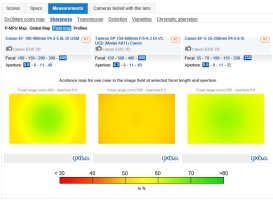
Tamron soft Pit123? That is unfounded, unsubstantiated drivel. Here are the acutance tests done by DxO. The first is the Tamron at 400mm f/5.6 vs the 100-400 at 400 f/5.6. The Tamron is just as sharp in the centre of the field and its sharpness extends more to the edges. This is not just a one-off result, lensrental measurements are in exact agreement.

The second (bottom) is the Tamron at 600mm f/8 vs the 100-400 at 400 f/5.6. The Tamron is as sharp at 600mm as the Canon is at 400 at the centre, and it is much better at the edges.

SOFT WIDE OPEN AT 600mm. Do I need to repeat myself 100 times!!
 

Attachments

  • SOFT.jpg
    SOFT.jpg
    209.9 KB · Views: 1,218
Upvote 0
Pit, is there any supernatural being that ordered you to hijack this thread and divulge endless nonsense? You've been given both theoretical and mathematical explanations, what are you after at this point? What do you want to hear? I, for one, would like to go back OT.
 
Upvote 0
AlanF said:
Jon
I see you have a 5DIII or 7DII on your buy list to replace your 7D. Your 600mm is so sharp that it doesn't take the crop hit, but the 100-400 does. I forked out on the 300mm f/2.8 because my 100-400 wasn't sharp enough on the 7D, and there was a huge leap in resolution with the 300/2.8 + 2xTC. Have you tried the 5DIII? It won't be as good for your astro-photography as the 7D but for nature photography its better IQ with colour shading and noise handling compensates for the loss of reach. I'll be using the Tammy with the 5DIII and not the 70D.

I have indeed tried the 5D III, a local wildlife photographer was kind enough to let me try his out on a few occasions when we randomly met up out in the wild. I've been very impressed with it.

I am pretty doubtful I'll be buying the 7D II, even if it hits the streets with every feature I expect. I do landscapes as well, and I also do astrophotography. The 5D III is better for both of the latter, and as you have said, it isn't quite as demanding on the optics. I am still very interested in seeing how the 7D II pans out, and I don't doubt it would kick the crap out of the 5D III in resolving power...but if it is anything like the 7D, it will definitely require more meticulous technique in order to extract the same kind of IQ.

Someone also brought up one aspect of the 7D that I have noticed and very much don't like: It has a "waxy" sheen to it's images. I honestly don't know why...AA filter? Weaker CFA? Both? Whatever it is, it is a particularly frustrating aspect of the 7D, especially at higher ISO settings. I am a little bummed to be dropping back to 6fps, but the 5D III has so much more dynamic range at higher ISO settings that there really isn't any contest. Even if the 7D II lands with 28ke- to 30ke- FWC, that is still less than HALF the FWC of the 5D III. I find myself working at ISO 1600 and up more and more often these days, even with the 600/4 II.

So yeah, I guess I should probably edit my signature and get rid of the 7D II. The 5D III is just a far more versatile, more capable camera. Plus, I can mitigate the reach difference with a 2x TC and f/8 AF if I really need it, so there really isn't any loss in the number of pixels I can put on my subjects.
 
Upvote 0
Pit123 said:
jrista said:
You are comparing different results taken under entirely different circumstances. Scientifically, that is invalid. You can only compare results taken under the same circumstances. You trying to compare your credit card samples to AlanF's chart samples is invalid. You can't make any kind of reasonable comparison between those two disparate data sets.
You can only legitimately compare YOUR OWN two samples, or Alan's TWO samples, but you cannot cross-compare them. Using only your two samples, you yourself have proved that the Tamron is markedly sharper than the upsampled Canon 100-400mm. MARKEDLY. I mean, plain as day, I could probably cut my fingers on the razor-sharp text in the Tamron sample, and sooth my bleeding fingers on the Canon sample, kind of difference here. If you can't see that, then you might want to get your eyes checked, because you are either exceptionally nearsighted, or particularly farsighted.

If you want to compare the Tamron with the 300/2.8 + 2x, then you need to do that test yourself with the exact same credit card, under the same lighting conditions, with the card at the same angle, imaging the same region of the card, so the results can all be DIRECTLY compared. Since you have not done that, then we really can't know what the relative difference between all three lenses is. We don't have a single complete data set that covers all three lenses tested under identical circumstances.
We had one common setup: the canon300mm + 2xtc combo.
Alan invited me to test the same combo against the upscaled 100-400mm to show how it compared to the 300mm combo.
Just for an indication to see if they are far apart or not. Nothing more.
And have I concluded anywhere that the upscaled 100-400mm gives more details than the Tammy?
Have you the Tammy? Can you contribute for anything here at all?


Maybe you can tell me how much more magnification 7d will give than your 1dx on a subject shooting from same distance with same lens mm?
According to your theory, the 7d has 2.56x more magnification than 1dx.
Wow! So you need a 2,56x tc do compensate for the lack of reach? Do you?

Well, you seem to sort of get it now. To determine the difference in pixels per area (magnification factor for sensors) between the 1D X and the 7D, you need to factor in pixel pitch, rather than crop factor. Crop factor is a constant based on total area of each sensor. Since FF and APS-C always have the same total areas regardless of pixel pitch, using crop factor is insufficient to determine the REAL magnification difference that smaller pixels can offer.

In the case of the 1D X, you have 6.95µm pixels, or an area of 6.95^2µm: 48.3µm^2. The 7D has 4.3µm pixels, or an area of 4.3^2µm: 18.49µm^2. Again, because were working in two dimensions here, it's not a linear scale, you can fit 48.3/18.5 7D pixels into one 1D X pixel. That comes out to 2.61x 7D pixels per 1D X pixel. You would need a 2.6x TC in in order to completely normalize the crop difference between the 7D and 1D X, all else being equal.

I mean, seriously...this isn't complicated stuff. It's rather basic geometry: Two dimensions. All pixels have two dimensions. You can't compute a simple scalar linear difference between pixel pitch (a ONE dimensional measure) or focal lengths (again, a ONE dimensional measure) and assume "that's it!". Images are resolved in two dimensions, across the horizontal and vertical height of the sensor. Regardless of whether you reduce FoV or reduce pixel size, its all still in two dimensions. So, you have to square whatever scalar measure your working with in order to determine the real two-dimensional difference.

Pit123 said:
Pit123 said:
And now back original question: Is it possible that a sharp 100-400mm centercrop upscaled by 1.5x can match a confirmed soft Tamron @ 600mmf63. Im quite sure its a closer match than many people here seems to believe.
If anyone read this as bashing the Tamron, then they have a problem I think. ;)
jrista said:
First fact your getting wrong: The Tamron is NOT "confirmed soft". It is tested (not sure why, I need to check with Alan about those results) "softer than" a 300mm f/2.8 L II PRIME. But that does not mean it is confirmed soft in general. Relative vs. absolute. Important distinction there. RELATIVELY SPEAKING, the Tamron is softer than the 300/2.8. RELATIVELY SPEAKING, according to your own results (!!!) the Tamron is sharper than the 100-400. Your own samples of the credit card PROVE that the Tamron is relatively sharper than the Canon.

Again, you have problem withe the Reading: The Tammy is confirmed soft @ 600mmf6.3. Also compared to any L tele from Canon including 100-400mm. Especial on a high pixel sensor. Even the cheap 55-250mm is much sharper than the Tammy at the longest end. From edge to edge.

Do you deny that? And please read again before you try to prove otherwise: Soft @600mm wide open.
Maybe not so soft that a sharp 100-400@400mmf56 center crop can be upscaled and show same details. But I GUESS its not far off.
I would love to replace my 100-400mm with a Tammy if someone could show me that it gives me valuable more details on the subject shooting at f6.3.

You could show yourself. Just rent the lens for a couple days, and compare. It is doubtful that the softness of the Tammy @ 600/6.3 is going to be enough to make it worse than the Canon @ 400/5.6. You just keep ignoring the fact that the Tammy is magnifying the subject so much more. You would have to have a SIGNIFICANT loss in resolving power at f/6.3 in order to completely obliterate that 2.25x greater resolving power.

You should really go look up a few things on optics and lenses. You keep using scalar (one dimensional) differences in lenses to compare them. A longer lens reduces the angular field of view. I assume you do know what area is (width * height). A 400mm lens has a 4.1°x2.73° AoV (relative to a FF 36x24mm sensor frame). A 600mm lens has a 2.73°x1.816° AoV (again, relative to FF frame). If we just take those angles as width and height dimensions, we have 4.1 * 2.73 and 2.73 * 1.816, or 11.193 and 4.958. If we divide 11.193 by 4.958, what do we get? We get 2.25756!! The area of a 600mm lens is 2.26 times SMALLER than the 400mm lens. In other words, the 600mm lens sees a 2.26x smaller region of your subject than the 400mm lens. However, the 600mm lens is projecting that smaller angle of view onto the exact same 36x24mm sensor area. That means its smaller region is being enlarged more...THAT is magnification.

The difference between a 600mm lens and a 400mm lens is a 2.26x magnification factor. The 600mm lens would have to be 2.27x softer in order for it to produce worse results than the upsampled 400mm frame.

Personally, I doubt that the 600mm is that soft at f/6.3. It isn't as sharp as humanly possible at f/6.3, but it would need to be pretty bad in order to be WORSE than an upsampled 400mm lens (which, BTW, is not resolving perfect detail at f/5.6 itself, which means our 600mm lens would have to be 3x worse at least at f/6.3 in order for it to be softer than an upsampled 400mm.)
 
Upvote 0
The difference in length is only 1.5x,but you get more than 1.5x pixels on the subject.If you dont belive others,try to shoot something with 600mm,then from same spot with 300,crop out the same object(card,whatever)and see how much MP the image is.It will be more than 2x.Just tried out,from same spot,at 18mm the object is 0,5MP,at ~36mm(2x) 1,9mp(nearly 4x).Just a 1min "test",but thats what others talking about when saying magnification/pixels on subject.
The Tamron is softer at 600mm,but not that much.If it's that soft,then why don't upscale the Tamron from 400mm(little better than the C100-400)i don't think Tamron made it 600mm just for the number.

I think what worth a look is where the Tamron lose the wide open sharpness between 500-600mm.From lensrental test,its pretty sharp at 500mm(sharper than 50-500 at 400mm)
 
Upvote 0
jrista said:
Well, you seem to sort of get it now. To determine the difference in pixels per area (magnification factor for sensors) between the 1D X and the 7D, you need to factor in pixel pitch, rather than crop factor. Crop factor is a constant based on total area of each sensor. Since FF and APS-C always have the same total areas regardless of pixel pitch, using crop factor is insufficient to determine the REAL magnification difference that smaller pixels can offer.

In the case of the 1D X, you have 6.95µm pixels, or an area of 6.95^2µm: 48.3µm^2. The 7D has 4.3µm pixels, or an area of 4.3^2µm: 18.49µm^2. Again, because were working in two dimensions here, it's not a linear scale, you can fit 48.3/18.5 7D pixels into one 1D X pixel. That comes out to 2.61x 7D pixels per 1D X pixel. You would need a 2.6x TC in in order to completely normalize the crop difference between the 7D and 1D X, all else being equal.

I mean, seriously...this isn't complicated stuff. It's rather basic geometry: Two dimensions. All pixels have two dimensions. You can't compute a simple scalar linear difference between pixel pitch (a ONE dimensional measure) or focal lengths (again, a ONE dimensional measure) and assume "that's it!". Images are resolved in two dimensions, across the horizontal and vertical height of the sensor. Regardless of whether you reduce FoV or reduce pixel size, its all still in two dimensions. So, you have to square whatever scalar measure your working with in order to determine the real two-dimensional difference.
Well, its obvious too complicated for you!

1dx=FF =18 MP, 7D=1.6 crop= 18MB
So the only and simple difference between them is the 1,6x crop factor. In this case you don’t even need to calculate the pixel pitch on each.( Because they have the same mp) Hence if you put a 1.6x TC on the 1dx you will have the same amount of pixels on the subject as the 7D. You claim 2.6x TC. That means you are so way off. Sorry man!
Another example: 7D vs 5DIII
According to your calculation you have to put a 2.1x TC on the 5d3 to compensate for the extra pixel density on 7D.
That is also far off. I think many people can confirm that the correct number is a 1.45x TC.
Come on guys! If you don't have the balls and confirm this, I am lost!
Just compare 100% crops from the 5d3 with a lens + 1,4 tc and a 7d with same lens. They will show almost the exact same magnification. Please confirm (if you have the balls), so I once and for all can say that his magnification “math” is wrong!
 
Upvote 0
Pit123 said:
Have you the Tammy? Can you contribute for anything here at all?

You said it. You don't own it, and you've rejected the postings that are contrary to your opinions from owners of the lens.

jrista said:
In the case of the 1D X, you have 6.95µm pixels, or an area of 6.95^2µm: 48.3µm^2. The 7D has 4.3µm pixels, or an area of 4.3^2µm: 18.49µm^2. Again, because were working in two dimensions here, it's not a linear scale, you can fit 48.3/18.5 7D pixels into one 1D X pixel. That comes out to 2.61x 7D pixels per 1D X pixel. You would need a 2.6x TC in in order to completely normalize the crop difference between the 7D and 1D X, all else being equal.

Wouldn't that be a sqrt(2.6)x teleconverter? Every teleconverter I've seen lists their focal length multiplier, meaning a 2x teleconverter puts 4x the pixels on a target.

Back to the topic, I'm interested in AI Servo performance of the Tamron. I really want to try to get a hold of this lens for a trip in March, but I'm a bit concerned by the varying stories I've read regarding AF in servo mode. I have a 6d so for it center point is really all that matters. I would like to purchase a 5d3 eventually though, so if the lens is not going to behave well for other AF points (I've read it's fine and I've read it's useless except for the center point) that's a bit of useful data to consider.
 
Upvote 0
Pit123 said:
jrista said:
Well, you seem to sort of get it now. To determine the difference in pixels per area (magnification factor for sensors) between the 1D X and the 7D, you need to factor in pixel pitch, rather than crop factor. Crop factor is a constant based on total area of each sensor. Since FF and APS-C always have the same total areas regardless of pixel pitch, using crop factor is insufficient to determine the REAL magnification difference that smaller pixels can offer.

In the case of the 1D X, you have 6.95µm pixels, or an area of 6.95^2µm: 48.3µm^2. The 7D has 4.3µm pixels, or an area of 4.3^2µm: 18.49µm^2. Again, because were working in two dimensions here, it's not a linear scale, you can fit 48.3/18.5 7D pixels into one 1D X pixel. That comes out to 2.61x 7D pixels per 1D X pixel. You would need a 2.6x TC in in order to completely normalize the crop difference between the 7D and 1D X, all else being equal.

I mean, seriously...this isn't complicated stuff. It's rather basic geometry: Two dimensions. All pixels have two dimensions. You can't compute a simple scalar linear difference between pixel pitch (a ONE dimensional measure) or focal lengths (again, a ONE dimensional measure) and assume "that's it!". Images are resolved in two dimensions, across the horizontal and vertical height of the sensor. Regardless of whether you reduce FoV or reduce pixel size, its all still in two dimensions. So, you have to square whatever scalar measure your working with in order to determine the real two-dimensional difference.
Well, its obvious too complicated for you!

1dx=FF =18 MP, 7D=1.6 crop= 18MB
So the only and simple difference between them is the 1,6x crop factor. In this case you don’t even need to calculate the pixel pitch on each.( Because they have the same mp) Hence if you put a 1.6x TC on the 1dx you will have the same amount of pixels on the subject as the 7D. You claim 2.6x TC. That means you are so way off. Sorry man!
Another example: 7D vs 5DIII
According to your calculation you have to put a 2.1x TC on the 5d3 to compensate for the extra pixel density on 7D.
That is also far off. I think many people can confirm that the correct number is a 1.45x TC.
Come on guys! If you don't have the balls and confirm this, I am lost!
Just compare 100% crops from the 5d3 with a lens + 1,4 tc and a 7d with same lens. They will show almost the exact same magnification. Please confirm (if you have the balls), so I once and for all can say that his magnification “math” is wrong!

If I have the balls, eh? LOL

Math is math. It doesn't lie.

Now, you've changed things up a bit here, by throwing the 5D III into the mix. You've also switched from a 2x TC to a 1.4x TC!! The 5D III pixel pitch is 6.25µm, vs. the 1D X 6.95µm. That means the magnification difference between the 5D III and 7D will be different than the magnification difference between the 1D X and 7D. So, what do you want...a test with the 1D X and a 2x TC or a test with the 5D III and a 1.4x TC? You can't keep mixing and matching things.

In the case of the 5D III. The scaling difference is 6.25^2/4.3^2, or 2.11. A 5D III with a 1.4x TC and a 7D, with the same lens, will produce roughly identical results. The 5D III technically needs a 1.5x TC, however in reality the 7D has a slightly strong AA filter. So in the end we can call it even. A cropped 5D III w/ 1.5x TC and a 7D using the same lens to image the same subject from the same distance will resolve the same amount of detail per pixel when viewed at 100%. That's what the math says. This isn't a crop factor thing. Framing doesn't matter a wit. You could assume both sensors are infinitely large if you wanted to, because "crop factor" has nothing to do with resolved detail at 100%. All that matters is the difference in pixel size.

Here is a picture that demonstrates this concept in two dimensions, with the math broken down on a per-area basis for 7D vs. 5D III pixels:

KWpsy6Y.png


Were not just talking pure math anymore. Here it is spelled out in literal geometric terms that are TO SCALE. The orange represents a 7D pixel (it is exactly 430x430 pixels in size). The blue represents a 5D III pixel (it is exactly 625x625 pixels in size). I've drawn two orange lines extending out from the lower right corner of the 7D pixel to show where the neighboring 7D pixels would lie on the actual sensor die. The area of those three blue boxes, now, represents the portions of EXTRA 7D pixels that will be resolving detail at a finer level than the single 5D III pixel. The total area of those three blue boxes is 20.5725µm. The total area of one single 7D pixel is 18.49µm. That means a total of 1.113 more 7D pixels in addition to the full pixel shown in orange, are being used to resolve detail that falls into the area of a SINGLE pixel in the 5D III. If you add the 1 pixel for the orange, and the 1.113 additional pixels, you have 2.113. The 7D resolves 2.113x more detail than than the 5D III in reach-limited scenarios.

This 2.113x pixels is basically the same thing as increased lens magnification. You would need a lens that produces a similar magnification difference. That comes down to sqrt(pixelRatio) * focalLength. If you have a 400mm lens on the 7D, you would need a 581mm focal length on the 5D III (sqrt(2.113) * 400). Break that down to actual lenses, you need a 600mm lens on a 5D III to compare to a 400mm lens on a 7D. In the case of the 1D X, you need a sqrt(2.61) * 400, or 646mm lens to compare to a 400mm lens on a 7D.

In full color, mathematics and geometry, all spelled out for you. This isn't some kind of joke. It isn't a misunderstanding. This isn't just pure abstract theory. This is how it works. If you really need me to, I can produce a diagram showing the geometry for different focal lengths, and prove why a 600mm lens enlarges subjects by 2.25x vs. a 400mm lens. It's all the same general stuff.

Just to make absolutely certain we are on exactly the same page, this is the case when two different cameras are used with the same lens, at the same distance. That is not the same as shooting the same subject with the same lens and different cameras with the same framing. In the same framing case, the only thing that matters is total pixels. The 5D III will win hands down over the 7D every single time because it has more pixels. In the case of the 1D X vs. 7D, there wouldn't be much difference, with the exception of the 7D's strong AA filter which will cause it to be softer.

 
Upvote 0
ifp said:
Pit123 said:
Have you the Tammy? Can you contribute for anything here at all?

You said it. You don't own it, and you've rejected the postings that are contrary to your opinions from owners of the lens.

jrista said:
In the case of the 1D X, you have 6.95µm pixels, or an area of 6.95^2µm: 48.3µm^2. The 7D has 4.3µm pixels, or an area of 4.3^2µm: 18.49µm^2. Again, because were working in two dimensions here, it's not a linear scale, you can fit 48.3/18.5 7D pixels into one 1D X pixel. That comes out to 2.61x 7D pixels per 1D X pixel. You would need a 2.6x TC in in order to completely normalize the crop difference between the 7D and 1D X, all else being equal.

Wouldn't that be a sqrt(2.6)x teleconverter? Every teleconverter I've seen lists their focal length multiplier, meaning a 2x teleconverter puts 4x the pixels on a target.

You are correct. That should actually read:

"That comes out to 2.61x 7D pixels per 1D X pixel. You would need a 1.6x TC in in order to completely normalize the crop difference between the 7D and 1D X, all else being equal."
 
Upvote 0
jrista said:
ifp said:
Pit123 said:
Have you the Tammy? Can you contribute for anything here at all?

You said it. You don't own it, and you've rejected the postings that are contrary to your opinions from owners of the lens.

jrista said:
In the case of the 1D X, you have 6.95µm pixels, or an area of 6.95^2µm: 48.3µm^2. The 7D has 4.3µm pixels, or an area of 4.3^2µm: 18.49µm^2. Again, because were working in two dimensions here, it's not a linear scale, you can fit 48.3/18.5 7D pixels into one 1D X pixel. That comes out to 2.61x 7D pixels per 1D X pixel. You would need a 2.6x TC in in order to completely normalize the crop difference between the 7D and 1D X, all else being equal.

Wouldn't that be a sqrt(2.6)x teleconverter? Every teleconverter I've seen lists their focal length multiplier, meaning a 2x teleconverter puts 4x the pixels on a target.

You are correct. That should actually read:

"That comes out to 2.61x 7D pixels per 1D X pixel. You would need a 1.6x TC in in order to completely normalize the crop difference between the 7D and 1D X, all else being equal."
Nice. I see you change your mind. You now admit to not have use a 2.6x tc to compensate, as you said before,, but a 1.6x.
If I have a 1dx and want the same pixels on the subject as the 7d, I have two choices. Put a 1,6x TC on the lens or upscale the image by 1.6x. When talk about upscaling you always talk about upscaling in both direction. Everything is upscaled 1.6x. Ok? Same with lenses. If I want a 400mm to act as a 600mm I put a 1.5x TC on it. Normally an upscaled image will not be as good as putting a tc on, or having a longer FL. But sometimes it does. And that not a claim for me that I can upscale the C400mm to give same IQ as the soft tammy @6.3. Its a question and a guess..Thats it!.
And now I'm out.
Thanks!
 
Upvote 0
Experiment is the only means of knowledge at our disposal, the rest is poetry, imagination.
Max Planck

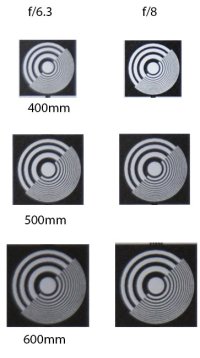
Here are the experiments. The centre crops (100%) from the iso-12233 chart taken by the Tamron 150-600mm, at 400, 500 and 600mm at f/6.3 and f/8. This lens is as sharp as the 100-400L at 400mm. A picture is worth a 1000 words for seeing how the fine lines are increasingly resolved at increasing focal length.
 

Attachments

  • Collage.jpg
    Collage.jpg
    53.4 KB · Views: 874
Upvote 0
Pit123 said:
jrista said:
ifp said:
Pit123 said:
Have you the Tammy? Can you contribute for anything here at all?

You said it. You don't own it, and you've rejected the postings that are contrary to your opinions from owners of the lens.

jrista said:
In the case of the 1D X, you have 6.95µm pixels, or an area of 6.95^2µm: 48.3µm^2. The 7D has 4.3µm pixels, or an area of 4.3^2µm: 18.49µm^2. Again, because were working in two dimensions here, it's not a linear scale, you can fit 48.3/18.5 7D pixels into one 1D X pixel. That comes out to 2.61x 7D pixels per 1D X pixel. You would need a 2.6x TC in in order to completely normalize the crop difference between the 7D and 1D X, all else being equal.

Wouldn't that be a sqrt(2.6)x teleconverter? Every teleconverter I've seen lists their focal length multiplier, meaning a 2x teleconverter puts 4x the pixels on a target.

You are correct. That should actually read:

"That comes out to 2.61x 7D pixels per 1D X pixel. You would need a 1.6x TC in in order to completely normalize the crop difference between the 7D and 1D X, all else being equal."
Nice. I see you change your mind. You now admit to not have use a 2.6x tc to compensate, as you said before,, but a 1.6x.
If I have a 1dx and want the same pixels on the subject as the 7d, I have two choices. Put a 1,6x TC on the lens or upscale the image by 1.6x. When talk about upscaling you always talk about upscaling in both direction. Everything is upscaled 1.6x. Ok? Same with lenses. If I want a 400mm to act as a 600mm I put a 1.5x TC on it. Normally an upscaled image will not be as good as putting a tc on, or having a longer FL. But sometimes it does. And that not a claim for me that I can upscale the C400mm to give same IQ as the soft tammy @6.3. Its a question and a guess..Thats it!.
And now I'm out.
Thanks!

First off, my bad. It was a typo. Not a change of mind. But still, my bad.

Second, your still not understanding. Things are magnified 2.61x. The LENS FOCAL LENGTH, and ONLY the lens focal length, is scaled by 1.6! It's the same deal in the end. If you square 1.615 (the actual focal ratio), what do you get? 2.61! The 7D resolves 2.61x more detail than the 1D X. To compensate for that difference, you need a focal length 1.6x as long. A 646mm lens results in 2.61x more 1D X pixels falling on the same subject area as a 400mm lens on the 7D. Don't get too caught up on the simple and scalar ratio of focal lengths...that doesn't tell you enough about the actual differences involved.

The difference in focal length is linear (1.615x), the difference in magnification is squared (2.61x). The value that really matters, from a detail perspective, is the magnification factor. If you use a 400mm lens on both a 1D X and a 7D, the 7D will resolve 2.61x MORE DETAIL. It sounds like a lot. It really IS a lot!

If you still don't believe me, maybe you will believe a well-known professional in the field of bird photography:

Size Does Matter; The Power of the Square of the Focal Length

[quote author=Art Morris]"In the original “The Art of Bird Photography” I wrote something to this effect: the size of the bird in the frame is not a factor of the focal length but rather a factor of the square of the focal length. In other words, if you go from a 400mm lens to an 800 mm lens, the bird will be four times bigger in the frame (not twice as big). "[/quote]

The focal ratio between 800mm and 400mm is 2x, but the subject is enlarged in the frame by 4x! Subject size in the frame is related to the SQUARE of the Focal Ratio, it is not a linear relationship. You can clearly see that in Art's animated image of the bird...one was taken at 700mm, the other at 1120mm. The square of that ratio, 1120/700^2 or 1.6^2 is, yup, you've got it, 2.6x! The animated bird jumped in size in the frame by 2.6x, not by 1.6x. You can even download the animated image and do some area measurements yourself if you want. Draw a box around the bird when it's smaller, draw a box around the bird when it's larger, and compare the areas.
 
Upvote 0
jrista said:
Pit123 said:
jrista said:
ifp said:
Pit123 said:
Have you the Tammy? Can you contribute for anything here at all?

You said it. You don't own it, and you've rejected the postings that are contrary to your opinions from owners of the lens.

jrista said:
In the case of the 1D X, you have 6.95µm pixels, or an area of 6.95^2µm: 48.3µm^2. The 7D has 4.3µm pixels, or an area of 4.3^2µm: 18.49µm^2. Again, because were working in two dimensions here, it's not a linear scale, you can fit 48.3/18.5 7D pixels into one 1D X pixel. That comes out to 2.61x 7D pixels per 1D X pixel. You would need a 2.6x TC in in order to completely normalize the crop difference between the 7D and 1D X, all else being equal.

Wouldn't that be a sqrt(2.6)x teleconverter? Every teleconverter I've seen lists their focal length multiplier, meaning a 2x teleconverter puts 4x the pixels on a target.

You are correct. That should actually read:

"That comes out to 2.61x 7D pixels per 1D X pixel. You would need a 1.6x TC in in order to completely normalize the crop difference between the 7D and 1D X, all else being equal."
Nice. I see you change your mind. You now admit to not have use a 2.6x tc to compensate, as you said before,, but a 1.6x.
If I have a 1dx and want the same pixels on the subject as the 7d, I have two choices. Put a 1,6x TC on the lens or upscale the image by 1.6x. When talk about upscaling you always talk about upscaling in both direction. Everything is upscaled 1.6x. Ok? Same with lenses. If I want a 400mm to act as a 600mm I put a 1.5x TC on it. Normally an upscaled image will not be as good as putting a tc on, or having a longer FL. But sometimes it does. And that not a claim for me that I can upscale the C400mm to give same IQ as the soft tammy @6.3. Its a question and a guess..Thats it!.
And now I'm out.
Thanks!

First off, my bad. It was a typo. Not a change of mind. But still, my bad.

Second, your still not understanding. Things are magnified 2.61x. The LENS FOCAL LENGTH, and ONLY the lens focal length, is scaled by 1.6! It's the same deal in the end. If you square 1.615 (the actual focal ratio), what do you get? 2.61! The 7D resolves 2.61x more detail than the 1D X. To compensate for that difference, you need a focal length 1.6x as long. A 646mm lens results in 2.61x more 1D X pixels falling on the same subject area as a 400mm lens on the 7D. Don't get too caught up on the simple and scalar ratio of focal lengths...that doesn't tell you enough about the actual differences involved.

The difference in focal length is linear (1.615x), the difference in magnification is squared (2.61x). The value that really matters, from a detail perspective, is the magnification factor. If you use a 400mm lens on both a 1D X and a 7D, the 7D will resolve 2.61x MORE DETAIL. It sounds like a lot. It really IS a lot!

If you still don't believe me, maybe you will believe a well-known professional in the field of bird photography:

Size Does Matter; The Power of the Square of the Focal Length

[quote author=Art Morris]"In the original “The Art of Bird Photography” I wrote something to this effect: the size of the bird in the frame is not a factor of the focal length but rather a factor of the square of the focal length. In other words, if you go from a 400mm lens to an 800 mm lens, the bird will be four times bigger in the frame (not twice as big). "

The focal ratio between 800mm and 400mm is 2x, but the subject is enlarged in the frame by 4x! Subject size in the frame is related to the SQUARE of the Focal Ratio, it is not a linear relationship. You can clearly see that in Art's animated image of the bird...one was taken at 700mm, the other at 1120mm. The square of that ratio, 1120/700^2 or 1.6^2 is, yup, you've got it, 2.6x! The animated bird jumped in size in the frame by 2.6x, not by 1.6x. You can even download the animated image and do some area measurements yourself if you want. Draw a box around the bird when it's smaller, draw a box around the bird when it's larger, and compare the areas.
[/quote]

WOW! If you really believe that double the focal length will enlarge the subject by 4x, then I have lost all respect for your skills! Sorry man!
It will enlarge the subject by 2x of course, nothing more, nothing less. Do you even own a camera? Or a lens?
 
Upvote 0
Pit123 said:
jrista said:
Pit123 said:
jrista said:
ifp said:
Pit123 said:
Have you the Tammy? Can you contribute for anything here at all?

You said it. You don't own it, and you've rejected the postings that are contrary to your opinions from owners of the lens.

jrista said:
In the case of the 1D X, you have 6.95µm pixels, or an area of 6.95^2µm: 48.3µm^2. The 7D has 4.3µm pixels, or an area of 4.3^2µm: 18.49µm^2. Again, because were working in two dimensions here, it's not a linear scale, you can fit 48.3/18.5 7D pixels into one 1D X pixel. That comes out to 2.61x 7D pixels per 1D X pixel. You would need a 2.6x TC in in order to completely normalize the crop difference between the 7D and 1D X, all else being equal.

Wouldn't that be a sqrt(2.6)x teleconverter? Every teleconverter I've seen lists their focal length multiplier, meaning a 2x teleconverter puts 4x the pixels on a target.

You are correct. That should actually read:

"That comes out to 2.61x 7D pixels per 1D X pixel. You would need a 1.6x TC in in order to completely normalize the crop difference between the 7D and 1D X, all else being equal."
Nice. I see you change your mind. You now admit to not have use a 2.6x tc to compensate, as you said before,, but a 1.6x.
If I have a 1dx and want the same pixels on the subject as the 7d, I have two choices. Put a 1,6x TC on the lens or upscale the image by 1.6x. When talk about upscaling you always talk about upscaling in both direction. Everything is upscaled 1.6x. Ok? Same with lenses. If I want a 400mm to act as a 600mm I put a 1.5x TC on it. Normally an upscaled image will not be as good as putting a tc on, or having a longer FL. But sometimes it does. And that not a claim for me that I can upscale the C400mm to give same IQ as the soft tammy @6.3. Its a question and a guess..Thats it!.
And now I'm out.
Thanks!

First off, my bad. It was a typo. Not a change of mind. But still, my bad.

Second, your still not understanding. Things are magnified 2.61x. The LENS FOCAL LENGTH, and ONLY the lens focal length, is scaled by 1.6! It's the same deal in the end. If you square 1.615 (the actual focal ratio), what do you get? 2.61! The 7D resolves 2.61x more detail than the 1D X. To compensate for that difference, you need a focal length 1.6x as long. A 646mm lens results in 2.61x more 1D X pixels falling on the same subject area as a 400mm lens on the 7D. Don't get too caught up on the simple and scalar ratio of focal lengths...that doesn't tell you enough about the actual differences involved.

The difference in focal length is linear (1.615x), the difference in magnification is squared (2.61x). The value that really matters, from a detail perspective, is the magnification factor. If you use a 400mm lens on both a 1D X and a 7D, the 7D will resolve 2.61x MORE DETAIL. It sounds like a lot. It really IS a lot!

If you still don't believe me, maybe you will believe a well-known professional in the field of bird photography:

Size Does Matter; The Power of the Square of the Focal Length

[quote author=Art Morris]"In the original “The Art of Bird Photography” I wrote something to this effect: the size of the bird in the frame is not a factor of the focal length but rather a factor of the square of the focal length. In other words, if you go from a 400mm lens to an 800 mm lens, the bird will be four times bigger in the frame (not twice as big). "

The focal ratio between 800mm and 400mm is 2x, but the subject is enlarged in the frame by 4x! Subject size in the frame is related to the SQUARE of the Focal Ratio, it is not a linear relationship. You can clearly see that in Art's animated image of the bird...one was taken at 700mm, the other at 1120mm. The square of that ratio, 1120/700^2 or 1.6^2 is, yup, you've got it, 2.6x! The animated bird jumped in size in the frame by 2.6x, not by 1.6x. You can even download the animated image and do some area measurements yourself if you want. Draw a box around the bird when it's smaller, draw a box around the bird when it's larger, and compare the areas.

WOW! If you really believe that double the focal length will enlarge the subject by 4x, then I have lost all respect for your skills! Sorry man!
It will enlarge the subject by 2x of course, nothing more, nothing less. Do you even own a camera? Or a lens?
[/quote]

Of course it does, the subject becomes twice as wide and twice as tall, that makes it cover four times the area it did before. You are forgetting you are going from a one dimensional measurement to a two dimensional representation of the subject. If it was a three dimensional model it would be doubled again for depth.

Here is a diagram, the image is a 3 x 2 format image, the blue square a subject, the green square is what happens if you either double the focal length or halve your subject distance, both edges are double the blue squares edges in length, the green square covers four times the area the blue square does.

Time to eat some humble pie :)
 

Attachments

  • 1.jpg
    1.jpg
    19.1 KB · Views: 1,038
Upvote 0