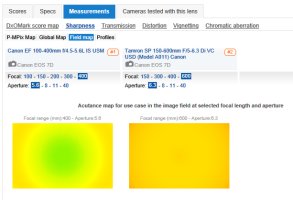
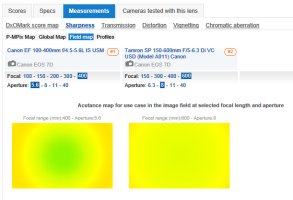
Shallow Review: Tamron 150-600 f/5-6.3 VC vs 300mm/2.8 II +2xTC III

Thanks for this comparison... It is certainly one I was very interested in seeing... I would love the 300 f/2.8, especially because most of my wildlife shots are in dimly lit conditions, and with a TC it has good IQ also. But the price is a little out of my reach... The tamron is a tempting solution, but still not won over by it... hmmmm, Well done Tamron, you have given a lot us pause to think!
 
Upvote 0
Upvote 0
mackguyver said:
lycan said:
Another review:

http://www.sumeetmoghe.com/2014/02/field-testing-bigron-aka-tamron-150.html

not MTF charts or any kind of lab stuff. In the field review, and the photos are simply amazing. Don't forget it's $1000 worth of 600mm..
Thanks for the link - amazing photos! If I didn't own the 300 + 2x already, those photos alone would sell me on this lens. Wow!

Yes those are nice photos.

And thanks to AlanF for posting the test shots! I would prefer to see the chart larger still somehow, to better show differences. The Tamron obviously is not close to the Canon combo in the outer 40% of the image, but it seems relatively close in the middle 60%, so that's really saying something for the Tamron.

However, from looking at the-digital-picture crops and comparisons (I spent some time doing it...and not just with a couple of lenses), I think it's safe to say that...the 300 f/2.8 ii, is really hampered by the 2x iii TC, compared to what it can do by itself at 300mm (from the perspective of resolution on the sensor alone...not when taking magnifying subjects at a long distance into account). I don't think there is another lens in the world that is sharper, regardless of focal length.

If you look at the crops in the test and compare the 300 + 2xTC iii, with the 200-400 with its internal TC switched in, the 200-400 and the 600 + 2xTC iii combo, are very...very close, even to the periphery. So that's saying something for the 200-400, as well.

Neither is all that close to the 600 f/4 ii, but both seem to be tons better than the old 600 f/4 (at least going by the sample shots). Yet the 600 f/4 ii, is also not all that close to the 300...at its native 300. The 500 f/4 ii, seems similar to the 600.

Makes me wonder what the future holds for Canon...
 
Upvote 0
jrista said:
Read this:
http://jonrista.com/2013/03/24/the-diffraction-myth/
So, technically speaking, stopping down to f/11 is stopping down to f/11...the ultimate result on IQ in reach-limmited scenarios (same lens, different cameras, same subject distance) is roughly the same regardless of FF vs. APS-C (technically, APS-C would actually have the edge, barring blurring from other factors...i.e. the 7D has a stronger low pass filter than the 5D III, which mitigates some of the benefit of having smaller pixels, but not entirely.) Smaller pixels will always give you a cropping advantage, and the more you stop down, the returns offered by those smaller pixels simply diminish until they offer no benefit over larger pixels (but at no point would smaller pixel EVER be "worse" than larger pixels from the standpoint of diffraction...noise is another matter.)

Jon
Beautiful webpage - thanks for the link. The so-called diffraction limit isn't a hard barrier but lowers resolution slowly as the aperture is narrowed through it. To reinforce and paraphrase what you have elegantly argued, at wide apertures, the crop sensor of the same number of megapixels as FF gives better resolution than full-frame because the pixels are 1.6x1.6 times smaller. But, when the disk of light caused by diffraction is larger than the pixels, the size of the disk limits resolution and the crop loses its resolution advantage.
 
Upvote 0
jrista said:
This is the diffraction myth. Diffraction is diffraction, it is the same regardless of the sensor. The difference in pixel size simply means your imaging the lesser effects of diffraction sooner, but that does not make the effect worse. Diffraction is purely optical, so whether you are using a FF sensor, an APS-C sensor, or a small 4/3rds sensor with even tinier pixels, you should really NEVER worry about diffraction.

Read this:
http://jonrista.com/2013/03/24/the-diffraction-myth/

So, technically speaking, stopping down to f/11 is stopping down to f/11...the ultimate result on IQ in reach-limmited scenarios (same lens, different cameras, same subject distance) is roughly the same regardless of FF vs. APS-C (technically, APS-C would actually have the edge, barring blurring from other factors...i.e. the 7D has a stronger low pass filter than the 5D III, which mitigates some of the benefit of having smaller pixels, but not entirely.) Smaller pixels will always give you a cropping advantage, and the more you stop down, the returns offered by those smaller pixels simply diminish until they offer no benefit over larger pixels (but at no point would smaller pixel EVER be "worse" than larger pixels from the standpoint of diffraction...noise is another matter.)

Thanks for the link. Pretty good points.

I ran across this post by Roger Cicala at lensrentals blog. He comes up with roughly similar findings using narrow apertures on a D800 -

http://www.lensrentals.com/blog/2013/03/overcoming-my-fentekaphobia
 
Upvote 0
AlanF said:
jrista said:
Read this:
http://jonrista.com/2013/03/24/the-diffraction-myth/
So, technically speaking, stopping down to f/11 is stopping down to f/11...the ultimate result on IQ in reach-limmited scenarios (same lens, different cameras, same subject distance) is roughly the same regardless of FF vs. APS-C (technically, APS-C would actually have the edge, barring blurring from other factors...i.e. the 7D has a stronger low pass filter than the 5D III, which mitigates some of the benefit of having smaller pixels, but not entirely.) Smaller pixels will always give you a cropping advantage, and the more you stop down, the returns offered by those smaller pixels simply diminish until they offer no benefit over larger pixels (but at no point would smaller pixel EVER be "worse" than larger pixels from the standpoint of diffraction...noise is another matter.)

Jon
Beautiful webpage - thanks for the link. The so-called diffraction limit isn't a hard barrier but lowers resolution slowly as the aperture is narrowed through it. To reinforce and paraphrase what you have elegantly argued, at wide apertures, the crop sensor of the same number of megapixels as FF gives better resolution than full-frame because the pixels are 1.6x1.6 times smaller. But, when the disk of light caused by diffraction is larger than the pixels, the size of the disk limits resolution and the crop loses its resolution advantage.

That is a good succinct summary ... Thanks Alan
 
Upvote 0
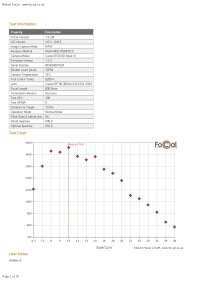
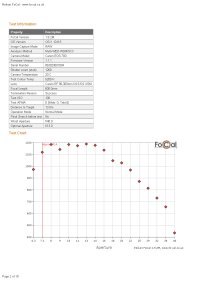
Here are the relative aperture sharpness plots from FoCal for the Tamron at 600mm on the 70D (Top) and 5DIII (Bottom). You can see the 70D, if anything, retains its sharpness with aperture better! I did the 5DIII measurements 3 times and got optimal values of f/9/, f/10 and f/11. Keep between f/8 and f/14 for maximum sharpness.
 

Attachments

  • 70D_Apertures_600mm.jpg
    70D_Apertures_600mm.jpg
    143.2 KB · Views: 1,259
  • 5DIII_Apertures_600mm.jpg
    5DIII_Apertures_600mm.jpg
    146 KB · Views: 1,251
Upvote 0
mackguyver said:
lycan said:
Another review:

http://www.sumeetmoghe.com/2014/02/field-testing-bigron-aka-tamron-150.html

not MTF charts or any kind of lab stuff. In the field review, and the photos are simply amazing. Don't forget it's $1000 worth of 600mm..
Thanks for the link - amazing photos! If I didn't own the 300 + 2x already, those photos alone would sell me on this lens. Wow!

+1 - Those are some amazing, amazing photos and the guy has a great writing style. One of the best practical reviews that I have read on the lens.
 
Upvote 0
jrista said:
J.R. said:
jrista said:
J.R. said:
Dylan777 said:
Thanks Alan,

@ f8 and smaller, Tammy shows better IQ in 600mm. This is good news for those want long zoom & shooting at slower shutter speed.

I'm no expert in BIF photography. Last time I tried, my shutter speed was in 1/2000ish.

F8 + 1/2000ish = ??? IQ

I hear you brother!

The f/8 or narrower makes it a deal breaker for me. I typically shoot birds in a well wooded area. The foliage makes it difficult for me to keep ISOs under control with the f/5.6 aperture. It's all very well shooting in bright daylight but for the shooting I do, I'm yearning for f/4 or faster lenses ... f/8 just won't cut it even with the high ISO performance of the 5D3/6D

Owning a 600mm f/4 lens myself, I can tell you that you are often limited by too-thin DOF than you might expect. At 600mm, an f/4 aperture results in VERY THIN DOF. Quite often too thin. Unless you are photographing particularly large birds (which seems unlikely in a wooded area), even if you owned a 600mm f/4 lens you will find yourself somewhere between f/5.6 to f/8 often enough anyway. It does help having f/4 as an option, and when you really get down to the wire (near sunset in a wooded area) then you open up and deal with the DOF issues regardless.

But having an f/4 lens does not necessarily mean you are always shooting at f/4.

Ha ... I didn't think about that ... Thanks Jon!

I do my birding with the 100-400 right now and being limited to 400mm and f/5.6, I've not run into any serious DOF concerns - that will sure change with a supertele as you quite rightly point out above. The 100-400 isn't the sharpest of lenses and combined with super high ISOs, my pictures turn out too soft and lacking detail - I usually blame high ISOs for the lack of detail and noise and hence my cringing for a faster lens.

Aye, I always used the 100-400 at f/7.1 once I realized it was softish at f/5.6 and f/6.3. With a 7D, that really exacerbated issues with noise. Having the option of f/4 is certainly helpful for that. Keep in mind, you can get the 500/4 L II at a pretty significant discount to the 600mm f/4, and still have the option of using it at 700/5.6 and 1000/8 if you need to. It's a great middle-ground option when you can't afford the extra $2000+ for the 600mm.


J.R. said:
I've used the 600 only a few times but that was for shooting shore birds in reasonable light so I could stop down happily without any concern over the ISO.

I'd say the 600mm is the best lens on earth for shorebirds. At low perspectives (i.e. laying on the sand of a beach, lens on a ground-level pod of some kind) gets you the most exquisite background blur you'll ever see. The 500mm will do much the same, if you need the cost savings, but the 600mm can't be beat for shorebird work.

J.R. said:
Jon, a large section of the buyers of the Tammy will end up using them on the APS-C cameras where diffraction sets in real early - sometimes as soon as f/6.3. If you were to stop down to f/11, how much do you think the images will suffer in sharpness?

This is the diffraction myth. Diffraction is diffraction, it is the same regardless of the sensor. The difference in pixel size simply means your imaging the lesser effects of diffraction sooner, but that does not make the effect worse. Diffraction is purely optical, so whether you are using a FF sensor, an APS-C sensor, or a small 4/3rds sensor with even tinier pixels, you should really NEVER worry about diffraction.

Read this:
http://jonrista.com/2013/03/24/the-diffraction-myth/

So, technically speaking, stopping down to f/11 is stopping down to f/11...the ultimate result on IQ in reach-limmited scenarios (same lens, different cameras, same subject distance) is roughly the same regardless of FF vs. APS-C (technically, APS-C would actually have the edge, barring blurring from other factors...i.e. the 7D has a stronger low pass filter than the 5D III, which mitigates some of the benefit of having smaller pixels, but not entirely.) Smaller pixels will always give you a cropping advantage, and the more you stop down, the returns offered by those smaller pixels simply diminish until they offer no benefit over larger pixels (but at no point would smaller pixel EVER be "worse" than larger pixels from the standpoint of diffraction...noise is another matter.)
That's a lot of very useful info Jon ... thanks for sharing.
 
Upvote 0
AlanF said:
Here are the relative aperture sharpness plots from FoCal for the Tamron at 600mm on the 70D (Top) and 5DIII (Bottom). You can see the 70D, if anything, retains its sharpness with aperture better! I did the 5DIII measurements 3 times and got optimal values of f/9/, f/10 and f/11. Keep between f/8 and f/14 for maximum sharpness.

You know, I've noticed that with my 7D and FoCal. There sometimes seems to be a jitter, where as FoCal moves through the apertures, it doesn't exhibit the kind of smooth curve you would expect. If I retest a few times, then it will usually get back to normal, and finally produce the smooth curve I'm looking for. I don't know why that happens...always bugged me about FoCal.
 
Upvote 0
Alan, as you move beyond the test charts and such, I'd be interested to hear your thoughts on the more subjective comparisons between the Tamron & Canon combo - things like AF speed, color, contrast, bokeh, and general handling of the lenses.

Also, I just realized that the Canon has a huge advantage in polarizer use. I'm sure you can find a big one for the Tamron, but you certainly can't adjust it like you can with the drop in CPL on the Canon.
 
Upvote 0
Pit123 said:
I hope I have time to do a comparison between my 100-400 and 300mm +2x tomorrow, and see if that can make us any wiser. :)

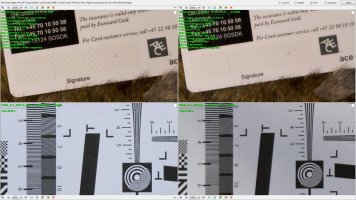
Download the following image and look at full screen (1920x1080).
You see four 100% center crops:
Top: from 7D iso 200 (My test shots from today)
Bottom: from 5d3 iso 640. (Alans crops)
Top left: Canon 300 f2.8 IS MK2 + 2xTCIII wide open.
Top right: Canon 100-400mm @400mmf56 and upscaled to 600mm.
Bottom left: Canon 300mm f2.8 is mk2 + 2x TCIII wide open
Bottom left: Tammy @600mm f6.3

Can an upscaled (to 600mm) 100-400mm wide open shot give same details as the Tammy?
 

Attachments

  • TammyvsCanon.jpg
    TammyvsCanon.jpg
    306.7 KB · Views: 1,125
Upvote 0
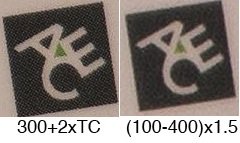
Superficially, your upscaled credit card from the 100-400 (x1.5) looks as good as the image from the 300 f/2.8 II plus 2xTC III. That is because you look at the thick black lines etc that dominate. But, look at the elements with fine detail. I have cropped the ACE sections from the image from the 300+2xTC and the (100-400)x1.5, which have fine detail on the black background. You can see that the fine detail is lost in the upscaled 100-400. (Download to see clearly).
 

Attachments

  • Pit123Tests.jpg
    Pit123Tests.jpg
    17.3 KB · Views: 828
Upvote 0
Pit123 said:
Pit123 said:
I hope I have time to do a comparison between my 100-400 and 300mm +2x tomorrow, and see if that can make us any wiser. :)

Download the following image and look at full screen (1920x1080).
You see four 100% center crops:
Top: from 7D iso 200 (My test shots from today)
Bottom: from 5d3 iso 640. (Alans crops)
Top left: Canon 300 f2.8 IS MK2 + 2xTCIII wide open.
Top right: Canon 100-400mm @400mmf56 and upscaled to 600mm.
Bottom left: Canon 300mm f2.8 is mk2 + 2x TCIII wide open
Bottom left: Tammy @600mm f6.3

Can an upscaled (to 600mm) 100-400mm wide open shot give same details as the Tammy?

Um, simple answer is, NO! Your upscaled 400mm sample is soft all over. You can CLEARLY see it in the text, in the gray watermark, in the ACE logo, in the black box with text in it. There is absolutely no question, the upscaled 400mm shot doesn't compare to the 600mm shot.

There isn't any way to slice this such that a 400mm lens could win, not when the Tamron resolves as well as it does at 600mm. If the Tammy was particularly BAD, then maybe, but the Tammy is NOT bad...it's quite good for it's relative position in the broader scope of DSLR lenses. At non-diffraction limited apertures like f/5.6 and f/6.3, even the EF 400mm f/2.8 L isn't going to outdo the Tamron. At this point, thanks to the Tamron's good resolving power, it all boils down to pixels on subject. For the same sensor used at the same distance to subject, longer focal lengths will always produce sharper results than upscaled shorter focal lengths. No way around that.

The only way the 400mm could compare to any 600mm, when they all offer decent resolving power, is when you normalize framing, rather than maintaining subject distance. If you move the 400mm setup closer such that the credit card fills the frame in exactly the same way as a more distant 600mm, then your putting the same number of pixels on subject. If the two lenses offer similar resolving power, the results should be largely indiscernible. But if you can get closer with a 400mm, you wouldn't need a 600mm...so it kind of defeats the point of the argument. In reach-limited scenarios, more optical magnification is pretty much always going to be better unless the longer lens is of radically poor design or uses particularly poor quality glass.
 
Upvote 0
AlanF said:
Superficially, your upscaled credit card from the 100-400 (x1.5) looks as good as the image from the 300 f/2.8 II plus 2xTC III.
What?!!
Did you look at the image in full view? If you cant see the day/night difference between the 300mm +2xtc and 100-400 upscaled, then you really need some glasses or a new monitor.... ;)
But thats not what I want to show. My question is: is the upscaled 100-400 as good as a tammy can be at 600mm wide open?
I would never replace my 300mm+2x combo with tammy. But can the tammy replace my 100-400mm as a travel lighter/smaller package? For me, it looks like the tammy only gives better results than an upscaled 100-400mm if you shoot at f8. And thats a turn off for me.
 
Upvote 0
jrista said:
Pit123 said:
Pit123 said:
I hope I have time to do a comparison between my 100-400 and 300mm +2x tomorrow, and see if that can make us any wiser. :)

Download the following image and look at full screen (1920x1080).
You see four 100% center crops:
Top: from 7D iso 200 (My test shots from today)
Bottom: from 5d3 iso 640. (Alans crops)
Top left: Canon 300 f2.8 IS MK2 + 2xTCIII wide open.
Top right: Canon 100-400mm @400mmf56 and upscaled to 600mm.
Bottom left: Canon 300mm f2.8 is mk2 + 2x TCIII wide open
Bottom left: Tammy @600mm f6.3

Can an upscaled (to 600mm) 100-400mm wide open shot give same details as the Tammy?

Um, simple answer is, NO! Your upscaled 400mm sample is soft all over. You can CLEARLY see it in the text, in the gray watermark, in the ACE logo, in the black box with text in it. There is absolutely no question, the upscaled 400mm shot doesn't compare to the 600mm shot.

There isn't any way to slice this such that a 400mm lens could win, not when the Tamron resolves as well as it does at 600mm. If the Tammy was particularly BAD, then maybe, but the Tammy is NOT bad...it's quite good for it's relative position in the broader scope of DSLR lenses. At non-diffraction limited apertures like f/5.6 and f/6.3, even the EF 400mm f/2.8 L isn't going to outdo the Tamron. At this point, thanks to the Tamron's good resolving power, it all boils down to pixels on subject. For the same sensor used at the same distance to subject, longer focal lengths will always produce sharper results than upscaled shorter focal lengths. No way around that.

The only way the 400mm could compare to any 600mm, when they all offer decent resolving power, is when you normalize framing, rather than maintaining subject distance. If you move the 400mm setup closer such that the credit card fills the frame in exactly the same way as a more distant 600mm, then your putting the same number of pixels on subject. If the two lenses offer similar resolving power, the results should be largely indiscernible. But if you can get closer with a 400mm, you wouldn't need a 600mm...so it kind of defeats the point of the argument. In reach-limited scenarios, more optical magnification is pretty much always going to be better unless the longer lens is of radically poor design or uses particularly poor quality glass.
I do not deny that the upscaled 100-400mm is soft all over. Compared to the excellent 300mm+2x combo it is bad. But is it more soft than the tammy wide open as shown in the lower right side?

A very sharp quality lens can outresolve a lens with longer FL. Of course it can! Or do you say that a sharp 590mm never can outresolve a soft 600mm lens? And if thats possible, is it any magic limit where this is not possible anymore?
Have you tried digiscoping with a cheap telescope (800mm) and compared the results with a 600mm? What do you think resolves best?

You may be surprised but my 300mm+2xTCIII @F6.3 upscaled to 700mm outresolves my 500mm is mk1 + 1.4xIII. (Using my 7D)
 
Upvote 0
Upscaling doesn't outresolve anything (not even the original image) because the new pixels are created by interpolation and not by resolution. Software can't create detail. It can guess it, it can sharpen to fake it, etc.

So your question is rather: can a good upscaling software produce better results than a soft longer lens? Yes, maybe, to a certain extent depending on how bad the longer lens is. And it is quite apparent that the Tamron is not that bad at all.
 
Upvote 0
Pit123 said:
jrista said:
Pit123 said:
Pit123 said:
I hope I have time to do a comparison between my 100-400 and 300mm +2x tomorrow, and see if that can make us any wiser. :)

Download the following image and look at full screen (1920x1080).
You see four 100% center crops:
Top: from 7D iso 200 (My test shots from today)
Bottom: from 5d3 iso 640. (Alans crops)
Top left: Canon 300 f2.8 IS MK2 + 2xTCIII wide open.
Top right: Canon 100-400mm @400mmf56 and upscaled to 600mm.
Bottom left: Canon 300mm f2.8 is mk2 + 2x TCIII wide open
Bottom left: Tammy @600mm f6.3

Can an upscaled (to 600mm) 100-400mm wide open shot give same details as the Tammy?

Um, simple answer is, NO! Your upscaled 400mm sample is soft all over. You can CLEARLY see it in the text, in the gray watermark, in the ACE logo, in the black box with text in it. There is absolutely no question, the upscaled 400mm shot doesn't compare to the 600mm shot.

There isn't any way to slice this such that a 400mm lens could win, not when the Tamron resolves as well as it does at 600mm. If the Tammy was particularly BAD, then maybe, but the Tammy is NOT bad...it's quite good for it's relative position in the broader scope of DSLR lenses. At non-diffraction limited apertures like f/5.6 and f/6.3, even the EF 400mm f/2.8 L isn't going to outdo the Tamron. At this point, thanks to the Tamron's good resolving power, it all boils down to pixels on subject. For the same sensor used at the same distance to subject, longer focal lengths will always produce sharper results than upscaled shorter focal lengths. No way around that.

The only way the 400mm could compare to any 600mm, when they all offer decent resolving power, is when you normalize framing, rather than maintaining subject distance. If you move the 400mm setup closer such that the credit card fills the frame in exactly the same way as a more distant 600mm, then your putting the same number of pixels on subject. If the two lenses offer similar resolving power, the results should be largely indiscernible. But if you can get closer with a 400mm, you wouldn't need a 600mm...so it kind of defeats the point of the argument. In reach-limited scenarios, more optical magnification is pretty much always going to be better unless the longer lens is of radically poor design or uses particularly poor quality glass.
I do not deny that the upscaled 100-400mm is soft all over. Compared to the excellent 300mm+2x combo it is bad. But is it more soft than the tammy wide open as shown in the lower right side?

I don't believe it is valid to compare the upper and lower left. Two entirely different scenarios. You can only compare results when the results are produced under identical circumstances. This is made clear by the fact that the Top Left is CLEARLY sharper than the Top Right, and both of those examples were shot under the same circumstances. You cannot dismiss the clear advantage of the Top Left Tammy because the Lower Right Tammy is an entirely different setup...the Lower samples are comparable to each other, but not to the Upper samples.

Pit123 said:
A very sharp quality lens can outresolve a lens with longer FL. Of course it can! Or do you say that a sharp 590mm never can outresolve a soft 600mm lens? And if thats possible, is it any magic limit where this is not possible anymore?

If the 600mm lens had really bad optics, yes, a 590mm lens could outresolve it. I actually said as much. But that isn't the case. Both the Tammy 150-600 and Canon 100-400 have good optics. Neither of them are bad, they are on par with each other, the Tammy actually has the edge. So no matter how you slice it, the 400mm lens isn't going to be outresolving the 600mm lens.

Lets assume that 600mm had worse optics than the 400mm lens. The difference in focal length is 150%, however when it comes to magnification, a 600mm lens enlarges subjects 2.25x more than a 400mm lens. The difference in magnification is the square of the ratio beetween the focal lengths. That means that, for a 600mm lens to perform WORSE than a 400mm lens thats been cropped and upsampled...it would have to perform SIGNIFICANTLY worse. Such a circumstance is highly unlikely.

Pit123 said:
Have you tried digiscoping with a cheap telescope (800mm) and compared the results with a 600mm? What do you think resolves best?

Your comparing dissimilar lens designs now. A spotting scope is designed for optical use. Field curvature, spherical aberration and other optical aberrations are usually not corrected, or corrected to a far lesser degree than with photographic lenses.

I'm assuming we are comparing similar lens designs...to be precise, photographic lens designs. To be even more explicit, Canon EF mount lens designs, although the same rules would apply if you compared Nikon brand and offbrand lenses for the Nikon F mount, etc.

We aren't talking about digiscoping. Were talking about DSLR camera lenses. Mathematically, a 600mm lens puts 2.25x as many pixels on subject as a 400mm lens. Your 600mm lens would have to be so bad as to completely counteract that 2.25x magnification advantage to produce worse results than an upsampled 400mm lens. The chances of that occurring are very low, especially in the increasingly competitive marketplace that exists for DSLR lenses.

Pit123 said:
You may be surprised but my 300mm+2xTCIII @F6.3 upscaled to 700mm outresolves my 500mm is mk1 + 1.4xIII. (Using my 7D)

I'd need to see evidence of that. You claim the EF 100-400mm outresolves the Tammy 150-600mm, when it clearly does not. Either your 500mm lens needs tuning to recenter a misaligned element, or your 1.4x TC does.
 
Upvote 0
AlanF said:
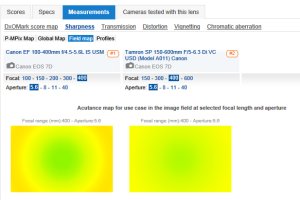
DxO rates the Tammy better than the 100-400 in the range where they overlap:
For bird/wildlife photo, I would look at other criterias than dxomark when rating a lens.

100-400 is clearly sharper in center wide open at 400mm. And is able to give really quality sharpness (green)
Tamron is not. And it is quite soft at 600mm, even stopped down to f8. A deal breaker for me.
 

Attachments

Upvote 0