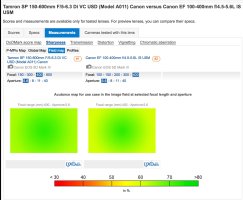
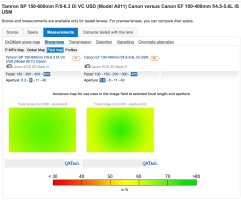
Pit123 said:
jrista said:
I'm sorry, but that's completely illogical. Resolving power is resolving power. A 500mm lens resolves more detail than a 300mm lens, because it's resolving it at a higher magnification, plain and simple. It magnifies your subject 2.78x more. That is even more than the difference between a 400mm and 600mm lens. Additionally, the 2x TC introduces more of it's own optical aberrations than the 1.4x TC. There is no way that the 300mm + 2x will ever outresolve the 500mm + 1.4x. Just plain aint going to happen.
The difference in magnification between 600mm and 700mm is 1.16x.
So I have to upsample the image by 1.16x to give the same image. The same effect as putting a 1.16x TC on it. How you translate this to 2.78x more magnification is just simple stupid.
How much magnification gives a 1.4x tc?
How much more magnification gives a 18mp 1.6 crop camera vs a 18mp FF.
And how can you claim the magnification between 400 and 600 to be more than 2x?.
It is 1.5x. Nothing more, nothing less.
I just ask since you don’t seem to understand what we talk about here.
LOL! I know EXACTLY what I'm talking about!

There is a very simple mathematical formula that proves it.
Sorry, but 1.5x is the ratio of focal lengths. The ratio of magnification is the ratio of focal lengths SQUARED!!!! You have to SQUARE the ratio of focal lengths, because lenses resolve in
two dimensions!
Code:
(600mm/400mm)^2 = 1.5^2 = 2.25
The FoV is 1.5x smaller in
both the horizontal and vertical...meaning 600mm FoV covers 2.25x less total area than the 400mm lens, but that 2.25x less total area is enlarged to fill the same sensor area....it has 2.25x GREATER MAGNIFICATION!
As for 2.78x, that was the ratio of area between 500mm and 300mm:
Code:
[code](500mm/300mm)^2 = 1.67^2 = 2.7889
So a 500mm lens magnifies it's subjects about 2.8x more than a 300mm lens! That's a pretty significant difference.
BTW, MAGNIFICATION is the factor we want here, rather than the simple ratio of focal lengths, because the number of pixels on subject is relevant in those
same two dimensions. You enlarge the subject both horizontally and vertically
relative to the sensor frame. That means you
put more pixels on any given area of subject detail in both the horizontal and vertical.
Pit123 said:
Pit123 said:
I give you two examples: one from short distance (10meters), the other 948 meters from subject (according Google maps). Download and show in full size 1920x1080.
Short distance:
jrista said:
I'm not really sure what your saying about the distances. Were they at the exact same distance, or was the 600mm combo closer? If you normalized framing, then the comparison is invalidated, as the 600mm combo would effectively be putting the same number of pixels on subject...when the 600mm combo used at the same distance should be putting fewer pixels on subject. Either way, your own example shows the 500mm+1.4x is sharper than 300mm+2x. The 700mm combo is pretty crisp, you can clearly see the effect of the 2x TC on the 600mm combo.
Read again. The first example image was taken from approx 10 meters, The other example was taken from 943 meter (about 3000 feet). Would it make sense to change the distance depending on lens used if I try to demonstrate the effect of upscaling a very sharp lens vs a lens with more FL? No, Of course not. I said I can upscale the 300mm+2x combo to show similar (or even better details than the 500mm+1.4x combo).
I guess you had to ask because you cant believe your own eyes here.

Sorry, but there is absolutely NO way that either one of those sample credit card photos was taken from 3000 feet away. That is the better part of a mile. Neither of those lenses has that kind of resolving power. Not even REMOTELY close to that kind of resolving power. LOL I don't know what your smoking, but you need to double check your facts. Like you need to double-check your understanding of what magnification is and why it matters.
Three thousand feet...and it somehow resolved just as good as something photographed from about 33 feet away? HAH! Bullsh*t!! Bull. Sh*t.
Pit123 said:
Did I say that the upscaling will add details compared to original image? Of course not.
But its much easier to compare lenses with different lens mm when the one is upsampled to the other lens mm. Or you can downsample the other. But downsampling will loose details. Upscaling will remain the details already there.
How can you clearly see the effect of the 2x? Explain? What you can see is the effect of the upscaling.
But even after upscaling, the 300mm+2x, shows at least similar details, especially in the long range image.
But also on the hair detail in the short range.
I have both lenses, and have compared them a lot.
You are comparing different results taken under entirely different circumstances. Scientifically, that is invalid. You can only compare results taken under the same circumstances. You trying to compare your credit card samples to AlanF's chart samples is invalid. You can't make any kind of reasonable comparison between those two disparate data sets.
You can only legitimately compare YOUR OWN two samples, or Alan's TWO samples, but you cannot cross-compare them. Using only your two samples, you yourself have proved that the Tamron is markedly sharper than the upsampled Canon 100-400mm. MARKEDLY. I mean, plain as day, I could probably cut my fingers on the razor-sharp text in the Tamron sample, and sooth my bleeding fingers on the Canon sample, kind of difference here. If you can't see that, then you might want to get your eyes checked, because you are either exceptionally nearsighted, or particularly farsighted.
If you want to compare the Tamron with the 300/2.8 + 2x, then you need to do that test yourself with the exact same credit card, under the same lighting conditions, with the card at the same angle, imaging the same region of the card, so the results can all be DIRECTLY compared. Since you have not done that, then we really can't know what the relative difference between all three lenses is. We don't have a single complete data set that covers all three lenses tested under identical circumstances.
Pit123 said:
And now back original question: Is it possible that a sharp 100-400mm centercrop upscaled by 1.5x can match a confirmed soft Tamron @ 600mmf63. Im quite sure its a closer match than many people here seems to believe.
If anyone read this as bashing the Tamron, then they have a problem I think.
First fact your getting wrong: The Tamron is NOT "confirmed soft". It is tested (not sure why, I need to check with Alan about those results) "softer than" a 300mm f/2.8 L II PRIME. But that does not mean it is confirmed soft in general. Relative vs. absolute. Important distinction there. RELATIVELY SPEAKING, the Tamron is softer than the 300/2.8. RELATIVELY SPEAKING, according to your own results (!!!) the Tamron is sharper than the 100-400. Your own samples of the credit card PROVE that the Tamron is relatively sharper than the Canon.
Oh, and it's still a magnification ratio, i.e. a resolving power difference, of 2.25x. Your missing a VERY fundamental optical concept here that conforms to a very simple mathematical formula:
Code:
(LongerFL/ShorterFL)^2 = MagRatio




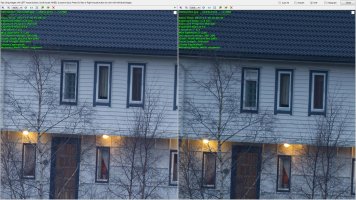
 It's like that device from Blade Runner that allowed him to extrapolate content from within that one room by extracting detail out of tiny reflections and what not...the Infinite Resolution Device. Oh, but were it true!
 I bolded the relevant part to make it a little easier for you.