Show your Bird Portraits

sedwards said:
Orangutan said:
sedwards said:
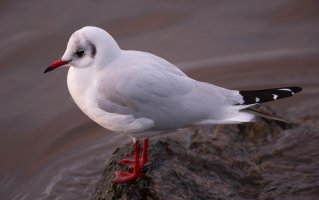
These white birds have been the hardest for me to get exposure right , i always seem to overexpose and loose all the detail in the feathers. If anyone has any pointers on getting the right exposure on white birds , please chime in.

Not that I'd presume to give you advice, but what settings do you typically use? I have the same problem, of course, with all birds that have a lot of bright white plumage. It's like shooting a pile of fresh snow in the middle of a green forest on a bright sunny day -- seems to confuse my camera's metering. If they give you enough time, could you spot meter, then expose manually from that?
I am using manual mode and i have been underexposing up to 1.5 stops for the white birds , but i still need to pull back the highlights in post. I am able to get useable shots but i was jst wondering if there was a rule of thumb for bright white subjects.
I've been underexposing by a stop and using spot metering..... and bracketing the shot.
 
Upvote 0
sedwards said:
Orangutan said:
sedwards said:
These white birds have been the hardest for me to get exposure right , i always seem to overexpose and loose all the detail in the feathers. If anyone has any pointers on getting the right exposure on white birds , please chime in.

Not that I'd presume to give you advice, but what settings do you typically use? I have the same problem, of course, with all birds that have a lot of bright white plumage. It's like shooting a pile of fresh snow in the middle of a green forest on a bright sunny day -- seems to confuse my camera's metering. If they give you enough time, could you spot meter, then expose manually from that?
I am using manual mode and i have been underexposing up to 1.5 stops for the white birds , but i still need to pull back the highlights in post. I am able to get useable shots but i was jst wondering if there was a rule of thumb for bright white subjects.
I'm also usually shooting in manual mode. When I get a new lens I usually bracket shots of some cloud to try to nail ETTR (for white) settings. I can then set up my custom shooting modes based on the lens transmission.
e.g.
C1 - 9 AF pt cluster, continuous high speed, ETTR-full sun
C2 - sneak mode - spot AF, quiet continuous, ETTR-full sun,
C3 - grab-shot mode - f/10, continuous high speed, ETTR-full sun

If subject goes into full shade then I bump up my ISO usually 1 or 2 stops (but it depends on the environment), also if cloud moves overhead I bump up my ISO.

The trickiest situation is when if it's partly cloudy with low level clouds. Then I take my ETTR exposure and look for a reasonable-sized reference (e.g. a patch of glassgrass in full sun) which I'll periodically measure with spot metering. If a proper (ETTR for white) exposure of the grass gives a +0.3Ev luminance meter reading and I measure later and my meter says -0.7 Ev then I need to compensate by bumping up my ISO 1-stop.

(EDITED: To phrase my thoughts better)
 
Upvote 0
PiNo said:
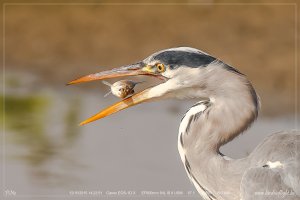
Grey Heron catch a fish
Welcome to the forum. You captured some great action of the Gray Heron, but I think that you could have done some things to make this an even stronger shot. If I can ask, what made you choose ISO 640 for this shot? Seems like you were shooting in strong sun. Shutter speed was surely fast enough at SS 1/2500. The reason I am asking is that the whites on the neck and the lower part of the face are are too hot. For better exposure a lower ISO and some negative exposure compensation would help to tone down the highlights. This is a lesson I have learned the hard way. I live in New York and we have Great Blue Herons that are very similar to your Gray Heron. You should see how many times I missed exposure and had blown out whites on those birds. I recently posted a shot of a coot with similar issues. Very hard to get details in the blacks but not blow out the white of the beak. Just trying to be helpful and I hope it is taken that way.
 
Upvote 0
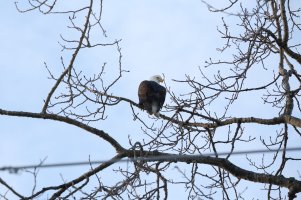
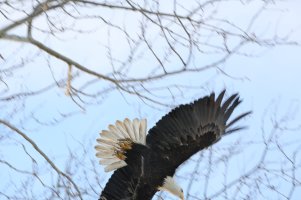
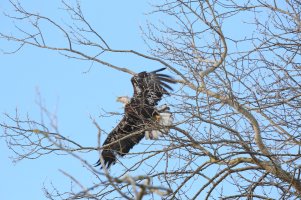
Went back to the same place today. Weather was better, no rain, and clear blue sky. Late afternoon, around 4 PM. So light was satisfactory. I brought along a 600EX II speedlight, 1/8 power with Better Beamer. Distance about 50 feet, below and to the side of the tree it perched on.
Another one began to take flight. Couldn't properly frame it. Sorry. Then, one more.
No editing, full frame, just reduce size for uploading.
-r
 

Attachments

  • image.jpeg
    image.jpeg
    720.6 KB · Views: 126
  • image.jpeg
    image.jpeg
    479.3 KB · Views: 118
  • image.jpeg
    image.jpeg
    1 MB · Views: 129
Upvote 0
Nice Riley, brought back memories. I'd be aiming and waiting for one to fly and then fatigue would set in and away he'd go when my lens was down. In another case right down over me so that not even half the bird would fit the frame. Then another time away he'd go in the opposite direction giving a useless tail shot.

Keep at it, you'll luck out.

Jack
 
Upvote 0
They are unpredictable: when will they take flight? which direction?
In my case, I could see that they got ready to hop off. I know that the direction of flight is away from me because of the branches, but those did not help me one bit to be prepared for their flight. On top of that, I had to pay attention to the traffic around me, after all I was on the side of a busy road.
I have 2 more days to try out to shoot more. Tomorrow because we have to see someone in Richmond on our way just south of us, and perhaps on our return. And then Sunday, when we have to drive back to Seattle for our flight back to Virginia.
So, shall send you some if there's any decent ones.
-r
 
Upvote 0