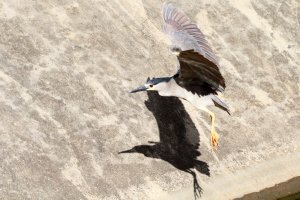
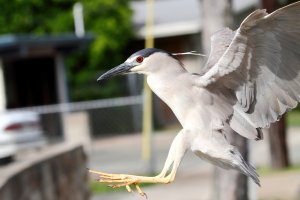
serendipidy said:A couple of shots of a very juvenile Black Crowned Night Heron in a tree from this evening.
7D, 100-400L @ 400mm, F/7.1, 1/160-1/200s, ISO 400, flash with Better Beamer, handheld at dusk.
Very nice serendipidy.

Upvote
0
serendipidy said:A couple of shots of a very juvenile Black Crowned Night Heron in a tree from this evening.
7D, 100-400L @ 400mm, F/7.1, 1/160-1/200s, ISO 400, flash with Better Beamer, handheld at dusk.

Click said:serendipidy said:A couple of shots of a very juvenile Black Crowned Night Heron in a tree from this evening.
7D, 100-400L @ 400mm, F/7.1, 1/160-1/200s, ISO 400, flash with Better Beamer, handheld at dusk.
Very nice serendipidy.
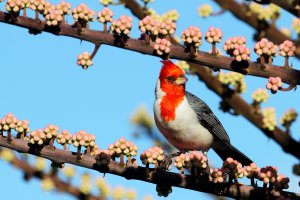
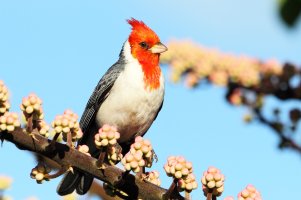
Lovely pictures!serendipidy said:And finally, while I was up the ladder this afternoon shooting the waxbills, my Brazilian Cardinal friend landed in the octopus tree a few feet from me begging for another bread handout (even though I had already given him a whole slice just 30 minutes earlier). So I got down and gave him more.
7D, 100-400mmL @ 310mm, F/6.3, ISO 100, 1/1000s and 1/2000 s.
Thanks rpt.rpt said:Lovely pictures!serendipidy said:And finally, while I was up the ladder this afternoon shooting the waxbills, my Brazilian Cardinal friend landed in the octopus tree a few feet from me begging for another bread handout (even though I had already given him a whole slice just 30 minutes earlier). So I got down and gave him more.
7D, 100-400mmL @ 310mm, F/6.3, ISO 100, 1/1000s and 1/2000 s.
serendipidy said:And finally, while I was up the ladder this afternoon shooting the waxbills, my Brazilian Cardinal friend landed in the octopus tree a few feet from me begging for another bread handout (even though I had already given him a whole slice just 30 minutes earlier). So I got down and gave him more.
7D, 100-400mmL @ 310mm, F/6.3, ISO 100, 1/1000s and 1/2000 s.

Very nice! Beautiful bird!serendipidy said:And finally, while I was up the ladder this afternoon shooting the waxbills, my Brazilian Cardinal friend landed in the octopus tree a few feet from me begging for another bread handout (even though I had already given him a whole slice just 30 minutes earlier). So I got down and gave him more.
7D, 100-400mmL @ 310mm, F/6.3, ISO 100, 1/1000s and 1/2000 s.
Catching the "not often seen" chicks was a great addition to these images, Islander!IslanderMV said:My contribution to the "birds with fish" thread.
Common Tern catching a fish, then hanging out on the beach waiting for me to leave so she cam feed her hungry chicks waiting in the dunes. (Martha's Vineyard)
and since folks have been asking for exif data:
Exposure Program: Shutter priority
Exposure Time: 1/1600
FNumber: 6.3
Focal Length: 400
ISO Speed Ratings: 250
Lens Model: EF100-400mm f/4.5-5.6L IS USM
Canon 60D
Exposure Program: Shutter priority
Exposure Time: 1/1250
FNumber: 6.3
Focal Length: 400
ISO Speed Ratings: 250
Exposure Program: Shutter priority
Exposure Time: 1/1250
FNumber: 5.6
Focal Length: 125
ISO Speed Ratings: 250
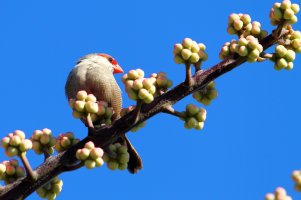
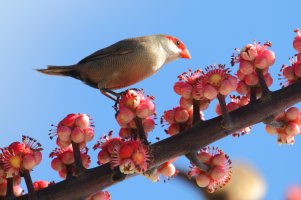
They are quite remarkable looking birds Serendipity! Thanks for posting them, very nice!serendipidy said:The octopus tree in my yard is starting to bloom and attracting some birds and bees. I climbed up a step ladder to shoot a few common waxbills this afternoon. They are very skittish and move very fast. The shutter firing on my 7D is loud enough to often make them fly off until they start to accept it. They are often so fast, that take off at shutter sound makes them a blur. They are quite small and average about 3-4 inches in length. 7D, 100-400mmL @ 400mm, 1/640s, F/6.3, ISO 125 and 400.
From Wikipedia:
The Common Waxbill (Estrilda astrild), also known as the St Helena Waxbill, is a small passerine bird belonging to the estrildid finch family. It is native to sub-Saharan Africa but has been introduced to many other regions of the world and now has an estimated global extent of occurrence of 10,000,000 km². It is popular and easy to keep in captivity.There are about 17 subspecies distributed widely across much of Africa south of the Sahara. They are present in most parts of East, Central and Southern Africa.Birds have often escaped from captivity or been deliberately released. Breeding populations have become established in many places where the climate is sufficiently warm and where there is a sufficient supply of grass seeds. They are now found on many islands around Africa: Saint Helena, Ascension Island, the Cape Verde Islands, São Tomé and Príncipe, Mauritius, Réunion, Rodrigues, the Seychelles and Ile Amsterdam. They may possibly be native on some of these islands. In Europe the Common Waxbill has become widespread in Portugal and is spreading through Spain. There are small populations on Madeira and Gran Canaria and it has recently appeared on Tenerife and the Azores. In the Americas waxbills are found in Trinidad, several parts of Brazil and there are a few on Bermuda. In the Pacific there are populations on New Caledonia, Efate Island in Vanuatu, Tahiti and the Hawaiian Islands.
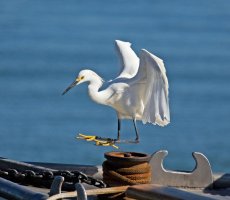
steven kessel said:It's been a while since I've posted. I photographed this egret yesterday at Dana Point, Ca. 5D iii, 100-400 F 4-5.6 @400 mm, ISO 640, F8 @ 1/8000. Cropped, and that's about it.
Great image Steve! Thought I was in the 1dx forum for a minute there...steven kessel said:It's been a while since I've posted. I photographed this egret yesterday at Dana Point, Ca. 5D iii, 100-400 F 4-5.6 @400 mm, ISO 640, F8 @ 1/8000. Cropped, and that's about it.
Absolutely fabulous!Krob78 said:Great image Steve! Thought I was in the 1dx forum for a minute there...steven kessel said:It's been a while since I've posted. I photographed this egret yesterday at Dana Point, Ca. 5D iii, 100-400 F 4-5.6 @400 mm, ISO 640, F8 @ 1/8000. Cropped, and that's about it.