Show your Bird Portraits

Jack Douglas said:
Neuroanatomist, thanks for the comments. Why, is not easy to answer because as an older fellow and a beginner I often get caught up in spur of the moment events and my brain doesn't think too clearly. I don't fully understand the mechanics behind AF and simply followed some advice from the forum regarding birds that are not still, was told to stay away from 1 shot. I guess I've also had an artificial aversion to higher ISOs thinking that the ISO 4000 on the one shot was getting pretty high for grain but I agree with you that 1600 leaves me some room to get better DOF. I'll try harder. I also got the idea that I had to stay at least 1/800th because of the action - don't know in that shot if that's necessary but I'm guessing I might have gone higher for a sharper picture??

In summary, I basically don't know what I'm doing. Somehow a fair number of decent shots come out! At least enough times to keep me happy as a lark!! However, I do want to learn.

There have been so many waxwings at the pond this summer I've tired of shooting them. They love eating dragonfly larvae.

6D 300 X2 800th F14 ISO 1250

Jack

Great shot. Bit over-exposed, I agree with Neuro you could stop down a bit to deepen DOF when necessary. I really love Waxwings. We have had a number here in Colorado this summer, which is pretty rare.

When it comes to focus and birds, you want the most active focus option available. That is AI Servo. AI Servo will continually adjust focus to maintain sharp focus on the subject under your selected AF point(s). For the 6D, its safe to assume you just want to use the middle point, unless that prohibits your ability to compose (with the big frame, your probably fine.) AI Focus can be quirky. AI Servo is very responsive, and usually immediately does what is necessary to adjust focus...even when shooting continuously.

I am not sure if the 6D has this feature, but it can also be very helpful to decouple AF from the shutter button. Called rear-button focus, you can usually reassign AF to the * button, and assign only shutter/meter activate to the shutter button. That gives you a LOT more control over focus, and the ability to immediately force refocusing if necessary without stopping IS or metering, just by releasing and pressing the * button again. It may seem odd and overly advanced at first, but it doesn't take long to get used to, and the chances are you'll love the flexibility.

Other than that...don't be afraid of higher ISO settings. Noise is easy to clean up these days. Topaz DeNoise 5 is an excellent tool to have on hand, as it can completely clean up background noise while leaving the subject alone even on a moderate setting. Well worth the money if you are a bird or wildlife photographer...I don't think I could live without it these days. It even does debanding and DR recovery for those more extreme situations.
 
Upvote 0
AlanF said:
Carl
Believe it or not, there are some of us, maybe only two, who do not wish to carry a monopod or tripod. Also our hands are steady enough that 4 stops of IS and the high iso capabilities of the 5D are enough to hand hold a 600 mm without any observable shake. Perhaps your hands are trembling under the strain of 19.99 lb of camera and lens on your carbon fibre monopod?

So lets come to an amicable compromise. You let us continue carrying around only 6 or 7 lb of camera and lens and we will give you a friendly smile when we see you struggling with your monopod and let you carry on with your lifestyle.

By the way, most keen birdies use tripods, not monopods. They sit in hides with two legs of the tripod splayed across the ledge and the third balancing their kit. You can't use a monopod to have the camera fixed on a target for long periods of time.

Well aware of bird photographers' use of tripods, and I don't struggle with my monopod at all. Just letting you know there's more than one way of doing things.
 
Upvote 0
Krob78 said:
AlanF said:
Carl
Believe it or not, there are some of us, maybe only two, who do not wish to carry a monopod or tripod. Also our hands are steady enough that 4 stops of IS and the high iso capabilities of the 5D are enough to hand hold a 600 mm without any observable shake. Perhaps your hands are trembling under the strain of 19.99 lb of camera and lens on your carbon fibre monopod?

So lets come to an amicable compromise. You let us continue carrying around only 6 or 7 lb of camera and lens and we will give you a friendly smile when we see you struggling with your monopod and let you carry on with your lifestyle.

By the way, most keen birdies use tripods, not monopods. They sit in hides with two legs of the tripod splayed across the ledge and the third balancing their kit. You can't use a monopod to have the camera fixed on a target for long periods of time.
Perhaps your hands are trembling under the strain of 19.99 lb of camera and lens on your carbon fibre monopod?
In fairness Alan, Carl didn't say he was carrying around 19.99 pounds of camera and lens on his carbon fibre monopod. He is simply stating that his Carbon Fibre monopod has no issues carrying around any camera and lens combo that is under 20lbs, that it's a good lightweight alternative, for him anyway... Peace :)

For what it's worth, I shoot a lot handheld, a fair amount with monopod, very little tripod and a fair amount with gimbal... I prefer and love to shoot handheld but there are times and situations when another methodology is more efficacious and will produce me better results.

Ultimately, I think there's room enough for all of us to use whatever works best for us or to utilize multiple methodologies as a great many of us do for better results in particular situations, no? I think that's what you were hinting at with your sentence regarding the amicable compromise... I'm open to anything that works in any given situation... I often use the treepod, works well too! :D

+1, thanks for your voice of reason!
 
Upvote 0
AlanF said:
Some of us like to spend most of our time with a tripod, others hand holding, and others in between. So let's get on with it and each do our own thing, especially we amateurs who just want to enjoy ourselves and not make a living from our photos.

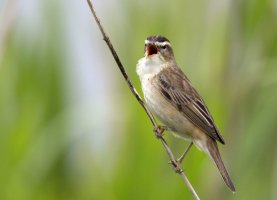
We shouldn't turn this thread into the usual rhetoric so here is another hand held shot from last weekend.

Sedge warbler @ 600mm
 

Attachments

  • image.jpg
    image.jpg
    1.2 MB · Views: 583
Upvote 0
Thanks for the complements and suggestions, guys. Jrista, I was reading a recent thread about back button focus and have started to look into that. I'm not exactly sure yet how to achieve the desired effects. There have been so many shooting opportunities lately that I'm hard pressed to find time to read up on technicalities. Winter will change all that up here. And thanks for the pointers on AI servo, I'll make a point of trying to personally evaluate all three modes to see how they behave relative to my situations.

Yes I only use the center point with what I've been doing lately. Once I noticed other points going momentarily red when a bird moved (I did not have them enabled), would that have been due to AI Servo operation?

For me personally I appreciate the shortcomings being pointed out since otherwise I'll go on blindly doing the same old thing. In DPP one can brighten or darken the raw file and as I've fiddled with that I've wondered just how I would judge if it's over-exposed - just comes with experience or are there any guidelines??

CarlTN, thanks for the heads up and not to worry. I understand. You've given me many good pointers over on the 6D thread.

My friend printed one of the nicer hummingbird shots of mine with his Canon printer 13x19 tonight and I was pretty pleased. You can look from 5 inches and not see a flaw or grain - thrilled actually. However, it seems when a picture is physically there in front of you that it somehow presents differently. For example, the background that I thought was fine on the computer monitor doesn't seem quite so wonderful - any thoughts?

Jack
 
Upvote 0
steven kessel said:
Here's something you don't see every day.

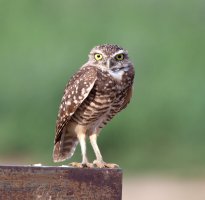
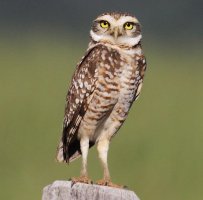
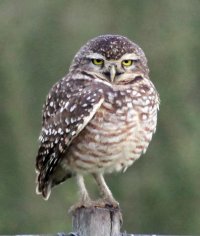
Burrowing owl. These little birds are the only owls that dig burrows. They're also diurnal unlike most of their relatives.

Here is another pair, one taken in daylight and the other in near darkness. They are difficult to get sharp images from as the feathers are so downy. Both are 100% crops taken on a 7D with a 100-400mm L in the Pantanal in Brazil, a bird lover's paradise.
 

Attachments

  • BurrowingOwlSel_0986CR.jpg
    BurrowingOwlSel_0986CR.jpg
    235.6 KB · Views: 554
  • DuskIMG_0684.jpg
    DuskIMG_0684.jpg
    133.2 KB · Views: 562
Upvote 0
Jack Douglas said:
Thanks for the complements and suggestions, guys. Jrista, I was reading a recent thread about back button focus and have started to look into that. I'm not exactly sure yet how to achieve the desired effects. There have been so many shooting opportunities lately that I'm hard pressed to find time to read up on technicalities. Winter will change all that up here. And thanks for the pointers on AI servo, I'll make a point of trying to personally evaluate all three modes to see how they behave relative to my situations.

Yes I only use the center point with what I've been doing lately. Once I noticed other points going momentarily red when a bird moved (I did not have them enabled), would that have been due to AI Servo operation?

The other points lighting would probably just be because you are using all AF points. You should manually select just the center point to guarantee focus occurs where you want it to. AI Servo simply continuously reevaluates focus at the given point...it won't switch to using other points. In the 7D, 5D III, and 1D X you have flexible point selection modes...you can select an expansion, which will include the points surrounding the selected one, or zone, which will include even more points, which is useful for tracking subjects (which is only really possible with AI Servo, no other mode will track effectively.) A single selected point, usually center, is best for learning, however.

Jack Douglas said:
For me personally I appreciate the shortcomings being pointed out since otherwise I'll go on blindly doing the same old thing. In DPP one can brighten or darken the raw file and as I've fiddled with that I've wondered just how I would judge if it's over-exposed - just comes with experience or are there any guidelines??

Experience definitely helps. The goal is to reproduce reality, but also avoid subjects becoming too bright such that they start to look washed out or otherwise unnatural. The wood perch in the last waxwing photo is what gives away the overexposure. Colors are also richest when they span the high shadows, midtones, and low highlights. Push them too deep into shadow or highlight, and you start losing color fidelity.

Jack Douglas said:
My friend printed one of the nicer hummingbird shots of mine with his Canon printer 13x19 tonight and I was pretty pleased. You can look from 5 inches and not see a flaw or grain - thrilled actually. However, it seems when a picture is physically there in front of you that it somehow presents differently. For example, the background that I thought was fine on the computer monitor doesn't seem quite so wonderful - any thoughts?

Print tends to have a lesser gamut than computer screens. Color extent is usually similar, or even higher, with Canon and Epson printers these days. Maximum bright white and deepest dark black tend to be much less than on a computer screen, however. Detail in the blacks, and crispness of the highlights, will usually be lost in print unless you are using a high dMax (black point) paper with a bright white point. Papers with the broadest range from black point to white point are usually more on the glossy side, and usually have OBAs, or optical brightening agents. Such papers usually result in very vibrant prints, however prints with OBAs have shorter lifetimes than natural fiber papers that have low acid and no OBA.

Print is a whole 'nother hobby in and of itself. There are a huge variety of papers, various types of canvas, a wide range of printers with different types of ink (Epson has UltraChrome, UltraChrome K3, UltraChrome HDR, UltraChrome HDR+White; Canon has Lucia, Lucia EX, ChromaLife). The quality of output from a printer depends on how well the selected paper is calibrated with that ink set (each printer only supports one ink set, btw). Noise in photos is usually not a real problem in print. Print pixel density is usually at least 3x higher than it is on a normal computer screen, assuming a 300ppi (360ppi for Epson) print resolution. Even if noise is visible on screen, it is usually invisible in print, and often helps smooth gradients and blurry backgrounds, eliminates posterization that might occur during color space conversion, etc. I always try to keep a little bit of noise around in my photos when I print them, and if I denoise, I'll add just a small amount back into the backgrounds to ensure my prints come out best.

There is a lot to know about print. If you really want to get into it, there is some good material out there. Otherwise, you can let a professional take care of it for you.
 
Upvote 0
In another thread, there has been some discussion of the benefits of higher fps. Here's an example of a moment that I might have missed with slower than the 8fps of my 7D. Of course, I might have caught it with a single shot, too. I figure my chances were better with the 8fps. :)

7D, 70-200/2.8, cropped a bit.

Harris Hawk (or mouse in flight), Cincinnati Zoo Bird Show
7D-IMG_110_1933-small-M.jpg
 
Upvote 0
schill said:
In another thread, there has been some discussion of the benefits of higher fps. Here's an example of a moment that I might have missed with slower than the 8fps of my 7D. Of course, I might have caught it with a single shot, too. I figure my chances were better with the 8fps. :)

7D, 70-200/2.8, cropped a bit.

Harris Hawk (or mouse in flight), Cincinnati Zoo Bird Show
7D-IMG_110_1933-small-M.jpg
Deadly! No pun intended! Fantastic picture. That is a scrawny mouse! The hawk must be very hungry.
 
Upvote 0
Thanks Jrista for taking the time to give that very informative reply. It all makes sense, but initially a guy is swimming in a sea of information.

I almost only ever use center spot focus, other than for small birds flying quickly in the sky.

Thankfully by hook or crook a fair number of impressive shots come out of the process and it's virtually impossible to get discouraged. For those I miss, there is always something that to me is awesome. Of course my critical sense is rising and I'm more aware of the shortcomings but peoploe around me are still blown away by what I have to show. For birds and me it's mainly extreme patience and luck but I won't broadcast that too much. ;)

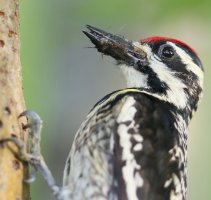
Here's one from back in May.

6D 300F2.8 II 1000th F2.8 ISO 2000
 

Attachments

  • Yummy_bug_thanks_mommy.JPG
    Yummy_bug_thanks_mommy.JPG
    1.3 MB · Views: 624
Upvote 0
schill said:
In another thread, there has been some discussion of the benefits of higher fps. Here's an example of a moment that I might have missed with slower than the 8fps of my 7D. Of course, I might have caught it with a single shot, too. I figure my chances were better with the 8fps. :)

7D, 70-200/2.8, cropped a bit.

Harris Hawk (or mouse in flight), Cincinnati Zoo Bird Show
7D-IMG_110_1933-small-M.jpg

Good timing. Well done Sir!
 
Upvote 0
Click said:
schill said:
In another thread, there has been some discussion of the benefits of higher fps. Here's an example of a moment that I might have missed with slower than the 8fps of my 7D. Of course, I might have caught it with a single shot, too. I figure my chances were better with the 8fps. :)

7D, 70-200/2.8, cropped a bit.

Harris Hawk (or mouse in flight), Cincinnati Zoo Bird Show

Good timing. Well done Sir!

Here's another from a couple weeks later. Same hawk, same gear. This is a crop of the right side of a landscape view (almost the entire height).

Both of these cases are misses, where she didn't catch the mouse in midair. Normally she does.

7D-IMG_110_3457-small-L.jpg
 
Upvote 0
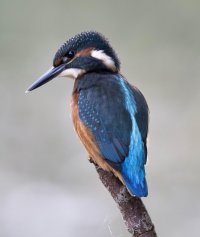
5DIII + 300mm f/2.8 II + 2xTC III @f/5.6 1/320 iso 1250, hand held. It's difficult to get detailed images of kingfisher's plumage, but the 2xTC III performed well.
 

Attachments

  • KIngfisher2U4A6871owRes.jpg
    KIngfisher2U4A6871owRes.jpg
    721.4 KB · Views: 577
Upvote 0